CHAPTER 14:
REFORMATIONS AND
RELIGIOUS WARS (1500-
1600)
AP European History
Magister Ricard
Objectives
 Compare and contrast the German and
English reformations
 Assess how the Protestant Reformation
affected society (nobility, middle class,
peasants)
 Evaluate the effects of Protestant Reformation
on established religious and political
institutions
 Compare and contrast attitudes of Martin
Luther and John Calvin toward political
authority and social orders
 Explain the appeal of Protestantism
Objectives
 Compare and contrast the effects of the
Renaissance and Reformation on women
 What was the role of the elite and popular
elements of culture in forming early European
witch hunts?
 Explain how the Roman Catholic Church
defended itself against Protestant Reformation
Chapter 14
(1500-1600)
The Early Reformation
The Christian Church and the Early
16th Century
 Europeans remained loyal to Roman Catholic
Church at outset of 16th century
 Many were growing more critical of the church
 Criticism focused on clerical immorality, clerical
ignorance, clerical pluralism
 Resentment of clerical privileges and immunities
 Was criticism focused on the religion or the
institution of the religion? What’s the
difference?
Martin Luther
 1483-1546
 Dissatisfied with religion, was not feeling a sense
of security over salvation despite being a friar
 Concluded that only simple faith in Christ led to
salvation
 Objected to the sale of “indulgences”
 Ninety-Five Theses argued against indulgences,
undermined Christianity
 He was excommunicated
 Ideas become very popular in politically-charged
Germany
Protestant Thought
 Followers of Luther = Protestants
 Ulrich Zwingli (1484-1531) was another important
reformer
 Protestant beliefs
 Salvation comes by faith alone
 Religious authority resided in Scripture alone
 Church consisted of whole community of
believers, not just the clergy
Protestant Thought
 Transubstantiation – bread and wine literally
became the body and blood of Christ
 Luther disagreed; opted for consubstantiation
– Christ was present (in the host) but the
bread and wine were not transformed
 John Calvin agreed with Luther on
consubstantiation
 Zwingli argued the Eucharist was a
commemoration of the Last Supper
Appeal of Protestantism
 Educated people and humanists were
attracted to Luther’s more simplified, personal
vision
 Attracted to Luther’s call for an end of clerical
privileges
 Printing press greatly aided spread of Luther’s
ideas
 Luther and Zwingli worked closely with political
authorities to gain support of Protestantism
Radical Reformation
 Some groups began to reject the notion of
uniting church and state
 Sought to create independent communities of
believers and varying interpretations
 Interpretation began to differ and set one
another at odds with each other
 Secular and religious leaders utilize harsh
punishments
The German Peasants’ War
 Crops fail in 1523 and 1524
 Swabian peasants demand end to death
taxes, new rents, and noble seizures of land in
1525
 Luther initially backs the peasants’ demands
 When peasants respond with violence, Luther
supports noble responses to crush rebellion
 Lutheranism supports the notion that the state
and church be subordinate to secular rulers
The Reformation and Marriage
 Many Protestant reformers married
 Marriage was praised, a good marriage demonstrated
spiritual equality of men and women
 Proper social hierarchy is that the wife is obedient
to her husband’s authority
 Catholics saw marriage as a sacrament
 Protestants saw marriage as a contract – allowing for
divorce
 Protestants condemned prostitution
 What is the impact of Protestantism on the life of
women?
Chapter 14
(1500-1600)
The Reformation and German
Politics
The Holy Roman Empire:
14th & 15th Centuries
 The Golden Bull of 1356 gave each of the
seven electors virtual sovereignty
 Localism and chronic disorder
 Allowed the nobility to strengthen their territories
 Reduce the authority of the emperor
Rise of the Habsburgs
 1477, marriage of Maximilian I (Habsburg) and
Mary of Burgundy
 Unites Austrian Empire with Burgundy and
Netherlands
 Habsburgs become strongest ruling family in Holy
Roman Empire
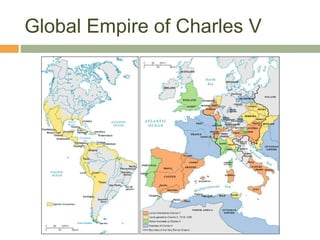
 Charles V (1500-1558, Habsburg) inherits
Spain, Spanish possessions in Italy, Sicily, and
Sardinia
 1519 Charles V is elected Holy Roman
Emperor, believes it is his duty to maintain
Global Empire of Charles V
Political Impact of the Protestant
Reformation
 Spiritual and material concerns convince German
princes to accept Protestantism
 Religious wars start in Switzerland and spread
 1530, Charles V calls for Imperial Diet at
Augsburg to try and stop religious division
 Charles rejects Protestant demands, Protestant
princes form a military alliance
 Outside powers begin to get involved in Germany’s
upheaval
 1555 – the Peace of Augsburg
 Charles accepts religious status quo in Germany
Chapter 14 (1500-1600)
The Spread of Protestant
Reformation
Reformation in England and
Ireland
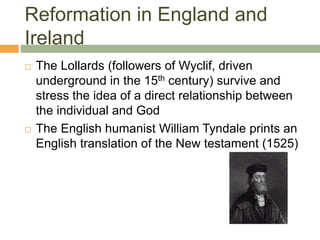
 The Lollards (followers of Wyclif, driven
underground in the 15th century) survive and
stress the idea of a direct relationship between
the individual and God
 The English humanist William Tyndale prints an
English translation of the New testament (1525)
Reformation in England and
Ireland
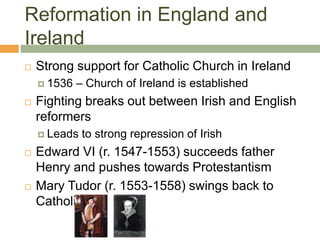
 1534 – King Henry VIII divorces his wife to
marry Anny Boleyn
 To legitimize this, convinces Parliament to pass
Act of Supremacy making him head of English
(Anglican) Church
 Henry seizes monasteries and redistributes
land to upper class
 Popular (the people) opposition – Pilgrimage
of Grace in 1536
Reformation in England and
Ireland
 Strong support for Catholic Church in Ireland
 1536 – Church of Ireland is established
 Fighting breaks out between Irish and English
reformers
 Leads to strong repression of Irish
 Edward VI (r. 1547-1553) succeeds father
Henry and pushes towards Protestantism
 Mary Tudor (r. 1553-1558) swings back to
Catholic
Reformation in England and
Ireland
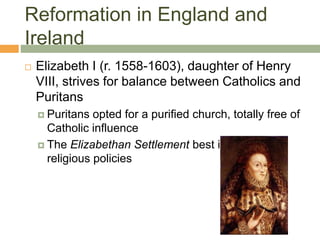
 Elizabeth I (r. 1558-1603), daughter of Henry
VIII, strives for balance between Catholics and
Puritans
 Puritans opted for a purified church, totally free of
Catholic influence
 The Elizabethan Settlement best illustrates her
religious policies
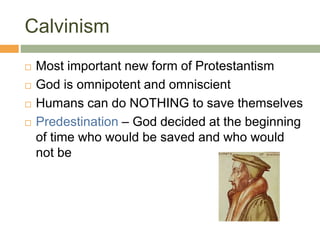
Calvinism
 Most important new form of Protestantism
 God is omnipotent and omniscient
 Humans can do NOTHING to save themselves
 Predestination – God decided at the beginning
of time who would be saved and who would
not be
Calvinism
 Predestination did not lead to fatalism
 Calvinists were convinced they were among the
saved
 Calvin and government of Geneva regulated
human behavior to create a “godly” city on
earth
 Inspired by Utopia?
 No card playing! No dancing!
 Between 1542-1546, 58 heretics were burned
 The Calling glorified all vocations as pleasing
to God
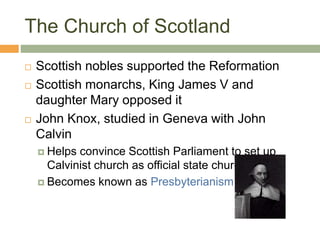
The Church of Scotland
 Scottish nobles supported the Reformation
 Scottish monarchs, King James V and
daughter Mary opposed it
 John Knox, studied in Geneva with John
Calvin
 Helps convince Scottish Parliament to set up
Calvinist church as official state church
 Becomes known as Presbyterianism
Reformation in Eastern Europe
 Ethnic factors helped shaped Reformation in
Eastern Europe (instead of political and
economic)
 In Bohemia, ethnic grievances of Czech
majority lead to resentment of Roman Catholic
church
 During Counter-Reformation, Catholic revival
would be promoted in Bohemia
Reformation in Eastern Europe
 By 1500, Poland and Lithuania would form
largest state in dynastic union
 King Sigismund I banned Lutheran teachings
 Polish not fond of Germans
 Szlachta (Polish nobility) preferred Calvinism
 Originated in France, not Germany
 Counter-Reformation would cement strength of
Catholicism in Poland
Chapter 14
(1500-1600)
The Catholic Reformation
The Reformed Papacy
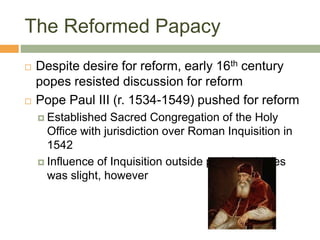
 Despite desire for reform, early 16th century
popes resisted discussion for reform
 Pope Paul III (r. 1534-1549) pushed for reform
 Established Sacred Congregation of the Holy
Office with jurisdiction over Roman Inquisition in
1542
 Influence of Inquisition outside papal territories
was slight, however
The Council of Trent
 Reaffirmed equal authority of Scripture and
Church (1545-1563)
 Reaffirms the 7 sacraments and
transubstantiation
 Required bishops to live in their dioceses
 Ended pluralism, simony
 Forbade sale of indulgences
 For a marriage to be legal, vows had to be
exchanged publicly
New Religious Orders
 Ursuline nuns fought heresy with religious
education of girls
 (Syncretism from classical world?)
 Ignatius of Loyola founded the Jesuit Order
 Mission to fight Reformation through education
 Goal was to “help souls”
 Noted for seeing “how at a given juncture change
is more consistent with one’s scope than staying
the course”
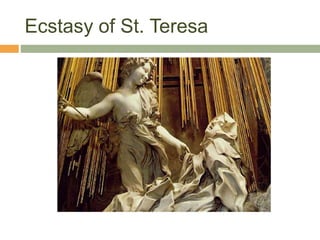
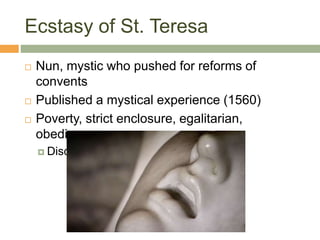
Ecstasy of St. Teresa
 Nun, mystic who pushed for reforms of
convents
 Published a mystical experience (1560)
 Poverty, strict enclosure, egalitarian,
obedience
 Discalced
Chapter 14
(1500-1600)
Religious Violence
French Religious Wars
 In order to raise revenue, Francis I sold public
offices and ended the Concordat of Bologna
 Lutheranism spreads to France in 1518
 Calvin’s Institutes published in 1536
 French Calvinists were called Huguenots
 Weakness of monarchy and religious division
lead to civil war
 Calvinism manifests as iconoclasm
French Religious Wars
 St. Bartholomew’s Day Massacre (8/24/1572)
 Thousands of Protestants killed, sparks 15 year
civil war
 Politiques believe only strong monarch can
restore order
 Henry IV (1589-1610) rises to power
 Converts to Catholicism, issues Edict of Nantes
The Netherlands Under Charles
V
 Under Charles V Netherlands remained stable
 In 1560’s, policies of Phillip II (Spain) lead to
rebellion in Netherlands
 Tries to end violence by sending 20,000 troops to
Netherlands under duke of Alva, but only intensifies
conflict
 Netherlands split
 10 southern (Catholic) provinces fall to Habsburg
Spain
 7 northern (Protestant) provinces form Union of
Utrecht in 1581 and declare independence from Spain
 Seek help and protection from outsiders, notably Protestant
England
Chapter 14
(1500-1600)
The Great European Witch
Hunt
The Great European Witch
Hunt!!
 Witchcraft was seen as a pact made with the devil
 During 16th and 17th centuries, between 40,000-
60,000 people were executed
 75-85% tried were women
 Legal changes were made to facilitate massive
trials
 Most trials began with a single accusation which grew
into numerous accusations
 Thus a “witch-hunt”
 Doubts and skepticism eventually brought trials to
a halt

AP Euro CH 14

  • 1.
    CHAPTER 14: REFORMATIONS AND RELIGIOUSWARS (1500- 1600) AP European History Magister Ricard
  • 2.
    Objectives  Compare andcontrast the German and English reformations  Assess how the Protestant Reformation affected society (nobility, middle class, peasants)  Evaluate the effects of Protestant Reformation on established religious and political institutions  Compare and contrast attitudes of Martin Luther and John Calvin toward political authority and social orders  Explain the appeal of Protestantism
  • 3.
    Objectives  Compare andcontrast the effects of the Renaissance and Reformation on women  What was the role of the elite and popular elements of culture in forming early European witch hunts?  Explain how the Roman Catholic Church defended itself against Protestant Reformation
  • 4.
  • 5.
    The Christian Churchand the Early 16th Century  Europeans remained loyal to Roman Catholic Church at outset of 16th century  Many were growing more critical of the church  Criticism focused on clerical immorality, clerical ignorance, clerical pluralism  Resentment of clerical privileges and immunities  Was criticism focused on the religion or the institution of the religion? What’s the difference?
  • 6.
    Martin Luther  1483-1546 Dissatisfied with religion, was not feeling a sense of security over salvation despite being a friar  Concluded that only simple faith in Christ led to salvation  Objected to the sale of “indulgences”  Ninety-Five Theses argued against indulgences, undermined Christianity  He was excommunicated  Ideas become very popular in politically-charged Germany
  • 7.
    Protestant Thought  Followersof Luther = Protestants  Ulrich Zwingli (1484-1531) was another important reformer  Protestant beliefs  Salvation comes by faith alone  Religious authority resided in Scripture alone  Church consisted of whole community of believers, not just the clergy
  • 8.
    Protestant Thought  Transubstantiation– bread and wine literally became the body and blood of Christ  Luther disagreed; opted for consubstantiation – Christ was present (in the host) but the bread and wine were not transformed  John Calvin agreed with Luther on consubstantiation  Zwingli argued the Eucharist was a commemoration of the Last Supper
  • 9.
    Appeal of Protestantism Educated people and humanists were attracted to Luther’s more simplified, personal vision  Attracted to Luther’s call for an end of clerical privileges  Printing press greatly aided spread of Luther’s ideas  Luther and Zwingli worked closely with political authorities to gain support of Protestantism
  • 10.
    Radical Reformation  Somegroups began to reject the notion of uniting church and state  Sought to create independent communities of believers and varying interpretations  Interpretation began to differ and set one another at odds with each other  Secular and religious leaders utilize harsh punishments
  • 11.
    The German Peasants’War  Crops fail in 1523 and 1524  Swabian peasants demand end to death taxes, new rents, and noble seizures of land in 1525  Luther initially backs the peasants’ demands  When peasants respond with violence, Luther supports noble responses to crush rebellion  Lutheranism supports the notion that the state and church be subordinate to secular rulers
  • 12.
    The Reformation andMarriage  Many Protestant reformers married  Marriage was praised, a good marriage demonstrated spiritual equality of men and women  Proper social hierarchy is that the wife is obedient to her husband’s authority  Catholics saw marriage as a sacrament  Protestants saw marriage as a contract – allowing for divorce  Protestants condemned prostitution  What is the impact of Protestantism on the life of women?
  • 13.
  • 14.
    The Holy RomanEmpire: 14th & 15th Centuries  The Golden Bull of 1356 gave each of the seven electors virtual sovereignty  Localism and chronic disorder  Allowed the nobility to strengthen their territories  Reduce the authority of the emperor
  • 15.
    Rise of theHabsburgs  1477, marriage of Maximilian I (Habsburg) and Mary of Burgundy  Unites Austrian Empire with Burgundy and Netherlands  Habsburgs become strongest ruling family in Holy Roman Empire  Charles V (1500-1558, Habsburg) inherits Spain, Spanish possessions in Italy, Sicily, and Sardinia  1519 Charles V is elected Holy Roman Emperor, believes it is his duty to maintain
  • 16.
  • 17.
    Political Impact ofthe Protestant Reformation  Spiritual and material concerns convince German princes to accept Protestantism  Religious wars start in Switzerland and spread  1530, Charles V calls for Imperial Diet at Augsburg to try and stop religious division  Charles rejects Protestant demands, Protestant princes form a military alliance  Outside powers begin to get involved in Germany’s upheaval  1555 – the Peace of Augsburg  Charles accepts religious status quo in Germany
  • 18.
    Chapter 14 (1500-1600) TheSpread of Protestant Reformation
  • 19.
    Reformation in Englandand Ireland  The Lollards (followers of Wyclif, driven underground in the 15th century) survive and stress the idea of a direct relationship between the individual and God  The English humanist William Tyndale prints an English translation of the New testament (1525)
  • 20.
    Reformation in Englandand Ireland  1534 – King Henry VIII divorces his wife to marry Anny Boleyn  To legitimize this, convinces Parliament to pass Act of Supremacy making him head of English (Anglican) Church  Henry seizes monasteries and redistributes land to upper class  Popular (the people) opposition – Pilgrimage of Grace in 1536
  • 21.
    Reformation in Englandand Ireland  Strong support for Catholic Church in Ireland  1536 – Church of Ireland is established  Fighting breaks out between Irish and English reformers  Leads to strong repression of Irish  Edward VI (r. 1547-1553) succeeds father Henry and pushes towards Protestantism  Mary Tudor (r. 1553-1558) swings back to Catholic
  • 22.
    Reformation in Englandand Ireland  Elizabeth I (r. 1558-1603), daughter of Henry VIII, strives for balance between Catholics and Puritans  Puritans opted for a purified church, totally free of Catholic influence  The Elizabethan Settlement best illustrates her religious policies
  • 23.
    Calvinism  Most importantnew form of Protestantism  God is omnipotent and omniscient  Humans can do NOTHING to save themselves  Predestination – God decided at the beginning of time who would be saved and who would not be
  • 24.
    Calvinism  Predestination didnot lead to fatalism  Calvinists were convinced they were among the saved  Calvin and government of Geneva regulated human behavior to create a “godly” city on earth  Inspired by Utopia?  No card playing! No dancing!  Between 1542-1546, 58 heretics were burned  The Calling glorified all vocations as pleasing to God
  • 25.
    The Church ofScotland  Scottish nobles supported the Reformation  Scottish monarchs, King James V and daughter Mary opposed it  John Knox, studied in Geneva with John Calvin  Helps convince Scottish Parliament to set up Calvinist church as official state church  Becomes known as Presbyterianism
  • 26.
    Reformation in EasternEurope  Ethnic factors helped shaped Reformation in Eastern Europe (instead of political and economic)  In Bohemia, ethnic grievances of Czech majority lead to resentment of Roman Catholic church  During Counter-Reformation, Catholic revival would be promoted in Bohemia
  • 27.
    Reformation in EasternEurope  By 1500, Poland and Lithuania would form largest state in dynastic union  King Sigismund I banned Lutheran teachings  Polish not fond of Germans  Szlachta (Polish nobility) preferred Calvinism  Originated in France, not Germany  Counter-Reformation would cement strength of Catholicism in Poland
  • 28.
  • 29.
    The Reformed Papacy Despite desire for reform, early 16th century popes resisted discussion for reform  Pope Paul III (r. 1534-1549) pushed for reform  Established Sacred Congregation of the Holy Office with jurisdiction over Roman Inquisition in 1542  Influence of Inquisition outside papal territories was slight, however
  • 30.
    The Council ofTrent  Reaffirmed equal authority of Scripture and Church (1545-1563)  Reaffirms the 7 sacraments and transubstantiation  Required bishops to live in their dioceses  Ended pluralism, simony  Forbade sale of indulgences  For a marriage to be legal, vows had to be exchanged publicly
  • 31.
    New Religious Orders Ursuline nuns fought heresy with religious education of girls  (Syncretism from classical world?)  Ignatius of Loyola founded the Jesuit Order  Mission to fight Reformation through education  Goal was to “help souls”  Noted for seeing “how at a given juncture change is more consistent with one’s scope than staying the course”
  • 32.
  • 33.
    Ecstasy of St.Teresa  Nun, mystic who pushed for reforms of convents  Published a mystical experience (1560)  Poverty, strict enclosure, egalitarian, obedience  Discalced
  • 34.
  • 35.
    French Religious Wars In order to raise revenue, Francis I sold public offices and ended the Concordat of Bologna  Lutheranism spreads to France in 1518  Calvin’s Institutes published in 1536  French Calvinists were called Huguenots  Weakness of monarchy and religious division lead to civil war  Calvinism manifests as iconoclasm
  • 36.
    French Religious Wars St. Bartholomew’s Day Massacre (8/24/1572)  Thousands of Protestants killed, sparks 15 year civil war  Politiques believe only strong monarch can restore order  Henry IV (1589-1610) rises to power  Converts to Catholicism, issues Edict of Nantes
  • 37.
    The Netherlands UnderCharles V  Under Charles V Netherlands remained stable  In 1560’s, policies of Phillip II (Spain) lead to rebellion in Netherlands  Tries to end violence by sending 20,000 troops to Netherlands under duke of Alva, but only intensifies conflict  Netherlands split  10 southern (Catholic) provinces fall to Habsburg Spain  7 northern (Protestant) provinces form Union of Utrecht in 1581 and declare independence from Spain  Seek help and protection from outsiders, notably Protestant England
  • 38.
  • 39.
    The Great EuropeanWitch Hunt!!  Witchcraft was seen as a pact made with the devil  During 16th and 17th centuries, between 40,000- 60,000 people were executed  75-85% tried were women  Legal changes were made to facilitate massive trials  Most trials began with a single accusation which grew into numerous accusations  Thus a “witch-hunt”  Doubts and skepticism eventually brought trials to a halt

Editor's Notes

  • #32 An ancient cult of Artemis was founded based on the tradition of virgin girls, between 5-10, going through a ritual called “playing the bear”. There was a bear that came to a sanctuary of Artemis which was tamed and kind of taken as a sacred animal of the sanctuary. But when a young girl started acting wrecklessly, the bear scratched her. Her brothers, enraged, speared the bear but this brought about a pestilence to Athens. When consulting the oracle, it was revealed that virgin girls must act as the she-bear as part of the blood price (or miasma?). Athenians later decreed that no woman would be given in marriage if not playing the bear previously. - Ricard