History of Christianity-II
COACH Institute of Intercultural Studies
Hyderabad
CONTACT @ +91-8309511427
coachinterculturalstudies@gmail.com
The Late
Middle Ages
(ca. 1300-1500)
The Church and Christianity
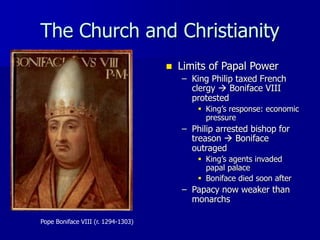
Pope Boniface VIII (r. 1294-1303)
 Limits of Papal Power
– King Philip taxed French
clergy  Boniface VIII
protested
 King’s response: economic
pressure
– Philip arrested bishop for
treason  Boniface
outraged
 King’s agents invaded
papal palace
 Boniface died soon after
– Papacy now weaker than
monarchs
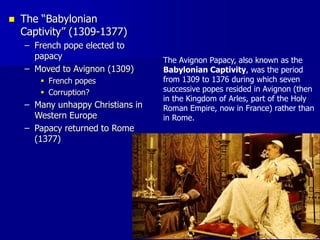
 The “Babylonian
Captivity” (1309-1377)
– French pope elected to
papacy
– Moved to Avignon (1309)
 French popes
 Corruption?
– Many unhappy Christians in
Western Europe
– Papacy returned to Rome
(1377)
The Avignon Papacy, also known as the
Babylonian Captivity, was the period
from 1309 to 1376 during which seven
successive popes resided in Avignon (then
in the Kingdom of Arles, part of the Holy
Roman Empire, now in France) rather than
in Rome.
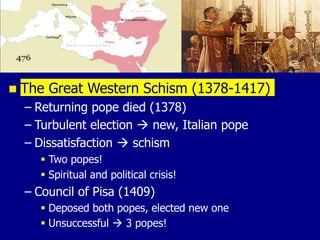
 The Great Western Schism (1378-1417)
– Returning pope died (1378)
– Turbulent election  new, Italian pope
– Dissatisfaction  schism
 Two popes!
 Spiritual and political crisis!
– Council of Pisa (1409)
 Deposed both popes, elected new one
 Unsuccessful  3 popes!
The Church and Christianity
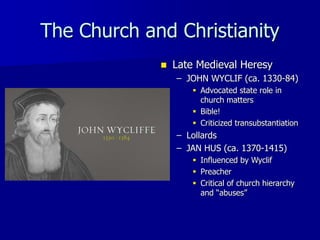
 Late Medieval Heresy
– JOHN WYCLIF (ca. 1330-84)
 Advocated state role in
church matters
 Bible!
 Criticized transubstantiation
– Lollards
– JAN HUS (ca. 1370-1415)
 Influenced by Wyclif
 Preacher
 Critical of church hierarchy
and “abuses”
The Church and Christianity
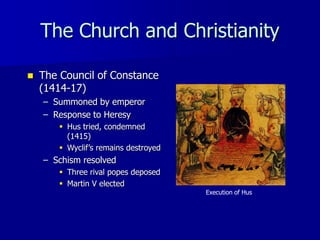
 The Council of Constance
(1414-17)
– Summoned by emperor
– Response to Heresy
 Hus tried, condemned
(1415)
 Wyclif’s remains destroyed
– Schism resolved
 Three rival popes deposed
 Martin V elected
Execution of Hus
The Church and Christianity
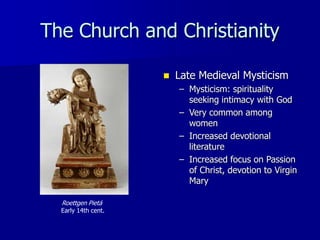
Roettgen Pietá
Early 14th cent.
 Late Medieval Mysticism
– Mysticism: spirituality
seeking intimacy with God
– Very common among
women
– Increased devotional
literature
– Increased focus on Passion
of Christ, devotion to Virgin
Mary
The Church and Christianity
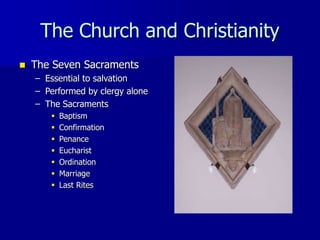
 The Seven Sacraments
– Essential to salvation
– Performed by clergy alone
– The Sacraments
 Baptism
 Confirmation
 Penance
 Eucharist
 Ordination
 Marriage
 Last Rites
The Church and Christianity
 Questions?
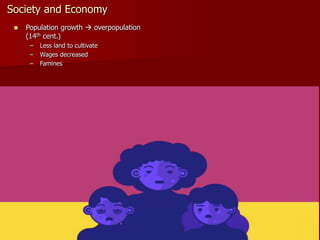
Society and Economy
 Population growth  overpopulation
(14th cent.)
– Less land to cultivate
– Wages decreased
– Famines
Society and Economy
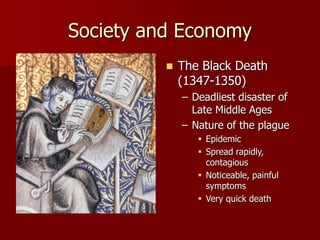
 The Black Death
(1347-1350)
– Deadliest disaster of
Late Middle Ages
– Nature of the plague
 Epidemic
 Spread rapidly,
contagious
 Noticeable, painful
symptoms
 Very quick death
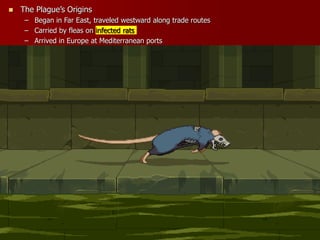
 The Plague’s Origins
– Began in Far East, traveled westward along trade routes
– Carried by fleas on infected rats
– Arrived in Europe at Mediterranean ports
 The Black Death
– Cause debated
– Why???
– Aftermath
 Death of up to 1/2 of
Europe’s population
 Obsession with death
 Recurred until 18th
century
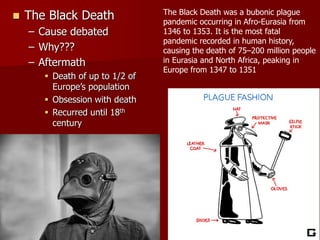
The Black Death was a bubonic plague
pandemic occurring in Afro-Eurasia from
1346 to 1353. It is the most fatal
pandemic recorded in human history,
causing the death of 75–200 million people
in Eurasia and North Africa, peaking in
Europe from 1347 to 1351
Society and Economy
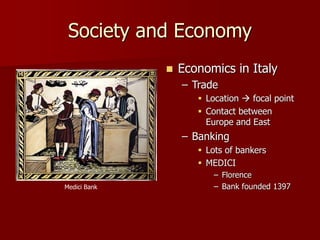
 Economics in Italy
– Trade
 Location  focal point
 Contact between
Europe and East
– Banking
 Lots of bankers
 MEDICI
– Florence
– Bank founded 1397
Medici Bank
Society and Economy
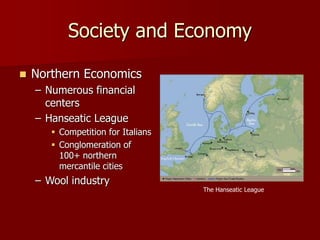
The Hanseatic League
 Northern Economics
– Numerous financial
centers
– Hanseatic League
 Competition for Italians
 Conglomeration of
100+ northern
mercantile cities
– Wool industry
Society and Economy
 Questions?
Political Issues
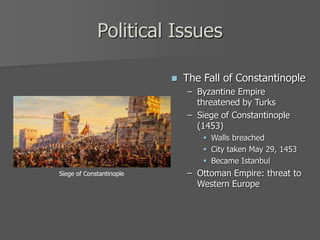
 The Fall of Constantinople
– Byzantine Empire
threatened by Turks
– Siege of Constantinople
(1453)
 Walls breached
 City taken May 29, 1453
 Became Istanbul
– Ottoman Empire: threat to
Western Europe
Siege of Constantinople
Political Issues
 The Hundred Years War (1337-1453): Causes
– Last Capetian monarch died (1328) – who succeeds?
 English king was a relation
 Philip VI elected by French nobility
 Neither candidate conceded claims  war!
– English claims to French lands
Political Issues
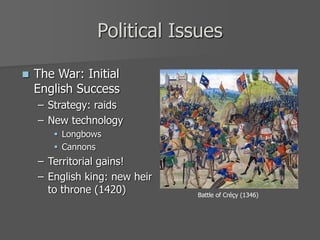
 The War: Initial
English Success
– Strategy: raids
– New technology
 Longbows
 Cannons
– Territorial gains!
– English king: new heir
to throne (1420) Battle of Créçy (1346)
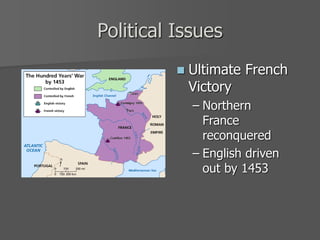
Political Issues
 Ultimate French
Victory
– Northern
France
reconquered
– English driven
out by 1453
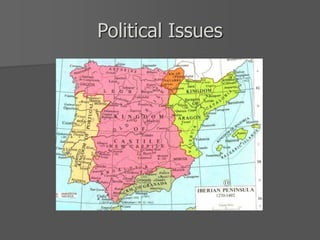
Political Issues
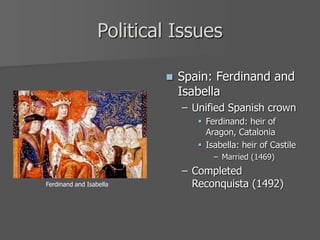
Ferdinand and Isabella
 Spain: Ferdinand and
Isabella
– Unified Spanish crown
 Ferdinand: heir of
Aragon, Catalonia
 Isabella: heir of Castile
– Married (1469)
– Completed
Reconquista (1492)
Political Issues
Political Issues
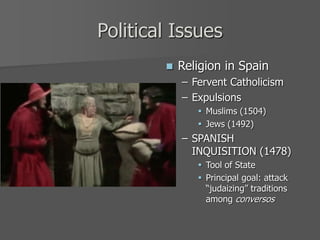
 Religion in Spain
– Fervent Catholicism
– Expulsions
 Muslims (1504)
 Jews (1492)
– SPANISH
INQUISITION (1478)
 Tool of State
 Principal goal: attack
“judaizing” traditions
among conversos
Political Issues
 Questions?

Lecture-1; Late Middle Ages

  • 1.
    History of Christianity-II COACHInstitute of Intercultural Studies Hyderabad
  • 2.
  • 3.
  • 4.
    The Church andChristianity Pope Boniface VIII (r. 1294-1303)  Limits of Papal Power – King Philip taxed French clergy  Boniface VIII protested  King’s response: economic pressure – Philip arrested bishop for treason  Boniface outraged  King’s agents invaded papal palace  Boniface died soon after – Papacy now weaker than monarchs
  • 5.
     The “Babylonian Captivity”(1309-1377) – French pope elected to papacy – Moved to Avignon (1309)  French popes  Corruption? – Many unhappy Christians in Western Europe – Papacy returned to Rome (1377) The Avignon Papacy, also known as the Babylonian Captivity, was the period from 1309 to 1376 during which seven successive popes resided in Avignon (then in the Kingdom of Arles, part of the Holy Roman Empire, now in France) rather than in Rome.
  • 6.
     The GreatWestern Schism (1378-1417) – Returning pope died (1378) – Turbulent election  new, Italian pope – Dissatisfaction  schism  Two popes!  Spiritual and political crisis! – Council of Pisa (1409)  Deposed both popes, elected new one  Unsuccessful  3 popes!
  • 7.
    The Church andChristianity  Late Medieval Heresy – JOHN WYCLIF (ca. 1330-84)  Advocated state role in church matters  Bible!  Criticized transubstantiation – Lollards – JAN HUS (ca. 1370-1415)  Influenced by Wyclif  Preacher  Critical of church hierarchy and “abuses”
  • 8.
    The Church andChristianity  The Council of Constance (1414-17) – Summoned by emperor – Response to Heresy  Hus tried, condemned (1415)  Wyclif’s remains destroyed – Schism resolved  Three rival popes deposed  Martin V elected Execution of Hus
  • 9.
    The Church andChristianity Roettgen Pietá Early 14th cent.  Late Medieval Mysticism – Mysticism: spirituality seeking intimacy with God – Very common among women – Increased devotional literature – Increased focus on Passion of Christ, devotion to Virgin Mary
  • 10.
    The Church andChristianity  The Seven Sacraments – Essential to salvation – Performed by clergy alone – The Sacraments  Baptism  Confirmation  Penance  Eucharist  Ordination  Marriage  Last Rites
  • 11.
    The Church andChristianity  Questions?
  • 12.
    Society and Economy Population growth  overpopulation (14th cent.) – Less land to cultivate – Wages decreased – Famines
  • 13.
    Society and Economy The Black Death (1347-1350) – Deadliest disaster of Late Middle Ages – Nature of the plague  Epidemic  Spread rapidly, contagious  Noticeable, painful symptoms  Very quick death
  • 14.
     The Plague’sOrigins – Began in Far East, traveled westward along trade routes – Carried by fleas on infected rats – Arrived in Europe at Mediterranean ports
  • 15.
     The BlackDeath – Cause debated – Why??? – Aftermath  Death of up to 1/2 of Europe’s population  Obsession with death  Recurred until 18th century The Black Death was a bubonic plague pandemic occurring in Afro-Eurasia from 1346 to 1353. It is the most fatal pandemic recorded in human history, causing the death of 75–200 million people in Eurasia and North Africa, peaking in Europe from 1347 to 1351
  • 16.
    Society and Economy Economics in Italy – Trade  Location  focal point  Contact between Europe and East – Banking  Lots of bankers  MEDICI – Florence – Bank founded 1397 Medici Bank
  • 17.
    Society and Economy TheHanseatic League  Northern Economics – Numerous financial centers – Hanseatic League  Competition for Italians  Conglomeration of 100+ northern mercantile cities – Wool industry
  • 18.
  • 19.
    Political Issues  TheFall of Constantinople – Byzantine Empire threatened by Turks – Siege of Constantinople (1453)  Walls breached  City taken May 29, 1453  Became Istanbul – Ottoman Empire: threat to Western Europe Siege of Constantinople
  • 20.
    Political Issues  TheHundred Years War (1337-1453): Causes – Last Capetian monarch died (1328) – who succeeds?  English king was a relation  Philip VI elected by French nobility  Neither candidate conceded claims  war! – English claims to French lands
  • 21.
    Political Issues  TheWar: Initial English Success – Strategy: raids – New technology  Longbows  Cannons – Territorial gains! – English king: new heir to throne (1420) Battle of Créçy (1346)
  • 22.
    Political Issues  UltimateFrench Victory – Northern France reconquered – English driven out by 1453
  • 23.
    Political Issues Ferdinand andIsabella  Spain: Ferdinand and Isabella – Unified Spanish crown  Ferdinand: heir of Aragon, Catalonia  Isabella: heir of Castile – Married (1469) – Completed Reconquista (1492)
  • 24.
  • 25.
    Political Issues  Religionin Spain – Fervent Catholicism – Expulsions  Muslims (1504)  Jews (1492) – SPANISH INQUISITION (1478)  Tool of State  Principal goal: attack “judaizing” traditions among conversos
  • 26.