The Microscope
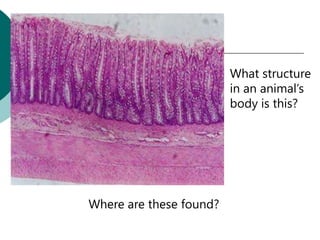
What structure
                         in an animal’s
                         body is this?


Where are these found?
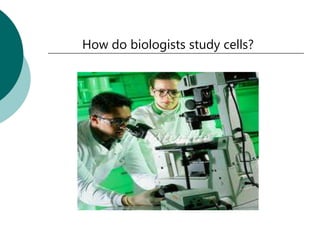
How do biologists study cells?
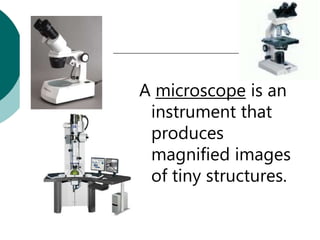
A microscope is an
 instrument that
 produces
 magnified images
 of tiny structures.
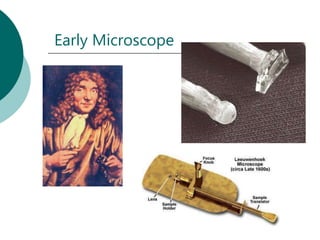
Early Microscope
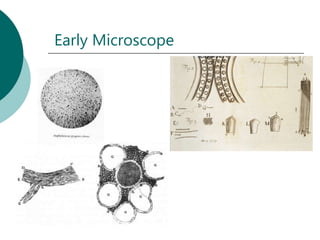
Early Microscope
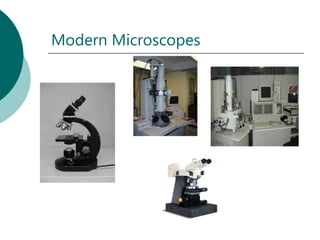
Modern Microscopes
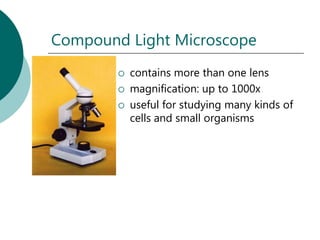
Compound Light Microscope
           contains more than one lens
           magnification: up to 1000x
           useful for studying many kinds of
            cells and small organisms
Electron Microscope
   in the 1920s, a German physicist discovered a way
    to use magnets to focus beam of electrons
   uses a beam of electrons instead of light to
    examine a sample
   magnification: as much as 1000x larger than a
    light microscope
Electron Microscope

 Two Kinds:
  Transmission Electron
   Microscope (TEM)
  Scanning Electron
   Microscope (SEM)
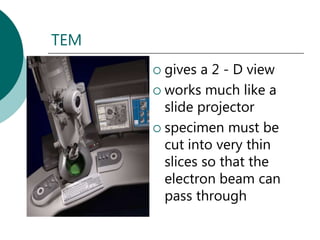
TEM
       gives a 2 - D view
       works much like a
        slide projector
       specimen must be
        cut into very thin
        slices so that the
        electron beam can
        pass through
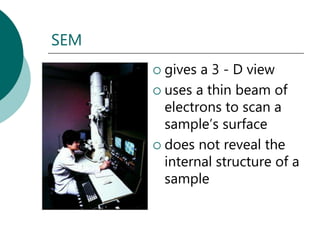
SEM
       gives a 3 - D view
       uses a thin beam of
        electrons to scan a
        sample’s surface
       does not reveal the
        internal structure of a
        sample
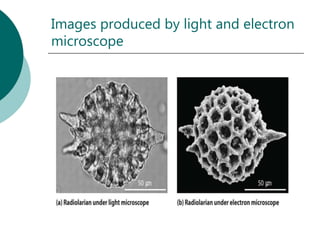
Images produced by light and electron
microscope
Terms to remember:
Magnification – ability of the microscope to
 magnify or enlarge an object (example:
 5x, 10x, 45x)

Total Magnification: magnification of the
  eyepiece x magnification of the objective

Resolution = sharpness of an image
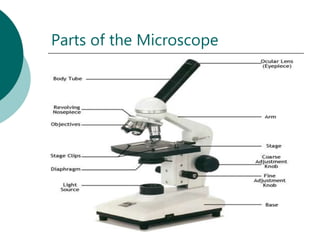
Parts of the Microscope

Three main parts:
A. Optical Parts

B. Illuminating Parts

C. Mechanical Parts
A. Optical Parts

-   used for magnification of
    the image
    1. Ocular / eyepiece
    2. Objectives
A. Optical Parts

Objectives – tubes attached to the revolving
  nosepiece
A. SPO (4x) – gives an overview of the
   specimen
B. LPO (10x) – used for locating parts of the
   specimen
C. HPO (40x) – use to view small details of
   the specimen
B. Illuminating Parts

-   used to focus or direct light
1. Mirror - used to reflect light
           - plane, convex
2. Diaphragm - regulates the amount of
light reflected
C. Mechanical Parts

-   necessary for movement and
    support
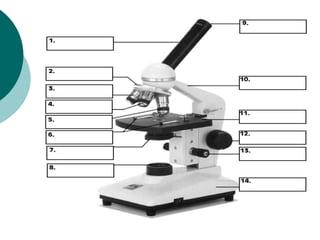
1. Base – allows the microscope to stand
2. Pillar – supports the stage
3. Stage – where glass slide is placed
4. Arm – curved part grasped when
carrying the microscope
C. Mechanical Parts

5. Revolving nosepiece – where the
objectives are attached
6. Draw tube – holds the eyepiece
7. Coarse adjustment knob – raises or
lowers the body tube to bring image into
focus
8. Fine adjustment knob – focuses image
further
C. Mechanical Parts

9. Inclination joint – allows tilting of the
microscope
10. Mirror rack – holds mirror in place
11. Stage clip – holds specimen in place
on the stage
The Microscope

The Microscope

  • 1.
  • 2.
    What structure in an animal’s body is this? Where are these found?
  • 3.
    How do biologistsstudy cells?
  • 4.
    A microscope isan instrument that produces magnified images of tiny structures.
  • 5.
  • 6.
  • 7.
  • 8.
    Compound Light Microscope  contains more than one lens  magnification: up to 1000x  useful for studying many kinds of cells and small organisms
  • 9.
    Electron Microscope  in the 1920s, a German physicist discovered a way to use magnets to focus beam of electrons  uses a beam of electrons instead of light to examine a sample  magnification: as much as 1000x larger than a light microscope
  • 10.
    Electron Microscope  TwoKinds:  Transmission Electron Microscope (TEM)  Scanning Electron Microscope (SEM)
  • 11.
    TEM  gives a 2 - D view  works much like a slide projector  specimen must be cut into very thin slices so that the electron beam can pass through
  • 12.
    SEM  gives a 3 - D view  uses a thin beam of electrons to scan a sample’s surface  does not reveal the internal structure of a sample
  • 13.
    Images produced bylight and electron microscope
  • 14.
    Terms to remember: Magnification– ability of the microscope to magnify or enlarge an object (example: 5x, 10x, 45x) Total Magnification: magnification of the eyepiece x magnification of the objective Resolution = sharpness of an image
  • 15.
    Parts of theMicroscope
  • 16.
    Parts of theMicroscope Three main parts: A. Optical Parts B. Illuminating Parts C. Mechanical Parts
  • 17.
    A. Optical Parts - used for magnification of the image 1. Ocular / eyepiece 2. Objectives
  • 18.
    A. Optical Parts Objectives– tubes attached to the revolving nosepiece A. SPO (4x) – gives an overview of the specimen B. LPO (10x) – used for locating parts of the specimen C. HPO (40x) – use to view small details of the specimen
  • 19.
    B. Illuminating Parts - used to focus or direct light 1. Mirror - used to reflect light - plane, convex 2. Diaphragm - regulates the amount of light reflected
  • 20.
    C. Mechanical Parts - necessary for movement and support 1. Base – allows the microscope to stand 2. Pillar – supports the stage 3. Stage – where glass slide is placed 4. Arm – curved part grasped when carrying the microscope
  • 21.
    C. Mechanical Parts 5.Revolving nosepiece – where the objectives are attached 6. Draw tube – holds the eyepiece 7. Coarse adjustment knob – raises or lowers the body tube to bring image into focus 8. Fine adjustment knob – focuses image further
  • 22.
    C. Mechanical Parts 9.Inclination joint – allows tilting of the microscope 10. Mirror rack – holds mirror in place 11. Stage clip – holds specimen in place on the stage