RESEARCH METHODS IN
EDUCATION
Course Code: 8604
Course Coordinator:
Dr. Azhar Mumtaz Saadi
Introduction to Book
 Unit–1: Introduction of Educational Research
 Unit–2: Types of Research
 Unit–3: Historical Research
 Unit–4: Experimental Research
 Unit–5: Descriptive Research
 Unit–6: Tools and Techniques of Research
 Unit–7: Sampling Techniques
 Unit–8: Designing a Research Proposal
 Unit–9: Writing Research Report
Course Code: 8604
Unit - 1
Introduction of Educational Research
Presented By:
Dr. Abdul Khaliq
PhD (Education)
Outline
We will learn today about:
 Sources of Knowledge
 Research and Educational Research
 Nature of Educational Research
 Characteristics of Educational Research
 Need of Research
 Scope of Research in Education
 Steps in the Process Of the Research
 Advantages of Educational Research
 Significance of Research
Meaning of Knowledge
 Knowledge is a familiarity, awareness or understanding of someone
or something, such as facts, information, descriptions, or skills,
which is acquired through experience or education by perceiving,
discovering, or learning.
 Knowledge can refer to a theoretical or practical understanding of a
subject.
 Knowledge is broader, deeper and rich than information.
Knowledge
 Knowledge, as defined by Oxford dictionary, is
 What is known in a particular field
 Awareness gained by experience of fact or situation
 The theoretical and practical understanding of a subject.
Ways To Gain Knowledge.
 There are many ways to obtain Knowledge, including
sensory experience, agreement with others, authority,
intuition, expert’s opinion, logic, and the scientific
method, etc.
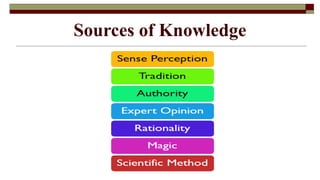
Sources of Knowledge
Sense Perception
Tradition
Authority
Expert Opinion
Rationality
Magic
Scientific Method
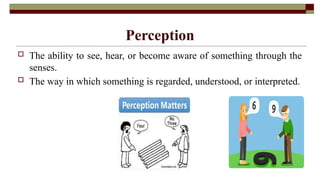
 The ability to see, hear, or become aware of something through the
senses.
 The way in which something is regarded, understood, or interpreted.
Perception
Sense Perception
 Sense perception is the use of our senses to acquire
information about the world around us and to become
acquainted with objects, events, and their features.
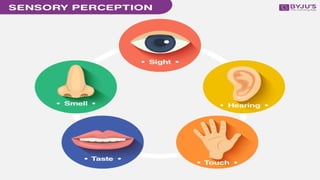
 Traditionally, there are taken to be five senses: sight, touch,
hearing, smell and taste.
Sensory/Empirical Information
 Knowledge is drawn through five senses (five gates of Knowledge).
 The more the senses are involved in process of acquiring
knowledge, more comprehensive would be the knowledge acquired.
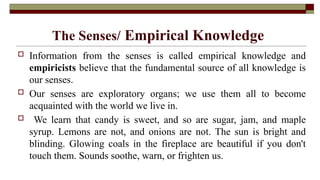
The Senses/ Empirical Knowledge
 Information from the senses is called empirical knowledge and
empiricists believe that the fundamental source of all knowledge is
our senses.
 Our senses are exploratory organs; we use them all to become
acquainted with the world we live in.
 We learn that candy is sweet, and so are sugar, jam, and maple
syrup. Lemons are not, and onions are not. The sun is bright and
blinding. Glowing coals in the fireplace are beautiful if you don't
touch them. Sounds soothe, warn, or frighten us.
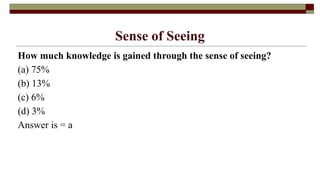
Sense of Seeing
How much knowledge is gained through the sense of seeing?
(a) 75%
(b) 13%
(c) 6%
(d) 3%
Answer is = a
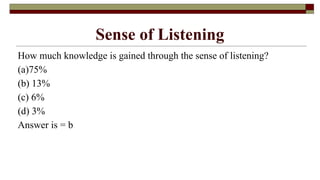
Sense of Listening
How much knowledge is gained through the sense of listening?
(a)75%
(b) 13%
(c) 6%
(d) 3%
Answer is = b
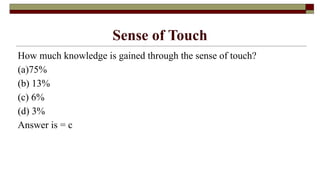
Sense of Touch
How much knowledge is gained through the sense of touch?
(a)75%
(b) 13%
(c) 6%
(d) 3%
Answer is = c
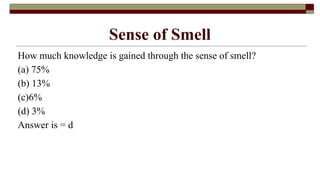
Sense of Smell
How much knowledge is gained through the sense of smell?
(a) 75%
(b) 13%
(c)6%
(d) 3%
Answer is = d
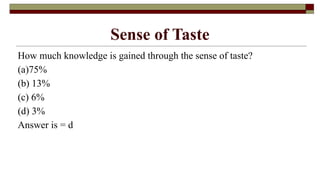
Sense of Taste
How much knowledge is gained through the sense of taste?
(a)75%
(b) 13%
(c) 6%
(d) 3%
Answer is = d
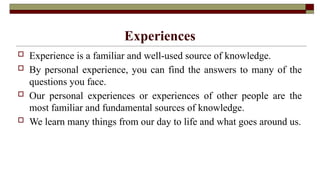
Experiences
 Experience is a familiar and well-used source of knowledge.
 By personal experience, you can find the answers to many of the
questions you face.
 Our personal experiences or experiences of other people are the
most familiar and fundamental sources of knowledge.
 We learn many things from our day to life and what goes around us.
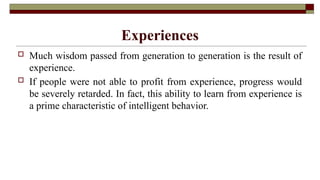
Experiences
 Much wisdom passed from generation to generation is the result of
experience.
 If people were not able to profit from experience, progress would
be severely retarded. In fact, this ability to learn from experience is
a prime characteristic of intelligent behavior.
Revelation
 A second influential source of knowledge throughout the span of
human history has been revelation.
 Revealed knowledge has been of prime importance in the field of
religion. It differs from all other sources of knowledge because it
presupposes a transcendent supernatural reality that breaks into the
natural order.
Tradition
 The transmission of customs or beliefs from generation to
generation, or the fact of being passed on in this way.
Tradition
 We depend on our traditions for the solution of many problems we might
face in our life.
 So, we have accepted various traditions of our forefathers or our culture.
 Everything that we have accepted from our traditions might not always be
valid.
 Over the period of time, people have rejected those wrong traditions
which were once valid.
 Therefore we should always evaluate the knowledge acquired from
traditions before accepting it.
Expert Opinion
 Sometimes in search of knowledge one can take the testimony
of experts who, because of their intellect, training, expert
experience or aptitudes, are better informed than other people.
Authority
 Authority is a quick and easy source of knowledge.
 The power or right to give orders, make decisions, and enforce obedience.
 Authority, a person with specialized expertise and recognition for that
expertise.
 Authority as an approach to acquiring knowledge represents an acceptance
of information or facts stated by another because that person is a highly
respected source.
 Teachers are accepted as an authority and great source of knowledge by
learners.
Authority
 Authority is a quick and easy source of knowledge.
 The power or right to give orders, make decisions, and enforce obedience.
 Authority, a person with specialized expertise and recognition for that expertise.
 Authority as an approach to acquiring knowledge represents an acceptance of
information or facts stated by another because that person is a highly respected
source.
 Comes from authority or specialist in a particular field of knowledge. For
example scientists, philosophers, professor, economists etc.
 Teachers are accepted as an authority and great source of knowledge by
learners.
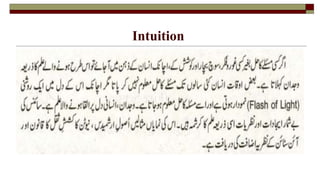
Intuition
 Intuition ‒ immediate knowledge of something.
 Knowledge of something without being consciously aware of
where the knowledge came from.
 An approach to acquiring knowledge that is not based on a
known reasoning process.
 Webster’s Third New International Dictionary defines intuition
as “the act or process of coming to direct knowledge or certainty
without reasoning or inferring.”
Intuition
Magic
 Another way an individual can gain knowledge and control the
world is through magic.
 There are two broad classes of magic. One is imitative magic and
other is contagious.
 In imitative magic people attempt to produce a desired effect by
imitating that effect.
 Contagious magic is based on associations between objects or
events.
Problem Solving
 Here the solution of the problem being solved becomes the
part of knowledge. So, problem-solving is also an effective
tool to acquire knowledge.
Rationalism
 The acquisition of knowledge through reasoning.
 Reasoning, thought, or logic is the central factor in knowledge is
known as rationalism.
Logical Reasoning
 Logic is the study of the methods and principles used to distinguish
correct from incorrect reasoning.
 Distinguishing correct reasoning from incorrect reasoning is the task of
logic.
 Reasoning - The drawing of inferences or conclusions from known or
assumed facts.
 Reasoning is defined as logical or sensible thinking.
 Reasoning is the action of thinking about something in a logical,
sensible way.
Kinds of Reasoning
1) Deductive Reasoning
2) Inductive Reasoning
 Both types of reasoning are useful as a means of understanding
phenomena.
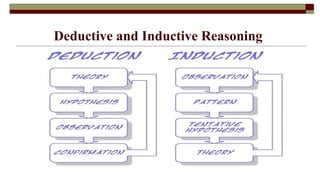
Deductive and Inductive Reasoning
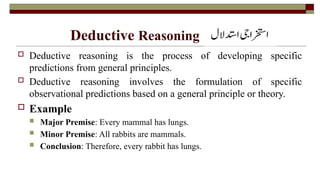
Deductive Reasoning
 Deductive reasoning is the process of developing specific
predictions from general principles.
 Deductive reasoning involves the formulation of specific
observational predictions based on a general principle or theory.
 Example
 Major Premise: Every mammal has lungs.
 Minor Premise: All rabbits are mammals.
 Conclusion: Therefore, every rabbit has lungs.
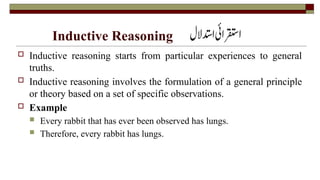
Inductive Reasoning
 Inductive reasoning starts from particular experiences to general
truths.
 Inductive reasoning involves the formulation of a general principle
or theory based on a set of specific observations.
 Example
 Every rabbit that has ever been observed has lungs.
 Therefore, every rabbit has lungs.
Scientific Method
 Science is a very important way of acquiring knowledge.
 Scientific method as the set of assumptions, rules, and
procedures that scientists use to conduct empirical research.
 Empirical research methods include collecting, analyzing,
and interpreting data, reaching conclusions, and sharing
information.
Scientific Method
 An approach to discover accurate information that includes
conceptualizing the problem, collecting data, drawing
conclusions, and revising research conclusions and theory.
Scientific Method
 The scientific method is, thus, based on certain basic postulates
which can be stated as under:
1) It relies on empirical evidence;
2) It utilizes relevant concepts;
3) It is committed to only objective considerations;
4) It presupposes ethical neutrality, i.e., it aims at nothing but making
only adequate and correct statements about population objects;
Scientific Method
1) It results into probabilistic predictions;
2) Its methodology is made known to all concerned for critical
scrutiny are for use in testing the conclusions through replication;
3) It aims at formulating most general axioms or what can be termed
as scientific theories.
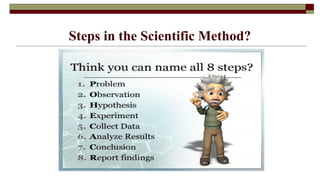
Steps in the Scientific Method?
Research
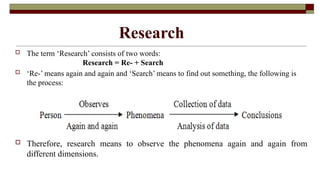
 The term ‘Research’ consists of two words:
Research = Re- + Search
 ‘Re-’ means again and again and ‘Search’ means to find out something, the following is
the process:
 Therefore, research means to observe the phenomena again and again from
different dimensions.
Definition
 Research is the formal, systematic application of the scientific
method to study of problems (L. R. Gay).
 Research is a systematized (systematic) effort to gain new
knowledge (Redman & Mori).
 Research is a method of studying problems whose solutions are to
be derived partly or wholly from facts (W. S. Monroes).
 Research is the voyage of discovery. It is the quest for answers to
unsolved problems.
Educational Research
 Educational Research is the formal, systematic application of
the scientific method to study of educational problems. The goal
of the educational research is to describe, explain, predict, or
control phenomenon under study. (L. R. Gay)
 Educational Research is the systematic application of scientific
method for solving educational problem. (Mouly)
Why Educational Research?
 Improve the practices
 Add the knowledge
 Address the gaps in knowledge
 Expand knowledge
 Replicate knowledge (Test the different findings)
 To identify truth regarding Enrolment, retention, dropout, quality of Education.
 To build new knowledge regarding the methodology & pedagogy.
 To solve a problem related to classroom, institution, administrative level, policy
level.
Nature of Educational Research
 The following characteristics are related in that, as a whole, they
describe the nature of research:
 Research is empirical;
 Research is systematic;
 Research should be valid;
 Research should be reliable;
 Research can take on a variety of forms.
Characteristics of Educational Research
 It is highly purposeful.
 It deals with educational problems regarding students and teachers as well.
 It is precise, objective, scientific and systematic process of investigation.
 It attempts to organize data quantitatively and qualitatively to arrive at
statistical inferences.
 It discovers new facts in new perspective. i.e., It generates new knowledge.
Characteristics of Educational Research
 It is based on some philosophic theory.
 It depends on the researchers ability, ingenuity and experience for
its interpretation and conclusions.
 It needs interdisciplinary approach for solving educational problem.
Scope of Educational Research
 It discovers facts and relationship in order to make educational
process more effective. It relates social sciences like education.
 It includes process like investigation, planning (design) collecting
data, processing of data, their analysis, interpretation and drawing
inferences.
 It covers areas from formal education and conformal education as
well.
Steps in the Process Of the Research
 Research is a process of steps used to collect and analyze
information to increase our understanding about a topic or issue.
 Identifying a Research Problem
 Reviewing the Literature
 Specifying a Purpose and Research Questions or Hypotheses
 Collecting Quantitative Data
 Analyzing and Interpreting Quantitative Data
 Collecting Qualitative Data
 Analyzing and Interpreting Qualitative Data
 Reporting and Evaluating Research
Advantages of Educational Research
Educational research leads to the following advantages:
• It brings confidence in the teacher.
• It also brings dignity to the work of the teacher.
• It leads to the adoption of new methods.
• It keeps up alert.
• It brings a sense of awareness.
• It develops a better understanding of the teaching learning process.
• It enables us to have a better understanding of the social life.
• It promotes educational reform.
Significance of Research
 Research is important because it helps us to understand the world
around us and to find solutions to problems. It helps us advance
knowledge and develop new technologies.
 Research is essential to the academic community, as it helps
scholars build on previous knowledge and advance their
understanding of the world. It is also important to the general public,
as it can help solve problems and improve our quality of life.
Cont.
 There are many different types of research, each with its importance.
Basic research helps us understand the world around us, while
applied research takes that knowledge and uses it to solve problems.
Clinical research is important for developing new medical
treatments, while social science research can help improve our
understanding of human behavior.
Unit 1 , Research methods in education 8604.pptx

Unit 1 , Research methods in education 8604.pptx

  • 1.
    RESEARCH METHODS IN EDUCATION CourseCode: 8604 Course Coordinator: Dr. Azhar Mumtaz Saadi
  • 2.
    Introduction to Book Unit–1: Introduction of Educational Research  Unit–2: Types of Research  Unit–3: Historical Research  Unit–4: Experimental Research  Unit–5: Descriptive Research  Unit–6: Tools and Techniques of Research  Unit–7: Sampling Techniques  Unit–8: Designing a Research Proposal  Unit–9: Writing Research Report
  • 3.
    Course Code: 8604 Unit- 1 Introduction of Educational Research Presented By: Dr. Abdul Khaliq PhD (Education)
  • 4.
    Outline We will learntoday about:  Sources of Knowledge  Research and Educational Research  Nature of Educational Research  Characteristics of Educational Research  Need of Research  Scope of Research in Education  Steps in the Process Of the Research  Advantages of Educational Research  Significance of Research
  • 6.
    Meaning of Knowledge Knowledge is a familiarity, awareness or understanding of someone or something, such as facts, information, descriptions, or skills, which is acquired through experience or education by perceiving, discovering, or learning.  Knowledge can refer to a theoretical or practical understanding of a subject.  Knowledge is broader, deeper and rich than information.
  • 7.
    Knowledge  Knowledge, asdefined by Oxford dictionary, is  What is known in a particular field  Awareness gained by experience of fact or situation  The theoretical and practical understanding of a subject.
  • 8.
    Ways To GainKnowledge.  There are many ways to obtain Knowledge, including sensory experience, agreement with others, authority, intuition, expert’s opinion, logic, and the scientific method, etc.
  • 9.
    Sources of Knowledge SensePerception Tradition Authority Expert Opinion Rationality Magic Scientific Method
  • 10.
     The abilityto see, hear, or become aware of something through the senses.  The way in which something is regarded, understood, or interpreted. Perception
  • 11.
    Sense Perception  Senseperception is the use of our senses to acquire information about the world around us and to become acquainted with objects, events, and their features.  Traditionally, there are taken to be five senses: sight, touch, hearing, smell and taste.
  • 13.
    Sensory/Empirical Information  Knowledgeis drawn through five senses (five gates of Knowledge).  The more the senses are involved in process of acquiring knowledge, more comprehensive would be the knowledge acquired.
  • 14.
    The Senses/ EmpiricalKnowledge  Information from the senses is called empirical knowledge and empiricists believe that the fundamental source of all knowledge is our senses.  Our senses are exploratory organs; we use them all to become acquainted with the world we live in.  We learn that candy is sweet, and so are sugar, jam, and maple syrup. Lemons are not, and onions are not. The sun is bright and blinding. Glowing coals in the fireplace are beautiful if you don't touch them. Sounds soothe, warn, or frighten us.
  • 15.
    Sense of Seeing Howmuch knowledge is gained through the sense of seeing? (a) 75% (b) 13% (c) 6% (d) 3% Answer is = a
  • 16.
    Sense of Listening Howmuch knowledge is gained through the sense of listening? (a)75% (b) 13% (c) 6% (d) 3% Answer is = b
  • 17.
    Sense of Touch Howmuch knowledge is gained through the sense of touch? (a)75% (b) 13% (c) 6% (d) 3% Answer is = c
  • 18.
    Sense of Smell Howmuch knowledge is gained through the sense of smell? (a) 75% (b) 13% (c)6% (d) 3% Answer is = d
  • 19.
    Sense of Taste Howmuch knowledge is gained through the sense of taste? (a)75% (b) 13% (c) 6% (d) 3% Answer is = d
  • 20.
    Experiences  Experience isa familiar and well-used source of knowledge.  By personal experience, you can find the answers to many of the questions you face.  Our personal experiences or experiences of other people are the most familiar and fundamental sources of knowledge.  We learn many things from our day to life and what goes around us.
  • 21.
    Experiences  Much wisdompassed from generation to generation is the result of experience.  If people were not able to profit from experience, progress would be severely retarded. In fact, this ability to learn from experience is a prime characteristic of intelligent behavior.
  • 22.
    Revelation  A secondinfluential source of knowledge throughout the span of human history has been revelation.  Revealed knowledge has been of prime importance in the field of religion. It differs from all other sources of knowledge because it presupposes a transcendent supernatural reality that breaks into the natural order.
  • 23.
    Tradition  The transmissionof customs or beliefs from generation to generation, or the fact of being passed on in this way.
  • 24.
    Tradition  We dependon our traditions for the solution of many problems we might face in our life.  So, we have accepted various traditions of our forefathers or our culture.  Everything that we have accepted from our traditions might not always be valid.  Over the period of time, people have rejected those wrong traditions which were once valid.  Therefore we should always evaluate the knowledge acquired from traditions before accepting it.
  • 25.
    Expert Opinion  Sometimesin search of knowledge one can take the testimony of experts who, because of their intellect, training, expert experience or aptitudes, are better informed than other people.
  • 26.
    Authority  Authority isa quick and easy source of knowledge.  The power or right to give orders, make decisions, and enforce obedience.  Authority, a person with specialized expertise and recognition for that expertise.  Authority as an approach to acquiring knowledge represents an acceptance of information or facts stated by another because that person is a highly respected source.  Teachers are accepted as an authority and great source of knowledge by learners.
  • 27.
    Authority  Authority isa quick and easy source of knowledge.  The power or right to give orders, make decisions, and enforce obedience.  Authority, a person with specialized expertise and recognition for that expertise.  Authority as an approach to acquiring knowledge represents an acceptance of information or facts stated by another because that person is a highly respected source.  Comes from authority or specialist in a particular field of knowledge. For example scientists, philosophers, professor, economists etc.  Teachers are accepted as an authority and great source of knowledge by learners.
  • 28.
    Intuition  Intuition ‒immediate knowledge of something.  Knowledge of something without being consciously aware of where the knowledge came from.  An approach to acquiring knowledge that is not based on a known reasoning process.  Webster’s Third New International Dictionary defines intuition as “the act or process of coming to direct knowledge or certainty without reasoning or inferring.”
  • 29.
  • 30.
    Magic  Another wayan individual can gain knowledge and control the world is through magic.  There are two broad classes of magic. One is imitative magic and other is contagious.  In imitative magic people attempt to produce a desired effect by imitating that effect.  Contagious magic is based on associations between objects or events.
  • 31.
    Problem Solving  Herethe solution of the problem being solved becomes the part of knowledge. So, problem-solving is also an effective tool to acquire knowledge.
  • 32.
    Rationalism  The acquisitionof knowledge through reasoning.  Reasoning, thought, or logic is the central factor in knowledge is known as rationalism.
  • 33.
    Logical Reasoning  Logicis the study of the methods and principles used to distinguish correct from incorrect reasoning.  Distinguishing correct reasoning from incorrect reasoning is the task of logic.  Reasoning - The drawing of inferences or conclusions from known or assumed facts.  Reasoning is defined as logical or sensible thinking.  Reasoning is the action of thinking about something in a logical, sensible way.
  • 34.
    Kinds of Reasoning 1)Deductive Reasoning 2) Inductive Reasoning  Both types of reasoning are useful as a means of understanding phenomena.
  • 35.
  • 36.
    Deductive Reasoning  Deductivereasoning is the process of developing specific predictions from general principles.  Deductive reasoning involves the formulation of specific observational predictions based on a general principle or theory.  Example  Major Premise: Every mammal has lungs.  Minor Premise: All rabbits are mammals.  Conclusion: Therefore, every rabbit has lungs.
  • 37.
    Inductive Reasoning  Inductivereasoning starts from particular experiences to general truths.  Inductive reasoning involves the formulation of a general principle or theory based on a set of specific observations.  Example  Every rabbit that has ever been observed has lungs.  Therefore, every rabbit has lungs.
  • 38.
    Scientific Method  Scienceis a very important way of acquiring knowledge.  Scientific method as the set of assumptions, rules, and procedures that scientists use to conduct empirical research.  Empirical research methods include collecting, analyzing, and interpreting data, reaching conclusions, and sharing information.
  • 39.
    Scientific Method  Anapproach to discover accurate information that includes conceptualizing the problem, collecting data, drawing conclusions, and revising research conclusions and theory.
  • 40.
    Scientific Method  Thescientific method is, thus, based on certain basic postulates which can be stated as under: 1) It relies on empirical evidence; 2) It utilizes relevant concepts; 3) It is committed to only objective considerations; 4) It presupposes ethical neutrality, i.e., it aims at nothing but making only adequate and correct statements about population objects;
  • 41.
    Scientific Method 1) Itresults into probabilistic predictions; 2) Its methodology is made known to all concerned for critical scrutiny are for use in testing the conclusions through replication; 3) It aims at formulating most general axioms or what can be termed as scientific theories.
  • 42.
    Steps in theScientific Method?
  • 43.
    Research  The term‘Research’ consists of two words: Research = Re- + Search  ‘Re-’ means again and again and ‘Search’ means to find out something, the following is the process:  Therefore, research means to observe the phenomena again and again from different dimensions.
  • 44.
    Definition  Research isthe formal, systematic application of the scientific method to study of problems (L. R. Gay).  Research is a systematized (systematic) effort to gain new knowledge (Redman & Mori).  Research is a method of studying problems whose solutions are to be derived partly or wholly from facts (W. S. Monroes).  Research is the voyage of discovery. It is the quest for answers to unsolved problems.
  • 45.
    Educational Research  EducationalResearch is the formal, systematic application of the scientific method to study of educational problems. The goal of the educational research is to describe, explain, predict, or control phenomenon under study. (L. R. Gay)  Educational Research is the systematic application of scientific method for solving educational problem. (Mouly)
  • 46.
    Why Educational Research? Improve the practices  Add the knowledge  Address the gaps in knowledge  Expand knowledge  Replicate knowledge (Test the different findings)  To identify truth regarding Enrolment, retention, dropout, quality of Education.  To build new knowledge regarding the methodology & pedagogy.  To solve a problem related to classroom, institution, administrative level, policy level.
  • 47.
    Nature of EducationalResearch  The following characteristics are related in that, as a whole, they describe the nature of research:  Research is empirical;  Research is systematic;  Research should be valid;  Research should be reliable;  Research can take on a variety of forms.
  • 48.
    Characteristics of EducationalResearch  It is highly purposeful.  It deals with educational problems regarding students and teachers as well.  It is precise, objective, scientific and systematic process of investigation.  It attempts to organize data quantitatively and qualitatively to arrive at statistical inferences.  It discovers new facts in new perspective. i.e., It generates new knowledge.
  • 49.
    Characteristics of EducationalResearch  It is based on some philosophic theory.  It depends on the researchers ability, ingenuity and experience for its interpretation and conclusions.  It needs interdisciplinary approach for solving educational problem.
  • 50.
    Scope of EducationalResearch  It discovers facts and relationship in order to make educational process more effective. It relates social sciences like education.  It includes process like investigation, planning (design) collecting data, processing of data, their analysis, interpretation and drawing inferences.  It covers areas from formal education and conformal education as well.
  • 51.
    Steps in theProcess Of the Research  Research is a process of steps used to collect and analyze information to increase our understanding about a topic or issue.  Identifying a Research Problem  Reviewing the Literature  Specifying a Purpose and Research Questions or Hypotheses  Collecting Quantitative Data  Analyzing and Interpreting Quantitative Data  Collecting Qualitative Data  Analyzing and Interpreting Qualitative Data  Reporting and Evaluating Research
  • 52.
    Advantages of EducationalResearch Educational research leads to the following advantages: • It brings confidence in the teacher. • It also brings dignity to the work of the teacher. • It leads to the adoption of new methods. • It keeps up alert. • It brings a sense of awareness. • It develops a better understanding of the teaching learning process. • It enables us to have a better understanding of the social life. • It promotes educational reform.
  • 53.
    Significance of Research Research is important because it helps us to understand the world around us and to find solutions to problems. It helps us advance knowledge and develop new technologies.  Research is essential to the academic community, as it helps scholars build on previous knowledge and advance their understanding of the world. It is also important to the general public, as it can help solve problems and improve our quality of life.
  • 54.
    Cont.  There aremany different types of research, each with its importance. Basic research helps us understand the world around us, while applied research takes that knowledge and uses it to solve problems. Clinical research is important for developing new medical treatments, while social science research can help improve our understanding of human behavior.