Course: Research and Publication Ethics
Topic: Publication Ethics & Misconducts
Dr.M.Deivam
Assistant Professor
Department of Education
H.N.B Garhwal University
(A Central University)
S.R.T Campus, Tehri Garhwal
Uttarakhand – 249 199
Data Fabrication
•Data Fabrication is making up
data or results. It also includes
construction of data that has
never occurred during the
experimentation or the
experiments might not have
been conducted only.
Examples:
•Creating fictitious patient records in a
clinical trial.
•Reporting experimental results that
were never conducted.
•Filling in missing data points with
fabricated values.
Data Falsification
•Data Falsification is
manipulating research
materials, equipment, or
processes, or changing or
omitting data or results such
that the research is not
accurately represented in the
research record. It’s the
manipulation of data giving
false impression of the study.
Examples:
•Modifying experimental conditions to produce
more favorable results.
•Selectively excluding data points that
contradict the hypothesis.
•Altering images or graphs to enhance the
appearance of findings.
Reasons for Data Fabrication and Falsification:
•Pressure to Publish: The "publish or perish" culture in
academia can create immense pressure to produce
positive results.
•Career Advancement: Researchers may feel the need to
fabricate data to secure grants, promotions, or
recognition.
•Personal Bias: Researchers may unconsciously or
consciously manipulate data to confirm their own beliefs
or hypotheses.
Preventing Data Fabrication and Falsification
• Ethical Training: Educating researchers on ethical research practices and the
importance of data integrity.
• Mentorship and Supervision: Providing adequate mentorship and
supervision, especially for early career researchers.
• Data Management Plans: Requiring researchers to create and follow data
management plans that outline data collection, storage, and analysis
procedures.
• Peer Review: Encouraging rigorous peer review processes that scrutinize data
analysis and interpretation.
• Whistleblowing Mechanisms: Establishing confidential channels for reporting
suspected research misconduct.
Plagiarism and self-plagiarism or text recycling
• Always cite your sources: Give credit to other researchers' ideas,
data, or text, even if you're only using a single sentence.
• Self-plagiarism is still plagiarism: Citing your previous work is
essential to maintain transparency and avoid misleading readers.
• Obtain permission when necessary: For substantial use of
someone else's work, especially figures or tables, seek
permission from the copyright holder.
• Plagiarism is a serious offense: It undermines academic integrity
and can have severe consequences for your reputation and
career.
Redundant Publication or Salami Publication or
Segmented Publication
• "Minimum Publishable Units" are unethical: Don't slice your
research into the smallest possible pieces just to increase
publication count.
• Redundant publication inflates research output: It creates the
illusion of more significant contributions than what truly exists.
• It wastes resources: Multiple papers with repetitive content waste
journal space, peer reviewer time, and reader attention.
• Focus on meaningful contributions: Aim to publish cohesive,
comprehensive papers that present a complete picture of your
research.
Dual submissions
•Don't submit the same article to multiple journals
simultaneously: It's considered unethical and disrespectful of
reviewers' time and effort.
•Dual submissions waste resources: Multiple journals
reviewing identical content is inefficient and burdens the peer
review system.
•It creates confusion for readers and researchers:
Published duplicates make it difficult to track citations and
understand the research landscape accurately.
Contd.,
•Even translated versions are problematic: Submitting the
same content in different languages without disclosure is still
considered unethical.
•Respect the peer review process: Submit your work to one
journal at a time and await a decision before submitting
elsewhere.
Improper author contribution or Inappropriate
authorship
•Authorship signifies significant contribution: Only those
who have made substantial intellectual contributions to the
research and paper should be listed as authors.
•Include all contributors, exclude non-contributors: Don't
omit anyone who has made a significant contribution, and
don't list anyone who hasn't.
•Author order should reflect contribution level: Establish a
clear and agreed-upon order of authorship that accurately
reflects the relative contributions of each author.
Contd.,
•Transparency is key: All co-authors should be aware of the
manuscript's content and agree with the claims made.
•Acknowledge those who assisted but don't qualify for
authorship: Individuals who provided support but didn't meet
authorship criteria can be acknowledged in a dedicated
section.
•Follow ethical authorship practices to avoid disputes:
Clear communication and adherence to ethical guidelines can
prevent conflicts and ensure fairness in authorship attribution.
Gift authorship
•Gift authorship is unethical: Including someone as an
author who hasn't made a genuine contribution to the
research is a misrepresentation of authorship.
•It undermines academic integrity: Gift authorship devalues
the contributions of legitimate authors and inflates the
credentials of those who haven't earned it.
•Motivations for gift authorship are often inappropriate:
Pressures to secure funding, advance careers, or gain favor
can lead to these unethical practices.
Contd.,
•Resist pressure from senior figures: Don't feel obligated
to include superiors as authors if they haven't contributed
substantially to the research.
•Focus on ethical authorship practices: Ensure that all
authors listed have earned their place through genuine
contributions to the research and publication.
Ghost authorship
•Ghost authorship is a serious ethical violation: Failing to
acknowledge individuals who have made significant
contributions to a research project is unacceptable.
•It exploits junior researchers: Ghost authorship often affects
trainees or early-career researchers who may feel pressured to
relinquish authorship or fear retaliation.
•It deceives readers: By obscuring the true authorship, ghost
authorship misrepresents the research process and
undermines transparency.
Contd.,
•Consequences can be severe, especially in medicine: Patients'
well-being can be jeopardized if research findings are
misrepresented or if unqualified individuals are credited with
authorship.
•Always acknowledge all contributors appropriately: Ensure that
everyone who has made a substantial contribution to the research is
listed as an author or acknowledged in the manuscript.
Conflicts of interest
•Conflicts of interest can compromise research integrity:
Financial or personal interests that influence research
decisions, analysis, or publication can lead to biased or
inaccurate findings.
•Transparency is crucial: Authors have an ethical obligation
to disclose any potential conflicts of interest to the journal
editor or publisher.
•Disclosure allows for informed evaluation: Readers and
reviewers can then assess the research while considering
the declared conflicts of interest.
Contd.,
•Journals may handle disclosures differently: Some
journals publish conflict of interest statements, while
others may reject submissions with potential biases.
•Failure to disclose is unethical: Hiding conflicts of
interest deceives readers and undermines trust in the
research.
Citation manipulation
•Cite responsibly and ethically: Citations should reflect
genuine intellectual influences and support the arguments
presented in your work.
•Avoid citation stacking: Don't cite irrelevant papers solely to
boost the citation count of your own work or that of
colleagues.
•Don't excessively self-cite: While citing your previous work
is sometimes necessary, avoid overdoing it, especially if it's
not directly relevant to the current research.
Contd.,
•Read the works you cite: Ensure that you understand the
content of each cited paper and that it supports the point
you're making.
•Don't blindly copy reference lists: Always verify the
relevance and accuracy of citations from other
publications before including them in your own work.
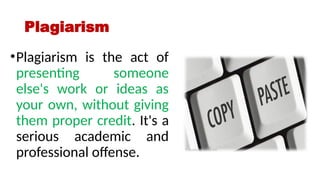
Plagiarism
•Plagiarism is the act of
presenting someone
else's work or ideas as
your own, without giving
them proper credit. It's a
serious academic and
professional offense.
Plagiarism: Types
1. Direct Plagiarism
•Definition: Word-for-word copying of another person's work without
quotation marks or acknowledgement.
•Example: Copying a paragraph directly from a website and pasting it into
your essay without citing the source.
2. Self-Plagiarism
•Definition: Reusing your own previous work without permission from
the teacher or proper citation.
•Example: Submitting a paper you wrote for one class to another class
without the knowledge or consent of both instructors.
3. Mosaic Plagiarism
•Definition: Combining phrases, sentences, or paragraphs from
different sources and presenting them as your own.
•Example: Taking bits and pieces of text from multiple
websites and weaving them together without proper attribution.
4. Paraphrasing Plagiarism
•Definition: Restating someone else's ideas in your own words
without proper citation.
•Example: Summarizing a paragraph from a book in your own
words but failing to cite the book as the source of the idea.
5. Accidental Plagiarism
•Definition: Unintentionally failing to cite sources properly
due to carelessness, misunderstanding of citation rules, or poor
note-taking.
•Example: Forgetting to include quotation marks around a
direct quote or incorrectly citing a source in the bibliography.
6. Global Plagiarism
•Definition: Submitting an entire piece of work that someone
else created as your own.
•Example: Buying an essay online and turning it in as your
own original work.
Consequences of Plagiarism
•Academic: Failing grades, suspension, or
expulsion.
•Professional: Damage to reputation, loss of
job, or publication withdrawals.
•Legal: Copyright violation lawsuits (in some
cases).
How to Avoid Plagiarism
•Cite all sources: Use quotation marks for direct quotes and provide
in-text citations and a bibliography.
•Develop good research habits: Take careful notes and keep track
of all sources.
•Understand paraphrasing: Ensure you're not just replacing words
– you need to express the ideas in your own way while still giving
credit.
•Use plagiarism checkers: These tools can help identify potential
issues, but they shouldn't replace careful citation practices.
PLAGIARISM DETECTION SOFTWARE
•Grammarly
•SmallSeoTools
•Duplichecker
•QuillBot
•Turnitin
•iThenticate
•Drillbit
References
• Tecnoscientífica. (n.d.). Publishing ethics and misconduct.
Tecnoscientífica.
https://tecnoscientifica.com/about/policies/publishing-ethics-and-miscon
duct
• Daroff, R. B., & Griggs, R. C. (2004). Scientific misconduct and
breach of publication ethics. Neurology, 62(3), 352-353.
• Marcovitch, H. (2007). Misconduct by researchers and
authors. Gaceta sanitaria, 21, 492-499.
• Sengupta, S., & Honavar, S. G. (2017). Publication ethics. Indian
journal of ophthalmology, 65(6), 429-432.
Thank You

Topic on Research Ethics and Misconducts

  • 1.
    Course: Research andPublication Ethics Topic: Publication Ethics & Misconducts Dr.M.Deivam Assistant Professor Department of Education H.N.B Garhwal University (A Central University) S.R.T Campus, Tehri Garhwal Uttarakhand – 249 199
  • 2.
    Data Fabrication •Data Fabricationis making up data or results. It also includes construction of data that has never occurred during the experimentation or the experiments might not have been conducted only.
  • 3.
    Examples: •Creating fictitious patientrecords in a clinical trial. •Reporting experimental results that were never conducted. •Filling in missing data points with fabricated values.
  • 4.
    Data Falsification •Data Falsificationis manipulating research materials, equipment, or processes, or changing or omitting data or results such that the research is not accurately represented in the research record. It’s the manipulation of data giving false impression of the study.
  • 5.
    Examples: •Modifying experimental conditionsto produce more favorable results. •Selectively excluding data points that contradict the hypothesis. •Altering images or graphs to enhance the appearance of findings.
  • 6.
    Reasons for DataFabrication and Falsification: •Pressure to Publish: The "publish or perish" culture in academia can create immense pressure to produce positive results. •Career Advancement: Researchers may feel the need to fabricate data to secure grants, promotions, or recognition. •Personal Bias: Researchers may unconsciously or consciously manipulate data to confirm their own beliefs or hypotheses.
  • 7.
    Preventing Data Fabricationand Falsification • Ethical Training: Educating researchers on ethical research practices and the importance of data integrity. • Mentorship and Supervision: Providing adequate mentorship and supervision, especially for early career researchers. • Data Management Plans: Requiring researchers to create and follow data management plans that outline data collection, storage, and analysis procedures. • Peer Review: Encouraging rigorous peer review processes that scrutinize data analysis and interpretation. • Whistleblowing Mechanisms: Establishing confidential channels for reporting suspected research misconduct.
  • 8.
    Plagiarism and self-plagiarismor text recycling • Always cite your sources: Give credit to other researchers' ideas, data, or text, even if you're only using a single sentence. • Self-plagiarism is still plagiarism: Citing your previous work is essential to maintain transparency and avoid misleading readers. • Obtain permission when necessary: For substantial use of someone else's work, especially figures or tables, seek permission from the copyright holder. • Plagiarism is a serious offense: It undermines academic integrity and can have severe consequences for your reputation and career.
  • 9.
    Redundant Publication orSalami Publication or Segmented Publication • "Minimum Publishable Units" are unethical: Don't slice your research into the smallest possible pieces just to increase publication count. • Redundant publication inflates research output: It creates the illusion of more significant contributions than what truly exists. • It wastes resources: Multiple papers with repetitive content waste journal space, peer reviewer time, and reader attention. • Focus on meaningful contributions: Aim to publish cohesive, comprehensive papers that present a complete picture of your research.
  • 10.
    Dual submissions •Don't submitthe same article to multiple journals simultaneously: It's considered unethical and disrespectful of reviewers' time and effort. •Dual submissions waste resources: Multiple journals reviewing identical content is inefficient and burdens the peer review system. •It creates confusion for readers and researchers: Published duplicates make it difficult to track citations and understand the research landscape accurately.
  • 11.
    Contd., •Even translated versionsare problematic: Submitting the same content in different languages without disclosure is still considered unethical. •Respect the peer review process: Submit your work to one journal at a time and await a decision before submitting elsewhere.
  • 12.
    Improper author contributionor Inappropriate authorship •Authorship signifies significant contribution: Only those who have made substantial intellectual contributions to the research and paper should be listed as authors. •Include all contributors, exclude non-contributors: Don't omit anyone who has made a significant contribution, and don't list anyone who hasn't. •Author order should reflect contribution level: Establish a clear and agreed-upon order of authorship that accurately reflects the relative contributions of each author.
  • 13.
    Contd., •Transparency is key:All co-authors should be aware of the manuscript's content and agree with the claims made. •Acknowledge those who assisted but don't qualify for authorship: Individuals who provided support but didn't meet authorship criteria can be acknowledged in a dedicated section. •Follow ethical authorship practices to avoid disputes: Clear communication and adherence to ethical guidelines can prevent conflicts and ensure fairness in authorship attribution.
  • 14.
    Gift authorship •Gift authorshipis unethical: Including someone as an author who hasn't made a genuine contribution to the research is a misrepresentation of authorship. •It undermines academic integrity: Gift authorship devalues the contributions of legitimate authors and inflates the credentials of those who haven't earned it. •Motivations for gift authorship are often inappropriate: Pressures to secure funding, advance careers, or gain favor can lead to these unethical practices.
  • 15.
    Contd., •Resist pressure fromsenior figures: Don't feel obligated to include superiors as authors if they haven't contributed substantially to the research. •Focus on ethical authorship practices: Ensure that all authors listed have earned their place through genuine contributions to the research and publication.
  • 16.
    Ghost authorship •Ghost authorshipis a serious ethical violation: Failing to acknowledge individuals who have made significant contributions to a research project is unacceptable. •It exploits junior researchers: Ghost authorship often affects trainees or early-career researchers who may feel pressured to relinquish authorship or fear retaliation. •It deceives readers: By obscuring the true authorship, ghost authorship misrepresents the research process and undermines transparency.
  • 17.
    Contd., •Consequences can besevere, especially in medicine: Patients' well-being can be jeopardized if research findings are misrepresented or if unqualified individuals are credited with authorship. •Always acknowledge all contributors appropriately: Ensure that everyone who has made a substantial contribution to the research is listed as an author or acknowledged in the manuscript.
  • 18.
    Conflicts of interest •Conflictsof interest can compromise research integrity: Financial or personal interests that influence research decisions, analysis, or publication can lead to biased or inaccurate findings. •Transparency is crucial: Authors have an ethical obligation to disclose any potential conflicts of interest to the journal editor or publisher. •Disclosure allows for informed evaluation: Readers and reviewers can then assess the research while considering the declared conflicts of interest.
  • 19.
    Contd., •Journals may handledisclosures differently: Some journals publish conflict of interest statements, while others may reject submissions with potential biases. •Failure to disclose is unethical: Hiding conflicts of interest deceives readers and undermines trust in the research.
  • 20.
    Citation manipulation •Cite responsiblyand ethically: Citations should reflect genuine intellectual influences and support the arguments presented in your work. •Avoid citation stacking: Don't cite irrelevant papers solely to boost the citation count of your own work or that of colleagues. •Don't excessively self-cite: While citing your previous work is sometimes necessary, avoid overdoing it, especially if it's not directly relevant to the current research.
  • 21.
    Contd., •Read the worksyou cite: Ensure that you understand the content of each cited paper and that it supports the point you're making. •Don't blindly copy reference lists: Always verify the relevance and accuracy of citations from other publications before including them in your own work.
  • 22.
    Plagiarism •Plagiarism is theact of presenting someone else's work or ideas as your own, without giving them proper credit. It's a serious academic and professional offense.
  • 23.
    Plagiarism: Types 1. DirectPlagiarism •Definition: Word-for-word copying of another person's work without quotation marks or acknowledgement. •Example: Copying a paragraph directly from a website and pasting it into your essay without citing the source. 2. Self-Plagiarism •Definition: Reusing your own previous work without permission from the teacher or proper citation. •Example: Submitting a paper you wrote for one class to another class without the knowledge or consent of both instructors.
  • 24.
    3. Mosaic Plagiarism •Definition:Combining phrases, sentences, or paragraphs from different sources and presenting them as your own. •Example: Taking bits and pieces of text from multiple websites and weaving them together without proper attribution. 4. Paraphrasing Plagiarism •Definition: Restating someone else's ideas in your own words without proper citation. •Example: Summarizing a paragraph from a book in your own words but failing to cite the book as the source of the idea.
  • 25.
    5. Accidental Plagiarism •Definition:Unintentionally failing to cite sources properly due to carelessness, misunderstanding of citation rules, or poor note-taking. •Example: Forgetting to include quotation marks around a direct quote or incorrectly citing a source in the bibliography. 6. Global Plagiarism •Definition: Submitting an entire piece of work that someone else created as your own. •Example: Buying an essay online and turning it in as your own original work.
  • 26.
    Consequences of Plagiarism •Academic:Failing grades, suspension, or expulsion. •Professional: Damage to reputation, loss of job, or publication withdrawals. •Legal: Copyright violation lawsuits (in some cases).
  • 27.
    How to AvoidPlagiarism •Cite all sources: Use quotation marks for direct quotes and provide in-text citations and a bibliography. •Develop good research habits: Take careful notes and keep track of all sources. •Understand paraphrasing: Ensure you're not just replacing words – you need to express the ideas in your own way while still giving credit. •Use plagiarism checkers: These tools can help identify potential issues, but they shouldn't replace careful citation practices.
  • 28.
  • 29.
    References • Tecnoscientífica. (n.d.).Publishing ethics and misconduct. Tecnoscientífica. https://tecnoscientifica.com/about/policies/publishing-ethics-and-miscon duct • Daroff, R. B., & Griggs, R. C. (2004). Scientific misconduct and breach of publication ethics. Neurology, 62(3), 352-353. • Marcovitch, H. (2007). Misconduct by researchers and authors. Gaceta sanitaria, 21, 492-499. • Sengupta, S., & Honavar, S. G. (2017). Publication ethics. Indian journal of ophthalmology, 65(6), 429-432.
  • 30.