The document discusses theoretical and practical knowledge, defining theoretical knowledge as the understanding gained through study and research, while practical knowledge focuses on application and hands-on experience. It highlights the advantages and limitations of both types of knowledge, emphasizing the need for practical application alongside theoretical understanding for effective learning. The importance of integrating theory and practice in education is also underscored to enhance retention and real-world application.
Theoretical and PracticalKnowledge
(सैद्धांतिक और व्यावहारिक ज्ञान)
Dr. M . Deivam
Assistant Professor
Department of Education
H.N.B Garhwal University (A Central University)
S.R.T Campus, Uttarakhand – 249 199
2.
Theoretical knowledge
•Theoretical knowledgereflects the knowledge,
abilities or skills possessed by a person.
•The study about any fact, incident, situation, context,
person, and object is called theoretical knowledge.
•This knowledge may be from books, mass media,
periodicals, journals, dictionary, encyclopedia, etc.
3.
Contd.,
•Theory teaches throughthe experiences of others.
•It can often lead to a deeper understanding of a
concept.
•It helps to understand why one technique works,
while another fails.
4.
Characteristics of TheoreticalKnowledge
•It is based on theories;
•It is gained by study and research;
•It involves all units of an incident;
•It involves different dimensions of a concept;
•Its scope is wide. Theoretical knowledge can be
acquired through study, research, observation, and
experience.
5.
Advantages of TheoreticalKnowledge
Deeper Understanding:
•Provides a strong conceptual foundation by explaining why and how things
work.
•Helps in comprehending complex ideas thoroughly.
Broad Perspective:
•Offers a holistic view of a subject by integrating various elements.
•Enhances critical thinking and reasoning.
Predictive Power:
•Helps anticipate outcomes based on established principles.
•Aids in solving problems systematically by applying theoretical frameworks.
Supports Practical Application:
•Provides the basis for effective application of techniques and methods in real-life
situations.
•Clarifies why certain methods succeed while others fail.
6.
Contd.,
Knowledge Retention:
• Encourageslong-term retention through detailed explanations and logical
understanding.
• Serves as a reference for future learning and development.
Universal Relevance:
• Theoretical knowledge is not context-dependent and can be applied
across different scenarios and disciplines.
Foundation for Further Learning:
• Acts as a stepping stone for advanced study and specialized knowledge in
any field.
7.
Limitations of TheoreticalKnowledge
1.Lacks Practical Application: It often does not prepare individuals
for real-life challenges or hands-on tasks.
2.Contextual Irrelevance: Theories may not always apply to specific,
dynamic real-world situations.
3.Abstract Nature: Concepts can be hard to relate to without
practical examples or experience.
4.Outdated Information: Theories can become outdated with
technological and societal changes.
5.Overemphasis on Concepts: Focuses on "why" rather than
actionable "how," making it less immediately applicable.
8.
Practical Knowledge
Knowledge appliedto perform a specific skill or task.
Focuses on the "how" and involves direct application.
More directly useful in daily life.
Acquired through doing and experiencing.
Leads to a deeper understanding through personal
involvement.
The main aim of education is to impart theoretical
knowledge, develop skills in students, make them use these
in their daily life.
9.
Process of AcquiringPractical Knowledge
•Application: Putting knowledge into action.
•Practice: Repetition to refine skills.
•Experience: Learning through real-life situations.
10.
Dimensions of Knowledge
•TheoreticalKnowledge: Understanding concepts.
•Observational Knowledge: Learning by observing others.
•Suggestions: Incorporating advice and feedback.
•Practice or Repetition: Building proficiency through action.
•Experience: Gaining insights from firsthand involvement.
11.
Example:
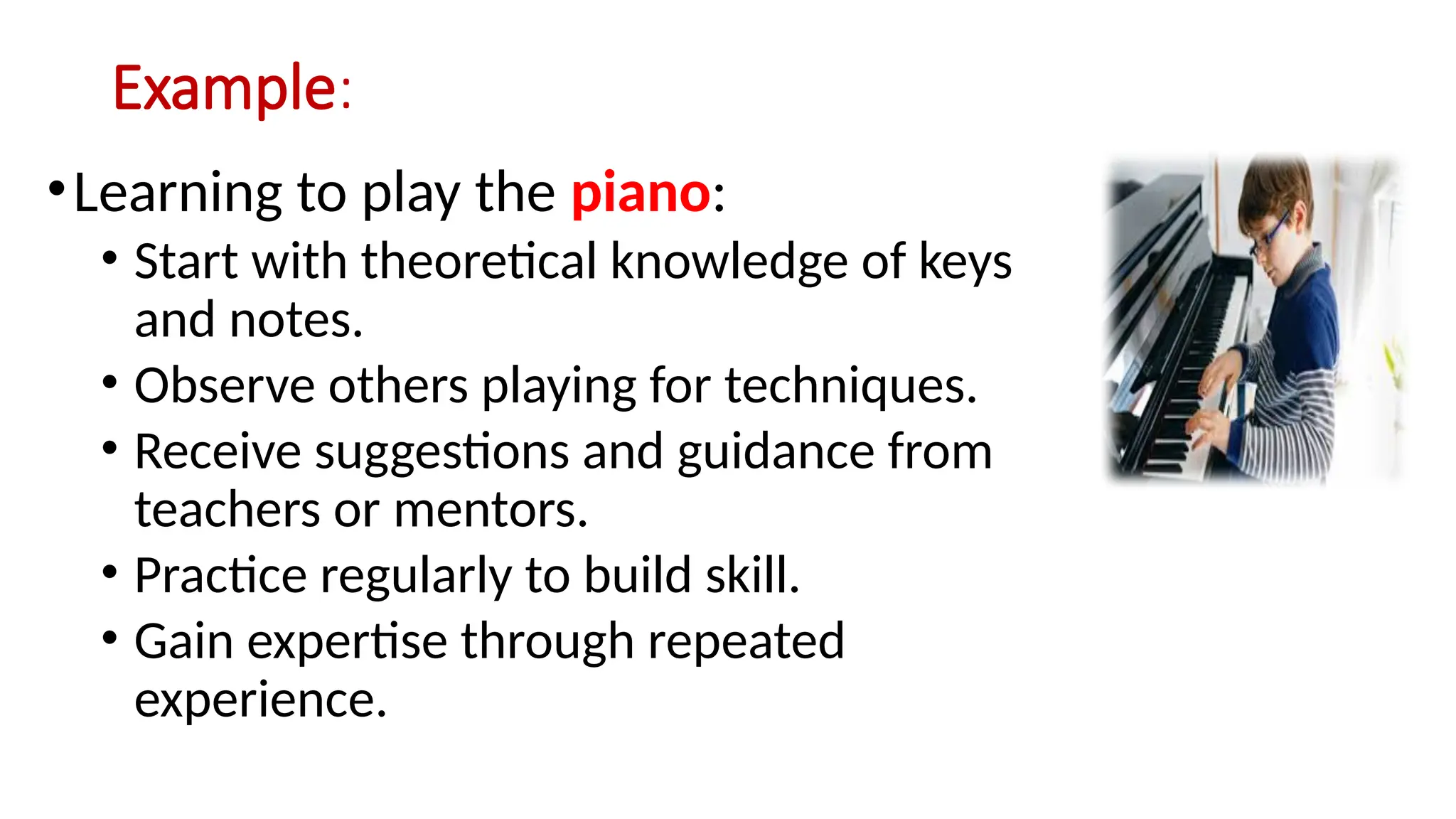
•Learning to playthe piano:
• Start with theoretical knowledge of keys
and notes.
• Observe others playing for techniques.
• Receive suggestions and guidance from
teachers or mentors.
• Practice regularly to build skill.
• Gain expertise through repeated
experience.
12.
Importance of PracticalKnowledge
Interactive Education Creates a Deeper Impact:
• Practical learning is interactive, using experiments, exercises, and group sessions for a
stronger understanding.
Motivates Teamwork:
• Team-based activities improve collaboration and communication while making learning
engaging.
Simplifies Learning:
• Practical activities make learning easier compared to purely theoretical methods.
Real-Life Application:
• Bridges the gap between theoretical understanding and practical implementation.
Better Retention:
• Practical knowledge is retained longer due to hands-on experience and personal
involvement.
13.
Limitations of PracticalKnowledge
Limited Theoretical Foundation: Practical knowledge often lacks a deep
understanding of the underlying principles, leading to gaps in conceptual
knowledge.
Context Dependency: It is highly situational and may not be easily transferable
to different scenarios or environments.
Trial-and-Error Risks: Learning through doing can involve errors or
inefficiencies, which may result in mistakes or wasted resources.
Time-Consuming: Gaining practical knowledge through experience often takes
more time compared to studying theoretical concepts.
Inability to Predict: Without theoretical grounding, it may not help in
predicting or analyzing situations outside the learner's direct experience.
14.
REFERENCES
• Bharathidasan University.(n.d.). Knowledge and curriculum – Centre for Distance
Education. Retrieved from
https://www.bdu.ac.in/cde/docs/ebooks/B-Ed/II/KNOWLEDGE%20AND%20CURRI
CULUM.pdf
• Mangalore University. (2019). Knowledge and curriculum – Open and Distance
Learning Programme for B.Ed. Retrieved from
https://www.mangaloreuniversity.ac.in/sites/default/files/2019/Course%20-
%209%20Knowledge%20%26%20Curriculum%20(English%20Version).pdf
• Mangalore University. (2019). Understanding disciplines and school subjects –
Open and Distance Learning Programme. Retrieved from
https://mangaloreuniversity.ac.in/sites/default/files/2019/Course-5%20English%2
0Version.pdf