Assumptions
Joe Matthews
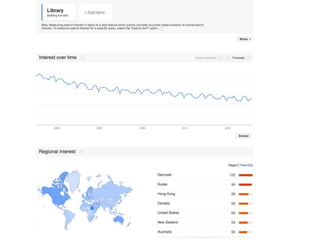
Many people believe that libraries
are inefficient, inflexible
and obsolete!
How do libraries deal with change?
Libraries have changed in many ways, including
adding digital services, and repurposing space
• But few services have ended and we have kept
the existing library paradigm – collections
matter
• Major driver of decisions about library – the
budget
• Change is outpacing us
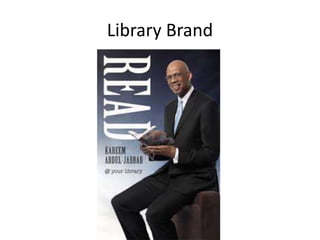
Library Brand
Collections
• Just-in-case
• Just-in-time
• eBooks
• Digital content
pBooks
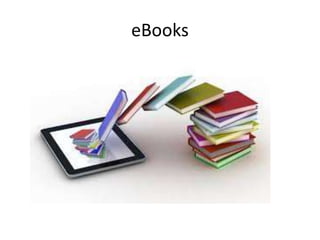
eBooks
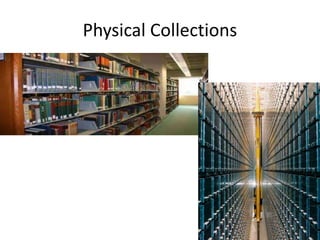
Physical Collections
Collections
• Store on/off campus
• Shared storage facility
• Regional storage facility
• Impact of HathiTrust & Google Books
Organizing the Collection
• Use – LC, Dewey, other
• Other options – C3, others
• None – BISAC, Anythink, San Mateo
County Library (FindIt), Monarch
Method (high school in Colorado)
• Needed in a AS/RS?
Library classification is a knowledge
prevention system
- Karen Coyle
Everything is Miscellaneous
- David Weinberger
Cataloging / Tech Services
• In-house
• Shared service center
• Outsource
• Other options
• What is the value of a record?
A Record
• The MARC format was designed for magnetic tapes
• Lack of standardized statements/declarations when
those would be useful
• Inability to unambiguously encode important
characteristics
• Over-reliance on punctuation for semantic purposes
• Some MARC fields are ambiguous
• Some information is presented redundantly
• MARC has needless complexity
• Lack of sufficient granularity
A Record
• Some MARC free-text fields have formatting
requirements
• Punctuation in free-text fields is sometimes
meaningful, sometimes not
• Some MARC fields are coded with hidden assumptions
• Some MARC fields are semantically complex
• Lack of easy extensibility
• Technical marginalization (MARC is isolated to the
library community)
• MARC has a long tail – while the standard has many
tags most are rarely used.
• Moving towards RDA, BibFrame, Open Linked Systems
Acquisitions
• Librarians select
• Standing orders – profile
• Patron initiated
• Other
Interlibrary Loan
• OCLC
• FAST – Local consortium
• Regional/state consortiums
• Warehouse – Amazon
• Other
Reference
• Librarian at desk
• Options include virtual desk (email, chat,
telephone, Skype, appointments
• Go it alone or share
• Assumption: Reference is still important
Instruction
• Library instruction
• Bibliographic instruction
• Information literacy
The survey says ….
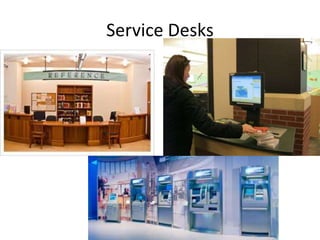
Service Desks
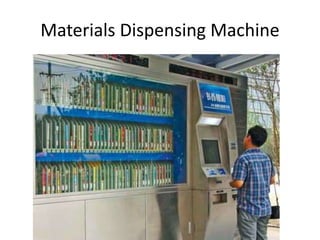
Materials Dispensing Machine
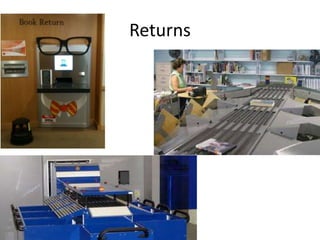
Returns
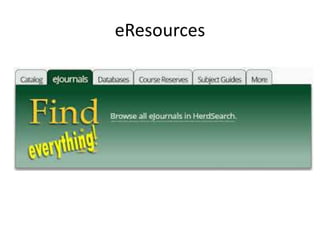
eResources
Discovery happens elsewhere
People operate at the network level
Library operates at the institutional level
eResources
• Big deals - consortium
• Flexible deals – usage
• Backfiles
• Document delivery
• ILL
• Others
eResources
Biggest change -
From purchase/preserve
To license to provide access
Ongoing impact on budget
What value does the library bring to the
subscription process? Purchasing Department?
Online Catalog
Do we need a catalog?
Special Collections
• Visit special collections
• Finding aids antiquated
• Majority of special collections not accessible via
the Web
• Organized by donor name not content
• Are your special collections findable on
Wikipedia, Flickr or Pinterest or …?
Special Collections
• Should have an active role in research
and teaching
• Focus for fundraising
• Focus for societal outreach
Technology Management
• Is this a strength?
• Who is responsible?
– Library
– Campus IT
– City/County IT
– Outside firm
• Multiple systems – ILS, ERMS, DAMS
- repository, link resolvers, Web-
based Discovery Service, ILL, …
Technology Management
• Moving to shared systems
• Increasingly cloud-based systems – Discovery
happens elsewhere
• DPLA – user interface, find vs. browse
• Investing in “back room” technology is
increasingly a hard sell
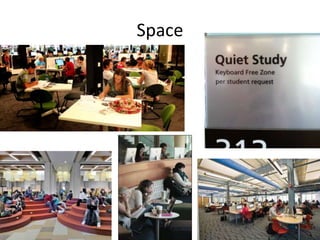
Space
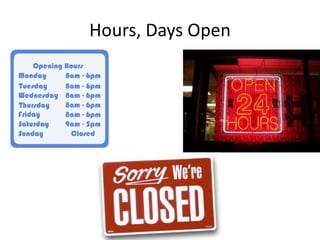
Hours, Days Open
Who Uses the Library?
• Borrowing materials
• Downloading eResources
• Technology
• Space (and why?)
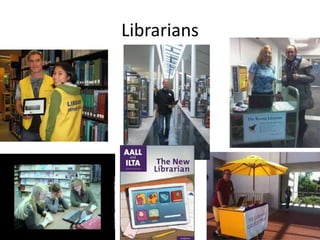
Librarians
Librarians
• Proactive
• Reactive
• Liaison
• Partners in
teaching &
research
If librarians are to be seen as experts, their expertise must be visible and valued!
Network Platforms
• Platform – concentrates data, infrastructure, …
• Community/network forms around platform
• Network effects are central
• Social interaction and analytics are key
• Gravitational hubs – the rich get richer
• Strong SEO and referencability
How Do We Add Value?
• Single library
• Shared services – consortium
• Outsource
• Collaborate with our users
How Do We Report Our Value?
However,
not everything that can be counted counts,
and not everything that counts can be counted.
William Cameron
What Holds Us Back …
• Transition is difficult and takes time
• Some of our users (faculty)
• Some of our librarians
• Our framework, our traditions, our culture
• Institutional territory
• Plenty of uncertainties
• Lack of scale
What Should We Be Doing
• Outsource generic (low value) work
• Focus on the needs of instructors & researchers
• Focus on outcomes for specific groups of
individuals (market segments)
• Be where your users are, use the tools they use
• Collaborate with other libraries
• Collaborate & connect more with your users
Moving Forward
• Initiate a discuss with library staff, faculty
& university administrators
• Collaborate with other libraries and units
on campus
• Provide professional development
opportunities for staff
• Start with pilot projects but start NOW!
• Demonstrate the value and impact of new
services – use outcome measures
• Have fun and celebrate success!
Changing a university is like
moving a graveyard –
you get no help from the
people inside!
- Geoffrey Boulton

Joseph Matthews assumptions librarians make

  • 1.
  • 2.
    Many people believethat libraries are inefficient, inflexible and obsolete!
  • 4.
    How do librariesdeal with change? Libraries have changed in many ways, including adding digital services, and repurposing space • But few services have ended and we have kept the existing library paradigm – collections matter • Major driver of decisions about library – the budget • Change is outpacing us
  • 5.
  • 6.
  • 7.
  • 8.
  • 9.
  • 11.
    Collections • Store on/offcampus • Shared storage facility • Regional storage facility • Impact of HathiTrust & Google Books
  • 12.
    Organizing the Collection •Use – LC, Dewey, other • Other options – C3, others • None – BISAC, Anythink, San Mateo County Library (FindIt), Monarch Method (high school in Colorado) • Needed in a AS/RS?
  • 13.
    Library classification isa knowledge prevention system - Karen Coyle Everything is Miscellaneous - David Weinberger
  • 14.
    Cataloging / TechServices • In-house • Shared service center • Outsource • Other options • What is the value of a record?
  • 15.
    A Record • TheMARC format was designed for magnetic tapes • Lack of standardized statements/declarations when those would be useful • Inability to unambiguously encode important characteristics • Over-reliance on punctuation for semantic purposes • Some MARC fields are ambiguous • Some information is presented redundantly • MARC has needless complexity • Lack of sufficient granularity
  • 16.
    A Record • SomeMARC free-text fields have formatting requirements • Punctuation in free-text fields is sometimes meaningful, sometimes not • Some MARC fields are coded with hidden assumptions • Some MARC fields are semantically complex • Lack of easy extensibility • Technical marginalization (MARC is isolated to the library community) • MARC has a long tail – while the standard has many tags most are rarely used. • Moving towards RDA, BibFrame, Open Linked Systems
  • 17.
    Acquisitions • Librarians select •Standing orders – profile • Patron initiated • Other
  • 18.
    Interlibrary Loan • OCLC •FAST – Local consortium • Regional/state consortiums • Warehouse – Amazon • Other
  • 19.
    Reference • Librarian atdesk • Options include virtual desk (email, chat, telephone, Skype, appointments • Go it alone or share • Assumption: Reference is still important
  • 20.
    Instruction • Library instruction •Bibliographic instruction • Information literacy The survey says ….
  • 21.
  • 22.
  • 23.
  • 24.
  • 25.
    Discovery happens elsewhere Peopleoperate at the network level Library operates at the institutional level
  • 26.
    eResources • Big deals- consortium • Flexible deals – usage • Backfiles • Document delivery • ILL • Others
  • 27.
    eResources Biggest change - Frompurchase/preserve To license to provide access Ongoing impact on budget What value does the library bring to the subscription process? Purchasing Department?
  • 28.
    Online Catalog Do weneed a catalog?
  • 29.
    Special Collections • Visitspecial collections • Finding aids antiquated • Majority of special collections not accessible via the Web • Organized by donor name not content • Are your special collections findable on Wikipedia, Flickr or Pinterest or …?
  • 30.
    Special Collections • Shouldhave an active role in research and teaching • Focus for fundraising • Focus for societal outreach
  • 31.
    Technology Management • Isthis a strength? • Who is responsible? – Library – Campus IT – City/County IT – Outside firm • Multiple systems – ILS, ERMS, DAMS - repository, link resolvers, Web- based Discovery Service, ILL, …
  • 32.
    Technology Management • Movingto shared systems • Increasingly cloud-based systems – Discovery happens elsewhere • DPLA – user interface, find vs. browse • Investing in “back room” technology is increasingly a hard sell
  • 33.
  • 34.
  • 35.
    Who Uses theLibrary? • Borrowing materials • Downloading eResources • Technology • Space (and why?)
  • 36.
  • 38.
    Librarians • Proactive • Reactive •Liaison • Partners in teaching & research If librarians are to be seen as experts, their expertise must be visible and valued!
  • 39.
    Network Platforms • Platform– concentrates data, infrastructure, … • Community/network forms around platform • Network effects are central • Social interaction and analytics are key • Gravitational hubs – the rich get richer • Strong SEO and referencability
  • 40.
    How Do WeAdd Value? • Single library • Shared services – consortium • Outsource • Collaborate with our users
  • 41.
    How Do WeReport Our Value? However, not everything that can be counted counts, and not everything that counts can be counted. William Cameron
  • 42.
    What Holds UsBack … • Transition is difficult and takes time • Some of our users (faculty) • Some of our librarians • Our framework, our traditions, our culture • Institutional territory • Plenty of uncertainties • Lack of scale
  • 43.
    What Should WeBe Doing • Outsource generic (low value) work • Focus on the needs of instructors & researchers • Focus on outcomes for specific groups of individuals (market segments) • Be where your users are, use the tools they use • Collaborate with other libraries • Collaborate & connect more with your users
  • 44.
    Moving Forward • Initiatea discuss with library staff, faculty & university administrators • Collaborate with other libraries and units on campus • Provide professional development opportunities for staff • Start with pilot projects but start NOW! • Demonstrate the value and impact of new services – use outcome measures • Have fun and celebrate success!
  • 45.
    Changing a universityis like moving a graveyard – you get no help from the people inside! - Geoffrey Boulton

Editor's Notes

  • #4 Google/trends
  • #8 Amount published versus what libraries buy Overlap of academic library collections Univ of Michigan 5 years vs. 100 years Who does the work – digitizing? David Lewis
  • #14 Since it offers only one object oriented view of the information world Subject heading search success rate – 50%
  • #21 Is there value?
  • #25 But do they come to the online catalog?
  • #26 Lorcan Dempsey 2007 OCLC Perceptions report – people use search engines to find content JISC report on researchers
  • #29 Utrecht University Library has eliminated the catalog and is focusing on delivery
  • #34 Students come to study, meet friends, collaborate, use a computer, wifi, borrow laptops Reconfigure around the user experience rather than collections – focus on engagement
  • #39 People are entry points
  • #40 Knowledge and power in the network is more important than any one individual or group
  • #42 1963 text Informal Sociology: A Casual Introduction to Sociological Thinking