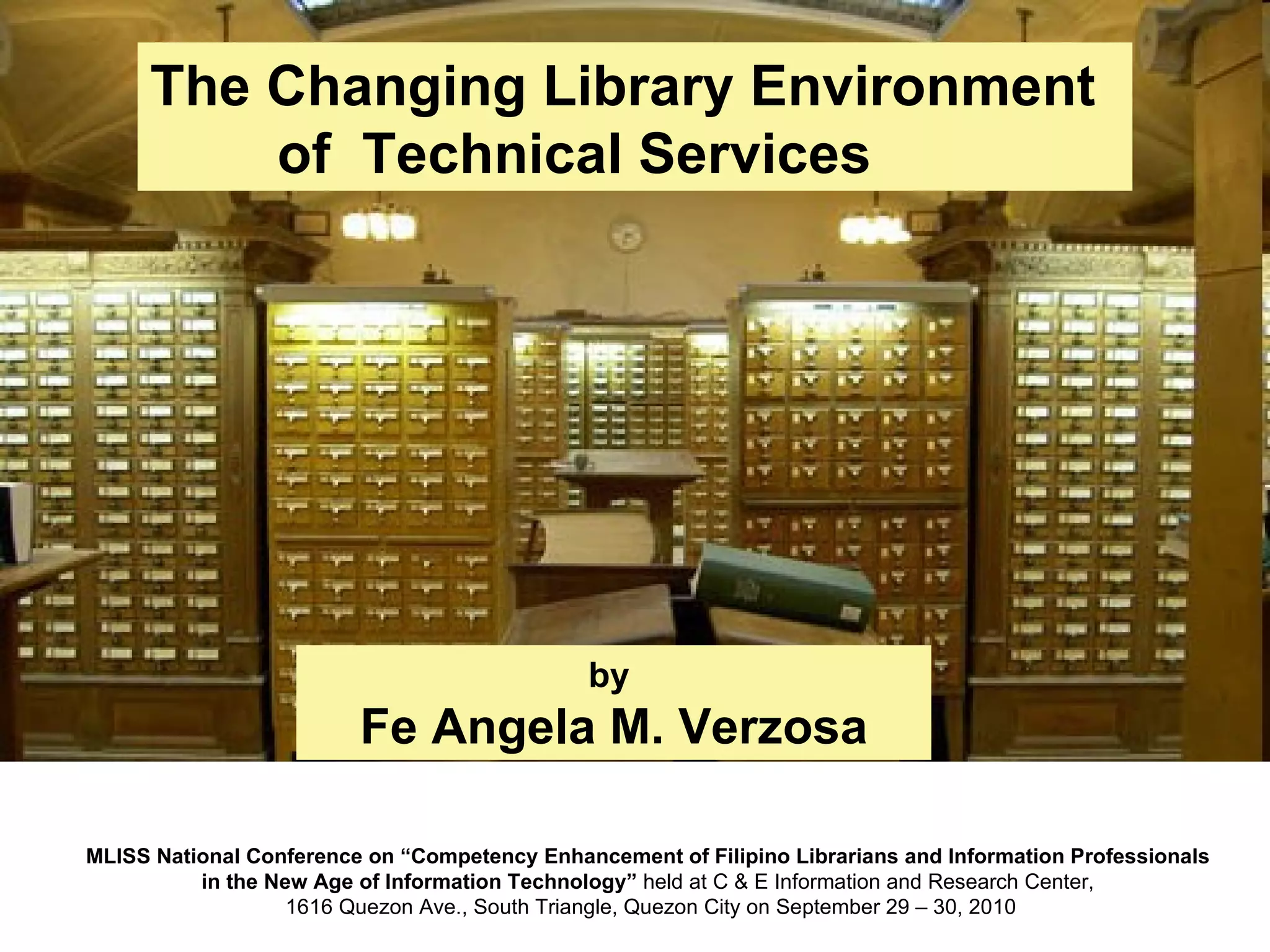
The Changing Library Environment  of  Technical Services by  Fe Angela M. Verzosa
Changing nature of library acquisitions and  cataloging of materials, and serials and  electronic resources management Increasing digital nature of library collections Innovative approaches to bibliographic  control Library automation and its impact on  technical services Changes in the library landscape resulting  from Library 2.0 initiatives that support  social learning and networking,  including using Web as infrastructure Digital preservation initiatives Challenges and opportunities Focus
Species that do not evolve in response to a changing environment do not survive, dinosaurs being a case in point. Librarians have the opportunity to choose to evolve, to emphasize relationships, and to respond to the environment. Unless we pause to take stock, to reach out to librarians in other parts of the library, to sound out our users as to their informational needs, we will find ourselves, like relics of the past instead of active participants in the information services of the future . (McCoombs 1992,147)
Information Technology information revolution in the 21 st  century  Information needs to be delivered in a  timely IT-driven  manner for efficiency overwhelming information explosion requires technology to locate,  filter, organize and access it Librarians are now  frontliners  in information management as IT-specialists and information providers
21 st  century library setting:     3 major paradigm shifts transition from paper to electronic media as the dominant form of information dissemination, storage and retrieval  *Convergence of different media, such as text, graphics, and sound, into multimedia resources, has direct impact on this transition.   increasing demand for accountability, with focus on quality customer services, performance measurement, bench marking, and continuous improvement new forms of work distribution (work-teams) resulting in downsizing, re-engineering, outsourcing etc.
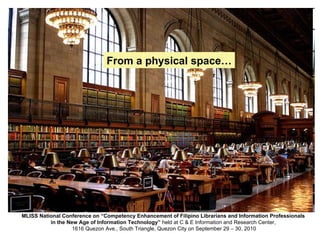
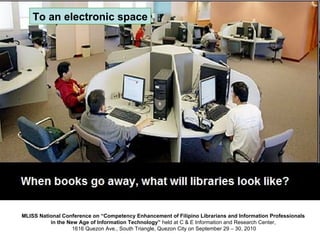
Change in library environment From a physical place where basic traditional services of acquisition, storage, preservation, retrieval, access and display are provided to on-site library patrons To an electronic space where these same services have been enhanced by technological innovations
From a physical space…
To an electronic space
Changing Library Service Needs… Online/offline access to digital information resources Online access to library catalogs, databases and the Internet Database searching Public access services Electronic reference service Public relations services Library promotion and marketing Epublishing Information literacy programs User Services, and queries
despite these changes….. Library’s organizational structure remains the same – based on logical grouping of people and work:  technical, readers, system services Technical services remain centralized and  focused on library processing activities Existing structures do not  meet users’ needs Focus should be on  integration/convergence  of technical, readers, and system services, to overcome fragmentation and over-specialization
How  to create  collaborative  Technical Services  environments in Libraries… Collection Development Selection/Deselection Acquisitions Bibliographic Control Preservation Stacks Management Inventory
Collection development… Collection development is a  major, major… need to develop a hybrid library of  print and non-print (electronic and  multimedia) demand for digital collections and e-resources (free and almost free) copyright and licensing issues that  relate to electronic resources that have to be addressed and will require policies that will guide their usage to prevent violations of copyright and licensing regulations need to collaborate with publishers and IT companies and other content providers in negotiating the cost of content and access need to resolve issues and concerns over access vis-à-vis ownership
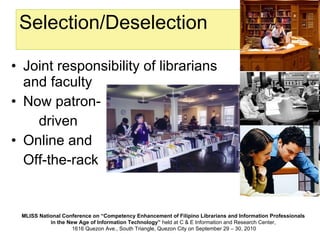
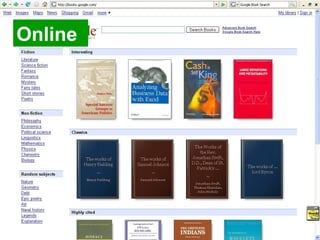
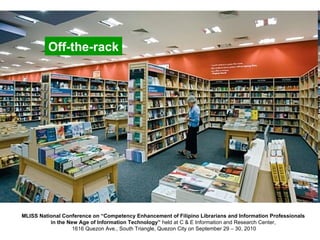
Selection/Deselection Joint responsibility of librarians and faculty Now patron- driven Online and Off-the-rack
Online
Off-the-rack
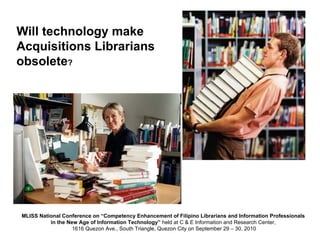
Will technology make Acquisitions Librarians obsolete ?
Acquisitions work Lack of formal training in acquisitions where training remains largely an "on the job" situation such as those dealing with increasingly complicated interests as contracts and licenses Technology has expanded the cast of players in acquisitions work; blurred roles between collection development and/or materials selection and acquisitions
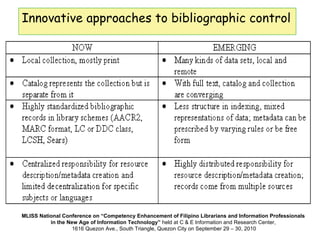
Innovative approaches to bibliographic control
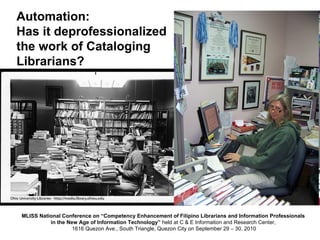
Automation:  Has it deprofessionalized the work of Cataloging Librarians?
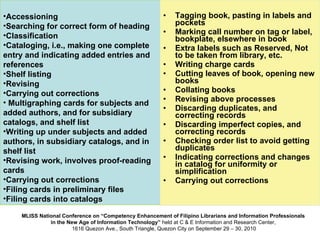
Tagging book, pasting in labels and pockets Marking call number on tag or label, bookplate, elsewhere in book Extra labels such as Reserved, Not to be taken from library, etc.  Writing charge cards  Cutting leaves of book, opening new books  Collating books  Revising above processes  Discarding duplicates, and correcting records  Discarding imperfect copies, and correcting records  Checking order list to avoid getting duplicates  Indicating corrections and changes in catalog for uniformity or simplification  Carrying out corrections  Accessioning Searching for correct form of heading Classification Cataloging, i.e., making one complete entry and indicating added entries and references Shelf listing Revising  Carrying out corrections  Multigraphing cards for subjects and added authors, and for subsidiary catalogs, and shelf list  Writing up under subjects and added authors, in subsidiary catalogs, and in shelf list  Revising work, involves proof-reading cards  Carrying out corrections  Filing cards in preliminary files  Filing cards into catalogs
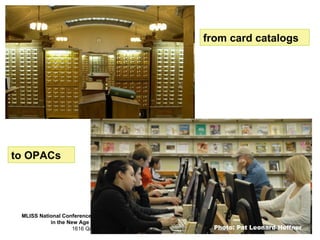
from card catalogs to OPACs
Impact of deprofessionalization Increasing no. of paraprofessionals to do cataloging work Shifting of professional catalogers to supervisory functions if not more difficult original cataloging work Expanding functions of professionals to manage automated systems, create innovative bibliographic databases, do researches, and teach/train.
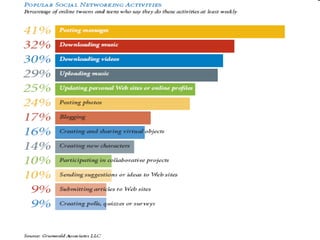
Changes in the library landscape resulting from Library 2.0 initiatives that support social learning and networking, including using Web as infrastructure and creating content using Web 2.0 tools one of the most active web-based activities in the Philippines “ with Filipinos being declared as the most active users on a number of web-based social network sites such as Facebook, Friendster and Multiply” . Cited in: http://en.wikipedia.org/wiki/Social_networking_in_the_Philippines
Librarians are responding to the popularity of social networking sites and their expanding role in the creation, use, and sharing of information by engaging them as a central medium for interacting with library patrons and providing services to meet their information needs
 
skills for interacting with patrons within the sites understanding and articulating the nature of social networking sites  creating presences and content evaluating and applying information and having the ability to assist patrons with gaining and applying these skills.
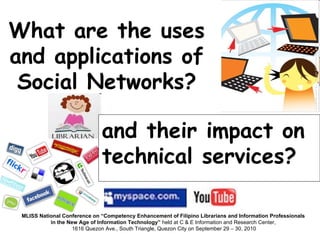
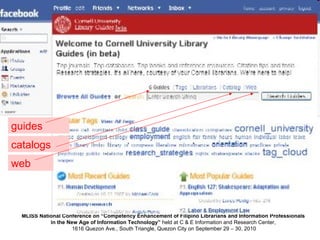
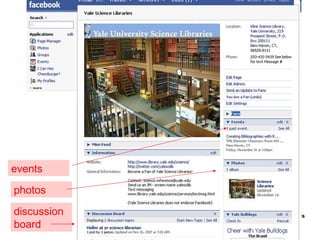
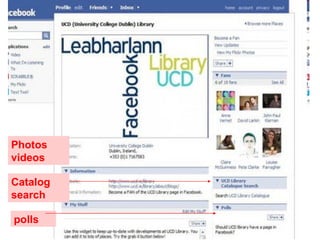
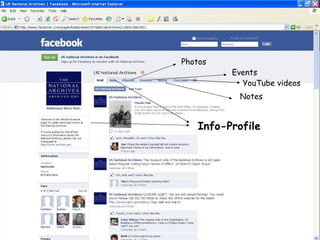
What are the uses and applications of Social Networks? and their impact on technical services?
guides catalogs web
discussionboard photos events
Catalog search Photos videos polls
Info-Profile Photos Events Notes YouTube videos
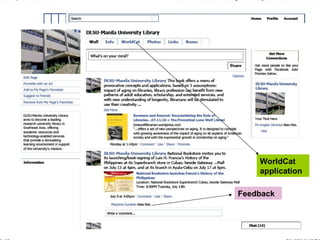
WorldCat application Feedback
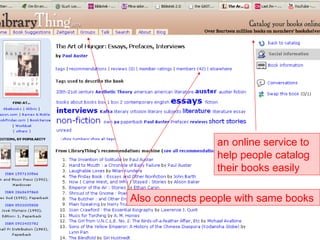
an online service to help people catalog their books easily Also connects people with same books
 
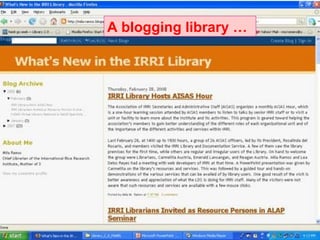
A blogging library …
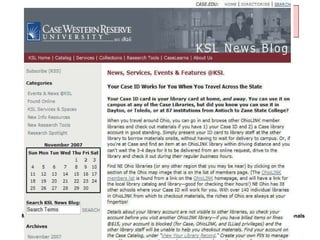
Blogs as Library News Vehicles
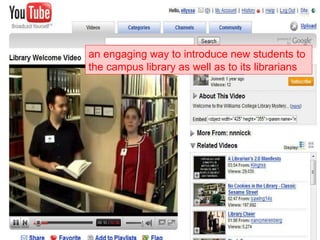
Video-sharing for Library Tours an engaging way to introduce new students to the campus library as well as to its librarians
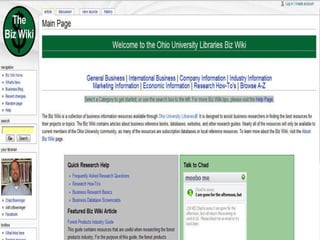
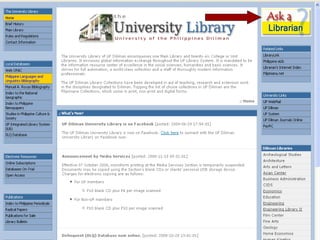
Wikis as Subject Guides
 
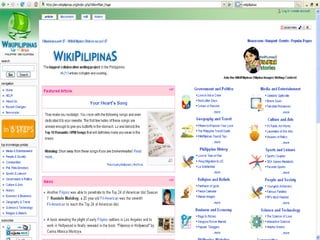
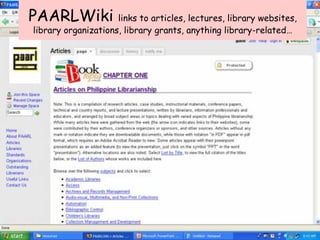
PAARLWiki  links to articles, lectures, library websites, library organizations, library grants, anything library-related…
 
Changing nature of library acquisitions and  cataloging of materials, and serials and  electronic resources management Increasing digital nature of library collections Innovative approaches to bibliographic  control Library automation and its impact on  technical services Changes in the library landscape resulting  from Library 2.0 initiatives that support  social learning and networking,  including using Web as infrastructure Digital preservation initiatives Challenges and opportunities Focus
Digital preservation initiatives Developing in-house expertise in digital preservation Providing secure archives  for digital materials Digitizing rare print collection Web-harvesting/web-mining Sharing institutional repositories Training staff on best practices
Challenges and opportunities Manage the transition Overcome limitations of  staff Integrate, innovate Collaborate to save resources- money and manpower
Save Money If librarians are trained to handle the library’s technology needs, there is no need to spend money on costly tech support.
Resource-sharing Join “buying clubs” or consortial acquisition strategies Share work  – cataloging and indexing Share bibliographic databases Share storage or shared institutional repositories Share digitization programs  for preservation Provide interlibrary lending  and direct borrowing Provide document-delivery services
What makes highly effective librarians today? Openness Responsiveness Collaboration Communication
Thank you for listening! Questions? Contact famverzosa@yahoo.com

The Changing Library Environment of Technical Services

  • 1.
    The Changing LibraryEnvironment of Technical Services by Fe Angela M. Verzosa
  • 2.
    Changing nature oflibrary acquisitions and cataloging of materials, and serials and electronic resources management Increasing digital nature of library collections Innovative approaches to bibliographic control Library automation and its impact on technical services Changes in the library landscape resulting from Library 2.0 initiatives that support social learning and networking, including using Web as infrastructure Digital preservation initiatives Challenges and opportunities Focus
  • 3.
    Species that donot evolve in response to a changing environment do not survive, dinosaurs being a case in point. Librarians have the opportunity to choose to evolve, to emphasize relationships, and to respond to the environment. Unless we pause to take stock, to reach out to librarians in other parts of the library, to sound out our users as to their informational needs, we will find ourselves, like relics of the past instead of active participants in the information services of the future . (McCoombs 1992,147)
  • 4.
    Information Technology informationrevolution in the 21 st century Information needs to be delivered in a timely IT-driven manner for efficiency overwhelming information explosion requires technology to locate, filter, organize and access it Librarians are now frontliners in information management as IT-specialists and information providers
  • 5.
    21 st century library setting: 3 major paradigm shifts transition from paper to electronic media as the dominant form of information dissemination, storage and retrieval *Convergence of different media, such as text, graphics, and sound, into multimedia resources, has direct impact on this transition. increasing demand for accountability, with focus on quality customer services, performance measurement, bench marking, and continuous improvement new forms of work distribution (work-teams) resulting in downsizing, re-engineering, outsourcing etc.
  • 6.
    Change in libraryenvironment From a physical place where basic traditional services of acquisition, storage, preservation, retrieval, access and display are provided to on-site library patrons To an electronic space where these same services have been enhanced by technological innovations
  • 7.
  • 8.
  • 9.
    Changing Library ServiceNeeds… Online/offline access to digital information resources Online access to library catalogs, databases and the Internet Database searching Public access services Electronic reference service Public relations services Library promotion and marketing Epublishing Information literacy programs User Services, and queries
  • 10.
    despite these changes…..Library’s organizational structure remains the same – based on logical grouping of people and work: technical, readers, system services Technical services remain centralized and focused on library processing activities Existing structures do not meet users’ needs Focus should be on integration/convergence of technical, readers, and system services, to overcome fragmentation and over-specialization
  • 11.
    How tocreate collaborative Technical Services environments in Libraries… Collection Development Selection/Deselection Acquisitions Bibliographic Control Preservation Stacks Management Inventory
  • 12.
    Collection development… Collectiondevelopment is a major, major… need to develop a hybrid library of print and non-print (electronic and multimedia) demand for digital collections and e-resources (free and almost free) copyright and licensing issues that relate to electronic resources that have to be addressed and will require policies that will guide their usage to prevent violations of copyright and licensing regulations need to collaborate with publishers and IT companies and other content providers in negotiating the cost of content and access need to resolve issues and concerns over access vis-à-vis ownership
  • 13.
    Selection/Deselection Joint responsibilityof librarians and faculty Now patron- driven Online and Off-the-rack
  • 14.
  • 15.
  • 16.
    Will technology makeAcquisitions Librarians obsolete ?
  • 17.
    Acquisitions work Lackof formal training in acquisitions where training remains largely an "on the job" situation such as those dealing with increasingly complicated interests as contracts and licenses Technology has expanded the cast of players in acquisitions work; blurred roles between collection development and/or materials selection and acquisitions
  • 18.
    Innovative approaches tobibliographic control
  • 19.
    Automation: Hasit deprofessionalized the work of Cataloging Librarians?
  • 20.
    Tagging book, pastingin labels and pockets Marking call number on tag or label, bookplate, elsewhere in book Extra labels such as Reserved, Not to be taken from library, etc. Writing charge cards Cutting leaves of book, opening new books Collating books Revising above processes Discarding duplicates, and correcting records Discarding imperfect copies, and correcting records Checking order list to avoid getting duplicates Indicating corrections and changes in catalog for uniformity or simplification Carrying out corrections Accessioning Searching for correct form of heading Classification Cataloging, i.e., making one complete entry and indicating added entries and references Shelf listing Revising Carrying out corrections Multigraphing cards for subjects and added authors, and for subsidiary catalogs, and shelf list Writing up under subjects and added authors, in subsidiary catalogs, and in shelf list Revising work, involves proof-reading cards Carrying out corrections Filing cards in preliminary files Filing cards into catalogs
  • 21.
  • 22.
    Impact of deprofessionalizationIncreasing no. of paraprofessionals to do cataloging work Shifting of professional catalogers to supervisory functions if not more difficult original cataloging work Expanding functions of professionals to manage automated systems, create innovative bibliographic databases, do researches, and teach/train.
  • 23.
    Changes in thelibrary landscape resulting from Library 2.0 initiatives that support social learning and networking, including using Web as infrastructure and creating content using Web 2.0 tools one of the most active web-based activities in the Philippines “ with Filipinos being declared as the most active users on a number of web-based social network sites such as Facebook, Friendster and Multiply” . Cited in: http://en.wikipedia.org/wiki/Social_networking_in_the_Philippines
  • 24.
    Librarians are respondingto the popularity of social networking sites and their expanding role in the creation, use, and sharing of information by engaging them as a central medium for interacting with library patrons and providing services to meet their information needs
  • 25.
  • 26.
    skills for interactingwith patrons within the sites understanding and articulating the nature of social networking sites creating presences and content evaluating and applying information and having the ability to assist patrons with gaining and applying these skills.
  • 27.
    What are theuses and applications of Social Networks? and their impact on technical services?
  • 28.
  • 29.
  • 30.
  • 31.
    Info-Profile Photos EventsNotes YouTube videos
  • 32.
  • 33.
    an online serviceto help people catalog their books easily Also connects people with same books
  • 34.
  • 35.
  • 36.
    Blogs as LibraryNews Vehicles
  • 37.
    Video-sharing for LibraryTours an engaging way to introduce new students to the campus library as well as to its librarians
  • 38.
  • 39.
  • 40.
    PAARLWiki linksto articles, lectures, library websites, library organizations, library grants, anything library-related…
  • 41.
  • 42.
    Changing nature oflibrary acquisitions and cataloging of materials, and serials and electronic resources management Increasing digital nature of library collections Innovative approaches to bibliographic control Library automation and its impact on technical services Changes in the library landscape resulting from Library 2.0 initiatives that support social learning and networking, including using Web as infrastructure Digital preservation initiatives Challenges and opportunities Focus
  • 43.
    Digital preservation initiativesDeveloping in-house expertise in digital preservation Providing secure archives for digital materials Digitizing rare print collection Web-harvesting/web-mining Sharing institutional repositories Training staff on best practices
  • 44.
    Challenges and opportunitiesManage the transition Overcome limitations of staff Integrate, innovate Collaborate to save resources- money and manpower
  • 45.
    Save Money Iflibrarians are trained to handle the library’s technology needs, there is no need to spend money on costly tech support.
  • 46.
    Resource-sharing Join “buyingclubs” or consortial acquisition strategies Share work – cataloging and indexing Share bibliographic databases Share storage or shared institutional repositories Share digitization programs for preservation Provide interlibrary lending and direct borrowing Provide document-delivery services
  • 47.
    What makes highlyeffective librarians today? Openness Responsiveness Collaboration Communication
  • 48.
    Thank you forlistening! Questions? Contact famverzosa@yahoo.com

Editor's Notes

  • #34 LibraryThing is an online service to help people catalog their books easily. You can access your catalog from anywhere—even on your mobile phone. Because everyone catalogs together, LibraryThing also connects people with the same books, comes up with suggestions for what to read next, and so forth. LibraryThing is a full-powered cataloging application, searching the Library of Congress, all five national Amazon sites, and more than 80 world libraries. You can edit your information, search and sort it, "tag" books with your own subjects, or use the Library of Congress and Dewey systems to organize your collection. How can libraries use LibraryThing? Fully integrate LibraryThing's social data into your catalog using LibraryThing for Libraries . LTFL lets you add tag-based browsing, book recommendations, ratings, reviews and more to your OPAC, by integrating with LibraryThing and its high-quality book data. can use LibraryThing as a catalog for their collection.
  • #37 The Kelvin Smith Library at Case Western Reserve University blogs about library news such as database changes, university receptions, and digital video acquisitions.
  • #38 The librarians at Williams College created a library welcome video for new students which leads them on a mystery tour of the library. They have it hosted up on YouTube. It's an engaging way to introduce new students to the campus library as well as to its librarians.
  • #39 Ohio University Libraries has combined their marketing, general, and international business subject guides in one place to create BizWiki A searchable & easily updatable resource for patrons which anyone can edit. Using Media Wiki, they have created this information resource about business databases and resources, instructional articles on how to research companies, guides to various industries, FARQs
  • #41 PAARLWiki is a project I spearheaded to provide our community of library information professionals with sources available locally and through the Internet, particularly on research articles, case studies, lecture presentations, technical reports, etc. on Philippine librarianship. In addition, I added more online information on library standards, profiles of various library organizations in the country, and outstanding librarians. I also uploaded many useful links on anything that is library-related, or may be useful to libraries.