THE SUN
The sun is by far the largest object in
the solar system. It contains more than
99.8% of the total mass of the Solar
System .
     The strong gravitational pull of the
Sun holds Earth and the other planets in
the solar system in orbit. The Sun’s light
and heat influence all of the objects in the
solar system and allow life to exist on
Earth.
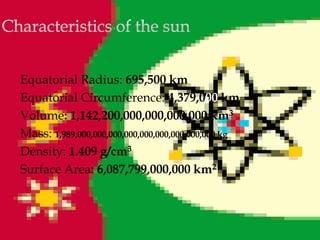
Equatorial Radius: 695,500 km
Equatorial Circumference: 4,379,000 km
Volume: 1,142,200,000,000,000,000 km3
Mass: 1,989,000,000,000,000,000,000,000,000,000 kg
Density: 1.409 g/cm3
Surface Area: 6,087,799,000,000 km2
The Sun is an average star—its
size, age, and temperature fall in about
the middle of the ranges of these
properties for all stars. Astronomers
believe that the Sun is about 4.6 billion
years old and will keep shining for about
another 7 billion years.
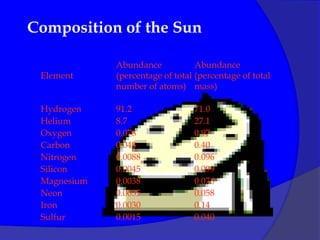
Composition of the Sun

             Abundance            Abundance
 Element     (percentage of total (percentage of total
             number of atoms) mass)

 Hydrogen    91.2                71.0
 Helium      8.7                 27.1
 Oxygen      0.078               0.97
 Carbon      0.043               0.40
 Nitrogen    0.0088              0.096
 Silicon     0.0045              0.099
 Magnesium   0.0038              0.076
 Neon        0.0035              0.058
 Iron        0.0030              0.14
 Sulfur      0.0015              0.040
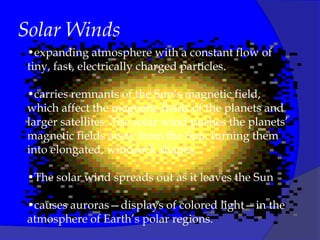
Solar Winds
 •expanding atmosphere with a constant flow of
 tiny, fast, electrically charged particles.

 •carries remnants of the Sun’s magnetic field,
 which affect the magnetic fields of the planets and
 larger satellites. The solar wind pushes the planets’
 magnetic fields away from the Sun, turning them
 into elongated, windsock shapes.

 •The solar wind spreads out as it leaves the Sun

 •causes auroras—displays of colored light—in the
 atmosphere of Earth’s polar regions.
Heliosphere
-    region through which the solar wind
blows

      Within the heliosphere, the Sun provides
most of the heat and light that are present, and
the particles in the solar wind interact with the
planets and satellites in the solar system.
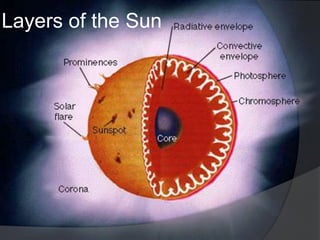
Layers of the Sun
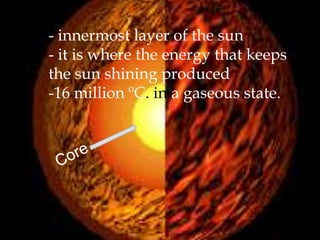
- innermost layer of the sun
- it is where the energy that keeps
the sun shining produced
-16 million ºC. in a gaseous state.
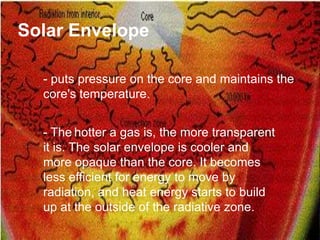
Solar Envelope

  - puts pressure on the core and maintains the
  core's temperature.


  - The hotter a gas is, the more transparent
  it is. The solar envelope is cooler and
  more opaque than the core. It becomes
  less efficient for energy to move by
  radiation, and heat energy starts to build
  up at the outside of the radiative zone.
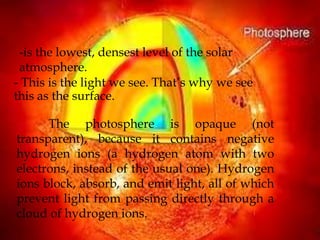
-is the lowest, densest level of the solar
 atmosphere.
- This is the light we see. That’s why we see
this as the surface.

      The photosphere is opaque (not
transparent), because it contains negative
hydrogen ions (a hydrogen atom with two
electrons, instead of the usual one). Hydrogen
ions block, absorb, and emit light, all of which
prevent light from passing directly through a
cloud of hydrogen ions.
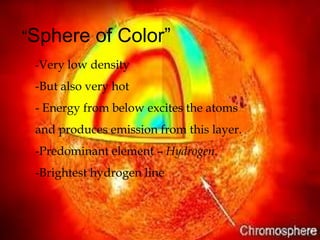
“Sphere     of Color”
 -Very low density

 -But also very hot
 - Energy from below excites the atoms
 and produces emission from this layer.
 -Predominant element – Hydrogen.
 -Brightest hydrogen line
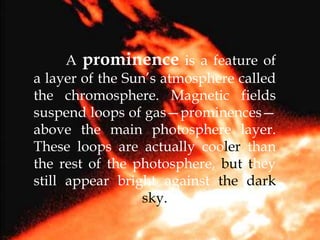
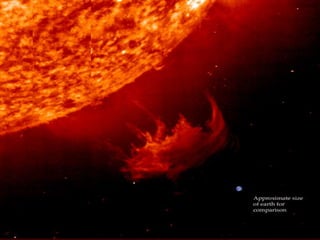
A prominence is a feature of
a layer of the Sun’s atmosphere called
the chromosphere. Magnetic fields
suspend loops of gas—prominences—
above the main photosphere layer.
These loops are actually cooler than
the rest of the photosphere, but they
still appear bright against the dark
                  sky.
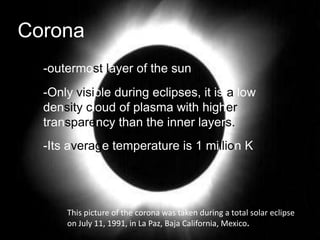
Corona
  -outermost layer of the sun
  -Only visible during eclipses, it is a low
  density cloud of plasma with higher
  transparency than the inner layers.
  -Its average temperature is 1 million K


      This picture of the corona was taken during a total solar eclipse
      on July 11, 1991, in La Paz, Baja California, Mexico.
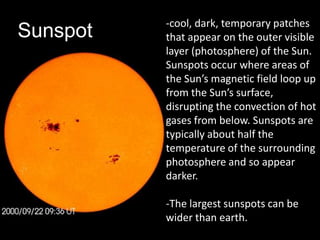
-cool, dark, temporary patches
Sunspot   that appear on the outer visible
          layer (photosphere) of the Sun.
          Sunspots occur where areas of
          the Sun’s magnetic field loop up
          from the Sun’s surface,
          disrupting the convection of hot
          gases from below. Sunspots are
          typically about half the
          temperature of the surrounding
          photosphere and so appear
          darker.

          -The largest sunspots can be
          wider than earth.
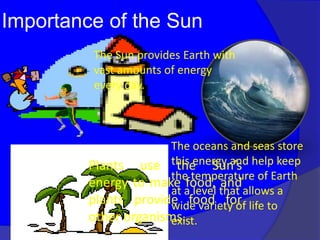
Importance of the Sun
         The Sun provides Earth with
         vast amounts of energy
         every day.


                       The oceans and seas store
         Plants use this energy and help keep
                        the Sun’s
                       the temperature of Earth
         energy to make food, and
                       at a level that allows a
         plants provide food for life to
                       wide variety of
         other organisms.
                       exist.
The Sun cannot shine forever, because it
will eventually use up its present fuel. The
nuclear fusion reactions that make the Sun glow
depend on the element hydrogen, but the
hydrogen in the Sun’s core will eventually run
out. Nuclear reactions have converted about 37
percent of the hydrogen originally in the Sun’s
core into helium. Astronomers estimate that the
Sun’s core will run out of hydrogen in about 7
billion years.
In 3 billion years, the Sun will be hot
enough to boil Earth’s oceans away. Four billion
years thereafter, the Sun will have used up all its
hydrogen and will balloon into a giant star that
engulfs the planet Mercury. At this point in its
life, the Sun will be a red giant star. The Sun will
then be 2,000 times brighter than it is now, and
hot enough to melt Earth’s rocks. At this time the
outer solar system will get warmer and more
habitable. The icy moons of the giant planets may
warm enough to be covered by water instead of
ice.

The sun

  • 1.
  • 2.
    The sun isby far the largest object in the solar system. It contains more than 99.8% of the total mass of the Solar System . The strong gravitational pull of the Sun holds Earth and the other planets in the solar system in orbit. The Sun’s light and heat influence all of the objects in the solar system and allow life to exist on Earth.
  • 3.
    Equatorial Radius: 695,500km Equatorial Circumference: 4,379,000 km Volume: 1,142,200,000,000,000,000 km3 Mass: 1,989,000,000,000,000,000,000,000,000,000 kg Density: 1.409 g/cm3 Surface Area: 6,087,799,000,000 km2
  • 4.
    The Sun isan average star—its size, age, and temperature fall in about the middle of the ranges of these properties for all stars. Astronomers believe that the Sun is about 4.6 billion years old and will keep shining for about another 7 billion years.
  • 5.
    Composition of theSun Abundance Abundance Element (percentage of total (percentage of total number of atoms) mass) Hydrogen 91.2 71.0 Helium 8.7 27.1 Oxygen 0.078 0.97 Carbon 0.043 0.40 Nitrogen 0.0088 0.096 Silicon 0.0045 0.099 Magnesium 0.0038 0.076 Neon 0.0035 0.058 Iron 0.0030 0.14 Sulfur 0.0015 0.040
  • 6.
    Solar Winds •expandingatmosphere with a constant flow of tiny, fast, electrically charged particles. •carries remnants of the Sun’s magnetic field, which affect the magnetic fields of the planets and larger satellites. The solar wind pushes the planets’ magnetic fields away from the Sun, turning them into elongated, windsock shapes. •The solar wind spreads out as it leaves the Sun •causes auroras—displays of colored light—in the atmosphere of Earth’s polar regions.
  • 7.
    Heliosphere - region through which the solar wind blows Within the heliosphere, the Sun provides most of the heat and light that are present, and the particles in the solar wind interact with the planets and satellites in the solar system.
  • 8.
  • 9.
    - innermost layerof the sun - it is where the energy that keeps the sun shining produced -16 million ºC. in a gaseous state.
  • 10.
    Solar Envelope - puts pressure on the core and maintains the core's temperature. - The hotter a gas is, the more transparent it is. The solar envelope is cooler and more opaque than the core. It becomes less efficient for energy to move by radiation, and heat energy starts to build up at the outside of the radiative zone.
  • 11.
    -is the lowest,densest level of the solar atmosphere. - This is the light we see. That’s why we see this as the surface. The photosphere is opaque (not transparent), because it contains negative hydrogen ions (a hydrogen atom with two electrons, instead of the usual one). Hydrogen ions block, absorb, and emit light, all of which prevent light from passing directly through a cloud of hydrogen ions.
  • 12.
    “Sphere of Color” -Very low density -But also very hot - Energy from below excites the atoms and produces emission from this layer. -Predominant element – Hydrogen. -Brightest hydrogen line
  • 13.
    A prominence isa feature of a layer of the Sun’s atmosphere called the chromosphere. Magnetic fields suspend loops of gas—prominences— above the main photosphere layer. These loops are actually cooler than the rest of the photosphere, but they still appear bright against the dark sky.
  • 15.
    Corona -outermostlayer of the sun -Only visible during eclipses, it is a low density cloud of plasma with higher transparency than the inner layers. -Its average temperature is 1 million K This picture of the corona was taken during a total solar eclipse on July 11, 1991, in La Paz, Baja California, Mexico.
  • 16.
    -cool, dark, temporarypatches Sunspot that appear on the outer visible layer (photosphere) of the Sun. Sunspots occur where areas of the Sun’s magnetic field loop up from the Sun’s surface, disrupting the convection of hot gases from below. Sunspots are typically about half the temperature of the surrounding photosphere and so appear darker. -The largest sunspots can be wider than earth.
  • 17.
    Importance of theSun The Sun provides Earth with vast amounts of energy every day. The oceans and seas store Plants use this energy and help keep the Sun’s the temperature of Earth energy to make food, and at a level that allows a plants provide food for life to wide variety of other organisms. exist.
  • 18.
    The Sun cannotshine forever, because it will eventually use up its present fuel. The nuclear fusion reactions that make the Sun glow depend on the element hydrogen, but the hydrogen in the Sun’s core will eventually run out. Nuclear reactions have converted about 37 percent of the hydrogen originally in the Sun’s core into helium. Astronomers estimate that the Sun’s core will run out of hydrogen in about 7 billion years.
  • 19.
    In 3 billionyears, the Sun will be hot enough to boil Earth’s oceans away. Four billion years thereafter, the Sun will have used up all its hydrogen and will balloon into a giant star that engulfs the planet Mercury. At this point in its life, the Sun will be a red giant star. The Sun will then be 2,000 times brighter than it is now, and hot enough to melt Earth’s rocks. At this time the outer solar system will get warmer and more habitable. The icy moons of the giant planets may warm enough to be covered by water instead of ice.