INTERIOR PLANETS 
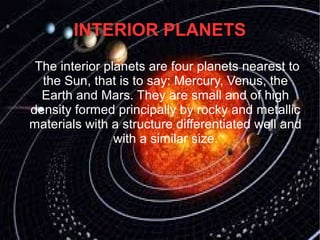
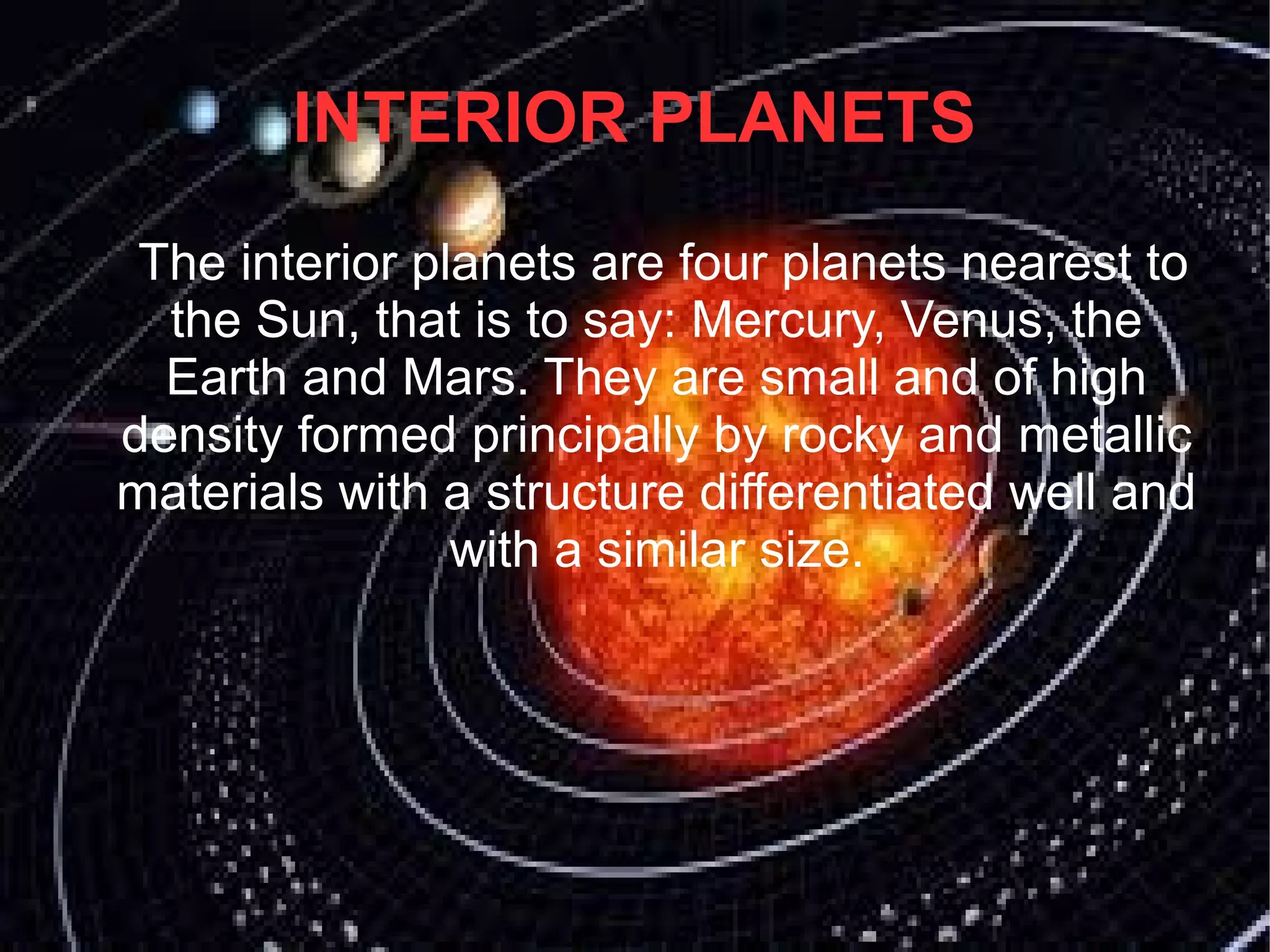
The interior planets are four planets nearest to 
the Sun, that is to say: Mercury, Venus, the 
Earth and Mars. They are small and of high 
density formed principally by rocky and metallic 
materials with a structure differentiated well and 
with a similar size.
MERCURY 
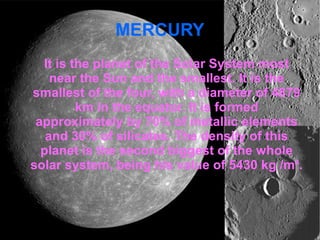
It is the planet of the Solar System most 
near the Sun and the smallest. It is the 
smallest of the four, with a diameter of 4879 
km in the equator. It is formed 
approximately by 70% of metallic elements 
and 30% of silicates. The density of this 
planet is the second biggest of the whole 
solar system, being his value of 5430 kg /m³.
VENUS 
It is a question of a planet of rocky and 
terrestrial type. Venus's orbit is an ellipse 
with an excentricity of less than 1 %. His 
atmospheric pressure is 90 times superior to 
the terrestrial one. It possesses the warmest 
atmosphere. It is composed by gases as the 
carbon dioxide. He is 243 days old, and his 
movement turns in the sense of the handles 
of the clock.
EARTH 
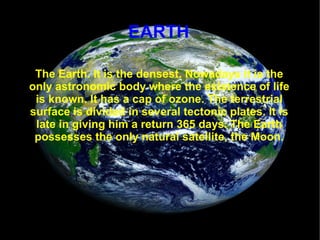
The Earth. It is the densest. Nowadays it is the 
only astronomic body where the existence of life 
is known. It has a cap of ozone. The terrestrial 
surface is divided in several tectonic plates. It is 
late in giving him a return 365 days. The Earth 
possesses the only natural satellite, the Moon.
MARS 
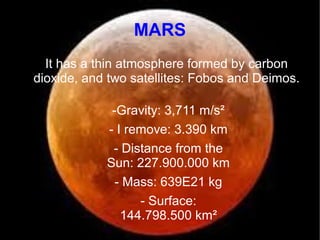
It has a thin atmosphere formed by carbon 
dioxide, and two satellites: Fobos and Deimos. 
-Gravity: 3,711 m/s² 
- I remove: 3.390 km 
- Distance from the 
Sun: 227.900.000 km 
- Mass: 639E21 kg 
- Surface: 
144.798.500 km²
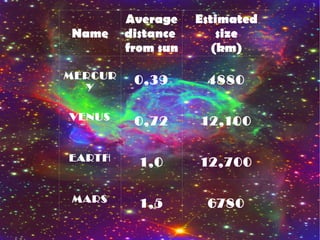
Name 
Average 
distance 
from sun 
Estimated 
size 
(km) 
MERCUR 
Y 
0,39 4880 
VENUS 0,72 12,100 
EARTH 1,0 12,700 
MARS 1,5 6780
Name 
Average 
distance 
from sun 
Estimated 
size 
(km) 
MERCUR 
Y 
0,39 4880 
VENUS 0,72 12,100 
EARTH 1,0 12,700 
MARS 1,5 6780

Planetas interiores (cmc)

  • 1.
    INTERIOR PLANETS Theinterior planets are four planets nearest to the Sun, that is to say: Mercury, Venus, the Earth and Mars. They are small and of high density formed principally by rocky and metallic materials with a structure differentiated well and with a similar size.
  • 2.
    MERCURY It isthe planet of the Solar System most near the Sun and the smallest. It is the smallest of the four, with a diameter of 4879 km in the equator. It is formed approximately by 70% of metallic elements and 30% of silicates. The density of this planet is the second biggest of the whole solar system, being his value of 5430 kg /m³.
  • 3.
    VENUS It isa question of a planet of rocky and terrestrial type. Venus's orbit is an ellipse with an excentricity of less than 1 %. His atmospheric pressure is 90 times superior to the terrestrial one. It possesses the warmest atmosphere. It is composed by gases as the carbon dioxide. He is 243 days old, and his movement turns in the sense of the handles of the clock.
  • 4.
    EARTH The Earth.It is the densest. Nowadays it is the only astronomic body where the existence of life is known. It has a cap of ozone. The terrestrial surface is divided in several tectonic plates. It is late in giving him a return 365 days. The Earth possesses the only natural satellite, the Moon.
  • 5.
    MARS It hasa thin atmosphere formed by carbon dioxide, and two satellites: Fobos and Deimos. -Gravity: 3,711 m/s² - I remove: 3.390 km - Distance from the Sun: 227.900.000 km - Mass: 639E21 kg - Surface: 144.798.500 km²
  • 6.
    Name Average distance from sun Estimated size (km) MERCUR Y 0,39 4880 VENUS 0,72 12,100 EARTH 1,0 12,700 MARS 1,5 6780
  • 7.
    Name Average distance from sun Estimated size (km) MERCUR Y 0,39 4880 VENUS 0,72 12,100 EARTH 1,0 12,700 MARS 1,5 6780