Dwarf planets
Work prepared by Kaunas “Vyturio “ catholic
secondary schoolstudents Gabrielė Grigonytė,
Monika Katlauskaitė and Simona Šapolaitė
Definition
Dwarf planet is a celestial body that:
 Is in direct orbit of the Sun
Have enough mass for its gravity to
turn into a nearly round shape
 It isn’t dominating body in its own
orbit
 It isn’t attendant
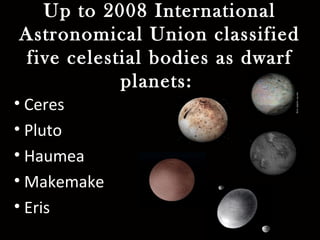
Up to 2008 International
Astronomical Union classified
five celestial bodies as dwarf
planets:
• Ceres
• Pluto
• Haumea
• Makemake
• Eris
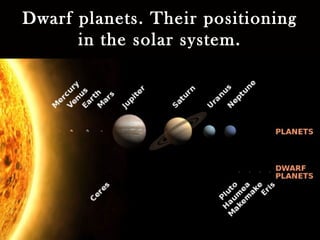
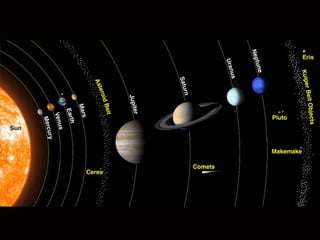
Dwarf planets. Their positioning
in the solar system.
Orbit
• Orbit – an imaginary curve in space, which some certain
number of the cosmic body moves.
• In spase all heavenly bodies are moving around the
other, bigger mass object, which infects the smaller
objects whit attraction force. The path of movement is
called orbit.
• Bodies, effected with mutual attraction, can move,
relate to each other in different cone angles in a circle,
by the ellipse, parabole or hiperbole.
• For example, for this point “not dominating body in its
own orbit” long-time considered as a planet, Pluto was
renamed dwarf planet, because it’s orbit intersect with
Neptunes.
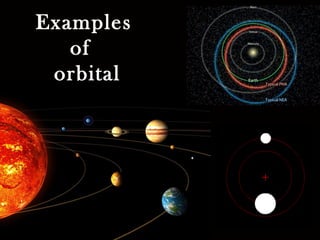
Examples
of
orbital
Ceres
• Ceres is a dwarf planet, discovered in 1801 January
1st. Before putting it in a class of asteroids, a half
century has been called as planet.
• Up to 2006 has been asteroid No 1 (Ceres was the first
discovered asteroid), but after a astronomets meeting it
was published as a dwarf planet.
• Dimensions of the planet is about 930x970 miles, less
than Earth's. This suggests that, under the surface is
hiding water, ice layers.
• Around its own axle turns around a 9.1 h.
• 22 January 2014 in Ceres European Space Agency
scientists had discovered water steam.
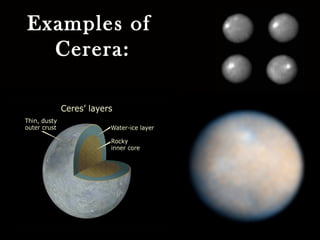
Examples of
Cerera:
Pluto
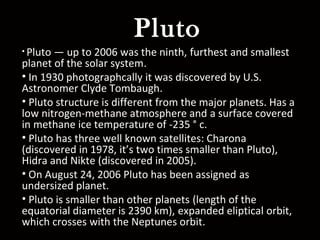
• Pluto — up to 2006 was the ninth, furthest and smallest
planet of the solar system.
• In 1930 photographcally it was discovered by U.S.
Astronomer Clyde Tombaugh.
• Pluto structure is different from the major planets. Has a
low nitrogen-methane atmosphere and a surface covered
in methane ice temperature of -235 ° c.
• Pluto has three well known satellites: Charona
(discovered in 1978, it’s two times smaller than Pluto),
Hidra and Nikte (discovered in 2005).
• On August 24, 2006 Pluto has been assigned as
undersized planet.
• Pluto is smaller than other planets (length of the
equatorial diameter is 2390 km), expanded eliptical orbit,
which crosses with the Neptunes orbit.
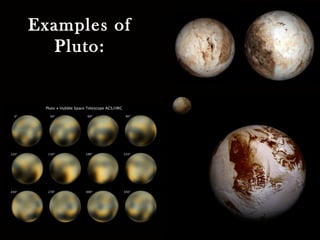
Examples of
Pluto:
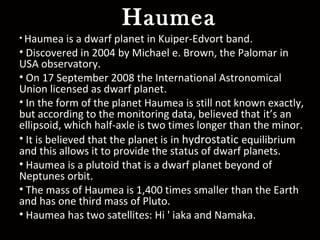
Haumea
• Haumea is a dwarf planet in Kuiper-Edvort band.
• Discovered in 2004 by Michael e. Brown, the Palomar in
USA observatory.
• On 17 September 2008 the International Astronomical
Union licensed as dwarf planet.
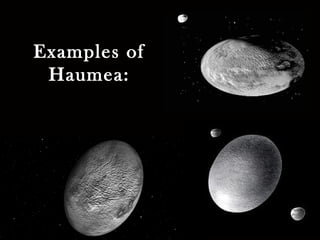
• In the form of the planet Haumea is still not known exactly,
but according to the monitoring data, believed that it’s an
ellipsoid, which half-axle is two times longer than the minor.
• It is believed that the planet is in hydrostatic equilibrium
and this allows it to provide the status of dwarf planets.
• Haumea is a plutoid that is a dwarf planet beyond of
Neptunes orbit.
• The mass of Haumea is 1,400 times smaller than the Earth
and has one third mass of Pluto.
• Haumea has two satellites: Hi ' iaka and Namaka.
Examples of
Haumea:
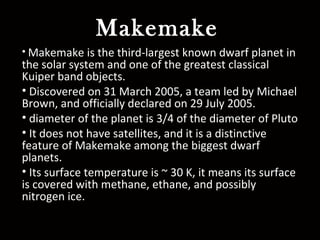
Makemake
• Makemake is the third-largest known dwarf planet in
the solar system and one of the greatest classical
Kuiper band objects.
• Discovered on 31 March 2005, a team led by Michael
Brown, and officially declared on 29 July 2005.
• diameter of the planet is 3/4 of the diameter of Pluto
• It does not have satellites, and it is a distinctive
feature of Makemake among the biggest dwarf
planets.
• Its surface temperature is ~ 30 K, it means its surface
is covered with methane, ethane, and possibly
nitrogen ice.
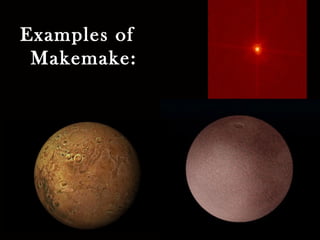
Examples of
Makemake:
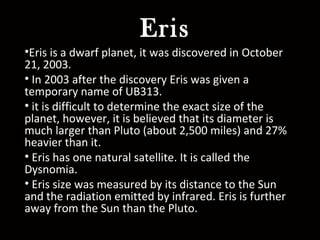
Eris
•Eris is a dwarf planet, it was discovered in October
21, 2003.
• In 2003 after the discovery Eris was given a
temporary name of UB313.
• it is difficult to determine the exact size of the
planet, however, it is believed that its diameter is
much larger than Pluto (about 2,500 miles) and 27%
heavier than it.
• Eris has one natural satellite. It is called the
Dysnomia.
• Eris size was measured by its distance to the Sun
and the radiation emitted by infrared. Eris is further
away from the Sun than the Pluto.
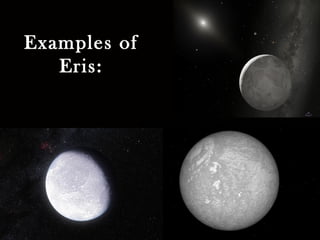
Examples of
Eris:
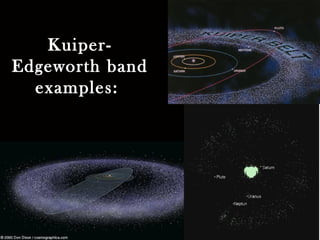
Kuiper-
Edgeworth band
examples:
• It is expected to discover at least another 40
planets and about 200 in the Edgeworth-Kuiper
band.
• It is believed that there are about 2000 objects, if
you are searching beyond Kuiper-belt Edgeworth
band.
• The Question of the planets in the other
planetary systems has not been thought about.
Nevertheless, they are not considered to be
planets.
• Dwarf planets has not yet been visited by
intergalactic spacecraft.
• This should change in 2015. Two missions are
planned: Dawn and New Horizons. The plan is to
reach Ceres and Pluto.
Interesting Facts:
•Pluto is named after the ancient Greek
God of the underworld Pluto.
• Ceres is named after the patroness of
the Sicily, she was Roman goddess of
fertility and agriculture.
•Makemake was firstly named as Easter
bunny, because it was discovered after
the Easter holidays, the day of 31 March.
Makemake is the creator of humanity and
God of fertility.
Thanks you
for your
attention!!

Dwarf planets

  • 1.
    Dwarf planets Work preparedby Kaunas “Vyturio “ catholic secondary schoolstudents Gabrielė Grigonytė, Monika Katlauskaitė and Simona Šapolaitė
  • 2.
    Definition Dwarf planet isa celestial body that:  Is in direct orbit of the Sun Have enough mass for its gravity to turn into a nearly round shape  It isn’t dominating body in its own orbit  It isn’t attendant
  • 3.
    Up to 2008International Astronomical Union classified five celestial bodies as dwarf planets: • Ceres • Pluto • Haumea • Makemake • Eris
  • 4.
    Dwarf planets. Theirpositioning in the solar system.
  • 5.
    Orbit • Orbit –an imaginary curve in space, which some certain number of the cosmic body moves. • In spase all heavenly bodies are moving around the other, bigger mass object, which infects the smaller objects whit attraction force. The path of movement is called orbit. • Bodies, effected with mutual attraction, can move, relate to each other in different cone angles in a circle, by the ellipse, parabole or hiperbole. • For example, for this point “not dominating body in its own orbit” long-time considered as a planet, Pluto was renamed dwarf planet, because it’s orbit intersect with Neptunes.
  • 6.
  • 7.
    Ceres • Ceres isa dwarf planet, discovered in 1801 January 1st. Before putting it in a class of asteroids, a half century has been called as planet. • Up to 2006 has been asteroid No 1 (Ceres was the first discovered asteroid), but after a astronomets meeting it was published as a dwarf planet. • Dimensions of the planet is about 930x970 miles, less than Earth's. This suggests that, under the surface is hiding water, ice layers. • Around its own axle turns around a 9.1 h. • 22 January 2014 in Ceres European Space Agency scientists had discovered water steam.
  • 8.
  • 9.
    Pluto • Pluto —up to 2006 was the ninth, furthest and smallest planet of the solar system. • In 1930 photographcally it was discovered by U.S. Astronomer Clyde Tombaugh. • Pluto structure is different from the major planets. Has a low nitrogen-methane atmosphere and a surface covered in methane ice temperature of -235 ° c. • Pluto has three well known satellites: Charona (discovered in 1978, it’s two times smaller than Pluto), Hidra and Nikte (discovered in 2005). • On August 24, 2006 Pluto has been assigned as undersized planet. • Pluto is smaller than other planets (length of the equatorial diameter is 2390 km), expanded eliptical orbit, which crosses with the Neptunes orbit.
  • 10.
  • 11.
    Haumea • Haumea isa dwarf planet in Kuiper-Edvort band. • Discovered in 2004 by Michael e. Brown, the Palomar in USA observatory. • On 17 September 2008 the International Astronomical Union licensed as dwarf planet. • In the form of the planet Haumea is still not known exactly, but according to the monitoring data, believed that it’s an ellipsoid, which half-axle is two times longer than the minor. • It is believed that the planet is in hydrostatic equilibrium and this allows it to provide the status of dwarf planets. • Haumea is a plutoid that is a dwarf planet beyond of Neptunes orbit. • The mass of Haumea is 1,400 times smaller than the Earth and has one third mass of Pluto. • Haumea has two satellites: Hi ' iaka and Namaka.
  • 12.
  • 13.
    Makemake • Makemake isthe third-largest known dwarf planet in the solar system and one of the greatest classical Kuiper band objects. • Discovered on 31 March 2005, a team led by Michael Brown, and officially declared on 29 July 2005. • diameter of the planet is 3/4 of the diameter of Pluto • It does not have satellites, and it is a distinctive feature of Makemake among the biggest dwarf planets. • Its surface temperature is ~ 30 K, it means its surface is covered with methane, ethane, and possibly nitrogen ice.
  • 14.
  • 15.
    Eris •Eris is adwarf planet, it was discovered in October 21, 2003. • In 2003 after the discovery Eris was given a temporary name of UB313. • it is difficult to determine the exact size of the planet, however, it is believed that its diameter is much larger than Pluto (about 2,500 miles) and 27% heavier than it. • Eris has one natural satellite. It is called the Dysnomia. • Eris size was measured by its distance to the Sun and the radiation emitted by infrared. Eris is further away from the Sun than the Pluto.
  • 16.
  • 17.
  • 18.
    • It isexpected to discover at least another 40 planets and about 200 in the Edgeworth-Kuiper band. • It is believed that there are about 2000 objects, if you are searching beyond Kuiper-belt Edgeworth band. • The Question of the planets in the other planetary systems has not been thought about. Nevertheless, they are not considered to be planets. • Dwarf planets has not yet been visited by intergalactic spacecraft. • This should change in 2015. Two missions are planned: Dawn and New Horizons. The plan is to reach Ceres and Pluto.
  • 20.
    Interesting Facts: •Pluto isnamed after the ancient Greek God of the underworld Pluto. • Ceres is named after the patroness of the Sicily, she was Roman goddess of fertility and agriculture. •Makemake was firstly named as Easter bunny, because it was discovered after the Easter holidays, the day of 31 March. Makemake is the creator of humanity and God of fertility.
  • 21.