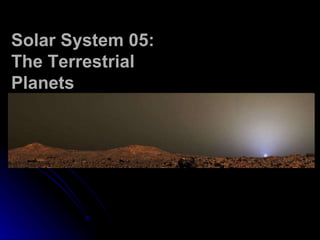
Solar System 05: The Terrestrial Planets
The Terrestrial Planets Terrestrial means “earthlike” The terrestrial planets are Mercury, Venus, and Mars
 
Mercury Data http://www.vegaattractions.com/images/1mercury.gif Surface Gravity if Earth = 1 0.38 Planet Symbol Mass if Earth = 1 0.055 Length of Day 58.65 Earth days Diameter if Earth = 1 0.38 Length of Year  (revolution around the sun) 87.97 Earth days Diameter at the Equator 3,031 miles Moons None Mean Distance from the sun 36,000,000 miles 0.4 AU
Mercury is only Slightly Larger  than the Moon MERCURY OUR MOON
Discovery Discovery : Mercury has been known since prehistoric times.  It was first mentioned in written records of the Sumerians (3000 BC).
Visibility Mercury is visible either early in the evening just after sunset or early in the morning just before sunrise. It is always close to the sun and can be seen for just a few minutes either at sunset or sunrise.
Phases of Mercury As an inferior planet (between sun and earth), Mercury displays phases that resemble the phases of earth’s moon.  You need a telescope to observe the phases of Mercury.  Galileo first observed the phases of Mercury and Venus. This observation represented proof of the heliocentric (sun-centered), or Copernican solar system
Phases of Inferior Planets http://www.polaris.iastate.edu/EveningStar/Unit1/Graphics/PicES1_6c.gif http://astromm.calstatela.edu/images/planets/larousse/Me_Phases.jpg Telescope sketches of Mercury Orbit of an inferior planet
Eccentric Orbit Mercury’s eccentric orbit brings it close and far from the sun during its revolution.  This means that the orbital shape is much more oval or elliptical in appearance.  Mercury’s orbit is one of the most eccentric in the solar system. At its closest approach to the sun (perihelion), Mercury lies at a distance of 46 million km At its farthest approach (aphelion) Mercury lies at a distance of 70 million km.
Planetary Eccentricities Which “planet” is most eccentric?
Mercury’s Lobsided Orbit www.astro.lsa.umich.edu/.../ mercury_layers.jpg Mercury’s Perihelion
Mercury’s Temperature The temperature changes on Mercury are the most extreme of the planets.  At perihelion, Mercury’s temperature equals 427ºC.  At aphelion, Mercury’s temperature equals -183ºC.  Mercury is still not the hottest planet in the solar system. Which planet is hotter?
Surface Features Mercury most resembles earth’s moon in appearance.  Mercury has no substantial atmosphere. It is a naked ball of rock. Mercury’s surface is heavily cratered and very old.  The surface features enormous cliffs (scarps), some up to hundreds of kilometers in length and as high as 3 kilometers.  Beethoven is the largest crater on Mercury. At 402 mi, it is the largest crater in the solar system http://www.r-ds.com/images/ImagesOpera/beethoven.jpg
Impact craters on Mercury have similar features to those on the Moon.  CRATERS ON BOTH MERCURY AND THE MOON HAVE RINGS OF MOUNTAINS SURROUNDING THEM MERCURY OUR MOON Jumbled hills surrounding the Caloris Impact Basin
Mercury also has numerous long cliffs, called scarps, believed to have formed when the planet cooled
Caloris Basin One huge impact feature on Mercury is named the Caloris Basin, it is about 800 miles in diameter and was created by the impact of a large comet or asteroid.  The Caloris Basin resembles the large impact basins (maria) on earth’s moon.  The impact that created this basin was so large that it created a warped surface area on the area of the planet directly behind the impact. http://www.record-producer.com/i/capacitor-microphone-sizzle.jpg Hot basin
Mercury Names Features on Mercury have been named for famous writers, musicians, and painters.  For example, there are craters named after Beethoven, Homer, Mark Twain, and Matisse. There are 297 named features on Mercury
16 Largest Craters on Mercury Beethoven Tolstoy Raphael Goethe Homer Vyasa Rodin Monet Haydn Mozart Bach Valmiki Renoir Wren Vivaldi Matisse
Discovery Scarp
Shakespeare quadrangle of Mercury  http://www.hollowaypages.com/images/CHANDOS2.jpg
Caloris Basin & Antipodal, Jumbled Terrain, Mercury
Interior Mercury possesses a huge iron core that comprises about 80% of the planet’s mass.  Mercury could be described as a metal ball dipped in mud.
Mercury’s iron core takes up a much larger percentage its volume than that of Earth.
Mercury’s Strange Day In 1962, it was discovered that Mercury rotates three times in two of its years.  It’s day is 58.65 earth days long.  Its year is 87.97 earth days long. In other words, Mercury experiences only three days in two of its years. 3(58.65) = 175.95 2(87.97) = 175.94
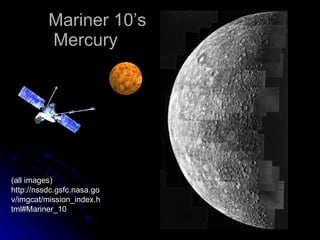
Mariner 10 Spacecraft : Mercury has been visited only by one spacecraft.  This mission was named Mariner 10, and it visited Mercury in 1975.  Only 45% of the planet’s surface was mapped by Mariner 10.  We are due for another Mercury mission.
Mariner 10’s  Mercury (all images) http://nssdc.gsfc.nasa.gov/imgcat/mission_index.html#Mariner_10
New Mission to Mercury (MESSENGER) Mission launched in August 2004, will reach Mercury January 2008  The MESSENGER spacecraft will orbit and map Mercury after making three flybys of the planet.  The spacecraft will enter Mercury orbit in March 2011 and examine the planet for one Earth year. http://ltpwww.gsfc.nasa.gov/ltp/images/Messengercraft.jpg
Water on Mercury!? Amazingly, radar observations of Mercury’s north pole from the Aricebo dish in Puerto Rico provide evidence that water ice may exists in the always-shadowed areas of some craters. These craters exist near the poles of Mercury, where sunlight never reaches. Similar deposits might also be present on our moon. If true, these deposits could contain a record of much of the solar system’s history.
Ice on Mercury? homepage.smc.edu/.../ MERCURY/polar_ice.jpg White patches in the right image may represent deposits of ice at Mercury’s south pole
Precession of Mercury’s Orbit Mercury’s orbital path precesses (wobbles) in a manner that could not be explained by the theories of Isaac Newton The planet’s perihelion position (closest approach to sun) drifts slowly as a result, and the rate of wobble is once per 30,140 years Explaining Mercury’s orbit was one of the first predicitons of Einstein’s theory of General Relativity Newton’s Laws break down in the presence of an intense gravitational field, such as that of the sun’s The warping of space by the sun’s gravity accounts for Mercury’s anomalous precession
Mercury’s Precession http://scholar.uwinnipeg.ca/courses/38/4500.6-001/Cosmology/general_relativity.htm http://antwrp.gsfc.nasa.gov/apod/image/einstein_clerk_big.gif Perihelion position
Vulcan LeVerrier, who along with Adams predicted the existence of Neptune, proposed that the mysterious precession of Mercury’s revolution was caused by the gravity of an undiscovered planet that lay between Mercury and the sun.  This hypothetical planet was named Vulcan.  Some astronomers in the 1800’s claimed to have observed this planet using telescopes, but these observations have never been confirmed, and it is unlikely that anything like Vulcan exists.  Live long and prosper
Transits of Mercury A transit is the passage of an inferior planet (Venus or Mercury) across the face of the sun On average, there are 13 transits of Mercury visible each century In contrast, Venus transits are much rarer, they occur in pairs over a century apart The last Mercury transit occur in November 2006
May 2003 Transit of Mercury
Nov 2006 Transit of Mercury Where’s Mercury?
November 2006 Mercury Transit Spaceweather  Link
Lore of Mercury Clay tablets written by the Sumerians show that these people kept very accurate records of the appearances of Mercury in the night sky. The Sumerians flourished around 5000 years ago in modern day Iraq Wednesday, or Woden’s Day, is named for the planet Mercury According to legend, Copernicus never was able to see Mercury. It’s not difficult, you just need to know when and where to look
Lore of Mercury, Cont. The Greeks named the evening appearance of the planet Apollo, they named the morning appearance Hermes In Roman mythology, Mercury is the god of commerce, travel, and thievery, the Roman counterpart of the Greek god Hermes, the messenger of the gods The planet probably received this name because it moves so quickly in the sky from night to night
Cuneiform Mercury Tablet, Roman Statue of Mercury www.gwydir.demon.co.uk
Other Lore of Mercury Mercury cars Freddie Mercury of Queen FTD flowers www.musclecarclub.com  sowhat.cocolog-nifty.com  http://www.gianteagle.com/media/static_content/store_services/gift_garden/images/FTD_Landing_Image_293_X_260.gif
Venus Data http://www.vegaattractions.com/images/1venus.gif Surface Gravity if Earth = 1 0.91   Planet Symbol Mass if Earth = 1 0.815   Length of Day 243.01 Earth days Diameter if Earth = 1 0.95   Length of Year  (revolution around the sun) 224.70 Earth days Diameter at the Equator 7,521 miles Moons 0 Mean Distance from the sun 67,200,000 miles 0.72 AU
Venus Venus : The Roman goddess Venus was the goddess of love and beauty Venus is the brightest planets seen from earth
Discovery of Venus Discovery : Venus has been known since prehistoric times. It is the brightest object in the sky except for the sun and the moon.  The appearances of Venus are described in the mythology of many peoples including the Sumerians and Mayans.
Evening and Morning Star Venus is visible either early in the evening just after sunset (evening star), or early in the morning just before sunrise (morning star) Although always near the sun, Venus can extend about 45º to the east or west of the sun On any particular evening or morning, Venus stays in the sky much longer than Mercury Venus often pairs with the crescent moon for pretty scenes
Venus as Evening Star Venus as an evening star in the western sky after sunset
Venus as Morning Star Venus as a morning star in the eastern sky before sunrise
Changing Positions of Venus, Mercury http://www.nmm.ac.uk/upload/img/mv-orbit.jpg
Evening Star: Venus and Moon http://www.russellsastronomy.com/sky/April-June%20Planets.htm
Phases of Venus As an inferior planet (between sun and earth), Venus displays phases that resemble the phases of earth’s moon You need a telescope to observe the phases of Venus Galileo first observed the phases of Venus in the early 1600s
Phases of Venus, cont. Galileo’s observation of the phases of Venus provided important evidence in favor of Copernicus’s heliocentric (sun-centered) theory of the solar system. The Ptolemaic, or earth-centered solar system would only allow Venus to have crescent phases The Copernican model allows a nearly “full” Venus, which is what Galileo observed. http://phyun5.ucr.edu/~wudka/Physics7/Notes_www/img152.gif Galileo’s Venus Sketches
Venus Phases, Earth and Sun Centered http://r2d2.stcloudstate.edu/~womack/astr/galileo/venuscop.jpg
Phases of Venus ( Click Here ) http://www.robertsilvey.com/notes/Venus02t.jpg
8 year cycle & Synodic Period Venus orbits the sun 13 times in 8 earth years From earth, we witness 5 Venus events every 8 earth years For example, 5 inferior conjunctions of Venus occur every 8 earth years Visually, appearances of Venus repeat every 8 years on virtually the same calendar date The time between successive conjunctions of a planet and the earth is termed the synodic period
Venus Synodic Period Venus Synodic Period = 584 days Compared to earth’s year, this is a 5:8 ratio 5 x 584 = 2920 days 8 x 365 = 2920 days There seems to be no physical reason for this ratio, it is a coincidence Again, it means that from earth Venus events repeat almost exactly every 8 earth years
8 Year Cycle Image created by drawing a line between the earth and Venus every few days for 8 years Outer edge is earth’s orbit Inner circle is Venus’s orbit Sun in center Notice the pentagon in the center representing 5 Venus events every 8 earth years http://www.dreamhawk.com/venusearth.jpg
Retrograde Rotation Rotation : Venus’s rotation is unusual in that it is both very slow (243 earth days long) and retrograde Retrograde means that the planet rotates backwards, or clockwise when looking down on the solar system Scientists are unsure of why Venus rotates backwards. Perhaps the planet was struck by a large object early in its history and became positioned upside down?
Venus’s Retrograde Rotation http://www.windows.ucar.edu/kids_space/images/ask_retrograde_sm.jpg
Earth’s Sister Planet Venus is considered to be earth’s sister planet in that it is nearly the same size as earth (95% of earth’s diameter, 80% of earth’s mass) Compared to Venus, in terms of climate our Earth is like Heaven and Venus is like Hell Interior : Venus likely exhibits an iron core similar to earth’s.
Earth’s Sister World http://www.arcadiastreet.com/cgvistas/images/venus_and_earth.jpg
Atmosphere of Venus Venus is entirely covered with a thick atmosphere of mainly Carbon Dioxide, and its surface is never visible from earth The Magellan spacecraft used radar to penetrate the clouds and map the planet’s surface The thick atmosphere produces an immense greenhouse effect that raises Venus’ surface temperature to 900ºF (hot enough to melt lead) Venus is hotter than Mercury despite being nearly twice as far away from the sun
Venus’s Environment The thick atmosphere also creates high pressure on the surface Sulfuric acid droplets rain from the thick atmospheric clouds An unprotected human would be crushed instantly by the weight of atmosphere overhead, dissolved in sulfuric acid, and baked immediately by the searing heat Venus is the place in our solar system that most resembles Hell http://www.uk2planets.org.uk/images/gallery/venus_greenhouse%20effect_esa.jpg Venus greenhouse
The Clouds of Venus Venus is covered with a dense layer of clouds that hides its surface.  Unlike the benign water vapor clouds on Earth, these clouds contain large amounts of sulfur dust and sulfur compounds, giving them a yellow-orange color.  The clouds on Venus are made of concentrated sulfuric acid.
Spacecraft to Venus Spacecraft : The first spacecraft to visit Venus was Mariner 2 in 1962 Venus was visited next by many others (more than 20 so far), including Pioneer Venus and Soviet Venera 7, the first spacecraft to land on another planet, and Venera 9, which returned the first photographs of the surface The orbiting US spacecraft Magellan has produced detailed maps of Venus’s surface using radar. Magellan entered Venus’s orbit in 1990 http://members.aol.com/NYRocketScience/space/1962/s199-us-mariner2.jpg
Mariner’s Venus http://www.solarviews.com/browse/venus/venusmar.jpg 1962
Venus’s Surface, courtesy of Venera Edge of Venera Lander
This image of the Venusian surface from the Soviet spacecraft Venera 13 shows rock plates which are possibly fractured lava.  Unfortunately, this craft was destroyed by the intense pressure and extreme temperatures on the Venusian surface.
Magellan’s Venus http://cseligman.com/text/planets/venus/magellan.jpg
The Magellan spacecraft, in an orbit around Venus, was able to “see through” the thick clouds using radar, giving us the best view of our sister planet.
This false color map of Venus, equivalent to a topographical map of Earth, shows the large-scale surface features of the planet.
A global view of Venus using radar images from the Magellan spacecraft The craters found on Venus tend to be in clusters.  This suggests that they were formed from a large single piece of falling debris that was broken up by the Venusian atmosphere.
Surface Features Most of Venus’ surface consists of gently rolling planes with little height differences There are very few surviving impact craters on Venus There are several large, low areas (depressions) such as the  Atalanta Planitia There are two large plateaus or highland areas, one is named the  Ishtar Terra  and the other is named the  Aphrodite Terra
Venus’s Surface Features, cont. Data from Magellan suggests that the surface is covered largely by lava flows.  There are several large volcanoes such as the  Sif Mons .  Recent findings suggest that Venus still has active volcanism, but only in a few areas. Venus also exhibits some unique landforms such as pancake volcanoes, spider-like “arachnoids,” and coronae.  The pancake volcanoes seem to be eruptions of very thick lava and the coronae seem to be collapsed lava domes.
3D Venus Map http://masa-p3-rw.hp.infoseek.co.jp/planet/venus_3dmap02.jpg Terras
Magellan Global Views http://nssdc.gsfc.nasa.gov/photo_gallery/photogallery-venus.html
Venus Volcanism (all images) http://nineplanets.edu
Unusual Volcanism, Pancake Domes
Corona and Arachnoid
Transits of Venus As an inferior planet, Venus can transit or cross in front of the sun Transits occur twice in 8 years, separated by over 120 years Transits of Venus are one of the rarest events in astronomy The last transit of Venus occurred June 8, 2004, the next will be in 2012 The previous transit had been in 1882
June 2004 Transit of Venus http://www.astrosurf.org/lombry/Documents/transit-venus-8juin2004-3d-contact-anim-furlanetto.gif http://www.atmob.org/Photo/venus_2004/venus%20transit%208.JPG Click on Link:
Transits of Venus 8 June 9, 2255 122 June 11, 2247 8 December 8, 2125 105 December 11, 2117 8 June 6, 2012 June 8, 2004 Separation in Years Transit Dates
Historical Transits of Venus In 1691, Edmond Halley demonstrated that a transit of Venus could be used to calculate the distance between the earth and sun In the eighteenth century, expeditions were sent to observe Venus transits from locations around the world in hopes of calculating the earth to sun distance Captain Cook's first expedition in the Endeavour was timed so that he could see the 1769 transit from the South Pacific  http://science.nasa.gov/headlines/y2004/images/cook/ptvenus.jpg
Feminist Planet The surface features of Venus, with a few exceptions, have been named after women These women include authentic historical figures such as Amelia Earhart and Sacajawea and ancient goddesses such as Ishtar and Aphrodite  The highest mountains on Venus ( Maxwell Montes ) were named after a man, the physicist James Clerk Maxwell http://www.feministcampus.org/images/egreeting/rosie_the_riveter.jpg
Swampy Venus Due to its clouds and distance, astronomers once thought that Venus was a natural garden filled with living things These ideas turned out to be pure fantasy Fantastic swamps of Venus
Behavior of Venus Venus moves back and forth between the evening and morning sky. It spends about 9 months in each Our ancestors interpreted the cyclical behavior of Venus as evening and morning star in many ways
Lore of Venus: Sumerians and Greeks Sumerians : To the Sumerians, Venus represented the goddess Ishtar Venus’s periodic conjunctions with the sun were thought to represent the goddess's death and rebirth Greeks : The Greeks called Venus Hesperus when it appeared in the evening sky and Phosphorus when it appeared in the morning sky. Eventually, the Greeks realized that both objects were the same planet
Goddess Ishtar http://www.unige.ch/lettres/antic/mesopotamie/ishtar.jpg Left: Bust of Ishtar, Right: Cylinder seal depiction of Ishtar in the underworld
Lore of Venus: Maya To the Maya of Central America, Venus represented the god Quetazlcóatl and figured prominently in their worship. Quetazlcóatl was pictured as a winged-serpent Mayan astronomers were able to predict the dates of the appearance of Venus many thousands of years into the future or past. Such records are preserved in the Dresden Codex, one of only two surviving Maya texts
Maya Venus, Dresden Codex http://www-groups.dcs.st-and.ac.uk/~history/Diagrams/Dresden.jpeg Maya depiction of Quetzecoatl (left); Dresden Codex (right)
Maya Venus “Observatory” at Chichen Itza http://centros.edu.aytolacoruna.es/sfxabier/world_links/mexico_observatory.jpg This famous structure is also named the Caracol Chichen Itza is located near Cancun, Mexido
Lore of Venus: Paradise Lost Milton : The movement of Venus in the sky was used by Milton as a metaphor of the fallen angel Lucifer and forms the central theme of his epic poem Paradise Lost.  Paradise Lost is a long poem that was first published in 1674, the poem deals directly with ideas from the Bible.
Paradise Lost http://www.clt.astate.edu/wnarey/Honors%20Seminars_files/Horror/summar3.jpg http://users.ox.ac.uk/~lina0897/emwo/images/big/PARADISE_LOST.jpg
Mars Data http://www.vegaattractions.com/astrology/symbols.html Surface Gravity if Earth = 1 0.38   Planet Symbol  (draw) Mass if Earth = 1 0.107   Length of Day 24 hr. 37 min. 22.6 sec. Diameter if Earth = 1 0.53   Length of Year  (revolution around the sun) 686.98 Earth days Diameter at the Equator 4,217 miles  Moons 2 Mean Distance from the sun 141,500,000 miles AU
Red Planet God of War : Mars was the Roman god of war.  The planet probably got this name due to its red color.  Mars is also referred to as the Red Planet.
Mars Discovery : Mars has been known since prehistoric times It is still a favorite location for science fiction stories Mars becomes very bright about every two years, sometimes even brighter than Jupiter and Sirius
Spacecraft Spacecraft : The first spacecraft to visit Mars was Mariner 4 in 1965 Several others followed including Mars 2, the first spacecraft to land on Mars and the two Viking landers in 1976 After 20 years, the Mars Pathfinder landed successfully on Mars on July 4, 1997
Mars Exploration In 2004 the Mars Expedition Rovers "Spirit" and "Opportunity" landed on Mars sending back geologic data and many pictures Spirit and Opportunity are still operating after more than three years (2007) on Mars Below: The crater Endurance, photographed by the Martian rover Opportunity
Mariner 4 : No Canals (1965) http://mpfwww.jpl.nasa.gov/MPF/martianchronicle/martianchron2/issue2images/mariner4photo.jpeg
Viking (1976) http://www.hypography.com/bilder/viking_on_mars.jpg Viking’s robotic arm (below) collected soil samples to test for life
Pathfinder (1997) http://users.bigpond.net.au/Nick/Mars/Pathfinder.jpg
Pathfinder (Mars or Arizona?) http://anw.com/mars/images/widescene.jpg
Spirit & Opportunity Panoramic Photos http://antwrp.gsfc.nasa.gov/apod/ap040318.html http://antwrp.gsfc.nasa.gov/apod/ap040114.html http://antwrp.gsfc.nasa.gov/apod/ap040204.html
Mars Missions
Cold Planet Climate : Temperatures on Mars range from –207ºF at the winter pole to 80ºF on the day side during summer The average temperature is –67ºF Despite being cold, Mars has the most earthlike climate of any of the planets
Dusty Planet Atmosphere : Mars has a very thin atmosphere composed mostly of carbon dioxide (95.3%) plus nitrogen (2.7%) and various other gases Mars displays strong winds and immense dust storms that can cover most of the planet and last for many months Dust devils, small tornadoes, have been sighted on Mars
Mars Dust Storm
Although it is sometimes blue, the Martian sky generally takes on a rust color because of dust particles blown into the atmosphere by strong winds.  Sunset on Mars
Ice Caps One earthlike feature of Mars are the ice caps which grow and shrink with the seasons on Mars The ice caps are composed mainly of frozen carbon dioxide (dry ice) and water ice
Mars is tilted on its axis by 25.19   (nearly the same as Earth) and has seasons.  Martian Seasons Large ice cap made mostly of frozen carbon dioxide (dry ice) The dry ice melts, leaving a much smaller polar cap
High winds create dust devils on the Martian surface. A DUST DEVIL FROM ABOVE DARK STREAKS SHOW THE PATH OF DUST DEVILS
Surface Features Surface : Although Mars diameter is less than earth, its surface area is about the same as the land area of earth’s continents  Much of Mars’ surface is old and cratered and resembles the highlands on earth’s moon, but there are also younger features such as rift valleys, ridges, hills, and plains.  Mars has some unique features and probably has the most interesting terrain of any world besides earth.
Mars Tour Guide Olympus Mons : A volcano, the largest mountain in the solar system (78,000 ft, about 22 mi). Its base is more than 310 mi in diameter Valles Marineris : A system of canyons 3,750 mi long and from 2-7 mi deep http://www.pi-software.com/tour_guide_barbie.jpg
The Martian terrain includes broad towering volcanoes, vast windswept plains, and enormous canyons. Valles Marineris is a vast canyon stretchimg over about one-fifth the circumference of Mars.
Vallis Marineris (Viking)
Mars also has volcanoes.  The largest of these is Olympus Mons. It covers an area the size of Missouri and rises three times higher than Mount Everest.
Tharsis Region Olympus Mons & clouds
Olympus Mons http://www.physast.uga.edu/~jss/1010/ch10/mtoly.jpg
Mars Volcanism No Plate Tectonics : Mars appears to lack plate tectonics This seems to have helped in the development of the huge volcanoes such as Olympus Mons Plate motions wouldn’t allow such large piles of lava to build up No active volcanism has been observed on Mars
Impact Craters on Mars Most of these craters are found in the Southern Hemisphere, suggesting that the northern vastness has been resurfaced.
Martian Water Liquid Water : There is much evidence of past running water on Mars’ surface including large floods and small river systems.  Some large lakes or oceans may also have existed.  Ice Caps : Mars has permanent ice caps at its north and south poles.  This ice is mainly composed of frozen carbon dioxide (dry ice) with a small amount of frozen water ice.
The winding canyons found on the Martian surface are similar to those found in river beds on Earth, suggesting that liquid water once flowed on Mars.  Martian winding canyon, photographed by the Viking orbiter The Yangtze River in China has similar features
Surface features believed to be ancient waterways An ancient lake A dried riverbed Sedimentation
Layers of rock laid down by water Hemetite black rocks, usually formed in water  Gullies in crater walls
Nirgal Vallis, possible river valley http://science.nasa.gov/headlines/y2001/ast05jan_1.htm
Sedimentary Layers from Water http://science.nasa.gov/headlines/images/mars_water/sediments.jpg
Chyrse, “Teardrop” Islands The teardrop islands represent an erosional feature created by past running water http://www.esa.int/images/mars_water_400.jpg
Martian Ice
Mars has been the Center of Speculation about Extraterrestrial Life   Early telescope images showed features which were perceived as irrigation canals.  People feared an attack from Mars, like this one portrayed in “The War of the Worlds.”
Canals on Mars? Life on Mars ? In the early 1900s, Percival Lowell claimed to have observed canals on Mars’ surface He created maps and theories concerning the canals, but we know that they do not exist Lowell believed that the canals were the efforts of a dying civilization on Mars to capture water from the frozen poles for survival
Lowell’s Canals http://www.nasm.si.edu/research/ceps/etp/mars/marsimg/mars_lowellglobe.jpg http://www.hencoup.com/Lowells%20Mars%20with%20canals.jpg Lowell’s “canal” network Percival Lowell
Lowell Observatory, Arizona http://www.theskyscrapers.org/stuff/contentmgr/files/61edba02500313dcb0e1f6b80940c8af/large/pict1246.jpg CW from Left : Lowell’s Telescope; Lowell canal sketch;  Lowell; Lowell’s Mausoleum http://www.rzuser.uni-heidelberg.de/~c88/Clark_1.jpg
Martian Life? The Viking landers performed experiments to determine the presence of live, but most scientists have concluded that no evidence of life was discovered A small number of meteorites are believed to have originated on Mars In 1996, NASA scientists announced the discovery of organic compounds in a Martian meteorite They also claimed to have discovered fossilized microorganisms These findings are controversial
Viking Lander
Viking Life Experiment Trenches http://www.physics.uc.edu/~hanson/ASTRO/LECTURENOTES/ET/Earth/VikingMarsBig.jpg
Meteorite from Mars! http://www.universetoday.com/am/uploads/meteorite.jpg http://www.newscientist.com/data/images/ns/cms/dn8004/dn8004-1_440.jpg
Bacteria from Mars?  (ALH84001) http://www.lpi.usra.edu/lpi/meteorites/Photomicrograph.gif
Fear & Panic Fear and Panic : Mars has two tiny moons that were discovered in 1877 by Asaph Hall of the Naval Observatory in Washington These two moons were named Phobos and Deimos—Fear and Panic—after two sons of the god of war mentioned in Homer’s  Iliad An inhabitant of Mars would see two moons crossing the sky in opposite directions These moons are small (Phobos is only 24 miles across) and resemble asteroids They are probably asteroids that were captured by Mars’ gravity
Phobos & Deimos http://www.sarkanniemi.fi/oppimateriaali/tahtiakatemia/kuvat/aurinkokunta/deimos_phobos.jpg http://perso.wanadoo.fr/pgj/phobos-deimos-061105.gif
Martian Names Martian Nomenclature : The main features on Mars were named by the astronomer Schiaparelli He selected geographical and imaginary names from Greek and Roman literature such as Solis Lacus (Lake of the Sun), Aurorae Sinus (Bay of Dawn), Margaritifer Sinus (coast of India), Syrtis Major (Gulf of Sidra), Mare Tyrrhenum (Tyrrhenian Sea) The names of dark areas were those of bodies of water, and those of bright areas, of lands
Lilliputian Moons Gulliver’s Travels : Jonathan Swift, in his 1726 book  Gulliver’s Travels , described how the astronomers of Lilliput had discovered “two lesser stars, or satellites, which revolve around Mars” Swift gives their periods of revolution as 21 and 10 hours (quite close to the true values) These conjectures seem to have been lucky guesses http://foxes.bluespot.org/images/gulliver.gif
Observing Mars Mars in the Night Sky : Every two years, Mars gets very bright and easily visible These events are named oppositions, they occur when earth and Mars reach a minimum distance apart Opposition occurs when a superior planet is opposite of the sun in earth’s sky At opposition, the planet rises in the east as the sun sets in the west.  Only superior planets can reach opposition
Oppositions of Mars Future Oppositions 7 Nov 2005 24 Dec 2007 29 Jan 2010 3 Mar 2012 8 April 2014 22 May 2016 27 July 2018 13 Oct 2020
Face on Mars “ Face on Mars ”: Images from the Viking Orbiter 1 show what appears to be a large, human face located in the Cydonia region of Mars.  Some writers have claimed that this shape was artificially sculpted, Richard Hoagland, for example, created elaborate systems of alignments linking the Face to the Egyptian Pyramids and Sphinx on earth Images returned from the Mars Global Surveyor reveal that the “face” is little more than a pile of rocks.
Viking’s Face on Mars (1976) http://mcadams.posc.mu.edu/images%5Cface_mars.jpg
Mars Global Surveyor Face (2001) http://mars.jpl.nasa.gov/mgs/msss/camera/images/moc_5_24_01/face/ “ Face” the truth, Mr. Hoagland http://www.sg.hu/kep/2004_03/0322mars1.jpg
War of the Worlds Scare War of the Worlds Scare : In 1938, Orson Welles broadcast a radio play based upon H.G. Wells’ novel  The War of the Worlds The realistic nature of the broadcast convinced many listeners that a Martian invasion was really taking place Hysterical listeners called the police and newspapers, fled from their homes, and gazed at the sky in terror About 28% of listeners thought that the invasion was real http://www.scifi2k.com/misc_html/warworlds/ww_logo.jpg
War of the Worlds In 1938, Orson Welles broadcast a radio play based upon H.G. Wells’ novel  The War of the Worlds The realistic nature of the broadcast convinced many listeners that a Martian invasion was really taking place About 28% of listeners thought that the invasion was real Orson Welles as a broadcaster
Science Fiction: War of the Worlds Science Fiction : Many science fiction works take place on Mars (here is your summer reading list): Herbert G. Wells,  The War of the Worlds  (1898).  This novel describes an invasion of the earth by technologically advanced Martians.
H.G. Wells “ Yet across the gulfs of space, minds that are to our minds as ours are to those of the beasts that perish, intellects vast and cool and unsympathetic, regarded this earth with envious eyes, and slowly and surely drew their plans against us. ”
A Princess of Mars Edgar Rice Burroughs,  A Princess of Mars  (1911) Burroughs, best known as the creator of Tarzan, wrote a series of novels placed on Mars The hero, Civil War veteran John Carter, is transported to Mars where has various adventures, and marries an egg-laying Martian Princess The term “little green men” came from these books.
E.R. Burroughs “ I opened my eyes upon a strange and weird landscape. I knew that I was on Mars; not once did I question my sanity or wakefulness .”
Martian Chronicles Ray Bradbury,  The Martian Chronicles  (1951).  This book is a series of loosely connected stories which relate the story of humanity’s conquest of Mars.  The Martians in these stories are often seen as the “good guys.”
Ray Bradbury “ The Men of Earth came to Mars. They came because they were afraid or unafraid, because they were happy or unhappy, because they felt like Pilgrims or did not feel like Pilgrims. There was a reason for each man .”
Stranger in a Strange Land Robert Heinlein’s, Stranger in a Strange Land (1961), was a favorite counterculture novel of the 1960’s It is the story of Valentine Michael Smith, the sole survivor of the first manned expedition to Mars who was raised and educated by Martians. Stranger introduced the term “Grok” to pop culture
R.A. Heinlein “ Smith is not a man. He is an intelligent creature with the genes and ancestry of a man, but he is not a man. He's more a Martian than a man. Until we came along he had never laid eyes on a human being. He thinks like a Martian, he feels like a Martian. He's been brought up by a race which has nothing in common with us. “ “ This had been a very short word. Smith still felt that he had grokked rightly the human word "God"... “
Mars Movies Mars in the Movies : Red Planet  and  Mission to Mars  (2000) My Favorite Martian  (1999) Species II (1998) Mars Attacks!  (1996) Total Recall  (1990) Invaders from Mars  (1986, 1953) Capricorn One  (1978) Mars Needs Women  (1966) War of the Worlds  (1953, 2005) http://www.cinemacom.com/50s-sci-fi/invaders-from-mars.jpg

Solar system 05 terrestrial planets

  • 1.
    Solar System 05:The Terrestrial Planets
  • 2.
    The Terrestrial PlanetsTerrestrial means “earthlike” The terrestrial planets are Mercury, Venus, and Mars
  • 3.
  • 4.
    Mercury Data http://www.vegaattractions.com/images/1mercury.gifSurface Gravity if Earth = 1 0.38 Planet Symbol Mass if Earth = 1 0.055 Length of Day 58.65 Earth days Diameter if Earth = 1 0.38 Length of Year (revolution around the sun) 87.97 Earth days Diameter at the Equator 3,031 miles Moons None Mean Distance from the sun 36,000,000 miles 0.4 AU
  • 5.
    Mercury is onlySlightly Larger than the Moon MERCURY OUR MOON
  • 6.
    Discovery Discovery :Mercury has been known since prehistoric times. It was first mentioned in written records of the Sumerians (3000 BC).
  • 7.
    Visibility Mercury isvisible either early in the evening just after sunset or early in the morning just before sunrise. It is always close to the sun and can be seen for just a few minutes either at sunset or sunrise.
  • 8.
    Phases of MercuryAs an inferior planet (between sun and earth), Mercury displays phases that resemble the phases of earth’s moon. You need a telescope to observe the phases of Mercury. Galileo first observed the phases of Mercury and Venus. This observation represented proof of the heliocentric (sun-centered), or Copernican solar system
  • 9.
    Phases of InferiorPlanets http://www.polaris.iastate.edu/EveningStar/Unit1/Graphics/PicES1_6c.gif http://astromm.calstatela.edu/images/planets/larousse/Me_Phases.jpg Telescope sketches of Mercury Orbit of an inferior planet
  • 10.
    Eccentric Orbit Mercury’seccentric orbit brings it close and far from the sun during its revolution. This means that the orbital shape is much more oval or elliptical in appearance. Mercury’s orbit is one of the most eccentric in the solar system. At its closest approach to the sun (perihelion), Mercury lies at a distance of 46 million km At its farthest approach (aphelion) Mercury lies at a distance of 70 million km.
  • 11.
    Planetary Eccentricities Which“planet” is most eccentric?
  • 12.
    Mercury’s Lobsided Orbitwww.astro.lsa.umich.edu/.../ mercury_layers.jpg Mercury’s Perihelion
  • 13.
    Mercury’s Temperature Thetemperature changes on Mercury are the most extreme of the planets. At perihelion, Mercury’s temperature equals 427ºC. At aphelion, Mercury’s temperature equals -183ºC. Mercury is still not the hottest planet in the solar system. Which planet is hotter?
  • 14.
    Surface Features Mercurymost resembles earth’s moon in appearance. Mercury has no substantial atmosphere. It is a naked ball of rock. Mercury’s surface is heavily cratered and very old. The surface features enormous cliffs (scarps), some up to hundreds of kilometers in length and as high as 3 kilometers. Beethoven is the largest crater on Mercury. At 402 mi, it is the largest crater in the solar system http://www.r-ds.com/images/ImagesOpera/beethoven.jpg
  • 15.
    Impact craters onMercury have similar features to those on the Moon. CRATERS ON BOTH MERCURY AND THE MOON HAVE RINGS OF MOUNTAINS SURROUNDING THEM MERCURY OUR MOON Jumbled hills surrounding the Caloris Impact Basin
  • 16.
    Mercury also hasnumerous long cliffs, called scarps, believed to have formed when the planet cooled
  • 17.
    Caloris Basin Onehuge impact feature on Mercury is named the Caloris Basin, it is about 800 miles in diameter and was created by the impact of a large comet or asteroid. The Caloris Basin resembles the large impact basins (maria) on earth’s moon. The impact that created this basin was so large that it created a warped surface area on the area of the planet directly behind the impact. http://www.record-producer.com/i/capacitor-microphone-sizzle.jpg Hot basin
  • 18.
    Mercury Names Featureson Mercury have been named for famous writers, musicians, and painters. For example, there are craters named after Beethoven, Homer, Mark Twain, and Matisse. There are 297 named features on Mercury
  • 19.
    16 Largest Craterson Mercury Beethoven Tolstoy Raphael Goethe Homer Vyasa Rodin Monet Haydn Mozart Bach Valmiki Renoir Wren Vivaldi Matisse
  • 20.
  • 21.
    Shakespeare quadrangle ofMercury http://www.hollowaypages.com/images/CHANDOS2.jpg
  • 22.
    Caloris Basin &Antipodal, Jumbled Terrain, Mercury
  • 23.
    Interior Mercury possessesa huge iron core that comprises about 80% of the planet’s mass. Mercury could be described as a metal ball dipped in mud.
  • 24.
    Mercury’s iron coretakes up a much larger percentage its volume than that of Earth.
  • 25.
    Mercury’s Strange DayIn 1962, it was discovered that Mercury rotates three times in two of its years. It’s day is 58.65 earth days long. Its year is 87.97 earth days long. In other words, Mercury experiences only three days in two of its years. 3(58.65) = 175.95 2(87.97) = 175.94
  • 26.
    Mariner 10 Spacecraft: Mercury has been visited only by one spacecraft. This mission was named Mariner 10, and it visited Mercury in 1975. Only 45% of the planet’s surface was mapped by Mariner 10. We are due for another Mercury mission.
  • 27.
    Mariner 10’s Mercury (all images) http://nssdc.gsfc.nasa.gov/imgcat/mission_index.html#Mariner_10
  • 28.
    New Mission toMercury (MESSENGER) Mission launched in August 2004, will reach Mercury January 2008 The MESSENGER spacecraft will orbit and map Mercury after making three flybys of the planet. The spacecraft will enter Mercury orbit in March 2011 and examine the planet for one Earth year. http://ltpwww.gsfc.nasa.gov/ltp/images/Messengercraft.jpg
  • 29.
    Water on Mercury!?Amazingly, radar observations of Mercury’s north pole from the Aricebo dish in Puerto Rico provide evidence that water ice may exists in the always-shadowed areas of some craters. These craters exist near the poles of Mercury, where sunlight never reaches. Similar deposits might also be present on our moon. If true, these deposits could contain a record of much of the solar system’s history.
  • 30.
    Ice on Mercury?homepage.smc.edu/.../ MERCURY/polar_ice.jpg White patches in the right image may represent deposits of ice at Mercury’s south pole
  • 31.
    Precession of Mercury’sOrbit Mercury’s orbital path precesses (wobbles) in a manner that could not be explained by the theories of Isaac Newton The planet’s perihelion position (closest approach to sun) drifts slowly as a result, and the rate of wobble is once per 30,140 years Explaining Mercury’s orbit was one of the first predicitons of Einstein’s theory of General Relativity Newton’s Laws break down in the presence of an intense gravitational field, such as that of the sun’s The warping of space by the sun’s gravity accounts for Mercury’s anomalous precession
  • 32.
    Mercury’s Precession http://scholar.uwinnipeg.ca/courses/38/4500.6-001/Cosmology/general_relativity.htmhttp://antwrp.gsfc.nasa.gov/apod/image/einstein_clerk_big.gif Perihelion position
  • 33.
    Vulcan LeVerrier, whoalong with Adams predicted the existence of Neptune, proposed that the mysterious precession of Mercury’s revolution was caused by the gravity of an undiscovered planet that lay between Mercury and the sun. This hypothetical planet was named Vulcan. Some astronomers in the 1800’s claimed to have observed this planet using telescopes, but these observations have never been confirmed, and it is unlikely that anything like Vulcan exists. Live long and prosper
  • 34.
    Transits of MercuryA transit is the passage of an inferior planet (Venus or Mercury) across the face of the sun On average, there are 13 transits of Mercury visible each century In contrast, Venus transits are much rarer, they occur in pairs over a century apart The last Mercury transit occur in November 2006
  • 35.
    May 2003 Transitof Mercury
  • 36.
    Nov 2006 Transitof Mercury Where’s Mercury?
  • 37.
    November 2006 MercuryTransit Spaceweather Link
  • 38.
    Lore of MercuryClay tablets written by the Sumerians show that these people kept very accurate records of the appearances of Mercury in the night sky. The Sumerians flourished around 5000 years ago in modern day Iraq Wednesday, or Woden’s Day, is named for the planet Mercury According to legend, Copernicus never was able to see Mercury. It’s not difficult, you just need to know when and where to look
  • 39.
    Lore of Mercury,Cont. The Greeks named the evening appearance of the planet Apollo, they named the morning appearance Hermes In Roman mythology, Mercury is the god of commerce, travel, and thievery, the Roman counterpart of the Greek god Hermes, the messenger of the gods The planet probably received this name because it moves so quickly in the sky from night to night
  • 40.
    Cuneiform Mercury Tablet,Roman Statue of Mercury www.gwydir.demon.co.uk
  • 41.
    Other Lore ofMercury Mercury cars Freddie Mercury of Queen FTD flowers www.musclecarclub.com sowhat.cocolog-nifty.com http://www.gianteagle.com/media/static_content/store_services/gift_garden/images/FTD_Landing_Image_293_X_260.gif
  • 42.
    Venus Data http://www.vegaattractions.com/images/1venus.gifSurface Gravity if Earth = 1 0.91 Planet Symbol Mass if Earth = 1 0.815 Length of Day 243.01 Earth days Diameter if Earth = 1 0.95 Length of Year (revolution around the sun) 224.70 Earth days Diameter at the Equator 7,521 miles Moons 0 Mean Distance from the sun 67,200,000 miles 0.72 AU
  • 43.
    Venus Venus :The Roman goddess Venus was the goddess of love and beauty Venus is the brightest planets seen from earth
  • 44.
    Discovery of VenusDiscovery : Venus has been known since prehistoric times. It is the brightest object in the sky except for the sun and the moon. The appearances of Venus are described in the mythology of many peoples including the Sumerians and Mayans.
  • 45.
    Evening and MorningStar Venus is visible either early in the evening just after sunset (evening star), or early in the morning just before sunrise (morning star) Although always near the sun, Venus can extend about 45º to the east or west of the sun On any particular evening or morning, Venus stays in the sky much longer than Mercury Venus often pairs with the crescent moon for pretty scenes
  • 46.
    Venus as EveningStar Venus as an evening star in the western sky after sunset
  • 47.
    Venus as MorningStar Venus as a morning star in the eastern sky before sunrise
  • 48.
    Changing Positions ofVenus, Mercury http://www.nmm.ac.uk/upload/img/mv-orbit.jpg
  • 49.
    Evening Star: Venusand Moon http://www.russellsastronomy.com/sky/April-June%20Planets.htm
  • 50.
    Phases of VenusAs an inferior planet (between sun and earth), Venus displays phases that resemble the phases of earth’s moon You need a telescope to observe the phases of Venus Galileo first observed the phases of Venus in the early 1600s
  • 51.
    Phases of Venus,cont. Galileo’s observation of the phases of Venus provided important evidence in favor of Copernicus’s heliocentric (sun-centered) theory of the solar system. The Ptolemaic, or earth-centered solar system would only allow Venus to have crescent phases The Copernican model allows a nearly “full” Venus, which is what Galileo observed. http://phyun5.ucr.edu/~wudka/Physics7/Notes_www/img152.gif Galileo’s Venus Sketches
  • 52.
    Venus Phases, Earthand Sun Centered http://r2d2.stcloudstate.edu/~womack/astr/galileo/venuscop.jpg
  • 53.
    Phases of Venus( Click Here ) http://www.robertsilvey.com/notes/Venus02t.jpg
  • 54.
    8 year cycle& Synodic Period Venus orbits the sun 13 times in 8 earth years From earth, we witness 5 Venus events every 8 earth years For example, 5 inferior conjunctions of Venus occur every 8 earth years Visually, appearances of Venus repeat every 8 years on virtually the same calendar date The time between successive conjunctions of a planet and the earth is termed the synodic period
  • 55.
    Venus Synodic PeriodVenus Synodic Period = 584 days Compared to earth’s year, this is a 5:8 ratio 5 x 584 = 2920 days 8 x 365 = 2920 days There seems to be no physical reason for this ratio, it is a coincidence Again, it means that from earth Venus events repeat almost exactly every 8 earth years
  • 56.
    8 Year CycleImage created by drawing a line between the earth and Venus every few days for 8 years Outer edge is earth’s orbit Inner circle is Venus’s orbit Sun in center Notice the pentagon in the center representing 5 Venus events every 8 earth years http://www.dreamhawk.com/venusearth.jpg
  • 57.
    Retrograde Rotation Rotation: Venus’s rotation is unusual in that it is both very slow (243 earth days long) and retrograde Retrograde means that the planet rotates backwards, or clockwise when looking down on the solar system Scientists are unsure of why Venus rotates backwards. Perhaps the planet was struck by a large object early in its history and became positioned upside down?
  • 58.
    Venus’s Retrograde Rotationhttp://www.windows.ucar.edu/kids_space/images/ask_retrograde_sm.jpg
  • 59.
    Earth’s Sister PlanetVenus is considered to be earth’s sister planet in that it is nearly the same size as earth (95% of earth’s diameter, 80% of earth’s mass) Compared to Venus, in terms of climate our Earth is like Heaven and Venus is like Hell Interior : Venus likely exhibits an iron core similar to earth’s.
  • 60.
    Earth’s Sister Worldhttp://www.arcadiastreet.com/cgvistas/images/venus_and_earth.jpg
  • 61.
    Atmosphere of VenusVenus is entirely covered with a thick atmosphere of mainly Carbon Dioxide, and its surface is never visible from earth The Magellan spacecraft used radar to penetrate the clouds and map the planet’s surface The thick atmosphere produces an immense greenhouse effect that raises Venus’ surface temperature to 900ºF (hot enough to melt lead) Venus is hotter than Mercury despite being nearly twice as far away from the sun
  • 62.
    Venus’s Environment Thethick atmosphere also creates high pressure on the surface Sulfuric acid droplets rain from the thick atmospheric clouds An unprotected human would be crushed instantly by the weight of atmosphere overhead, dissolved in sulfuric acid, and baked immediately by the searing heat Venus is the place in our solar system that most resembles Hell http://www.uk2planets.org.uk/images/gallery/venus_greenhouse%20effect_esa.jpg Venus greenhouse
  • 63.
    The Clouds ofVenus Venus is covered with a dense layer of clouds that hides its surface. Unlike the benign water vapor clouds on Earth, these clouds contain large amounts of sulfur dust and sulfur compounds, giving them a yellow-orange color. The clouds on Venus are made of concentrated sulfuric acid.
  • 64.
    Spacecraft to VenusSpacecraft : The first spacecraft to visit Venus was Mariner 2 in 1962 Venus was visited next by many others (more than 20 so far), including Pioneer Venus and Soviet Venera 7, the first spacecraft to land on another planet, and Venera 9, which returned the first photographs of the surface The orbiting US spacecraft Magellan has produced detailed maps of Venus’s surface using radar. Magellan entered Venus’s orbit in 1990 http://members.aol.com/NYRocketScience/space/1962/s199-us-mariner2.jpg
  • 65.
  • 66.
    Venus’s Surface, courtesyof Venera Edge of Venera Lander
  • 67.
    This image ofthe Venusian surface from the Soviet spacecraft Venera 13 shows rock plates which are possibly fractured lava. Unfortunately, this craft was destroyed by the intense pressure and extreme temperatures on the Venusian surface.
  • 68.
  • 69.
    The Magellan spacecraft,in an orbit around Venus, was able to “see through” the thick clouds using radar, giving us the best view of our sister planet.
  • 70.
    This false colormap of Venus, equivalent to a topographical map of Earth, shows the large-scale surface features of the planet.
  • 71.
    A global viewof Venus using radar images from the Magellan spacecraft The craters found on Venus tend to be in clusters. This suggests that they were formed from a large single piece of falling debris that was broken up by the Venusian atmosphere.
  • 72.
    Surface Features Mostof Venus’ surface consists of gently rolling planes with little height differences There are very few surviving impact craters on Venus There are several large, low areas (depressions) such as the Atalanta Planitia There are two large plateaus or highland areas, one is named the Ishtar Terra and the other is named the Aphrodite Terra
  • 73.
    Venus’s Surface Features,cont. Data from Magellan suggests that the surface is covered largely by lava flows. There are several large volcanoes such as the Sif Mons . Recent findings suggest that Venus still has active volcanism, but only in a few areas. Venus also exhibits some unique landforms such as pancake volcanoes, spider-like “arachnoids,” and coronae. The pancake volcanoes seem to be eruptions of very thick lava and the coronae seem to be collapsed lava domes.
  • 74.
    3D Venus Maphttp://masa-p3-rw.hp.infoseek.co.jp/planet/venus_3dmap02.jpg Terras
  • 75.
    Magellan Global Viewshttp://nssdc.gsfc.nasa.gov/photo_gallery/photogallery-venus.html
  • 76.
    Venus Volcanism (allimages) http://nineplanets.edu
  • 77.
  • 78.
  • 79.
    Transits of VenusAs an inferior planet, Venus can transit or cross in front of the sun Transits occur twice in 8 years, separated by over 120 years Transits of Venus are one of the rarest events in astronomy The last transit of Venus occurred June 8, 2004, the next will be in 2012 The previous transit had been in 1882
  • 80.
    June 2004 Transitof Venus http://www.astrosurf.org/lombry/Documents/transit-venus-8juin2004-3d-contact-anim-furlanetto.gif http://www.atmob.org/Photo/venus_2004/venus%20transit%208.JPG Click on Link:
  • 81.
    Transits of Venus8 June 9, 2255 122 June 11, 2247 8 December 8, 2125 105 December 11, 2117 8 June 6, 2012 June 8, 2004 Separation in Years Transit Dates
  • 82.
    Historical Transits ofVenus In 1691, Edmond Halley demonstrated that a transit of Venus could be used to calculate the distance between the earth and sun In the eighteenth century, expeditions were sent to observe Venus transits from locations around the world in hopes of calculating the earth to sun distance Captain Cook's first expedition in the Endeavour was timed so that he could see the 1769 transit from the South Pacific http://science.nasa.gov/headlines/y2004/images/cook/ptvenus.jpg
  • 83.
    Feminist Planet Thesurface features of Venus, with a few exceptions, have been named after women These women include authentic historical figures such as Amelia Earhart and Sacajawea and ancient goddesses such as Ishtar and Aphrodite The highest mountains on Venus ( Maxwell Montes ) were named after a man, the physicist James Clerk Maxwell http://www.feministcampus.org/images/egreeting/rosie_the_riveter.jpg
  • 84.
    Swampy Venus Dueto its clouds and distance, astronomers once thought that Venus was a natural garden filled with living things These ideas turned out to be pure fantasy Fantastic swamps of Venus
  • 85.
    Behavior of VenusVenus moves back and forth between the evening and morning sky. It spends about 9 months in each Our ancestors interpreted the cyclical behavior of Venus as evening and morning star in many ways
  • 86.
    Lore of Venus:Sumerians and Greeks Sumerians : To the Sumerians, Venus represented the goddess Ishtar Venus’s periodic conjunctions with the sun were thought to represent the goddess's death and rebirth Greeks : The Greeks called Venus Hesperus when it appeared in the evening sky and Phosphorus when it appeared in the morning sky. Eventually, the Greeks realized that both objects were the same planet
  • 87.
    Goddess Ishtar http://www.unige.ch/lettres/antic/mesopotamie/ishtar.jpgLeft: Bust of Ishtar, Right: Cylinder seal depiction of Ishtar in the underworld
  • 88.
    Lore of Venus:Maya To the Maya of Central America, Venus represented the god Quetazlcóatl and figured prominently in their worship. Quetazlcóatl was pictured as a winged-serpent Mayan astronomers were able to predict the dates of the appearance of Venus many thousands of years into the future or past. Such records are preserved in the Dresden Codex, one of only two surviving Maya texts
  • 89.
    Maya Venus, DresdenCodex http://www-groups.dcs.st-and.ac.uk/~history/Diagrams/Dresden.jpeg Maya depiction of Quetzecoatl (left); Dresden Codex (right)
  • 90.
    Maya Venus “Observatory”at Chichen Itza http://centros.edu.aytolacoruna.es/sfxabier/world_links/mexico_observatory.jpg This famous structure is also named the Caracol Chichen Itza is located near Cancun, Mexido
  • 91.
    Lore of Venus:Paradise Lost Milton : The movement of Venus in the sky was used by Milton as a metaphor of the fallen angel Lucifer and forms the central theme of his epic poem Paradise Lost. Paradise Lost is a long poem that was first published in 1674, the poem deals directly with ideas from the Bible.
  • 92.
    Paradise Lost http://www.clt.astate.edu/wnarey/Honors%20Seminars_files/Horror/summar3.jpghttp://users.ox.ac.uk/~lina0897/emwo/images/big/PARADISE_LOST.jpg
  • 93.
    Mars Data http://www.vegaattractions.com/astrology/symbols.htmlSurface Gravity if Earth = 1 0.38 Planet Symbol (draw) Mass if Earth = 1 0.107 Length of Day 24 hr. 37 min. 22.6 sec. Diameter if Earth = 1 0.53 Length of Year (revolution around the sun) 686.98 Earth days Diameter at the Equator 4,217 miles Moons 2 Mean Distance from the sun 141,500,000 miles AU
  • 94.
    Red Planet Godof War : Mars was the Roman god of war. The planet probably got this name due to its red color. Mars is also referred to as the Red Planet.
  • 95.
    Mars Discovery :Mars has been known since prehistoric times It is still a favorite location for science fiction stories Mars becomes very bright about every two years, sometimes even brighter than Jupiter and Sirius
  • 96.
    Spacecraft Spacecraft :The first spacecraft to visit Mars was Mariner 4 in 1965 Several others followed including Mars 2, the first spacecraft to land on Mars and the two Viking landers in 1976 After 20 years, the Mars Pathfinder landed successfully on Mars on July 4, 1997
  • 97.
    Mars Exploration In2004 the Mars Expedition Rovers "Spirit" and "Opportunity" landed on Mars sending back geologic data and many pictures Spirit and Opportunity are still operating after more than three years (2007) on Mars Below: The crater Endurance, photographed by the Martian rover Opportunity
  • 98.
    Mariner 4 :No Canals (1965) http://mpfwww.jpl.nasa.gov/MPF/martianchronicle/martianchron2/issue2images/mariner4photo.jpeg
  • 99.
    Viking (1976) http://www.hypography.com/bilder/viking_on_mars.jpgViking’s robotic arm (below) collected soil samples to test for life
  • 100.
  • 101.
    Pathfinder (Mars orArizona?) http://anw.com/mars/images/widescene.jpg
  • 102.
    Spirit & OpportunityPanoramic Photos http://antwrp.gsfc.nasa.gov/apod/ap040318.html http://antwrp.gsfc.nasa.gov/apod/ap040114.html http://antwrp.gsfc.nasa.gov/apod/ap040204.html
  • 103.
  • 104.
    Cold Planet Climate: Temperatures on Mars range from –207ºF at the winter pole to 80ºF on the day side during summer The average temperature is –67ºF Despite being cold, Mars has the most earthlike climate of any of the planets
  • 105.
    Dusty Planet Atmosphere: Mars has a very thin atmosphere composed mostly of carbon dioxide (95.3%) plus nitrogen (2.7%) and various other gases Mars displays strong winds and immense dust storms that can cover most of the planet and last for many months Dust devils, small tornadoes, have been sighted on Mars
  • 106.
  • 107.
    Although it issometimes blue, the Martian sky generally takes on a rust color because of dust particles blown into the atmosphere by strong winds. Sunset on Mars
  • 108.
    Ice Caps Oneearthlike feature of Mars are the ice caps which grow and shrink with the seasons on Mars The ice caps are composed mainly of frozen carbon dioxide (dry ice) and water ice
  • 109.
    Mars is tiltedon its axis by 25.19  (nearly the same as Earth) and has seasons. Martian Seasons Large ice cap made mostly of frozen carbon dioxide (dry ice) The dry ice melts, leaving a much smaller polar cap
  • 110.
    High winds createdust devils on the Martian surface. A DUST DEVIL FROM ABOVE DARK STREAKS SHOW THE PATH OF DUST DEVILS
  • 111.
    Surface Features Surface: Although Mars diameter is less than earth, its surface area is about the same as the land area of earth’s continents Much of Mars’ surface is old and cratered and resembles the highlands on earth’s moon, but there are also younger features such as rift valleys, ridges, hills, and plains. Mars has some unique features and probably has the most interesting terrain of any world besides earth.
  • 112.
    Mars Tour GuideOlympus Mons : A volcano, the largest mountain in the solar system (78,000 ft, about 22 mi). Its base is more than 310 mi in diameter Valles Marineris : A system of canyons 3,750 mi long and from 2-7 mi deep http://www.pi-software.com/tour_guide_barbie.jpg
  • 113.
    The Martian terrainincludes broad towering volcanoes, vast windswept plains, and enormous canyons. Valles Marineris is a vast canyon stretchimg over about one-fifth the circumference of Mars.
  • 114.
  • 115.
    Mars also hasvolcanoes. The largest of these is Olympus Mons. It covers an area the size of Missouri and rises three times higher than Mount Everest.
  • 116.
  • 117.
  • 118.
    Mars Volcanism NoPlate Tectonics : Mars appears to lack plate tectonics This seems to have helped in the development of the huge volcanoes such as Olympus Mons Plate motions wouldn’t allow such large piles of lava to build up No active volcanism has been observed on Mars
  • 119.
    Impact Craters onMars Most of these craters are found in the Southern Hemisphere, suggesting that the northern vastness has been resurfaced.
  • 120.
    Martian Water LiquidWater : There is much evidence of past running water on Mars’ surface including large floods and small river systems. Some large lakes or oceans may also have existed. Ice Caps : Mars has permanent ice caps at its north and south poles. This ice is mainly composed of frozen carbon dioxide (dry ice) with a small amount of frozen water ice.
  • 121.
    The winding canyonsfound on the Martian surface are similar to those found in river beds on Earth, suggesting that liquid water once flowed on Mars. Martian winding canyon, photographed by the Viking orbiter The Yangtze River in China has similar features
  • 122.
    Surface features believedto be ancient waterways An ancient lake A dried riverbed Sedimentation
  • 123.
    Layers of rocklaid down by water Hemetite black rocks, usually formed in water Gullies in crater walls
  • 124.
    Nirgal Vallis, possibleriver valley http://science.nasa.gov/headlines/y2001/ast05jan_1.htm
  • 125.
    Sedimentary Layers fromWater http://science.nasa.gov/headlines/images/mars_water/sediments.jpg
  • 126.
    Chyrse, “Teardrop” IslandsThe teardrop islands represent an erosional feature created by past running water http://www.esa.int/images/mars_water_400.jpg
  • 127.
  • 128.
    Mars has beenthe Center of Speculation about Extraterrestrial Life Early telescope images showed features which were perceived as irrigation canals. People feared an attack from Mars, like this one portrayed in “The War of the Worlds.”
  • 129.
    Canals on Mars?Life on Mars ? In the early 1900s, Percival Lowell claimed to have observed canals on Mars’ surface He created maps and theories concerning the canals, but we know that they do not exist Lowell believed that the canals were the efforts of a dying civilization on Mars to capture water from the frozen poles for survival
  • 130.
    Lowell’s Canals http://www.nasm.si.edu/research/ceps/etp/mars/marsimg/mars_lowellglobe.jpghttp://www.hencoup.com/Lowells%20Mars%20with%20canals.jpg Lowell’s “canal” network Percival Lowell
  • 131.
    Lowell Observatory, Arizonahttp://www.theskyscrapers.org/stuff/contentmgr/files/61edba02500313dcb0e1f6b80940c8af/large/pict1246.jpg CW from Left : Lowell’s Telescope; Lowell canal sketch; Lowell; Lowell’s Mausoleum http://www.rzuser.uni-heidelberg.de/~c88/Clark_1.jpg
  • 132.
    Martian Life? TheViking landers performed experiments to determine the presence of live, but most scientists have concluded that no evidence of life was discovered A small number of meteorites are believed to have originated on Mars In 1996, NASA scientists announced the discovery of organic compounds in a Martian meteorite They also claimed to have discovered fossilized microorganisms These findings are controversial
  • 133.
  • 134.
    Viking Life ExperimentTrenches http://www.physics.uc.edu/~hanson/ASTRO/LECTURENOTES/ET/Earth/VikingMarsBig.jpg
  • 135.
    Meteorite from Mars!http://www.universetoday.com/am/uploads/meteorite.jpg http://www.newscientist.com/data/images/ns/cms/dn8004/dn8004-1_440.jpg
  • 136.
    Bacteria from Mars? (ALH84001) http://www.lpi.usra.edu/lpi/meteorites/Photomicrograph.gif
  • 137.
    Fear & PanicFear and Panic : Mars has two tiny moons that were discovered in 1877 by Asaph Hall of the Naval Observatory in Washington These two moons were named Phobos and Deimos—Fear and Panic—after two sons of the god of war mentioned in Homer’s Iliad An inhabitant of Mars would see two moons crossing the sky in opposite directions These moons are small (Phobos is only 24 miles across) and resemble asteroids They are probably asteroids that were captured by Mars’ gravity
  • 138.
    Phobos & Deimoshttp://www.sarkanniemi.fi/oppimateriaali/tahtiakatemia/kuvat/aurinkokunta/deimos_phobos.jpg http://perso.wanadoo.fr/pgj/phobos-deimos-061105.gif
  • 139.
    Martian Names MartianNomenclature : The main features on Mars were named by the astronomer Schiaparelli He selected geographical and imaginary names from Greek and Roman literature such as Solis Lacus (Lake of the Sun), Aurorae Sinus (Bay of Dawn), Margaritifer Sinus (coast of India), Syrtis Major (Gulf of Sidra), Mare Tyrrhenum (Tyrrhenian Sea) The names of dark areas were those of bodies of water, and those of bright areas, of lands
  • 140.
    Lilliputian Moons Gulliver’sTravels : Jonathan Swift, in his 1726 book Gulliver’s Travels , described how the astronomers of Lilliput had discovered “two lesser stars, or satellites, which revolve around Mars” Swift gives their periods of revolution as 21 and 10 hours (quite close to the true values) These conjectures seem to have been lucky guesses http://foxes.bluespot.org/images/gulliver.gif
  • 141.
    Observing Mars Marsin the Night Sky : Every two years, Mars gets very bright and easily visible These events are named oppositions, they occur when earth and Mars reach a minimum distance apart Opposition occurs when a superior planet is opposite of the sun in earth’s sky At opposition, the planet rises in the east as the sun sets in the west. Only superior planets can reach opposition
  • 142.
    Oppositions of MarsFuture Oppositions 7 Nov 2005 24 Dec 2007 29 Jan 2010 3 Mar 2012 8 April 2014 22 May 2016 27 July 2018 13 Oct 2020
  • 143.
    Face on Mars“ Face on Mars ”: Images from the Viking Orbiter 1 show what appears to be a large, human face located in the Cydonia region of Mars. Some writers have claimed that this shape was artificially sculpted, Richard Hoagland, for example, created elaborate systems of alignments linking the Face to the Egyptian Pyramids and Sphinx on earth Images returned from the Mars Global Surveyor reveal that the “face” is little more than a pile of rocks.
  • 144.
    Viking’s Face onMars (1976) http://mcadams.posc.mu.edu/images%5Cface_mars.jpg
  • 145.
    Mars Global SurveyorFace (2001) http://mars.jpl.nasa.gov/mgs/msss/camera/images/moc_5_24_01/face/ “ Face” the truth, Mr. Hoagland http://www.sg.hu/kep/2004_03/0322mars1.jpg
  • 146.
    War of theWorlds Scare War of the Worlds Scare : In 1938, Orson Welles broadcast a radio play based upon H.G. Wells’ novel The War of the Worlds The realistic nature of the broadcast convinced many listeners that a Martian invasion was really taking place Hysterical listeners called the police and newspapers, fled from their homes, and gazed at the sky in terror About 28% of listeners thought that the invasion was real http://www.scifi2k.com/misc_html/warworlds/ww_logo.jpg
  • 147.
    War of theWorlds In 1938, Orson Welles broadcast a radio play based upon H.G. Wells’ novel The War of the Worlds The realistic nature of the broadcast convinced many listeners that a Martian invasion was really taking place About 28% of listeners thought that the invasion was real Orson Welles as a broadcaster
  • 148.
    Science Fiction: Warof the Worlds Science Fiction : Many science fiction works take place on Mars (here is your summer reading list): Herbert G. Wells, The War of the Worlds (1898). This novel describes an invasion of the earth by technologically advanced Martians.
  • 149.
    H.G. Wells “Yet across the gulfs of space, minds that are to our minds as ours are to those of the beasts that perish, intellects vast and cool and unsympathetic, regarded this earth with envious eyes, and slowly and surely drew their plans against us. ”
  • 150.
    A Princess ofMars Edgar Rice Burroughs, A Princess of Mars (1911) Burroughs, best known as the creator of Tarzan, wrote a series of novels placed on Mars The hero, Civil War veteran John Carter, is transported to Mars where has various adventures, and marries an egg-laying Martian Princess The term “little green men” came from these books.
  • 151.
    E.R. Burroughs “I opened my eyes upon a strange and weird landscape. I knew that I was on Mars; not once did I question my sanity or wakefulness .”
  • 152.
    Martian Chronicles RayBradbury, The Martian Chronicles (1951). This book is a series of loosely connected stories which relate the story of humanity’s conquest of Mars. The Martians in these stories are often seen as the “good guys.”
  • 153.
    Ray Bradbury “The Men of Earth came to Mars. They came because they were afraid or unafraid, because they were happy or unhappy, because they felt like Pilgrims or did not feel like Pilgrims. There was a reason for each man .”
  • 154.
    Stranger in aStrange Land Robert Heinlein’s, Stranger in a Strange Land (1961), was a favorite counterculture novel of the 1960’s It is the story of Valentine Michael Smith, the sole survivor of the first manned expedition to Mars who was raised and educated by Martians. Stranger introduced the term “Grok” to pop culture
  • 155.
    R.A. Heinlein “Smith is not a man. He is an intelligent creature with the genes and ancestry of a man, but he is not a man. He's more a Martian than a man. Until we came along he had never laid eyes on a human being. He thinks like a Martian, he feels like a Martian. He's been brought up by a race which has nothing in common with us. “ “ This had been a very short word. Smith still felt that he had grokked rightly the human word "God"... “
  • 156.
    Mars Movies Marsin the Movies : Red Planet and Mission to Mars (2000) My Favorite Martian (1999) Species II (1998) Mars Attacks! (1996) Total Recall (1990) Invaders from Mars (1986, 1953) Capricorn One (1978) Mars Needs Women (1966) War of the Worlds (1953, 2005) http://www.cinemacom.com/50s-sci-fi/invaders-from-mars.jpg