OUR SOLAR SYSTEM
             CONSISTS OF
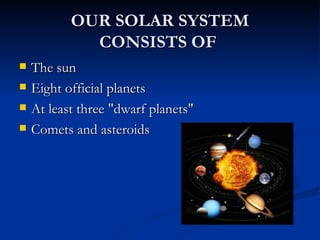
   The sun
   Eight official planets
   At least three "dwarf planets"
   Comets and asteroids
THE SUN
    THE STAR AT THE CENTER OF
        THE SOLAR SYSTEM
   The largest object in the solar system
   One hundred and nine Earths would be required
    to fit across the Sun's disk, and its interior could
    hold over 1.3 million Earths
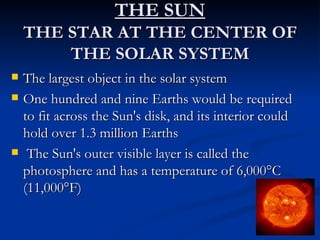
    The Sun's outer visible layer is called the
    photosphere and has a temperature of 6,000°C
    (11,000°F)
MERCURY
   About the same size as the Moon
   Closest planet to the Sun, about 58 million kilometers
    from the Sun
    Makes one complete orbit around the Sun every 87.97
    days
    Rotates on its axis very slowly compared to Earth. It
    completes one rotation in about 58 days and 15 minutes

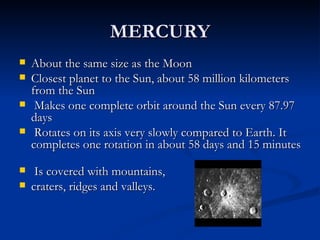
    Is covered with mountains,
   craters, ridges and valleys.
MERCURY
 Q&A
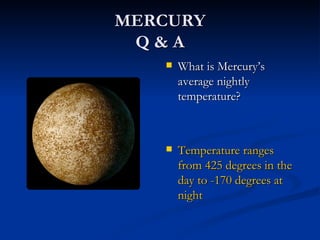
      What is Mercury’s
       average nightly
       temperature?


      Temperature ranges
       from 425 degrees in the
       day to -170 degrees at
       night
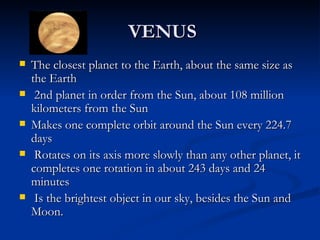
VENUS
   The closest planet to the Earth, about the same size as
    the Earth
    2nd planet in order from the Sun, about 108 million
    kilometers from the Sun
   Makes one complete orbit around the Sun every 224.7
    days
    Rotates on its axis more slowly than any other planet, it
    completes one rotation in about 243 days and 24
    minutes
    Is the brightest object in our sky, besides the Sun and
    Moon.
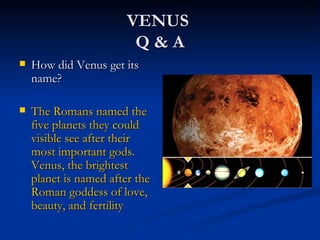
VENUS
                         Q&A
   How did Venus get its
    name?

   The Romans named the
    five planets they could
    visible see after their
    most important gods.
    Venus, the brightest
    planet is named after the
    Roman goddess of love,
    beauty, and fertility
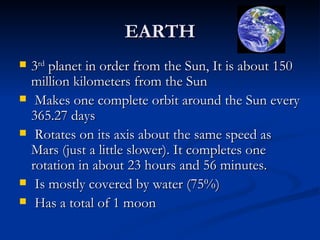
EARTH
   3rd planet in order from the Sun, It is about 150
    million kilometers from the Sun
    Makes one complete orbit around the Sun every
    365.27 days
    Rotates on its axis about the same speed as
    Mars (just a little slower). It completes one
    rotation in about 23 hours and 56 minutes.
    Is mostly covered by water (75%)
    Has a total of 1 moon
EARTH
 Q&A
     Why is Earth called the
      “Blue Planet”?


     Earth is around 70 %
      water and when viewed
      from space it appears
      mostly blue.
MARS
              THE RED PLANET
   Its mass (weight) is 1/10th of the Earth, its diameter is
    1/2 that of earth
     4th planet from the Sun, it is about 228 million
    kilometers from the Sun
     Makes one complete orbit around the Sun every
    686.98 days
    Rotates on its axis about the same speed as the Earth.
    It completes one rotation in about 24 hours and 37
    minutes.
   Has seasons similar to our planet, but they last much
    longer
    Has a total of 2 moons
MARS
                         Q&A
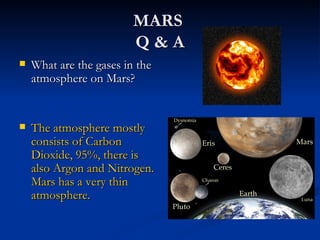
   What are the gases in the
    atmosphere on Mars?


   The atmosphere mostly
    consists of Carbon
    Dioxide, 95%, there is
    also Argon and Nitrogen.
    Mars has a very thin
    atmosphere.
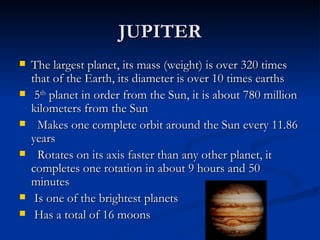
JUPITER
   The largest planet, its mass (weight) is over 320 times
    that of the Earth, its diameter is over 10 times earths
    5th planet in order from the Sun, it is about 780 million
    kilometers from the Sun
     Makes one complete orbit around the Sun every 11.86
    years
     Rotates on its axis faster than any other planet, it
    completes one rotation in about 9 hours and 50
    minutes
    Is one of the brightest planets
    Has a total of 16 moons
JUPITER
 Q&A
      What is special about
       Jupiter?


      The thing that is special
       about Jupiter is that it
       has a big red spot. The
       big red spot is a storm.
       Jupiter is cold and rocky.
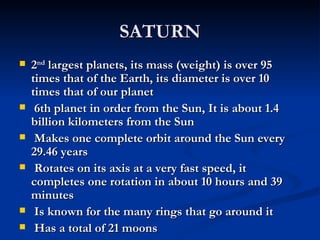
SATURN
   2nd largest planets, its mass (weight) is over 95
    times that of the Earth, its diameter is over 10
    times that of our planet
    6th planet in order from the Sun, It is about 1.4
    billion kilometers from the Sun
    Makes one complete orbit around the Sun every
    29.46 years
    Rotates on its axis at a very fast speed, it
    completes one rotation in about 10 hours and 39
    minutes
    Is known for the many rings that go around it
    Has a total of 21 moons
SATURN
 Q&A
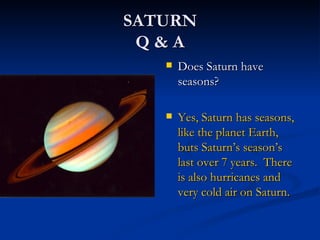
      Does Saturn have
       seasons?

      Yes, Saturn has seasons,
       like the planet Earth,
       buts Saturn’s season’s
       last over 7 years. There
       is also hurricanes and
       very cold air on Saturn.
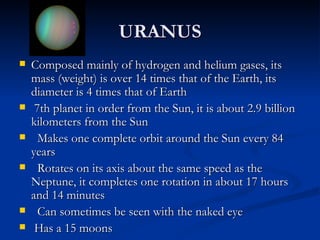
URANUS
   Composed mainly of hydrogen and helium gases, its
    mass (weight) is over 14 times that of the Earth, its
    diameter is 4 times that of Earth
    7th planet in order from the Sun, it is about 2.9 billion
    kilometers from the Sun
     Makes one complete orbit around the Sun every 84
    years
     Rotates on its axis about the same speed as the
    Neptune, it completes one rotation in about 17 hours
    and 14 minutes
     Can sometimes be seen with the naked eye
    Has a 15 moons
URANUS
                           Q&A
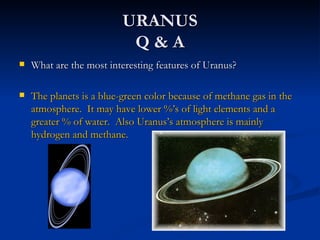
   What are the most interesting features of Uranus?

   The planets is a blue-green color because of methane gas in the
    atmosphere. It may have lower %’s of light elements and a
    greater % of water. Also Uranus’s atmosphere is mainly
    hydrogen and methane.
NEPTUNE
   Very similar to Uranus in size, its mass (weight) is over
    17 times that of the Earth, its diameter is 4 times that of
    earth
   8th planet in order from the Sun, it is about 4.5 billion
    kilometers from the Sun
    Makes one complete orbit around the Sun every 164.79
    years
    Rotates on its axis about the same speed as Uranus, it
    completes one rotation in about 18 hours and 26
    minutes
    Has a weather system that is very active, some storms
    with winds of 400 miles per hour have lasted for
    hundreds of years on its surface
    Has a total of 8 moons
NEPTUNE Q & A


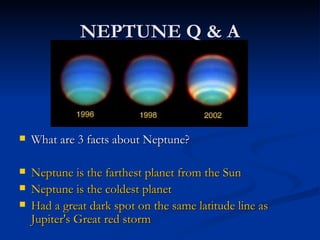
   What are 3 facts about Neptune?

   Neptune is the farthest planet from the Sun
   Neptune is the coldest planet
   Had a great dark spot on the same latitude line as
    Jupiter's Great red storm
PLUTO
   Is known now as a dwarf planet, its mass (weight) is
    1/500th that of the Earth, its diameter is about 1/6 that
    of our planet
   It is about 5.9 billion kilometers from the Sun
     Makes one complete orbit around the Sun every 248
    years
    Rotates on its axis slowly when compared to Earth, it
    completes one rotation in about 6 days and 9 minutes
    Is sometimes known as a double-planet because it has
    a moon (Charon) that orbits it
    Has a total of 1 moon
PLUTO
                           Q&A
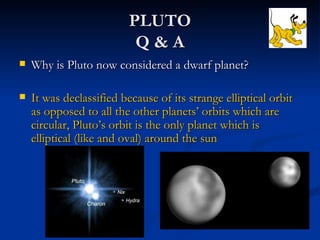
   Why is Pluto now considered a dwarf planet?

   It was declassified because of its strange elliptical orbit
    as opposed to all the other planets’ orbits which are
    circular, Pluto’s orbit is the only planet which is
    elliptical (like and oval) around the sun

The Solar System

  • 2.
    OUR SOLAR SYSTEM CONSISTS OF  The sun  Eight official planets  At least three "dwarf planets"  Comets and asteroids
  • 3.
    THE SUN THE STAR AT THE CENTER OF THE SOLAR SYSTEM  The largest object in the solar system  One hundred and nine Earths would be required to fit across the Sun's disk, and its interior could hold over 1.3 million Earths  The Sun's outer visible layer is called the photosphere and has a temperature of 6,000°C (11,000°F)
  • 4.
    MERCURY  About the same size as the Moon  Closest planet to the Sun, about 58 million kilometers from the Sun  Makes one complete orbit around the Sun every 87.97 days  Rotates on its axis very slowly compared to Earth. It completes one rotation in about 58 days and 15 minutes  Is covered with mountains,  craters, ridges and valleys.
  • 5.
    MERCURY Q&A  What is Mercury’s average nightly temperature?  Temperature ranges from 425 degrees in the day to -170 degrees at night
  • 6.
    VENUS  The closest planet to the Earth, about the same size as the Earth  2nd planet in order from the Sun, about 108 million kilometers from the Sun  Makes one complete orbit around the Sun every 224.7 days  Rotates on its axis more slowly than any other planet, it completes one rotation in about 243 days and 24 minutes  Is the brightest object in our sky, besides the Sun and Moon.
  • 7.
    VENUS Q&A  How did Venus get its name?  The Romans named the five planets they could visible see after their most important gods. Venus, the brightest planet is named after the Roman goddess of love, beauty, and fertility
  • 8.
    EARTH  3rd planet in order from the Sun, It is about 150 million kilometers from the Sun  Makes one complete orbit around the Sun every 365.27 days  Rotates on its axis about the same speed as Mars (just a little slower). It completes one rotation in about 23 hours and 56 minutes.  Is mostly covered by water (75%)  Has a total of 1 moon
  • 9.
    EARTH Q&A  Why is Earth called the “Blue Planet”?  Earth is around 70 % water and when viewed from space it appears mostly blue.
  • 10.
    MARS THE RED PLANET  Its mass (weight) is 1/10th of the Earth, its diameter is 1/2 that of earth  4th planet from the Sun, it is about 228 million kilometers from the Sun  Makes one complete orbit around the Sun every 686.98 days  Rotates on its axis about the same speed as the Earth. It completes one rotation in about 24 hours and 37 minutes.  Has seasons similar to our planet, but they last much longer  Has a total of 2 moons
  • 11.
    MARS Q&A  What are the gases in the atmosphere on Mars?  The atmosphere mostly consists of Carbon Dioxide, 95%, there is also Argon and Nitrogen. Mars has a very thin atmosphere.
  • 12.
    JUPITER  The largest planet, its mass (weight) is over 320 times that of the Earth, its diameter is over 10 times earths  5th planet in order from the Sun, it is about 780 million kilometers from the Sun  Makes one complete orbit around the Sun every 11.86 years  Rotates on its axis faster than any other planet, it completes one rotation in about 9 hours and 50 minutes  Is one of the brightest planets  Has a total of 16 moons
  • 13.
    JUPITER Q&A  What is special about Jupiter?  The thing that is special about Jupiter is that it has a big red spot. The big red spot is a storm. Jupiter is cold and rocky.
  • 14.
    SATURN  2nd largest planets, its mass (weight) is over 95 times that of the Earth, its diameter is over 10 times that of our planet  6th planet in order from the Sun, It is about 1.4 billion kilometers from the Sun  Makes one complete orbit around the Sun every 29.46 years  Rotates on its axis at a very fast speed, it completes one rotation in about 10 hours and 39 minutes  Is known for the many rings that go around it  Has a total of 21 moons
  • 15.
    SATURN Q&A  Does Saturn have seasons?  Yes, Saturn has seasons, like the planet Earth, buts Saturn’s season’s last over 7 years. There is also hurricanes and very cold air on Saturn.
  • 16.
    URANUS  Composed mainly of hydrogen and helium gases, its mass (weight) is over 14 times that of the Earth, its diameter is 4 times that of Earth  7th planet in order from the Sun, it is about 2.9 billion kilometers from the Sun  Makes one complete orbit around the Sun every 84 years  Rotates on its axis about the same speed as the Neptune, it completes one rotation in about 17 hours and 14 minutes  Can sometimes be seen with the naked eye  Has a 15 moons
  • 17.
    URANUS Q&A  What are the most interesting features of Uranus?  The planets is a blue-green color because of methane gas in the atmosphere. It may have lower %’s of light elements and a greater % of water. Also Uranus’s atmosphere is mainly hydrogen and methane.
  • 18.
    NEPTUNE  Very similar to Uranus in size, its mass (weight) is over 17 times that of the Earth, its diameter is 4 times that of earth  8th planet in order from the Sun, it is about 4.5 billion kilometers from the Sun  Makes one complete orbit around the Sun every 164.79 years  Rotates on its axis about the same speed as Uranus, it completes one rotation in about 18 hours and 26 minutes  Has a weather system that is very active, some storms with winds of 400 miles per hour have lasted for hundreds of years on its surface  Has a total of 8 moons
  • 19.
    NEPTUNE Q &A  What are 3 facts about Neptune?  Neptune is the farthest planet from the Sun  Neptune is the coldest planet  Had a great dark spot on the same latitude line as Jupiter's Great red storm
  • 20.
    PLUTO  Is known now as a dwarf planet, its mass (weight) is 1/500th that of the Earth, its diameter is about 1/6 that of our planet  It is about 5.9 billion kilometers from the Sun  Makes one complete orbit around the Sun every 248 years  Rotates on its axis slowly when compared to Earth, it completes one rotation in about 6 days and 9 minutes  Is sometimes known as a double-planet because it has a moon (Charon) that orbits it  Has a total of 1 moon
  • 21.
    PLUTO Q&A  Why is Pluto now considered a dwarf planet?  It was declassified because of its strange elliptical orbit as opposed to all the other planets’ orbits which are circular, Pluto’s orbit is the only planet which is elliptical (like and oval) around the sun