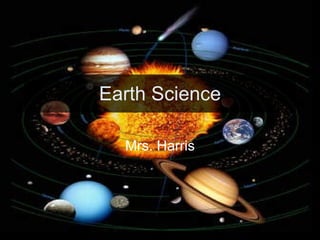
Earth Science Mrs. Harris
This week’s objectives Characteristics of the inner planets Characteristics of the outer planets Comparing the size and distance
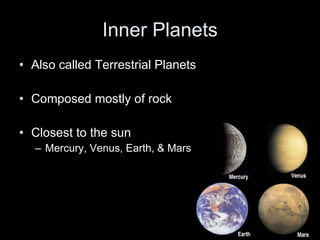
Inner Planets Also called Terrestrial Planets Composed mostly of rock Closest to the sun Mercury, Venus, Earth, & Mars
Mercury Takes 88 Earth days to travel around the sun Takes 59 days to rotate once on its axis Being so close to the sun, it gets really hot! But without much of an atmosphere the heat leaves quickly!  Today on Mercury we’ll have a balmy high of 800 o F and a night time low of chilly -280 o F
Venus Takes 225 days to orbit the sun Takes 243 days to rotate on its axis!!! Most similar to Earth  (size, density, distance from sun)…  however… Atmosphere of 97% carbon dioxide- it’s greenhouse effect is extreme! If you like sunny days and temperatures around 860 o F, then Venus is for you!
Earth Takes 365 ¼ days to orbit the sun Rotates on its axis once a day One moon named Moon   Amazing combination of liquid water and an oxygen-rich atmosphere to support life  Temperatures range from -160 o F to 140 o F
Mars Takes 687 days to orbit the sun Takes about 24 hours to rotate on it’s axis Because of a tilt in the axis, Mars also experiences seasonal changes Two moons: Phobos and Deimos Temperatures from -125 o F to 23 o F
Martians?  Scientists have been looking for evidence of life on Mars Scientists have also been looking for water on Mars Some think it is possible for us to make an atmosphere on Mars to eventually make it a second planet for us! We could be the first Martians! http://videos.howstuffworks.com/tlc/31625-solar-empire-turning-mars-into-earth-video.htm
Outer Planets Also called the Gas Giants An asteroid belt separates the inner and outer planets All the Gas Giants are less dense than the inner planets and they all have rings Jupiter, Saturn, Uranus, & Neptune (Remember Pluto was taken off the list of official planets and is now a dwarf planet)
Jupiter Takes 12 years to orbit the sun Fastest rotation: about 10 hours on its axis Jupiter’s mass = mass of all other planets x 2! Made of mostly helium and hydrogen Has about 60 moons! Four are the size of small planets:  Io, Europa, Callisto, & Gannymede The Great Red Spot  (3 Earth’s would fit in it) Average temperature: a brisk -230 o F
Saturn Takes 29 ½ years to orbit the sun Takes about 10 ½ hours to spin on it’s axis Most famous for it’s rings- made of ice and dust debris Saturn has 47 moons… so far Saturn also consists mostly of helium and hydrogen, but is the least dense of all You’ll find a chilly average temp of -280 o F
Uranus Takes 84 years to get around the sun Rotates on it’s axis every 17 hours Unlike other planets, it’s axis mostly points towards the sun Has 27 moons and 11 rings Also, mostly made of helium and hydrogen but it’s blue appearance comes from methane in the atmosphere Cool blue -360 o F
Neptune Takes about 164 years to orbit the sun Rotates on it’s axis about every 16 hours Is also blue because of methane It was known before it was seen! Because it affects the orbit of Uranus, astronomers were able to figure out where Neptune was located before it was seen! 13 moons and 6 rings and a nippy -350 o F
Pop Quiz What is the name of the region beyond the Gas Giants? * hint… it’s a belt*
Comparisons Check out this video that gives a great visual on the sizes of the planets and even the size of our sun against other stars! http://www.youtube.com/watch?v=BS88G5WBcfQ&feature=PlayList&p=3C4F39B2897AEFE6&playnext=1&playnext_from=PL&index=20 We’re going to group up and fill out the table on the next slide: http://science.nationalgeographic.com/science/space/solar-system.html
Planet Diameter Distance from sun 130 lbs. weighs… Mercury Venus Earth Mars Jupiter Saturn Uranus Neptune “ Pluto”

Planets Lesson

  • 1.
  • 2.
    This week’s objectivesCharacteristics of the inner planets Characteristics of the outer planets Comparing the size and distance
  • 3.
    Inner Planets Alsocalled Terrestrial Planets Composed mostly of rock Closest to the sun Mercury, Venus, Earth, & Mars
  • 4.
    Mercury Takes 88Earth days to travel around the sun Takes 59 days to rotate once on its axis Being so close to the sun, it gets really hot! But without much of an atmosphere the heat leaves quickly! Today on Mercury we’ll have a balmy high of 800 o F and a night time low of chilly -280 o F
  • 5.
    Venus Takes 225days to orbit the sun Takes 243 days to rotate on its axis!!! Most similar to Earth (size, density, distance from sun)… however… Atmosphere of 97% carbon dioxide- it’s greenhouse effect is extreme! If you like sunny days and temperatures around 860 o F, then Venus is for you!
  • 6.
    Earth Takes 365¼ days to orbit the sun Rotates on its axis once a day One moon named Moon  Amazing combination of liquid water and an oxygen-rich atmosphere to support life Temperatures range from -160 o F to 140 o F
  • 7.
    Mars Takes 687days to orbit the sun Takes about 24 hours to rotate on it’s axis Because of a tilt in the axis, Mars also experiences seasonal changes Two moons: Phobos and Deimos Temperatures from -125 o F to 23 o F
  • 8.
    Martians? Scientistshave been looking for evidence of life on Mars Scientists have also been looking for water on Mars Some think it is possible for us to make an atmosphere on Mars to eventually make it a second planet for us! We could be the first Martians! http://videos.howstuffworks.com/tlc/31625-solar-empire-turning-mars-into-earth-video.htm
  • 9.
    Outer Planets Alsocalled the Gas Giants An asteroid belt separates the inner and outer planets All the Gas Giants are less dense than the inner planets and they all have rings Jupiter, Saturn, Uranus, & Neptune (Remember Pluto was taken off the list of official planets and is now a dwarf planet)
  • 10.
    Jupiter Takes 12years to orbit the sun Fastest rotation: about 10 hours on its axis Jupiter’s mass = mass of all other planets x 2! Made of mostly helium and hydrogen Has about 60 moons! Four are the size of small planets: Io, Europa, Callisto, & Gannymede The Great Red Spot (3 Earth’s would fit in it) Average temperature: a brisk -230 o F
  • 11.
    Saturn Takes 29½ years to orbit the sun Takes about 10 ½ hours to spin on it’s axis Most famous for it’s rings- made of ice and dust debris Saturn has 47 moons… so far Saturn also consists mostly of helium and hydrogen, but is the least dense of all You’ll find a chilly average temp of -280 o F
  • 12.
    Uranus Takes 84years to get around the sun Rotates on it’s axis every 17 hours Unlike other planets, it’s axis mostly points towards the sun Has 27 moons and 11 rings Also, mostly made of helium and hydrogen but it’s blue appearance comes from methane in the atmosphere Cool blue -360 o F
  • 13.
    Neptune Takes about164 years to orbit the sun Rotates on it’s axis about every 16 hours Is also blue because of methane It was known before it was seen! Because it affects the orbit of Uranus, astronomers were able to figure out where Neptune was located before it was seen! 13 moons and 6 rings and a nippy -350 o F
  • 14.
    Pop Quiz Whatis the name of the region beyond the Gas Giants? * hint… it’s a belt*
  • 15.
    Comparisons Check outthis video that gives a great visual on the sizes of the planets and even the size of our sun against other stars! http://www.youtube.com/watch?v=BS88G5WBcfQ&feature=PlayList&p=3C4F39B2897AEFE6&playnext=1&playnext_from=PL&index=20 We’re going to group up and fill out the table on the next slide: http://science.nationalgeographic.com/science/space/solar-system.html
  • 16.
    Planet Diameter Distancefrom sun 130 lbs. weighs… Mercury Venus Earth Mars Jupiter Saturn Uranus Neptune “ Pluto”