Ecology Review Chapter 5, Lessons 1-6
Organisms An  organism  is any living things. This includes plants, animals, bacteria, and even fungi. All organisms are also biotic. Can you list some organisms that you know of?
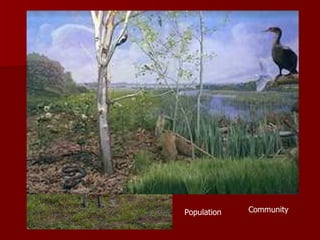
Populations Many  populations  make up the living parts of an ecosystem.  A population is a group of organisms of one species that live in an area at the same time.  A population may be all the pine trees or all the squirrels in an area.
Community A  community  is made up of all the populations in an area. Members of a community depend on each other to fill needs, such as food and shelter. In other words, a community is all the living things in an area and they all depend on each other.
Organism Population Community
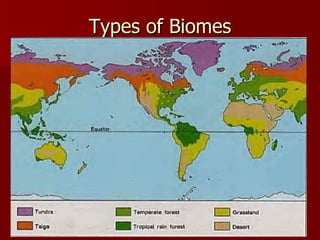
Biomes A  biome  is a large ecosystem with generally the same climate and organisms.  All the biomes together create the  biosphere . (The part of Earth in which all living things are located.) There several types of biomes.
Types of Biomes
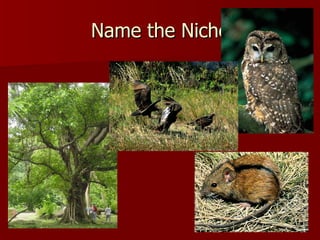
Habitats A  habitat  is the place in which an organism lives.  Made up of the soil, air, and water, as well as the plants of the area.  What is your habitat made up of? A  niche  is the role or job of a specific organism.  Each organism has a specific niche.  The niche of a spotted owl in his habitat is that of a hunter.  What is the niche of a mushroom?
Name the Niche
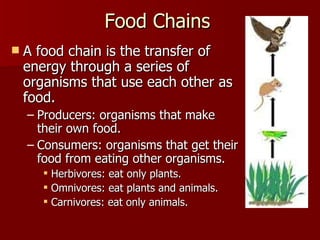
Food Chains A food chain is the transfer of energy through a series of organisms that use each other as food.  Producers: organisms that make their own food.  Consumers: organisms that get their food from eating other organisms. Herbivores: eat only plants. Omnivores: eat plants and animals. Carnivores: eat only animals.
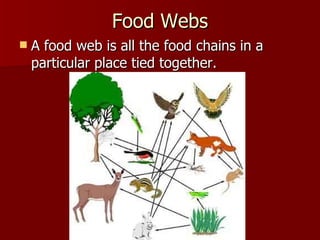
Food Webs A food web is all the food chains in a particular place tied together.
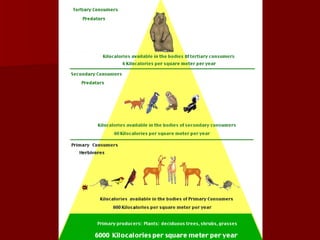
Energy Pyramids An  energy pyramid  is a diagram that shows the amounts of energy that flows through each level of a food chain.  Example:  Plants get energy from the sunlight. They store some of it. Hares (herbivores) get energy from the plants. Only a small amount of this energy is stored. Owls get energy from eating animals. Only a small fraction of this energy is stored.
 
Cycles A cycle is a repeating process or flow of material through a system.  Nitrogen Cycle Carbon/Carbon Dioxide Cycle
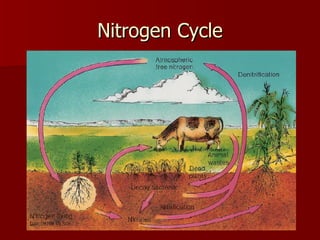
Nitrogen Cycle
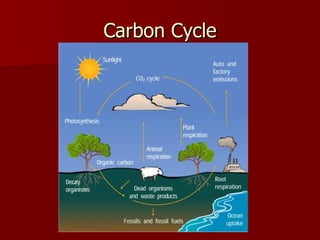
Carbon Cycle
Credit Slide All information was retrieved from Scott Foresman Chapter 5, Lessons 1-6 All pictures were retrieved from a Yahoo Search.

Ecology Review

  • 1.
    Ecology Review Chapter5, Lessons 1-6
  • 2.
    Organisms An organism is any living things. This includes plants, animals, bacteria, and even fungi. All organisms are also biotic. Can you list some organisms that you know of?
  • 3.
    Populations Many populations make up the living parts of an ecosystem. A population is a group of organisms of one species that live in an area at the same time. A population may be all the pine trees or all the squirrels in an area.
  • 4.
    Community A community is made up of all the populations in an area. Members of a community depend on each other to fill needs, such as food and shelter. In other words, a community is all the living things in an area and they all depend on each other.
  • 5.
  • 6.
    Biomes A biome is a large ecosystem with generally the same climate and organisms. All the biomes together create the biosphere . (The part of Earth in which all living things are located.) There several types of biomes.
  • 7.
  • 8.
    Habitats A habitat is the place in which an organism lives. Made up of the soil, air, and water, as well as the plants of the area. What is your habitat made up of? A niche is the role or job of a specific organism. Each organism has a specific niche. The niche of a spotted owl in his habitat is that of a hunter. What is the niche of a mushroom?
  • 9.
  • 10.
    Food Chains Afood chain is the transfer of energy through a series of organisms that use each other as food. Producers: organisms that make their own food. Consumers: organisms that get their food from eating other organisms. Herbivores: eat only plants. Omnivores: eat plants and animals. Carnivores: eat only animals.
  • 11.
    Food Webs Afood web is all the food chains in a particular place tied together.
  • 12.
    Energy Pyramids An energy pyramid is a diagram that shows the amounts of energy that flows through each level of a food chain. Example: Plants get energy from the sunlight. They store some of it. Hares (herbivores) get energy from the plants. Only a small amount of this energy is stored. Owls get energy from eating animals. Only a small fraction of this energy is stored.
  • 13.
  • 14.
    Cycles A cycleis a repeating process or flow of material through a system. Nitrogen Cycle Carbon/Carbon Dioxide Cycle
  • 15.
  • 16.
  • 17.
    Credit Slide Allinformation was retrieved from Scott Foresman Chapter 5, Lessons 1-6 All pictures were retrieved from a Yahoo Search.