The Solar SystemThe Solar System
An IntroAn Intro
Designed ByDesigned By
www.CBSEQuestionPaper.comwww.CBSEQuestionPaper.com
About the lesson….About the lesson….
Things we will learn:
 Components of our Solar System.
 Relative positions of our planets.
 Some Interesting facts about space!!!
 More about Sun.
 What are Planets & Satellites??
 Terrestrial and Jovian Planets.
 About Asteroids, Meteors and Comets.
 Internal Structure of Earth
An IntroductionAn Introduction
Solar System consists of:Solar System consists of:
SunSun
TheThe Nine PlanetsNine Planets (Mercury, Venus, Earth, Mars, Jupiter,(Mercury, Venus, Earth, Mars, Jupiter,
Saturn, Uranus, Neptune, Pluto)Saturn, Uranus, Neptune, Pluto)
Large number ofLarge number of AsteroidsAsteroids between the orbit of Marsbetween the orbit of Mars
and Jupiterand Jupiter
Large number ofLarge number of CometsComets revolving around sun in highlyrevolving around sun in highly
elliptical paths.elliptical paths.
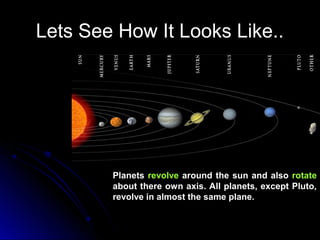
Lets See How It Looks Like..Lets See How It Looks Like..
Planets revolve around the sun and also rotate
about there own axis. All planets, except Pluto,
revolve in almost the same plane.
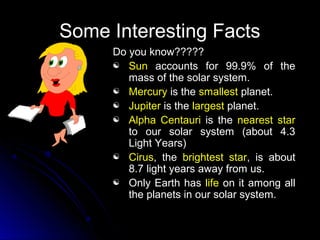
Some Interesting FactsSome Interesting Facts
Do you know?????Do you know?????
 SunSun accounts for 99.9% of theaccounts for 99.9% of the
mass of the solar system.mass of the solar system.
 MercuryMercury is theis the smallestsmallest planet.planet.
 JupiterJupiter is theis the largestlargest planet.planet.
 Alpha CentauriAlpha Centauri is theis the nearest starnearest star
to our solar system (about 4.3to our solar system (about 4.3
Light Years)Light Years)
 CirusCirus, the, the brightest starbrightest star, is about, is about
8.7 light years away from us.8.7 light years away from us.
 Only Earth hasOnly Earth has lifelife on it among allon it among all
the planets in our solar system.the planets in our solar system.
SunSun The centre of Attraction!!The centre of Attraction!!
It is the nearest star from us and hence looks much bigger than
other stars.
The sun has a diameter of about 1, 392, 000 Km
(about 109 times the diameter of earth!!!!)
Sun is about 333000 times as heavy as Earth.
Average distance of sun from earth is 15 crore Km
Light takes about 500s (about 8 minutes) to travel from sun to
earth.
The temperature at the core of Sun is about 14 x 106
Kelvin.
Sun is the source of energy for earth. It is made up ofSun is the source of energy for earth. It is made up of HydrogenHydrogen
(70%),(70%), Helium (28%)Helium (28%) and other gases like Nitrogen, Oxygen andand other gases like Nitrogen, Oxygen and
Carbon (2%). The energy is produced in the Sun due toCarbon (2%). The energy is produced in the Sun due to NuclearNuclear
Fusion ReactionFusion Reaction in which four hydrogen nuclei fuse to form ain which four hydrogen nuclei fuse to form a
Helium nuclei (and two positrons).Helium nuclei (and two positrons).
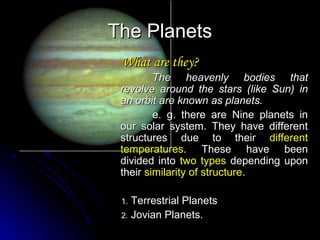
The PlanetsThe Planets
What are they?What are they?
The heavenly bodies thatThe heavenly bodies that
revolve around the stars (like Sun) inrevolve around the stars (like Sun) in
an orbit are known as planets.an orbit are known as planets.
e. g. there are Nine planets ine. g. there are Nine planets in
our solar system. They have differentour solar system. They have different
structures due to theirstructures due to their differentdifferent
temperaturestemperatures. These have been. These have been
divided intodivided into two typestwo types depending upondepending upon
theirtheir similarity of structuresimilarity of structure..
1.1. Terrestrial PlanetsTerrestrial Planets
2.2. Jovian Planets.Jovian Planets.
Terrestrial PlanetsTerrestrial Planets
The four planets near to Sun, namelyThe four planets near to Sun, namely Mercury, Venus,Mercury, Venus,
Earth and MarsEarth and Mars are known as Terrestrial Planetsare known as Terrestrial Planets
because theirbecause their structure is similar to Earth.structure is similar to Earth.
Common FeaturesCommon Features of these planets are:of these planets are:
i.i. A thin rocky crust.A thin rocky crust.
ii.ii. A mantle rich in Iron and MagnesiumA mantle rich in Iron and Magnesium
iii.iii. A core of Molten Metals.A core of Molten Metals.
iv.iv. Thin atmosphereThin atmosphere
v.v. Very few moonsVery few moons
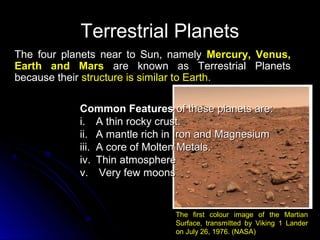
The first colour image of the Martian
Surface, transmitted by Viking 1 Lander
on July 26, 1976. (NASA)
Jovian PlanetsJovian Planets
The five planets beyond the orbit of Mars are known asThe five planets beyond the orbit of Mars are known as
Terrestrial Planets because theirTerrestrial Planets because their structure is similar tostructure is similar to
JupiterJupiter. These are. These are Jupiter, Saturn, Uranus, Neptune &Jupiter, Saturn, Uranus, Neptune &
Pluto.Pluto.
Common FeaturesCommon Features of these planets are:of these planets are:
i.i. They are Gaseous BodiesThey are Gaseous Bodies
ii.ii. They have ring system around them.They have ring system around them.
iii.iii. Except Pluto they all have a large numberExcept Pluto they all have a large number
of moons (i.e. natural satellites). Pluto hasof moons (i.e. natural satellites). Pluto has
only one moon.only one moon.
iv.iv. They are too distant from Sun as comparedThey are too distant from Sun as compared
to Terrestrial Planets.to Terrestrial Planets.
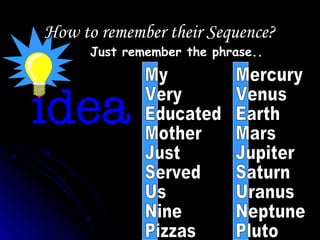
How to remember their Sequence?How to remember their Sequence?
Just remember the phrase..
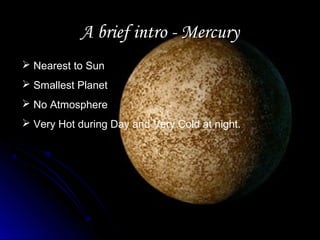
A brief intro - MercuryA brief intro - Mercury
 Nearest to Sun
 Smallest Planet
 No Atmosphere
 Very Hot during Day and Very Cold at night.
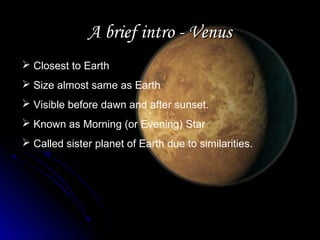
A brief intro - VenusA brief intro - Venus
 Closest to Earth
 Size almost same as Earth
 Visible before dawn and after sunset.
 Known as Morning (or Evening) Star
 Called sister planet of Earth due to similarities.
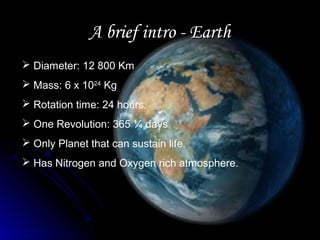
A brief intro - EarthA brief intro - Earth
 Diameter: 12 800 Km
 Mass: 6 x 1024
Kg
 Rotation time: 24 hours.
 One Revolution: 365 ¼ days
 Only Planet that can sustain life.
 Has Nitrogen and Oxygen rich atmosphere.
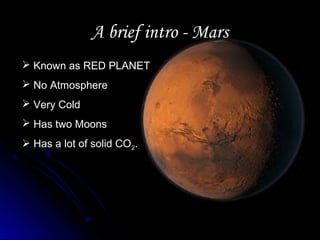
A brief intro - MarsA brief intro - Mars
 Known as RED PLANET
 No Atmosphere
 Very Cold
 Has two Moons
 Has a lot of solid CO2.
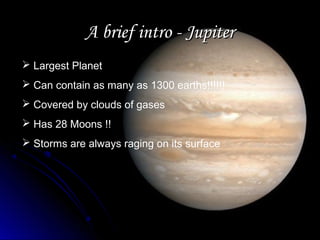
A brief intro - JupiterA brief intro - Jupiter
 Largest Planet
 Can contain as many as 1300 earths!!!!!!
 Covered by clouds of gases
 Has 28 Moons !!
 Storms are always raging on its surface
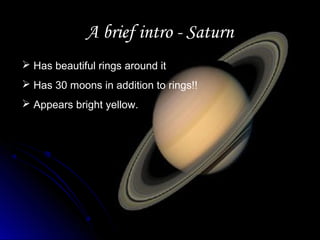
A brief intro - SaturnA brief intro - Saturn
 Has beautiful rings around it
 Has 30 moons in addition to rings!!
 Appears bright yellow.
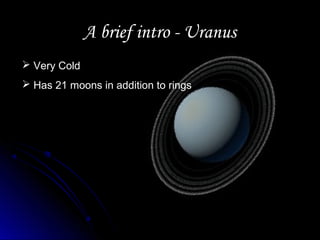
A brief intro - UranusA brief intro - Uranus
 Very Cold
 Has 21 moons in addition to rings
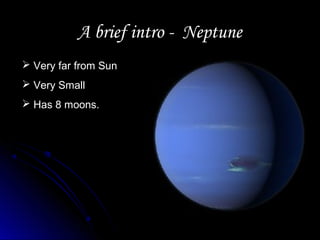
A brief intro - NeptuneA brief intro - Neptune
 Very far from Sun
 Very Small
 Has 8 moons.
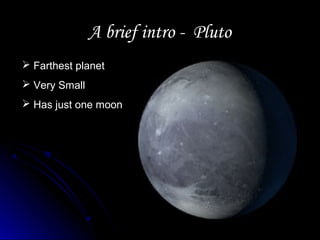
A brief intro - PlutoA brief intro - Pluto
 Farthest planet
 Very Small
 Has just one moon
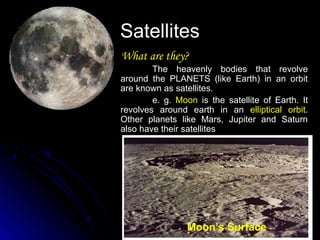
SatellitesSatellites
What are they?What are they?
The heavenly bodies that revolveThe heavenly bodies that revolve
around the PLANETS (like Earth) in an orbitaround the PLANETS (like Earth) in an orbit
are known as satellites.are known as satellites.
e. g.e. g. MoonMoon is the satellite of Earth. Itis the satellite of Earth. It
revolves around earth in anrevolves around earth in an elliptical orbitelliptical orbit..
Other planets like Mars, Jupiter and SaturnOther planets like Mars, Jupiter and Saturn
also have their satellitesalso have their satellites
Moon’s Surface
AsteroidsAsteroids
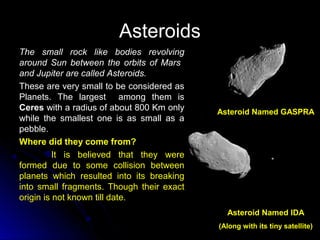
The small rock like bodies revolvingThe small rock like bodies revolving
around Sun between the orbits of Marsaround Sun between the orbits of Mars
and Jupiter are called Asteroids.and Jupiter are called Asteroids.
These are very small to be considered asThese are very small to be considered as
Planets. The largest among them isPlanets. The largest among them is
CeresCeres with a radius of about 800 Km onlywith a radius of about 800 Km only
while the smallest one is as small as awhile the smallest one is as small as a
pebble.pebble.
Where did they come from?
It is believed that they were
formed due to some collision between
planets which resulted into its breaking
into small fragments. Though their exact
origin is not known till date.
Asteroid Named GASPRA
Asteroid Named IDA
(Along with its tiny satellite)
MeteorsMeteors
(Shooting Stars)(Shooting Stars)
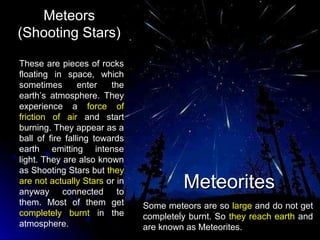
These are pieces of rocks
floating in space, which
sometimes enter the
earth’s atmosphere. They
experience a force of
friction of air and start
burning. They appear as a
ball of fire falling towards
earth emitting intense
light. They are also known
as Shooting Stars but they
are not actually Stars or in
anyway connected to
them. Most of them get
completely burnt in the
atmosphere.
MeteoritesMeteorites
Some meteors are so large and do not get
completely burnt. So they reach earth and
are known as Meteorites.
CometsComets
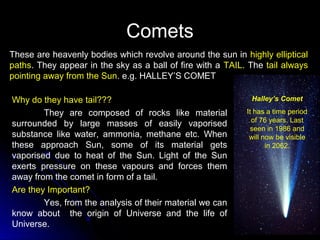
These are heavenly bodies which revolve around the sun in highly elliptical
paths. They appear in the sky as a ball of fire with a TAIL. The tail always
pointing away from the Sun. e.g. HALLEY’S COMET
Why do they have tail???
They are composed of rocks like material
surrounded by large masses of easily vaporised
substance like water, ammonia, methane etc. When
these approach Sun, some of its material gets
vaporised due to heat of the Sun. Light of the Sun
exerts pressure on these vapours and forces them
away from the comet in form of a tail.
Are they Important?
Yes, from the analysis of their material we can
know about the origin of Universe and the life of
Universe.
Halley’s Comet
It has a time period
of 76 years. Last
seen in 1986 and
will now be visible
in 2062.
Structure of EarthStructure of Earth
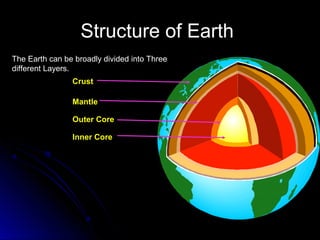
Crust
Mantle
Outer Core
Inner Core
The Earth can be broadly divided into Three
different Layers.
Structure of EarthStructure of Earth
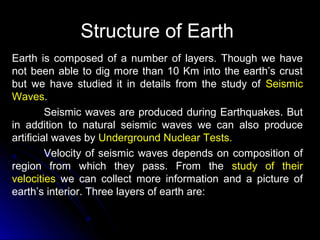
Earth is composed of a number of layers. Though we have
not been able to dig more than 10 Km into the earth’s crust
but we have studied it in details from the study of Seismic
Waves.
Seismic waves are produced during Earthquakes. But
in addition to natural seismic waves we can also produce
artificial waves by Underground Nuclear Tests.
Velocity of seismic waves depends on composition of
region from which they pass. From the study of their
velocities we can collect more information and a picture of
earth’s interior. Three layers of earth are:
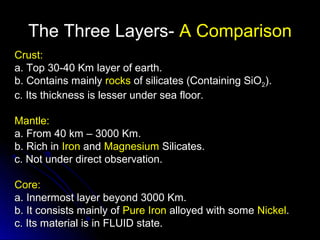
The Three Layers-The Three Layers- A ComparisonA Comparison
Crust:Crust:
a. Top 30-40 Km layer of earth.a. Top 30-40 Km layer of earth.
b. Contains mainlyb. Contains mainly rocksrocks of silicates (Containing SiOof silicates (Containing SiO22).).
c. Its thickness is lesser under sea floor.c. Its thickness is lesser under sea floor.
Mantle:Mantle:
a. From 40 km – 3000 Km.a. From 40 km – 3000 Km.
b. Rich inb. Rich in IronIron andand MagnesiumMagnesium Silicates.Silicates.
c. Not under direct observation.c. Not under direct observation.
Core:Core:
a. Innermost layer beyond 3000 Km.a. Innermost layer beyond 3000 Km.
b. It consists mainly ofb. It consists mainly of Pure IronPure Iron alloyed with somealloyed with some NickelNickel..
c. Its material is in FLUID state.c. Its material is in FLUID state.
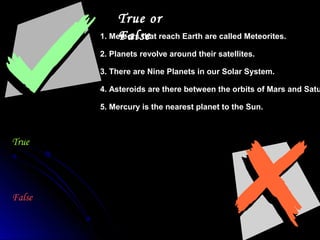
True or
False1. Meteors that reach Earth are called Meteorites.
2. Planets revolve around their satellites.
3. There are Nine Planets in our Solar System.
4. Asteroids are there between the orbits of Mars and Satu
5. Mercury is the nearest planet to the Sun.
True
False
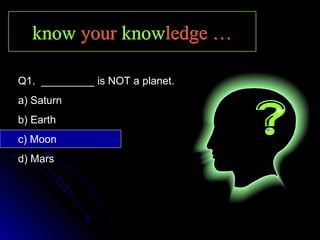
knowknow youryour knowknowledge …ledge …knowknow youryour knowknowledge …ledge …
Q1. _________ is NOT a planet.
a) Saturn
b) Earth
c) Moon
d) Mars
knowknow youryour knowknowledge …ledge …knowknow youryour knowknowledge …ledge …
Q2. The debris present between the
planets Mars and Jupiter are called
__________.
a) Meteors
b) Meteorites
c) Comets
d) Asteroids
knowknow youryour knowknowledge …ledge …knowknow youryour knowknowledge …ledge …
Q3. The ratio of diameter of Sun to
that of earth is _______
a) 109
b) 500
c) 1/109
d) 33000
knowknow youryour knowknowledge …ledge …knowknow youryour knowknowledge …ledge …
Q4. Morning and Evening Star is the
name given to the planet _______
a) Mercury
b) Venus
c) Pluto
d) Neptune
knowknow youryour knowknowledge …ledge …knowknow youryour knowknowledge …ledge …
Q5. Hottest Planet in our Solar
System is:
a) Mars
b) Venus
c) Mercury
d) Earth
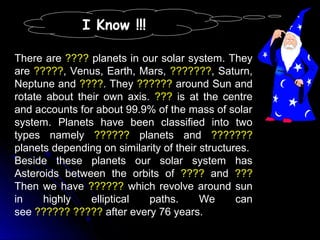
I Know !!!
There are ???? planets in our solar system. They
are ?????, Venus, Earth, Mars, ???????, Saturn,
Neptune and ????. They ?????? around Sun and
rotate about their own axis. ??? is at the centre
and accounts for about 99.9% of the mass of solar
system. Planets have been classified into two
types namely ?????? planets and ???????
planets depending on similarity of their structures.
Beside these planets our solar system has
Asteroids between the orbits of ???? and ???
Then we have ?????? which revolve around sun
in highly elliptical paths. We can
see ?????? ????? after every 76 years.
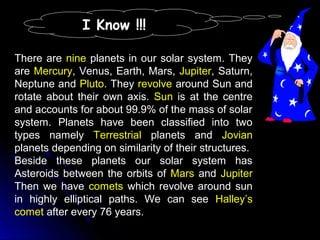
I Know !!!
There are nine planets in our solar system. They
are Mercury, Venus, Earth, Mars, Jupiter, Saturn,
Neptune and Pluto. They revolve around Sun and
rotate about their own axis. Sun is at the centre
and accounts for about 99.9% of the mass of solar
system. Planets have been classified into two
types namely Terrestrial planets and Jovian
planets depending on similarity of their structures.
Beside these planets our solar system has
Asteroids between the orbits of Mars and Jupiter
Then we have comets which revolve around sun
in highly elliptical paths. We can see Halley’s
comet after every 76 years.
Q 1. Name the nine planets of our Solar System.
Q 2. What is a comet?
Q 3. Why is life only possible on earth?
Q 4. Define following terms:
A. Planet
B. Satellite
C. Meteor
D. Asteroids
Q 5. Differentiate between Jovian and terrestrial
planets.
From:
www.cbsequestionpaper.com
For:
Class X Students

The Solar System

  • 1.
    The Solar SystemTheSolar System An IntroAn Intro Designed ByDesigned By www.CBSEQuestionPaper.comwww.CBSEQuestionPaper.com
  • 2.
    About the lesson….Aboutthe lesson…. Things we will learn:  Components of our Solar System.  Relative positions of our planets.  Some Interesting facts about space!!!  More about Sun.  What are Planets & Satellites??  Terrestrial and Jovian Planets.  About Asteroids, Meteors and Comets.  Internal Structure of Earth
  • 3.
    An IntroductionAn Introduction SolarSystem consists of:Solar System consists of: SunSun TheThe Nine PlanetsNine Planets (Mercury, Venus, Earth, Mars, Jupiter,(Mercury, Venus, Earth, Mars, Jupiter, Saturn, Uranus, Neptune, Pluto)Saturn, Uranus, Neptune, Pluto) Large number ofLarge number of AsteroidsAsteroids between the orbit of Marsbetween the orbit of Mars and Jupiterand Jupiter Large number ofLarge number of CometsComets revolving around sun in highlyrevolving around sun in highly elliptical paths.elliptical paths.
  • 4.
    Lets See HowIt Looks Like..Lets See How It Looks Like.. Planets revolve around the sun and also rotate about there own axis. All planets, except Pluto, revolve in almost the same plane.
  • 5.
    Some Interesting FactsSomeInteresting Facts Do you know?????Do you know?????  SunSun accounts for 99.9% of theaccounts for 99.9% of the mass of the solar system.mass of the solar system.  MercuryMercury is theis the smallestsmallest planet.planet.  JupiterJupiter is theis the largestlargest planet.planet.  Alpha CentauriAlpha Centauri is theis the nearest starnearest star to our solar system (about 4.3to our solar system (about 4.3 Light Years)Light Years)  CirusCirus, the, the brightest starbrightest star, is about, is about 8.7 light years away from us.8.7 light years away from us.  Only Earth hasOnly Earth has lifelife on it among allon it among all the planets in our solar system.the planets in our solar system.
  • 6.
    SunSun The centreof Attraction!!The centre of Attraction!! It is the nearest star from us and hence looks much bigger than other stars. The sun has a diameter of about 1, 392, 000 Km (about 109 times the diameter of earth!!!!) Sun is about 333000 times as heavy as Earth. Average distance of sun from earth is 15 crore Km Light takes about 500s (about 8 minutes) to travel from sun to earth. The temperature at the core of Sun is about 14 x 106 Kelvin. Sun is the source of energy for earth. It is made up ofSun is the source of energy for earth. It is made up of HydrogenHydrogen (70%),(70%), Helium (28%)Helium (28%) and other gases like Nitrogen, Oxygen andand other gases like Nitrogen, Oxygen and Carbon (2%). The energy is produced in the Sun due toCarbon (2%). The energy is produced in the Sun due to NuclearNuclear Fusion ReactionFusion Reaction in which four hydrogen nuclei fuse to form ain which four hydrogen nuclei fuse to form a Helium nuclei (and two positrons).Helium nuclei (and two positrons).
  • 7.
    The PlanetsThe Planets Whatare they?What are they? The heavenly bodies thatThe heavenly bodies that revolve around the stars (like Sun) inrevolve around the stars (like Sun) in an orbit are known as planets.an orbit are known as planets. e. g. there are Nine planets ine. g. there are Nine planets in our solar system. They have differentour solar system. They have different structures due to theirstructures due to their differentdifferent temperaturestemperatures. These have been. These have been divided intodivided into two typestwo types depending upondepending upon theirtheir similarity of structuresimilarity of structure.. 1.1. Terrestrial PlanetsTerrestrial Planets 2.2. Jovian Planets.Jovian Planets.
  • 8.
    Terrestrial PlanetsTerrestrial Planets Thefour planets near to Sun, namelyThe four planets near to Sun, namely Mercury, Venus,Mercury, Venus, Earth and MarsEarth and Mars are known as Terrestrial Planetsare known as Terrestrial Planets because theirbecause their structure is similar to Earth.structure is similar to Earth. Common FeaturesCommon Features of these planets are:of these planets are: i.i. A thin rocky crust.A thin rocky crust. ii.ii. A mantle rich in Iron and MagnesiumA mantle rich in Iron and Magnesium iii.iii. A core of Molten Metals.A core of Molten Metals. iv.iv. Thin atmosphereThin atmosphere v.v. Very few moonsVery few moons The first colour image of the Martian Surface, transmitted by Viking 1 Lander on July 26, 1976. (NASA)
  • 9.
    Jovian PlanetsJovian Planets Thefive planets beyond the orbit of Mars are known asThe five planets beyond the orbit of Mars are known as Terrestrial Planets because theirTerrestrial Planets because their structure is similar tostructure is similar to JupiterJupiter. These are. These are Jupiter, Saturn, Uranus, Neptune &Jupiter, Saturn, Uranus, Neptune & Pluto.Pluto. Common FeaturesCommon Features of these planets are:of these planets are: i.i. They are Gaseous BodiesThey are Gaseous Bodies ii.ii. They have ring system around them.They have ring system around them. iii.iii. Except Pluto they all have a large numberExcept Pluto they all have a large number of moons (i.e. natural satellites). Pluto hasof moons (i.e. natural satellites). Pluto has only one moon.only one moon. iv.iv. They are too distant from Sun as comparedThey are too distant from Sun as compared to Terrestrial Planets.to Terrestrial Planets.
  • 10.
    How to remembertheir Sequence?How to remember their Sequence? Just remember the phrase..
  • 11.
    A brief intro- MercuryA brief intro - Mercury  Nearest to Sun  Smallest Planet  No Atmosphere  Very Hot during Day and Very Cold at night.
  • 12.
    A brief intro- VenusA brief intro - Venus  Closest to Earth  Size almost same as Earth  Visible before dawn and after sunset.  Known as Morning (or Evening) Star  Called sister planet of Earth due to similarities.
  • 13.
    A brief intro- EarthA brief intro - Earth  Diameter: 12 800 Km  Mass: 6 x 1024 Kg  Rotation time: 24 hours.  One Revolution: 365 ¼ days  Only Planet that can sustain life.  Has Nitrogen and Oxygen rich atmosphere.
  • 14.
    A brief intro- MarsA brief intro - Mars  Known as RED PLANET  No Atmosphere  Very Cold  Has two Moons  Has a lot of solid CO2.
  • 15.
    A brief intro- JupiterA brief intro - Jupiter  Largest Planet  Can contain as many as 1300 earths!!!!!!  Covered by clouds of gases  Has 28 Moons !!  Storms are always raging on its surface
  • 16.
    A brief intro- SaturnA brief intro - Saturn  Has beautiful rings around it  Has 30 moons in addition to rings!!  Appears bright yellow.
  • 17.
    A brief intro- UranusA brief intro - Uranus  Very Cold  Has 21 moons in addition to rings
  • 18.
    A brief intro- NeptuneA brief intro - Neptune  Very far from Sun  Very Small  Has 8 moons.
  • 19.
    A brief intro- PlutoA brief intro - Pluto  Farthest planet  Very Small  Has just one moon
  • 20.
    SatellitesSatellites What are they?Whatare they? The heavenly bodies that revolveThe heavenly bodies that revolve around the PLANETS (like Earth) in an orbitaround the PLANETS (like Earth) in an orbit are known as satellites.are known as satellites. e. g.e. g. MoonMoon is the satellite of Earth. Itis the satellite of Earth. It revolves around earth in anrevolves around earth in an elliptical orbitelliptical orbit.. Other planets like Mars, Jupiter and SaturnOther planets like Mars, Jupiter and Saturn also have their satellitesalso have their satellites Moon’s Surface
  • 21.
    AsteroidsAsteroids The small rocklike bodies revolvingThe small rock like bodies revolving around Sun between the orbits of Marsaround Sun between the orbits of Mars and Jupiter are called Asteroids.and Jupiter are called Asteroids. These are very small to be considered asThese are very small to be considered as Planets. The largest among them isPlanets. The largest among them is CeresCeres with a radius of about 800 Km onlywith a radius of about 800 Km only while the smallest one is as small as awhile the smallest one is as small as a pebble.pebble. Where did they come from? It is believed that they were formed due to some collision between planets which resulted into its breaking into small fragments. Though their exact origin is not known till date. Asteroid Named GASPRA Asteroid Named IDA (Along with its tiny satellite)
  • 22.
    MeteorsMeteors (Shooting Stars)(Shooting Stars) Theseare pieces of rocks floating in space, which sometimes enter the earth’s atmosphere. They experience a force of friction of air and start burning. They appear as a ball of fire falling towards earth emitting intense light. They are also known as Shooting Stars but they are not actually Stars or in anyway connected to them. Most of them get completely burnt in the atmosphere. MeteoritesMeteorites Some meteors are so large and do not get completely burnt. So they reach earth and are known as Meteorites.
  • 23.
    CometsComets These are heavenlybodies which revolve around the sun in highly elliptical paths. They appear in the sky as a ball of fire with a TAIL. The tail always pointing away from the Sun. e.g. HALLEY’S COMET Why do they have tail??? They are composed of rocks like material surrounded by large masses of easily vaporised substance like water, ammonia, methane etc. When these approach Sun, some of its material gets vaporised due to heat of the Sun. Light of the Sun exerts pressure on these vapours and forces them away from the comet in form of a tail. Are they Important? Yes, from the analysis of their material we can know about the origin of Universe and the life of Universe. Halley’s Comet It has a time period of 76 years. Last seen in 1986 and will now be visible in 2062.
  • 24.
    Structure of EarthStructureof Earth Crust Mantle Outer Core Inner Core The Earth can be broadly divided into Three different Layers.
  • 25.
    Structure of EarthStructureof Earth Earth is composed of a number of layers. Though we have not been able to dig more than 10 Km into the earth’s crust but we have studied it in details from the study of Seismic Waves. Seismic waves are produced during Earthquakes. But in addition to natural seismic waves we can also produce artificial waves by Underground Nuclear Tests. Velocity of seismic waves depends on composition of region from which they pass. From the study of their velocities we can collect more information and a picture of earth’s interior. Three layers of earth are:
  • 26.
    The Three Layers-TheThree Layers- A ComparisonA Comparison Crust:Crust: a. Top 30-40 Km layer of earth.a. Top 30-40 Km layer of earth. b. Contains mainlyb. Contains mainly rocksrocks of silicates (Containing SiOof silicates (Containing SiO22).). c. Its thickness is lesser under sea floor.c. Its thickness is lesser under sea floor. Mantle:Mantle: a. From 40 km – 3000 Km.a. From 40 km – 3000 Km. b. Rich inb. Rich in IronIron andand MagnesiumMagnesium Silicates.Silicates. c. Not under direct observation.c. Not under direct observation. Core:Core: a. Innermost layer beyond 3000 Km.a. Innermost layer beyond 3000 Km. b. It consists mainly ofb. It consists mainly of Pure IronPure Iron alloyed with somealloyed with some NickelNickel.. c. Its material is in FLUID state.c. Its material is in FLUID state.
  • 27.
    True or False1. Meteorsthat reach Earth are called Meteorites. 2. Planets revolve around their satellites. 3. There are Nine Planets in our Solar System. 4. Asteroids are there between the orbits of Mars and Satu 5. Mercury is the nearest planet to the Sun. True False
  • 28.
    knowknow youryour knowknowledge…ledge …knowknow youryour knowknowledge …ledge … Q1. _________ is NOT a planet. a) Saturn b) Earth c) Moon d) Mars
  • 29.
    knowknow youryour knowknowledge…ledge …knowknow youryour knowknowledge …ledge … Q2. The debris present between the planets Mars and Jupiter are called __________. a) Meteors b) Meteorites c) Comets d) Asteroids
  • 30.
    knowknow youryour knowknowledge…ledge …knowknow youryour knowknowledge …ledge … Q3. The ratio of diameter of Sun to that of earth is _______ a) 109 b) 500 c) 1/109 d) 33000
  • 31.
    knowknow youryour knowknowledge…ledge …knowknow youryour knowknowledge …ledge … Q4. Morning and Evening Star is the name given to the planet _______ a) Mercury b) Venus c) Pluto d) Neptune
  • 32.
    knowknow youryour knowknowledge…ledge …knowknow youryour knowknowledge …ledge … Q5. Hottest Planet in our Solar System is: a) Mars b) Venus c) Mercury d) Earth
  • 33.
    I Know !!! Thereare ???? planets in our solar system. They are ?????, Venus, Earth, Mars, ???????, Saturn, Neptune and ????. They ?????? around Sun and rotate about their own axis. ??? is at the centre and accounts for about 99.9% of the mass of solar system. Planets have been classified into two types namely ?????? planets and ??????? planets depending on similarity of their structures. Beside these planets our solar system has Asteroids between the orbits of ???? and ??? Then we have ?????? which revolve around sun in highly elliptical paths. We can see ?????? ????? after every 76 years.
  • 34.
    I Know !!! Thereare nine planets in our solar system. They are Mercury, Venus, Earth, Mars, Jupiter, Saturn, Neptune and Pluto. They revolve around Sun and rotate about their own axis. Sun is at the centre and accounts for about 99.9% of the mass of solar system. Planets have been classified into two types namely Terrestrial planets and Jovian planets depending on similarity of their structures. Beside these planets our solar system has Asteroids between the orbits of Mars and Jupiter Then we have comets which revolve around sun in highly elliptical paths. We can see Halley’s comet after every 76 years.
  • 35.
    Q 1. Namethe nine planets of our Solar System. Q 2. What is a comet? Q 3. Why is life only possible on earth? Q 4. Define following terms: A. Planet B. Satellite C. Meteor D. Asteroids Q 5. Differentiate between Jovian and terrestrial planets.
  • 36.