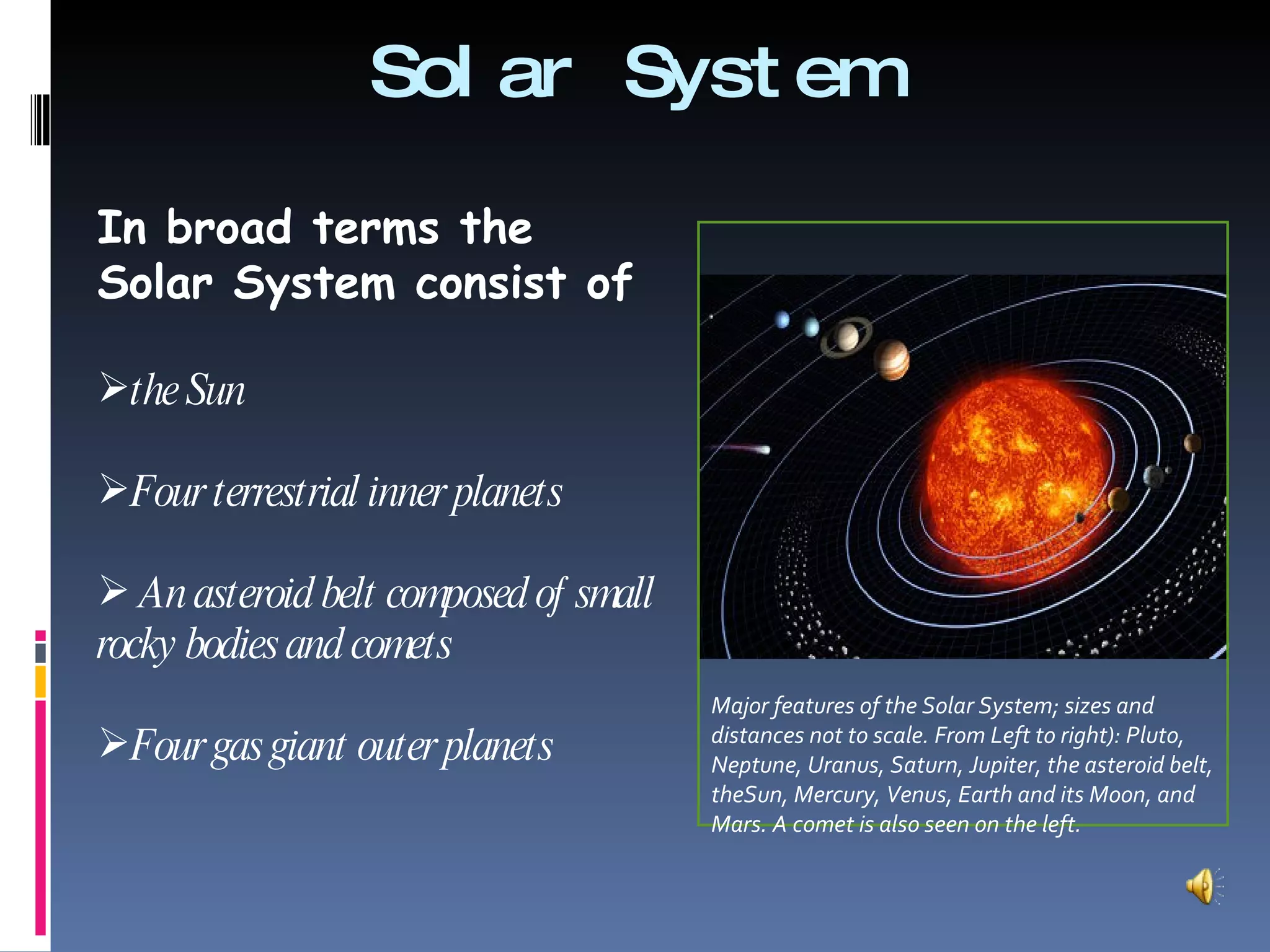
Solar System In broad terms the  Solar System consist of the Sun Four terrestrial inner planets An asteroid belt composed of small rocky bodies and comets Four gas giant outer planets Major features of the Solar System; sizes and distances not to scale. From Left to right): Pluto, Neptune, Uranus, Saturn, Jupiter, the asteroid belt, theSun, Mercury, Venus, Earth and its Moon, and Mars. A comet is also seen on the left.
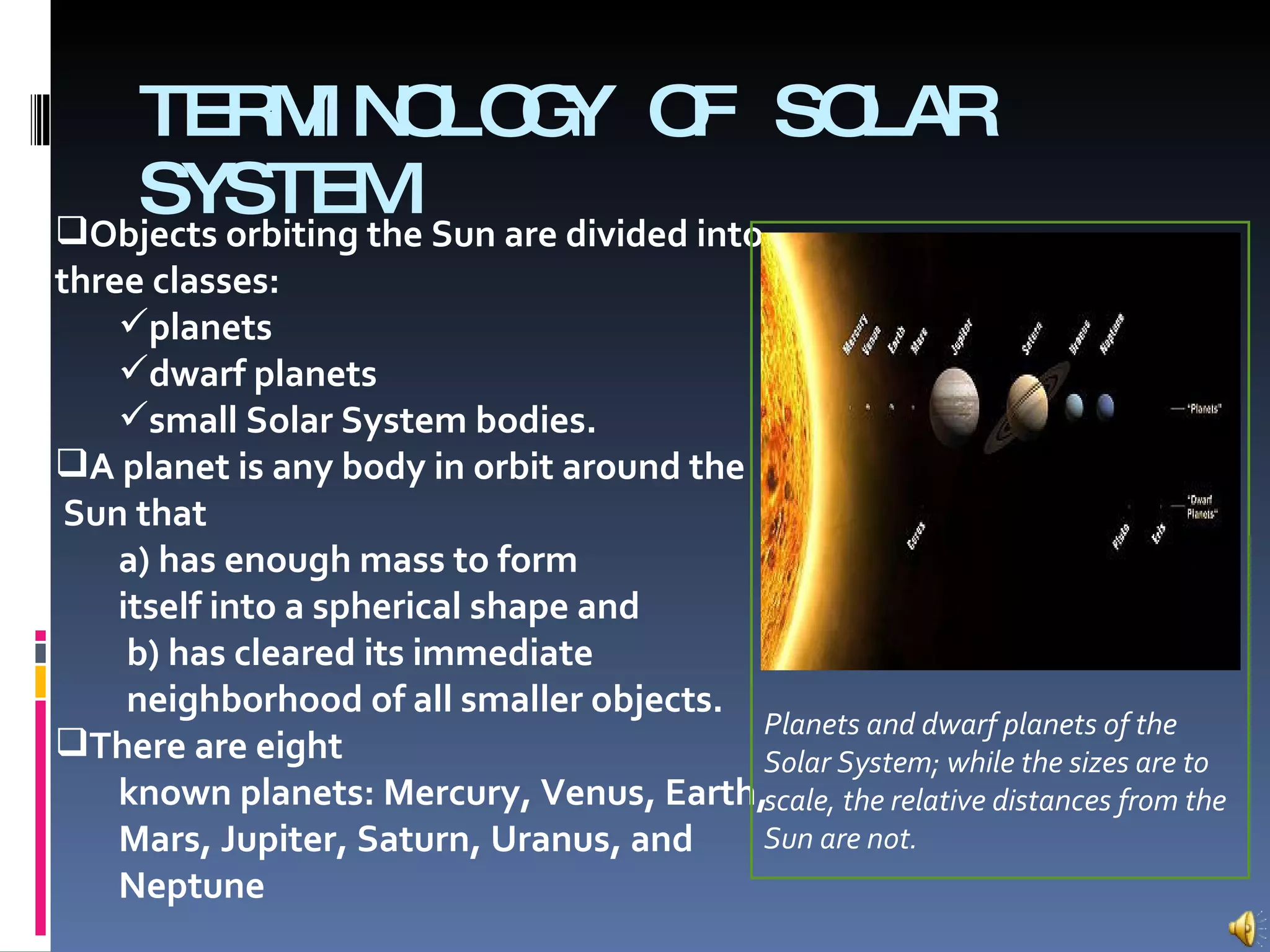
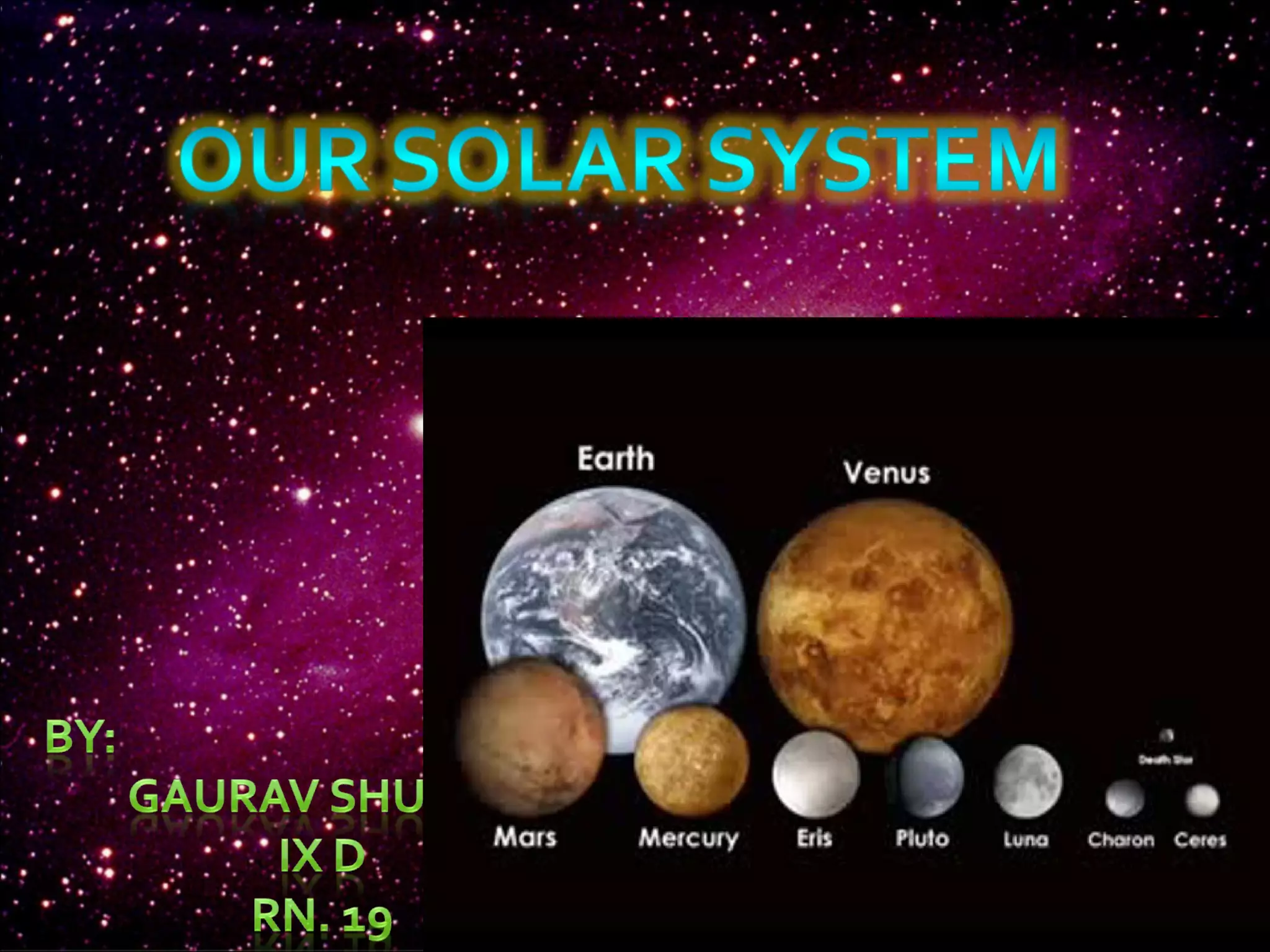
TERMINOLOGY OF SOLAR SYSTEM Objects orbiting the Sun are divided into three classes:  planets dwarf planets small Solar System bodies. A planet is any body in orbit around the Sun that a) has enough mass to form itself into a spherical shape and b) has cleared its immediate neighborhood of all smaller objects.  There are eight known planets: Mercury, Venus, Earth, Mars, Jupiter, Saturn, Uranus, and Neptune Planets and dwarf planets of the Solar System; while the sizes are to scale, the relative distances from the Sun are not.
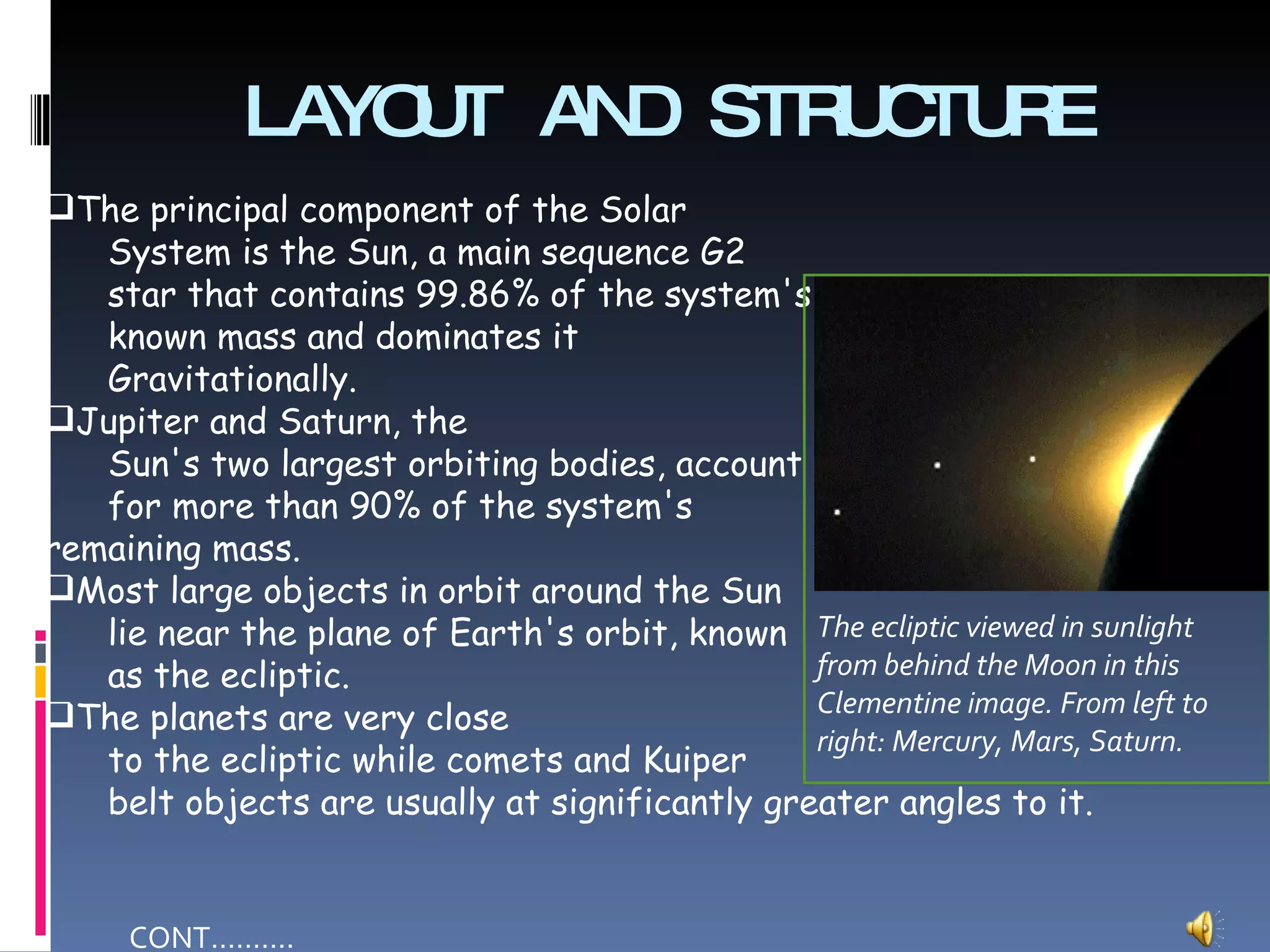
LAYOUT AND STRUCTURE The principal component of the Solar System is the Sun, a main sequence G2 star that contains 99.86% of the system's known mass and dominates it Gravitationally.  Jupiter and Saturn, the Sun's two largest orbiting bodies, account for more than 90% of the system's remaining mass. Most large objects in orbit around the Sun lie near the plane of Earth's orbit, known as the ecliptic.  The planets are very close to the ecliptic while comets and Kuiper belt objects are usually at significantly greater angles to it. CONT………. The ecliptic viewed in sunlight from behind the Moon in this Clementine image. From left to right: Mercury, Mars, Saturn.
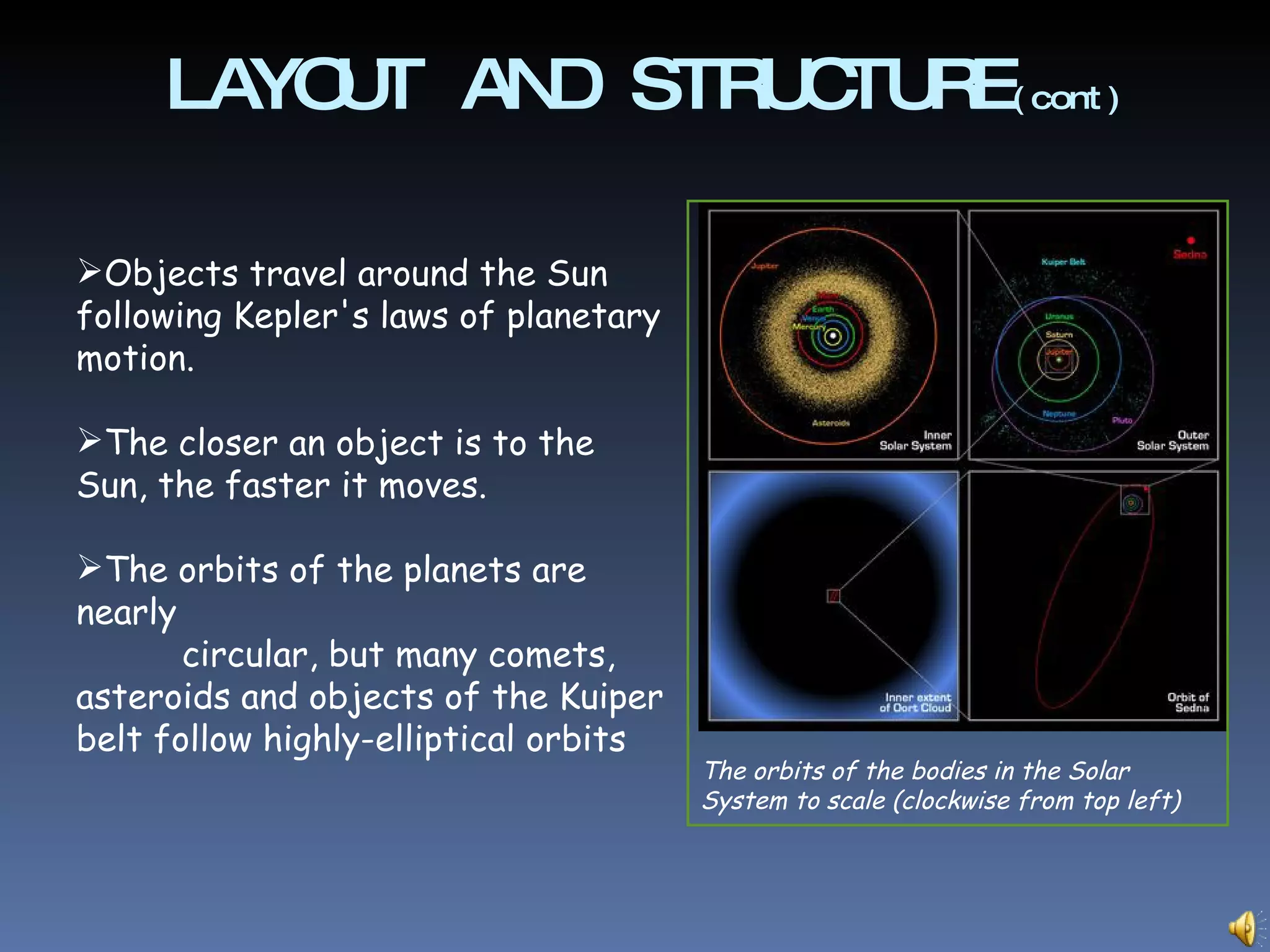
Objects travel around the Sun following Kepler's laws of planetary motion. The closer an object is to the Sun, the faster it moves.  The orbits of the planets are nearly  circular, but many comets, asteroids and objects of the Kuiper belt follow highly-elliptical orbits LAYOUT AND STRUCTURE (cont) The orbits of the bodies in the Solar System to scale (clockwise from top left)
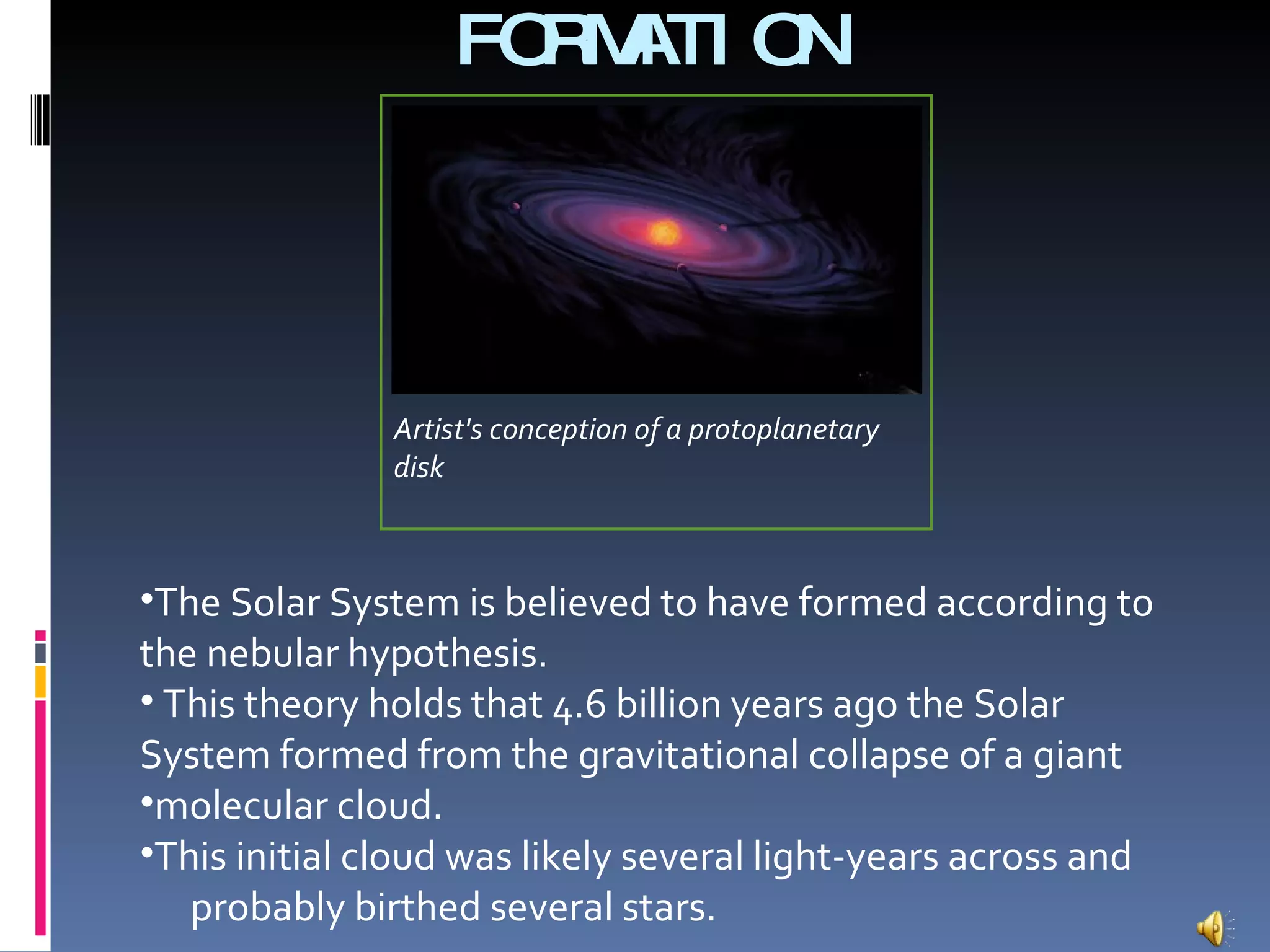
FORMATION  The Solar System is believed to have formed according to the nebular hypothesis. This theory holds that 4.6 billion years ago the Solar System formed from the gravitational collapse of a giant molecular cloud.  This initial cloud was likely several light-years across and  probably birthed several stars.   Artist's conception of a protoplanetary disk
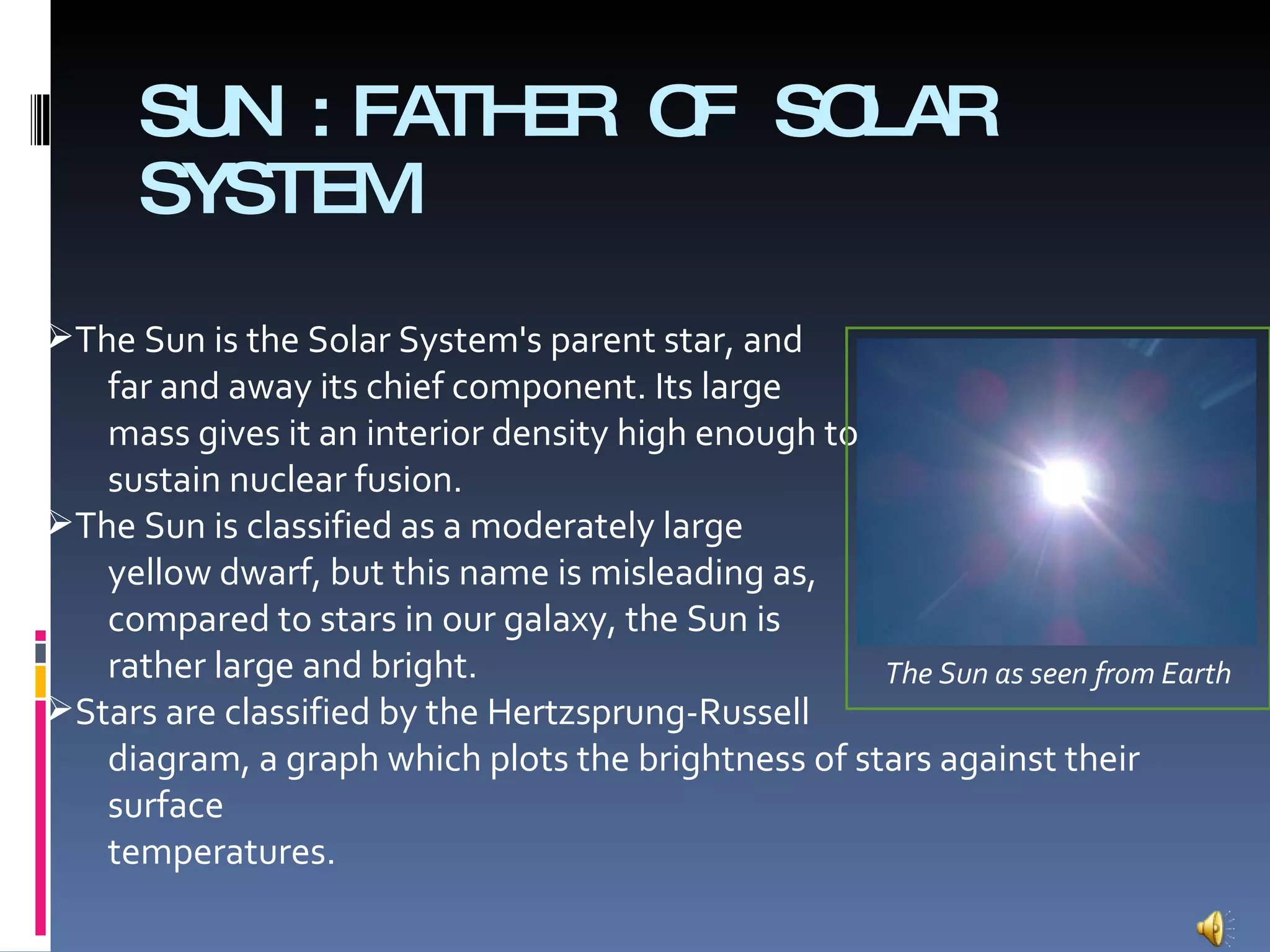
SUN :FATHER OF SOLAR SYSTEM The Sun is the Solar System's parent star, and far and away its chief component. Its large mass gives it an interior density high enough to sustain nuclear fusion. The Sun is classified as a moderately large yellow dwarf, but this name is misleading as, compared to stars in our galaxy, the Sun is rather large and bright.  Stars are classified by the Hertzsprung-Russell diagram, a graph which plots the brightness of stars against their surface temperatures. The Sun as seen from Earth
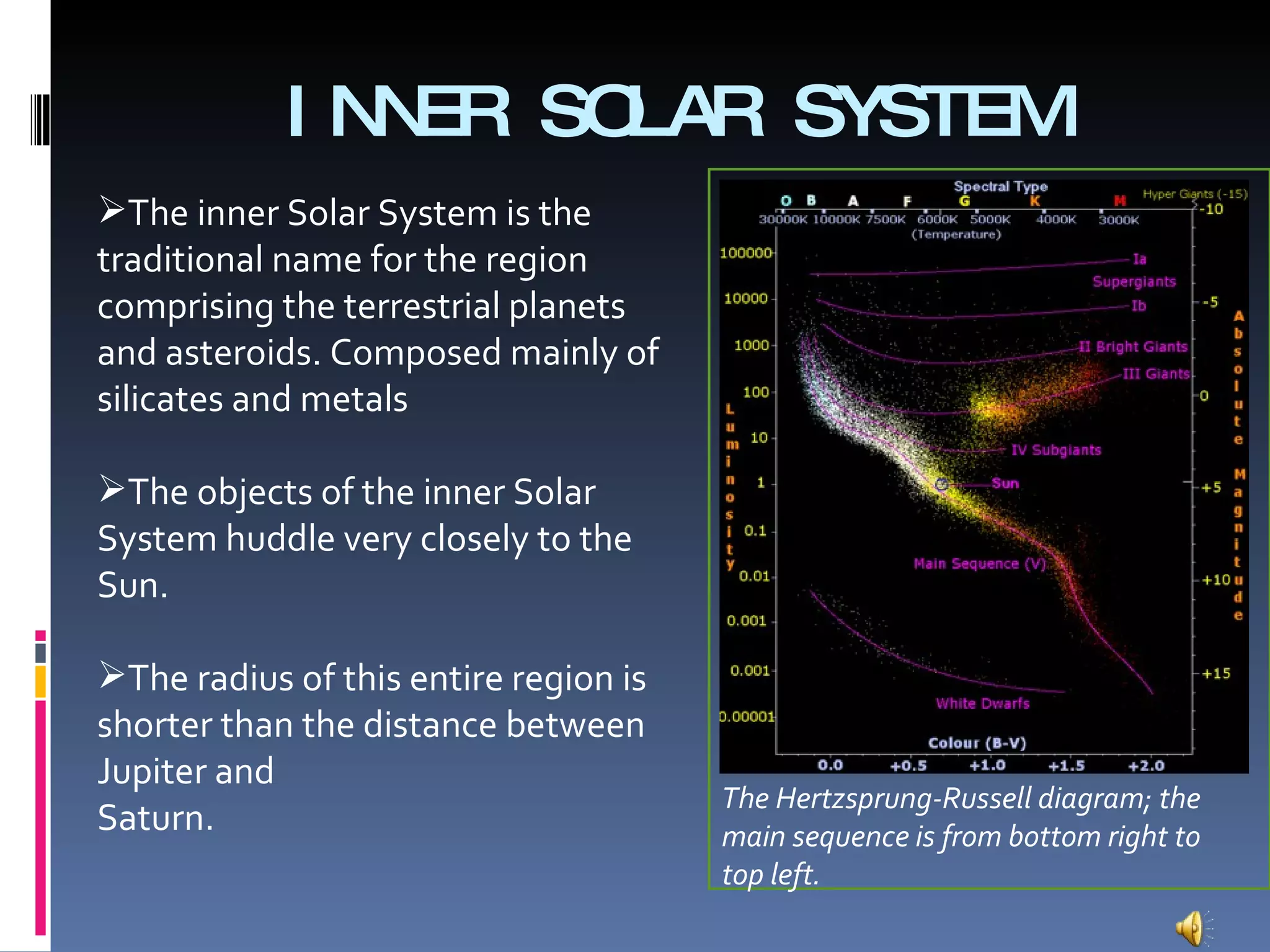
INNER SOLAR SYSTEM The inner Solar System is the traditional name for the region comprising the terrestrial planets and asteroids. Composed mainly of silicates and metals The objects of the inner Solar System huddle very closely to the Sun. The radius of this entire region is shorter than the distance between Jupiter and Saturn.  The Hertzsprung-Russell diagram; the main sequence is from bottom right to top left.
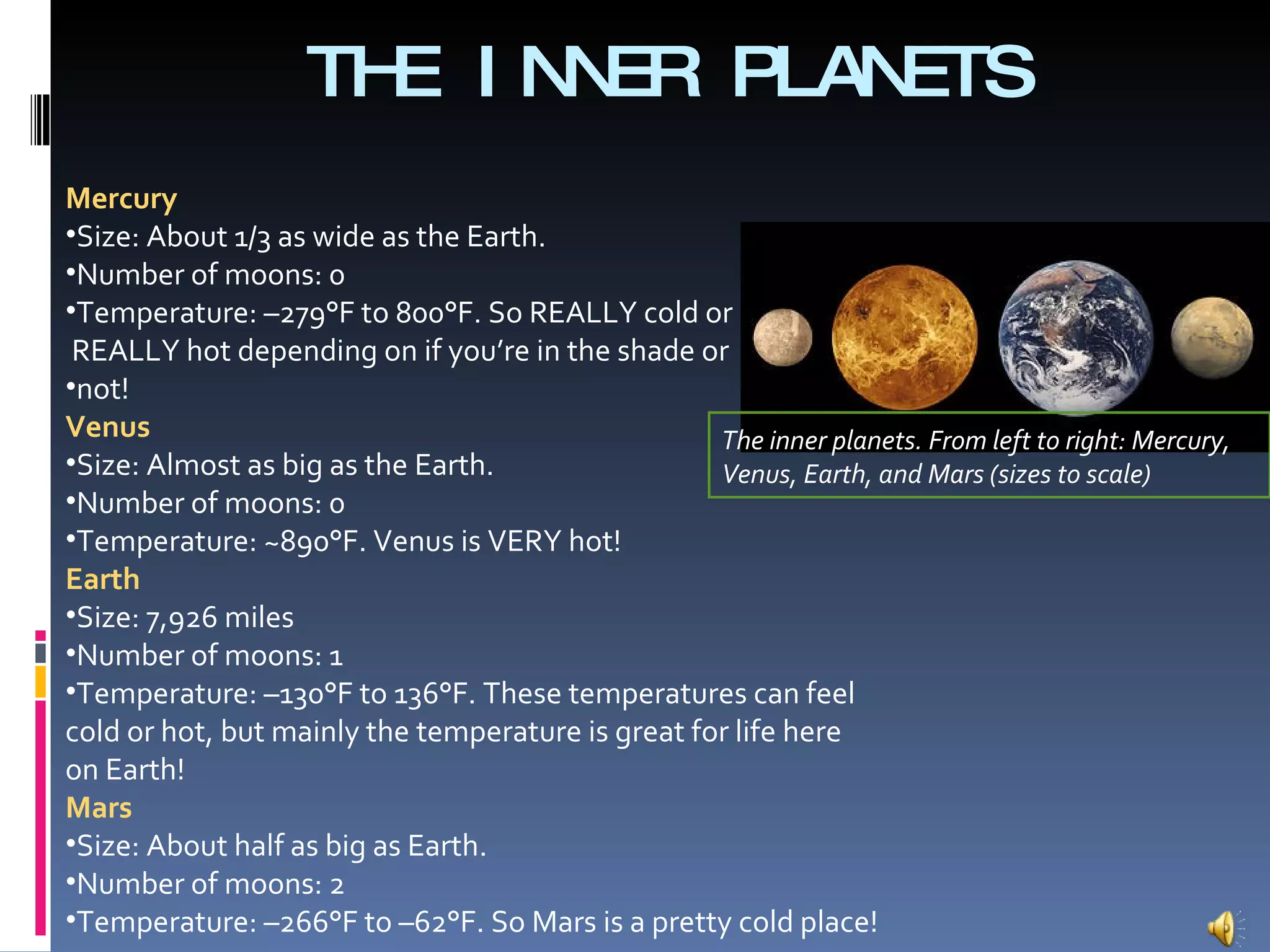
THE INNER PLANETS Mercury Size: About 1/3 as wide as the Earth. Number of moons: 0 Temperature: –279°F to 800°F. So REALLY cold or REALLY hot depending on if you’re in the shade or not! Venus Size: Almost as big as the Earth. Number of moons: 0 Temperature: ~890°F. Venus is VERY hot! Earth Size: 7,926 miles Number of moons: 1 Temperature: –130°F to 136°F. These temperatures can feel cold or hot, but mainly the temperature is great for life here on Earth! Mars Size: About half as big as Earth. Number of moons: 2 Temperature: –266°F to –62°F. So Mars is a pretty cold place! The inner planets. From left to right: Mercury, Venus, Earth, and Mars (sizes to scale)
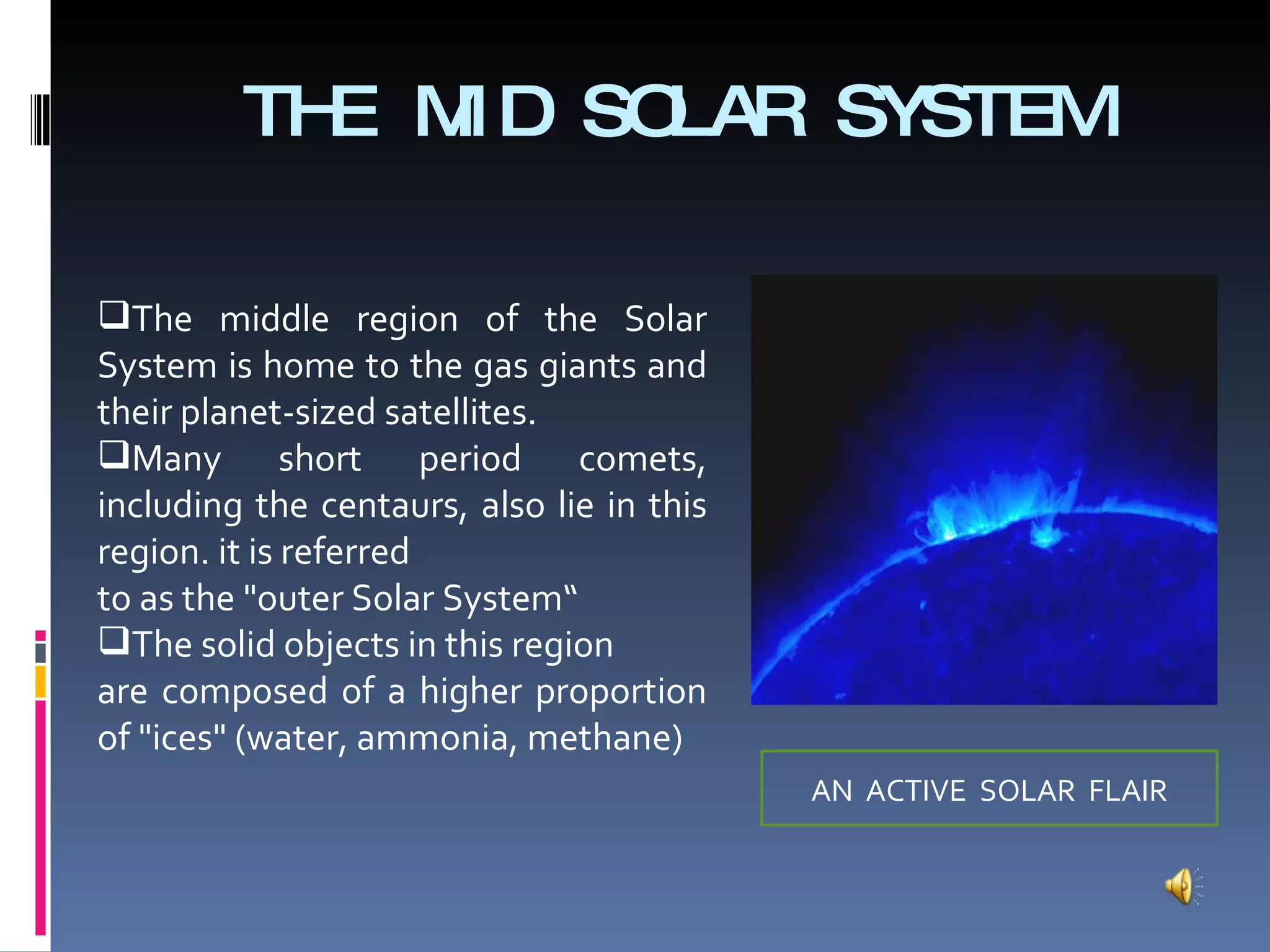
THE MID SOLAR SYSTEM The middle region of the Solar System is home to the gas giants and their planet-sized satellites.  Many short period comets, including the centaurs, also lie in this region. it is referred to as the "outer Solar System“ The solid objects in this region are composed of a higher proportion of "ices" (water, ammonia, methane) AN  ACTIVE  SOLAR  FLAIR
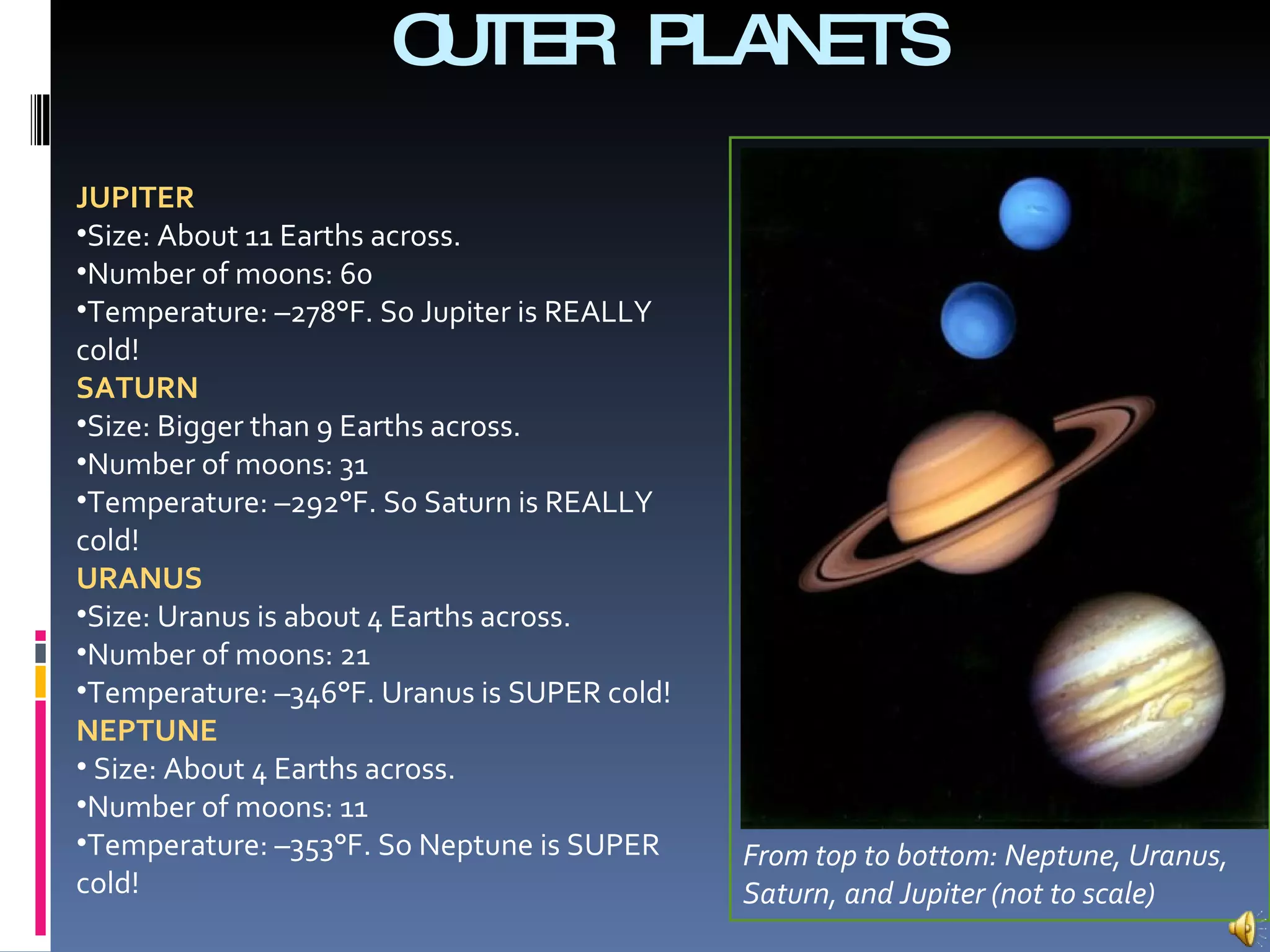
OUTER PLANETS JUPITER Size: About 11 Earths across. Number of moons: 60 Temperature: –278°F. So Jupiter is REALLY cold!  SATURN Size: Bigger than 9 Earths across. Number of moons: 31 Temperature: –292°F. So Saturn is REALLY cold!  URANUS Size: Uranus is about 4 Earths across. Number of moons: 21 Temperature: –346°F. Uranus is SUPER cold!  NEPTUNE Size: About 4 Earths across. Number of moons: 11 Temperature: –353°F. So Neptune is SUPER  cold! From top to bottom: Neptune, Uranus, Saturn, and Jupiter (not to scale)
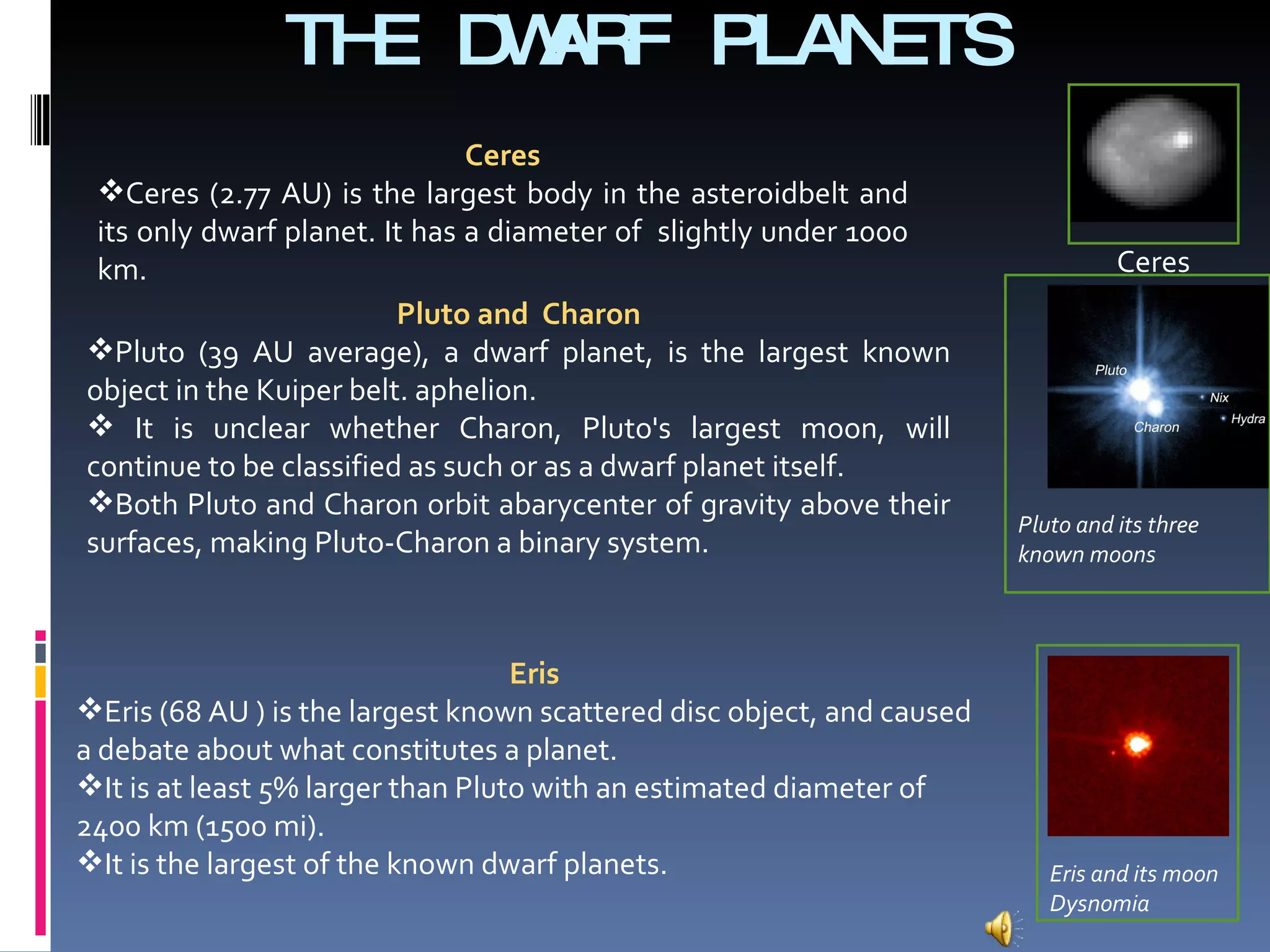
THE DWARF PLANETS  Ceres Ceres Ceres (2.77 AU) is the largest body in the asteroidbelt and its only dwarf planet. It has a diameter of  slightly under 1000 km. Pluto and  Charon Pluto (39 AU average), a dwarf planet, is the largest known object in the Kuiper belt. aphelion. It is unclear whether Charon, Pluto's largest moon, will continue to be classified as such or as a dwarf planet itself.  Both Pluto and Charon orbit abarycenter of gravity above their surfaces, making Pluto-Charon a binary system. Eris Eris (68 AU ) is the largest known scattered disc object, and caused a debate about what constitutes a planet. It is at least 5% larger than Pluto with an estimated diameter of 2400 km (1500 mi).  It is the largest of the known dwarf planets.  Pluto and its three known moons Eris and its moon Dysnomia
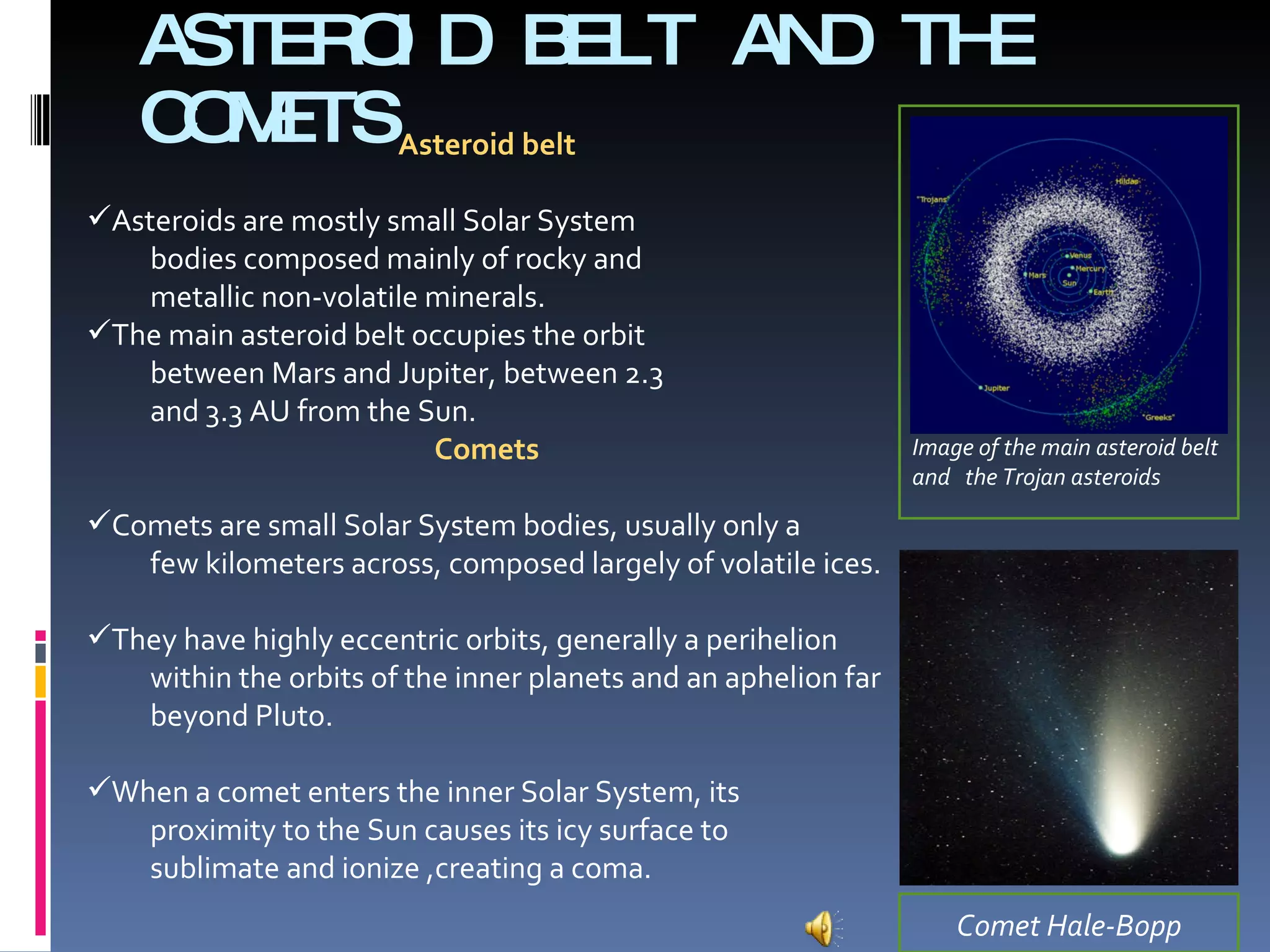
ASTEROID BELT AND THE COMETS Asteroid belt Asteroids are mostly small Solar System bodies composed mainly of rocky and metallic non-volatile minerals. The main asteroid belt occupies the orbit between Mars and Jupiter, between 2.3 and 3.3 AU from the Sun.  Comets Comets are small Solar System bodies, usually only a few kilometers across, composed largely of volatile ices. They have highly eccentric orbits, generally a perihelion within the orbits of the inner planets and an aphelion far beyond Pluto.  When a comet enters the inner Solar System, its  proximity to the Sun causes its icy surface to sublimate and ionize ,creating a coma. Image of the main asteroid belt and  the Trojan asteroids Comet Hale-Bopp
 

Solar System

  • 1.
  • 2.
    Solar System Inbroad terms the Solar System consist of the Sun Four terrestrial inner planets An asteroid belt composed of small rocky bodies and comets Four gas giant outer planets Major features of the Solar System; sizes and distances not to scale. From Left to right): Pluto, Neptune, Uranus, Saturn, Jupiter, the asteroid belt, theSun, Mercury, Venus, Earth and its Moon, and Mars. A comet is also seen on the left.
  • 3.
    TERMINOLOGY OF SOLARSYSTEM Objects orbiting the Sun are divided into three classes: planets dwarf planets small Solar System bodies. A planet is any body in orbit around the Sun that a) has enough mass to form itself into a spherical shape and b) has cleared its immediate neighborhood of all smaller objects. There are eight known planets: Mercury, Venus, Earth, Mars, Jupiter, Saturn, Uranus, and Neptune Planets and dwarf planets of the Solar System; while the sizes are to scale, the relative distances from the Sun are not.
  • 4.
    LAYOUT AND STRUCTUREThe principal component of the Solar System is the Sun, a main sequence G2 star that contains 99.86% of the system's known mass and dominates it Gravitationally. Jupiter and Saturn, the Sun's two largest orbiting bodies, account for more than 90% of the system's remaining mass. Most large objects in orbit around the Sun lie near the plane of Earth's orbit, known as the ecliptic. The planets are very close to the ecliptic while comets and Kuiper belt objects are usually at significantly greater angles to it. CONT………. The ecliptic viewed in sunlight from behind the Moon in this Clementine image. From left to right: Mercury, Mars, Saturn.
  • 5.
    Objects travel aroundthe Sun following Kepler's laws of planetary motion. The closer an object is to the Sun, the faster it moves. The orbits of the planets are nearly circular, but many comets, asteroids and objects of the Kuiper belt follow highly-elliptical orbits LAYOUT AND STRUCTURE (cont) The orbits of the bodies in the Solar System to scale (clockwise from top left)
  • 6.
    FORMATION TheSolar System is believed to have formed according to the nebular hypothesis. This theory holds that 4.6 billion years ago the Solar System formed from the gravitational collapse of a giant molecular cloud. This initial cloud was likely several light-years across and probably birthed several stars.   Artist's conception of a protoplanetary disk
  • 7.
    SUN :FATHER OFSOLAR SYSTEM The Sun is the Solar System's parent star, and far and away its chief component. Its large mass gives it an interior density high enough to sustain nuclear fusion. The Sun is classified as a moderately large yellow dwarf, but this name is misleading as, compared to stars in our galaxy, the Sun is rather large and bright. Stars are classified by the Hertzsprung-Russell diagram, a graph which plots the brightness of stars against their surface temperatures. The Sun as seen from Earth
  • 8.
    INNER SOLAR SYSTEMThe inner Solar System is the traditional name for the region comprising the terrestrial planets and asteroids. Composed mainly of silicates and metals The objects of the inner Solar System huddle very closely to the Sun. The radius of this entire region is shorter than the distance between Jupiter and Saturn. The Hertzsprung-Russell diagram; the main sequence is from bottom right to top left.
  • 9.
    THE INNER PLANETSMercury Size: About 1/3 as wide as the Earth. Number of moons: 0 Temperature: –279°F to 800°F. So REALLY cold or REALLY hot depending on if you’re in the shade or not! Venus Size: Almost as big as the Earth. Number of moons: 0 Temperature: ~890°F. Venus is VERY hot! Earth Size: 7,926 miles Number of moons: 1 Temperature: –130°F to 136°F. These temperatures can feel cold or hot, but mainly the temperature is great for life here on Earth! Mars Size: About half as big as Earth. Number of moons: 2 Temperature: –266°F to –62°F. So Mars is a pretty cold place! The inner planets. From left to right: Mercury, Venus, Earth, and Mars (sizes to scale)
  • 10.
    THE MID SOLARSYSTEM The middle region of the Solar System is home to the gas giants and their planet-sized satellites. Many short period comets, including the centaurs, also lie in this region. it is referred to as the "outer Solar System“ The solid objects in this region are composed of a higher proportion of "ices" (water, ammonia, methane) AN ACTIVE SOLAR FLAIR
  • 11.
    OUTER PLANETS JUPITERSize: About 11 Earths across. Number of moons: 60 Temperature: –278°F. So Jupiter is REALLY cold! SATURN Size: Bigger than 9 Earths across. Number of moons: 31 Temperature: –292°F. So Saturn is REALLY cold! URANUS Size: Uranus is about 4 Earths across. Number of moons: 21 Temperature: –346°F. Uranus is SUPER cold! NEPTUNE Size: About 4 Earths across. Number of moons: 11 Temperature: –353°F. So Neptune is SUPER cold! From top to bottom: Neptune, Uranus, Saturn, and Jupiter (not to scale)
  • 12.
    THE DWARF PLANETS Ceres Ceres Ceres (2.77 AU) is the largest body in the asteroidbelt and its only dwarf planet. It has a diameter of slightly under 1000 km. Pluto and Charon Pluto (39 AU average), a dwarf planet, is the largest known object in the Kuiper belt. aphelion. It is unclear whether Charon, Pluto's largest moon, will continue to be classified as such or as a dwarf planet itself. Both Pluto and Charon orbit abarycenter of gravity above their surfaces, making Pluto-Charon a binary system. Eris Eris (68 AU ) is the largest known scattered disc object, and caused a debate about what constitutes a planet. It is at least 5% larger than Pluto with an estimated diameter of 2400 km (1500 mi). It is the largest of the known dwarf planets. Pluto and its three known moons Eris and its moon Dysnomia
  • 13.
    ASTEROID BELT ANDTHE COMETS Asteroid belt Asteroids are mostly small Solar System bodies composed mainly of rocky and metallic non-volatile minerals. The main asteroid belt occupies the orbit between Mars and Jupiter, between 2.3 and 3.3 AU from the Sun. Comets Comets are small Solar System bodies, usually only a few kilometers across, composed largely of volatile ices. They have highly eccentric orbits, generally a perihelion within the orbits of the inner planets and an aphelion far beyond Pluto. When a comet enters the inner Solar System, its proximity to the Sun causes its icy surface to sublimate and ionize ,creating a coma. Image of the main asteroid belt and the Trojan asteroids Comet Hale-Bopp
  • 14.