Solar
system
The Solar System consists of the Sun, eight planets, and other smaller constituents
The Inner Planets and Outer Planets
tell many tales about the wonders of the Solar System


           While the gems in space unveils the myth of our galaxy
                         far beyond imagination..
Welcome to


      The

SOLAR SYSTEM
Solar system

                                                Inner planets

                                                Outer planets


Click on objects to find out more about them!
•All the nine planets move around the Sun in a large oval path.
•The planets also spin by itself.
•The Sun is the only star in the solar system.
•A star is an object in space that gives out light and heat.
•The Sun is also the biggest object in the Solar System.
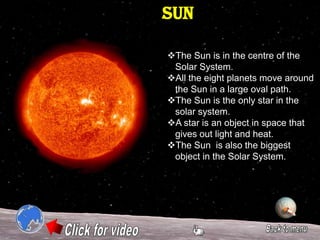
                                                                  SUN

                                                                       s
                                                                  The Sun is in the centre of the
                                                                   Solar System.
                                                                  All the eight planets move around
                                                                   the Sun in a large oval path.
                                                                  The Sun is the only star in the
                                                                   solar system.
                                                                  A star is an object in space that
                                                                   gives out light and heat.
                                                                  The Sun is also the biggest
                                                                   object in the Solar System.
mercury

  Mercury is the nearest planet to
   the Sun.
  It is 58 million km from the Sun.
  Its surface that faces the Sun has
   a very high temperature of 430°c.
  The temperature is too hot to
   support life.
  This high temperature causes no
   liquid water to exist on this planet.
  Mercury rotates very slowly.
venus
Venus is the second nearest planet to the
 Sun.
It is the hotter than Mercury because a
 great amount of the heat from the Sun is
 trapped in its atmosphere.
It is the brightest object in the sky besides
 our Sun and the Moon.
Nearly the whole atmosphere consists of
 carbon dioxide.
Venus is often called Earth’s twin because
 the two planets are close in size, but the
 conditions on the surface of Venus are
 completely different.
EARTH
Planet Earth is the third planet from the
 Sun and the fifth largest planet in the
 Solar System.
The Earth’s atmosphere, weather and
 many other factors are just right to keep
 us alive.
Earth is a complex system of air, water
 and land.
Earth has one moon, its name is Luna.
The Earth’s interior is composed of four
 layers, three solid and one liquid.
MARS
 It is also called the Red Planet or
  Red World because it is reddish in
  colour.
 Mars is the only planet whose
  surface can be seen in detail from
  the Earth.
 Mars is the fourth planet from the
  Sun.
 It has a very cold surface so
  almost all of its water is frozen.
 Mars is not conducive for living
  things.
JUPITER

  Jupiter is the fifth planet from the
   Sun .
  It is the biggest planet in the solar
   system.
  It has a diameter of 3000 km.
  Jupiter is usually the fourth
   brightest object in the sky (after
   the Sun, the Moon and Venus);
   however at times Mars appears
   brighter than Jupiter.
  Jupiter has at least 63 moons.
SATURN


  Saturn is the sixth planet from the
   Sun.
  Saturn is the second largest
   planet in our Solar System.
  Saturn has three wide rings. They
   can be seen with a telescope.
  Saturn has 34 moons.
uranus

Uranus is the seventh planet from
 the Sun.
Uranus is lying on its side as it goes
 round the Sun.
There are many layers of clouds
 found in this planet's
 atmosphere, however these clouds
 are difficult to see.
Uranus has 27 moons.
Neptune

  Neptune is the eighth planet from
   the Sun.
  Neptune is covered with a blue
   ocean of liquid methane.
  Neptune has 13 moons.
  Neptune appears to have two thin
   rings, with a third larger ring
                              Back to
   between them. These rings are
                              previous
   made up of dark rocky materials.
                             page
asteroids
   Asteroids are huge chunks of
   rocks and metals.
   Asteroids have different
   shapes and sizes. Most
   asteroids have a diameter of
   more than 200 km.
   The main asteroids belt
   occupies the orbit between
   Mars and Jupiter.
   Asteroids are left over
   materials from the formation of
   the Solar System.
meteoroids

   A meteoroid is a piece of rock
   that is floating in space.
   There are millions of
   meteoroids in the solar system.
   Most of them are small.
   Every day, a millions of
   meteoroids enter the Earth’s
   atmosphere from space.
meteor

  Meteors are tiny rocks which
  probably come from the
  asteroids belt.
  When a meteoroid enters the
  Earth’s atmosphere, it burns
  very brightly. Friction between
  the meteoroid and the air
  causes the meteoroid to
  burn, is called a meteor.
comet

 A comet is made of pieces of
 ice in space.
 It is made of water, dust and
 frozen gases.
 Comets have long glowing
 tails.
SOLAR SYSTEM
      The Sun and eight other
       planets are part of the solar
       system.
      The eight planets are
       Mercury, Venus, Earth, Mars,
       Jupiter, Saturn, Uranus and
       Neptune.
      Natural satellites
       (moons), meteors, comets
       and asteroids are also the
       constituents of the solar
       systems.
INNER PLANETS
      Mercury, Venus, Earth and Mars
       are the four planets that are the
       nearest to the Sun.
      They are called the inner
       planets.
      All these planets are made of
       rocks.
      Each of the inner planet has an
       atmosphere.
      The atmosphere of the inner
       planets is very thin and
       poisonous to living things,
       except the Earth.
OUTER PLANETS

     The outer planets are Jupiter,
      Saturn, Uranus, and Neptune.
     They are mainly composed of
      gases.
     Their temperature is too cold to
      support life.
BACK
BACK
BACK
BACK
BACK
BACK
BACK
BACK
BACK
BACK
Solar system

Solar system

  • 1.
  • 2.
    The Solar Systemconsists of the Sun, eight planets, and other smaller constituents
  • 3.
    The Inner Planetsand Outer Planets tell many tales about the wonders of the Solar System While the gems in space unveils the myth of our galaxy far beyond imagination..
  • 4.
    Welcome to The SOLAR SYSTEM
  • 5.
    Solar system Inner planets Outer planets Click on objects to find out more about them!
  • 6.
    •All the nineplanets move around the Sun in a large oval path. •The planets also spin by itself. •The Sun is the only star in the solar system. •A star is an object in space that gives out light and heat. •The Sun is also the biggest object in the Solar System. SUN s The Sun is in the centre of the Solar System. All the eight planets move around the Sun in a large oval path. The Sun is the only star in the solar system. A star is an object in space that gives out light and heat. The Sun is also the biggest object in the Solar System.
  • 7.
    mercury Mercuryis the nearest planet to the Sun. It is 58 million km from the Sun. Its surface that faces the Sun has a very high temperature of 430°c. The temperature is too hot to support life. This high temperature causes no liquid water to exist on this planet. Mercury rotates very slowly.
  • 8.
    venus Venus is thesecond nearest planet to the Sun. It is the hotter than Mercury because a great amount of the heat from the Sun is trapped in its atmosphere. It is the brightest object in the sky besides our Sun and the Moon. Nearly the whole atmosphere consists of carbon dioxide. Venus is often called Earth’s twin because the two planets are close in size, but the conditions on the surface of Venus are completely different.
  • 9.
    EARTH Planet Earth isthe third planet from the Sun and the fifth largest planet in the Solar System. The Earth’s atmosphere, weather and many other factors are just right to keep us alive. Earth is a complex system of air, water and land. Earth has one moon, its name is Luna. The Earth’s interior is composed of four layers, three solid and one liquid.
  • 10.
    MARS It isalso called the Red Planet or Red World because it is reddish in colour. Mars is the only planet whose surface can be seen in detail from the Earth. Mars is the fourth planet from the Sun. It has a very cold surface so almost all of its water is frozen. Mars is not conducive for living things.
  • 11.
    JUPITER Jupiteris the fifth planet from the Sun . It is the biggest planet in the solar system. It has a diameter of 3000 km. Jupiter is usually the fourth brightest object in the sky (after the Sun, the Moon and Venus); however at times Mars appears brighter than Jupiter. Jupiter has at least 63 moons.
  • 12.
    SATURN Saturnis the sixth planet from the Sun. Saturn is the second largest planet in our Solar System. Saturn has three wide rings. They can be seen with a telescope. Saturn has 34 moons.
  • 13.
    uranus Uranus is theseventh planet from the Sun. Uranus is lying on its side as it goes round the Sun. There are many layers of clouds found in this planet's atmosphere, however these clouds are difficult to see. Uranus has 27 moons.
  • 14.
    Neptune Neptuneis the eighth planet from the Sun. Neptune is covered with a blue ocean of liquid methane. Neptune has 13 moons. Neptune appears to have two thin rings, with a third larger ring Back to between them. These rings are previous made up of dark rocky materials. page
  • 15.
    asteroids Asteroids are huge chunks of rocks and metals. Asteroids have different shapes and sizes. Most asteroids have a diameter of more than 200 km. The main asteroids belt occupies the orbit between Mars and Jupiter. Asteroids are left over materials from the formation of the Solar System.
  • 16.
    meteoroids A meteoroid is a piece of rock that is floating in space. There are millions of meteoroids in the solar system. Most of them are small. Every day, a millions of meteoroids enter the Earth’s atmosphere from space.
  • 17.
    meteor Meteorsare tiny rocks which probably come from the asteroids belt. When a meteoroid enters the Earth’s atmosphere, it burns very brightly. Friction between the meteoroid and the air causes the meteoroid to burn, is called a meteor.
  • 18.
    comet A cometis made of pieces of ice in space. It is made of water, dust and frozen gases. Comets have long glowing tails.
  • 19.
    SOLAR SYSTEM The Sun and eight other planets are part of the solar system. The eight planets are Mercury, Venus, Earth, Mars, Jupiter, Saturn, Uranus and Neptune. Natural satellites (moons), meteors, comets and asteroids are also the constituents of the solar systems.
  • 20.
    INNER PLANETS Mercury, Venus, Earth and Mars are the four planets that are the nearest to the Sun. They are called the inner planets. All these planets are made of rocks. Each of the inner planet has an atmosphere. The atmosphere of the inner planets is very thin and poisonous to living things, except the Earth.
  • 21.
    OUTER PLANETS The outer planets are Jupiter, Saturn, Uranus, and Neptune. They are mainly composed of gases. Their temperature is too cold to support life.
  • 22.
  • 23.
  • 24.
  • 25.
  • 26.
  • 27.
  • 28.
  • 29.
  • 30.
  • 31.