PLANETS  OF OUR SOLAR SYSTEM BY: Geenie Choy 8C
General Information Revolve: The action of a smaller object circling around a larger object. Rotate: The action of an object spinning on its axis. There are  8 planets and  5  dwarf planets found. INNER PLANETS: Mercury Venus Earth Mars OUTER PLANETS: Jupiter Saturn Uranus Neptune Their differences: Inner planets have many  craters  due to asteroids and meteorites. Outer planets are much  larger and are made of gas Orbit: The path which an object (planet, satellites, etc.) follows  3 REQUIREMENTS: Must orbit around the Sun Round due to large mass and gravity Cleared orbit DWARF PLANETS  orbit around the sun and  are big enough to be round, but they do  not have a cleared orbit. -Pluto  -Ceres  -Eris
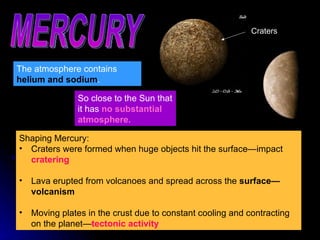
Shaping Mercury: Craters were formed when huge objects hit the surface—impact   cratering Lava erupted from volcanoes and spread across the  surface—volcanism Moving plates in the crust due to constant cooling and contracting   on the   planet— tectonic   activity So close to the Sun that it has  no substantial atmosphere. The atmosphere contains  helium and sodium . Craters MERCURY
VENUS “ Evening Star” --the clouds covering Venus  reflect sunlight easily, allowing Venus to be  seem extremely bright The atmosphere contains  carbon dioxide   and   sulfuric acid *acts as a greenhouse— traps   heat   this causes Venus to be the hottest planet in the solar system R etrogade rotation: when the planet spins in a clockwise direction on its axis. Since Venus has an opposite rotation than the other planets, the Sun would  appear to rise in the west and set in the east. It has a longer day than year because  one retrogade   rotation takes   225 Earth days .  This means Venus takes a longer time to spin than revolves around the Sun.
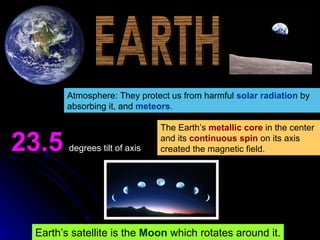
EARTH Atmosphere: They protect us from harmful   solar radiation   by absorbing it, and   meteors . 23.5   degrees tilt of axis The Earth’s  metallic core  in the center and its  continuous spin  on its axis created the magnetic field. Earth’s satellite is the   Moon   which rotates around it.
MARS Scientists examine  meteorites  from Mars for proof of ancient bacteria and signs of living things. Primary element:  95%  carbon dioxide The  iron-rich clay  that covers Mars gave the planet its red color. OLYMPUS MONS: tallest volcano in the solar system on Mars peak: 26 km over base shield volcano=gentle slope 20 times wider than height Satelites- Phobos  and  Deimos Irregular shape Believed to be asteroids
JUPITER The poles are flatten and the middle swell out because of the  rotation . ATMOSPHERE: Hydrogen Helium Nitrogen sulfur THE GREAT/GIANT RED SPOT: A storm that can be seen from space; it was first spotted when scientists discovered Jupiter. Astronomers believe it is caused by a storm-system on Jupiter 50   moons and 13   more unofficial satellites found. Io (one of Jupiter’s satellites) is  volcanically active  which causes it to have an extremely high tempereture.
SATURN ATMOSPHERE: H yrogen Helium Scientists think that Saturn’s rings are formed by  natural satellites breaking up . RINGS: Ice, water, and dust from satellites which broke up near Saturn T hickness:10-100 meters D ifferent brightness G aps in between some rings, others are braided Saturn could FLOAT due to its extremely  low density    Seasons last more than  7   Earth years!!!
URANUS UNIQUE due to its 98 degrees tilt this caused Uranus to look like it   rotates on its side . For known natural satellites, Uranus has  27 . ATMOSPHERE: H ydrogen H elium M ethane
NEPTUNE ATMOSPHERE: A mmonia H elium M ethane 13   known satellites with   4   circling Neptune inside the rings . Triton-the largest satellite of Neptune M ade of ice and rock Believed to be not originally a satellite, but it was forced to orbit around  Neptune by Neptune’s gravity. Why did astronomers thought it was not a satellite? R etrograde orbit D ensity Composition
DWARF PLANETS
PLUTO THREE MOONS: Charon — half of Pluto, orbits close to the dwarf planet Nix — farther away Hydra — farther away Using the spectoscope they found that Pluto has  methane frost  and Charon has  water frost . Charon is extremely large for a moon (half of Pluto). It is also bluer than Pluto.
CERES 1   year =   4.6  Earth years Ceres became known as an asteroid in 1802. This was because many other objects orbiting between Mars and Jupiter were named as asteroids. Since Ceres also orbits in the same area, it became known as an asteroid, too. Surface is covered with  clay ,  water ice ,  and  carbonates .  This helped differentiate Ceres from the other members of the asteroid belt.
ERIS O riginal name:  Xena , referring to the popular television show during the time Eris was found I t takes  557   years for Eris to make one orbit around the Sun. MOON:  Dysnomia — the daughter of Eris, cause of lawlessness It was not named a planet because Eris did not  clear its path of orbit , which meant it didn’t meet one of the requirements for a planet. Dysnomia
THE END. All information from: http://starchild.gsfc.nasa.gov/docs/StarChild/solar_system_level2/planets.html

Science Planets powerpoint

  • 1.
    PLANETS OFOUR SOLAR SYSTEM BY: Geenie Choy 8C
  • 2.
    General Information Revolve:The action of a smaller object circling around a larger object. Rotate: The action of an object spinning on its axis. There are 8 planets and 5 dwarf planets found. INNER PLANETS: Mercury Venus Earth Mars OUTER PLANETS: Jupiter Saturn Uranus Neptune Their differences: Inner planets have many craters due to asteroids and meteorites. Outer planets are much larger and are made of gas Orbit: The path which an object (planet, satellites, etc.) follows 3 REQUIREMENTS: Must orbit around the Sun Round due to large mass and gravity Cleared orbit DWARF PLANETS orbit around the sun and are big enough to be round, but they do not have a cleared orbit. -Pluto -Ceres -Eris
  • 3.
    Shaping Mercury: Craterswere formed when huge objects hit the surface—impact cratering Lava erupted from volcanoes and spread across the surface—volcanism Moving plates in the crust due to constant cooling and contracting on the planet— tectonic activity So close to the Sun that it has no substantial atmosphere. The atmosphere contains helium and sodium . Craters MERCURY
  • 4.
    VENUS “ EveningStar” --the clouds covering Venus reflect sunlight easily, allowing Venus to be seem extremely bright The atmosphere contains carbon dioxide and sulfuric acid *acts as a greenhouse— traps heat this causes Venus to be the hottest planet in the solar system R etrogade rotation: when the planet spins in a clockwise direction on its axis. Since Venus has an opposite rotation than the other planets, the Sun would appear to rise in the west and set in the east. It has a longer day than year because one retrogade rotation takes 225 Earth days . This means Venus takes a longer time to spin than revolves around the Sun.
  • 5.
    EARTH Atmosphere: Theyprotect us from harmful solar radiation by absorbing it, and meteors . 23.5 degrees tilt of axis The Earth’s metallic core in the center and its continuous spin on its axis created the magnetic field. Earth’s satellite is the Moon which rotates around it.
  • 6.
    MARS Scientists examine meteorites from Mars for proof of ancient bacteria and signs of living things. Primary element: 95% carbon dioxide The iron-rich clay that covers Mars gave the planet its red color. OLYMPUS MONS: tallest volcano in the solar system on Mars peak: 26 km over base shield volcano=gentle slope 20 times wider than height Satelites- Phobos and Deimos Irregular shape Believed to be asteroids
  • 7.
    JUPITER The polesare flatten and the middle swell out because of the rotation . ATMOSPHERE: Hydrogen Helium Nitrogen sulfur THE GREAT/GIANT RED SPOT: A storm that can be seen from space; it was first spotted when scientists discovered Jupiter. Astronomers believe it is caused by a storm-system on Jupiter 50 moons and 13 more unofficial satellites found. Io (one of Jupiter’s satellites) is volcanically active which causes it to have an extremely high tempereture.
  • 8.
    SATURN ATMOSPHERE: Hyrogen Helium Scientists think that Saturn’s rings are formed by natural satellites breaking up . RINGS: Ice, water, and dust from satellites which broke up near Saturn T hickness:10-100 meters D ifferent brightness G aps in between some rings, others are braided Saturn could FLOAT due to its extremely low density  Seasons last more than 7 Earth years!!!
  • 9.
    URANUS UNIQUE dueto its 98 degrees tilt this caused Uranus to look like it rotates on its side . For known natural satellites, Uranus has 27 . ATMOSPHERE: H ydrogen H elium M ethane
  • 10.
    NEPTUNE ATMOSPHERE: Ammonia H elium M ethane 13 known satellites with 4 circling Neptune inside the rings . Triton-the largest satellite of Neptune M ade of ice and rock Believed to be not originally a satellite, but it was forced to orbit around Neptune by Neptune’s gravity. Why did astronomers thought it was not a satellite? R etrograde orbit D ensity Composition
  • 11.
  • 12.
    PLUTO THREE MOONS:Charon — half of Pluto, orbits close to the dwarf planet Nix — farther away Hydra — farther away Using the spectoscope they found that Pluto has methane frost and Charon has water frost . Charon is extremely large for a moon (half of Pluto). It is also bluer than Pluto.
  • 13.
    CERES 1 year = 4.6 Earth years Ceres became known as an asteroid in 1802. This was because many other objects orbiting between Mars and Jupiter were named as asteroids. Since Ceres also orbits in the same area, it became known as an asteroid, too. Surface is covered with clay , water ice , and carbonates . This helped differentiate Ceres from the other members of the asteroid belt.
  • 14.
    ERIS O riginalname: Xena , referring to the popular television show during the time Eris was found I t takes 557 years for Eris to make one orbit around the Sun. MOON: Dysnomia — the daughter of Eris, cause of lawlessness It was not named a planet because Eris did not clear its path of orbit , which meant it didn’t meet one of the requirements for a planet. Dysnomia
  • 15.
    THE END. Allinformation from: http://starchild.gsfc.nasa.gov/docs/StarChild/solar_system_level2/planets.html