The Gothic protagonist

       Heathcliff
Task 1
• Create your own Gothic protagonist. Write a
  brief description of someone that you could
  imagine as being the main character in a
  gothic tale. Include reference to physical
  appearance.
• Consider: age, gender, voice, dominant
  colouring, profession, nationality, status etc
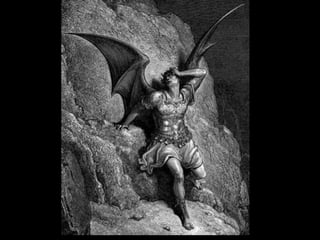
Milton’s Satan as a gothic protagonist
• Critics have often commented on the ways in
  which John Miton’s Satan has provided a
  model for the doomed central characters of
  gothic novels.
• In Book 1 of his epic poem Paradise Lost
  (1667), Milton describes the fall of Satan and
  his fellow rebel angels, cast out by God from
  Heaven into the terrible darkness of Hell.
Satan reflects on his terrible fall
       Now the thought
Both of lost happiness and lasting pain
Torments him; round he throws his baleful eyes
That witnessed huge affliction and dismay
Mixed with obdurate pride and steadfast hate.

At once, as far as Angels ken, he views
The dismal situation waste and wild.
A dungeon horible, on all sides round,
As one great furnace flamed; yet from those flames
No light; but rather darkness visible

                    Paradise Lost, Book 1, lines 54-63
Milton stresses the degree to which, however defiantly
        he acts, Satan is subject to God’s power
So stretched out huge in length the Arch-Fiend lay,
Chained on the burning lake; nor ever thence
Had risen, or heaved his head, but that the will
And high permission of all-ruling Heaven
Left him at large to his own dark designs,
That with reiterated crimes he might
Heap on himself damnation, while he sought
Evil to others, and enraged might see
How all his malice served but to bring forth
Infinite goodness, grace, and mercy, shewn
On Man by him seduced, but on himself
Treble confusion, wrath, and vengeance poured.

                     Paradise Lost, Book 1, lines 209-20
Characteristic features of the gothic
                protagonist
•   Some degree of tragic stature
•   Of high social rank
•   Somehow foreshadowed by doom
•   A tendency to be influenced by past events
•   Sharply contrasting qualities within the character
•   The possession of considerable powers
•   A striking physical presence
•   A strongly sexual element
•   Driven by siome all-consuming passion
•   A connection with the exotic
•   An occasional association with what is bestial or non-
    human
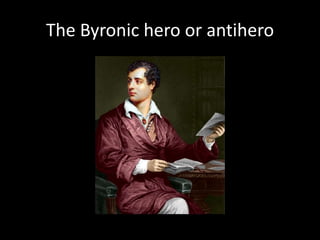
The Byronic hero or antihero
• The Byronic hero is an idealised but
  flawed character exemplified in the life and
  writings of English Romantic poet Lord Byron.
• It was characterised by Lady Caroline Lamb,
  later a lover of Byron's, as being "mad, bad,
  and dangerous to know".
• The Byronic hero first appears in Byron's semi-
  autobiographical epic narrative poem Childe
  Harold's Pilgrimage (1812–1818).
Characteristics
The Byronic hero typically exhibits several of the following traits:
• Arrogant
• Cunning and able to adapt
• Cynical
• Disrespectful of rank and privilege
• Emotionally conflicted, bipolar, or moody
• Having a distaste for social institutions and norms
• Having a troubled past or suffering from an unnamed crime
• Intelligent and perceptive
• Jaded, world-weary
• Mysterious, magnetic and charismatic
• Seductive and sexually attractive
• Self-critical and introspective
• Self-destructive
• Socially and sexually dominant
• Sophisticated and educated
• Struggling with integrity
• Treated as an exile, outcast, or outlaw
Romanticism
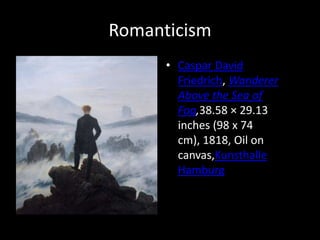
      • Caspar David
        Friedrich, Wanderer
        Above the Sea of
        Fog,38.58 × 29.13
        inches (98 x 74
        cm), 1818, Oil on
        canvas,Kunsthalle
        Hamburg
Romanticism
• Romanticism (or the Romantic era/Period) was an artistic, literary and
  intellectual movement that originated in the second half of the 18th
  century in Europe, and gained strength in reaction to the Industrial
  Revolution.[1] In part, it was a revolt against aristocratic social and political
  norms of the Age of Enlightenment and a reaction against the
  scientific rationalization of nature.[2] It was embodied most strongly in the
  visual arts, music, and literature, but had a major impact on
  historiography,[3]education[4] and natural history.[5]
• The movement validated strong emotion as an authentic source
  of aesthetic experience, placing new emphasis on such emotions as
  trepidation, horror and terror and awe—especially that which is
  experienced in confronting the sublimity of untamed nature and its
  picturesque qualities, both new aesthetic categories. It elevated folk
  art and ancient custom to something noble, made spontaneity a desirable
  characteristic (as in the musical impromptu), and argued for a "natural"
  epistemology of human activities as conditioned by nature in the form of
  language and customary usage.
•   Romanticism reached beyond the rational and Classicist ideal models to elevate a
    revived medievalism and elements of art and narrative perceived to be
    authentically medieval, in an attempt to escape the confines of population
    growth, urban sprawl, andindustrialism, and it also attempted to embrace the
    exotic, unfamiliar, and distant in modes more authentic
    than Rococochinoiserie, harnessing the power of the imagination to envision and
    to escape.
•   The modern sense of a romantic character may be expressed in Byronic ideals of a
    gifted, perhaps misunderstood loner, creatively following the dictates of his
    inspiration rather than the standard ways of contemporary society.
•   Although the movement was rooted in the German Sturm und
    Drang movement, which prized intuition and emotion over Enlightenment
    rationalism, the ideologies and events of the French Revolution laid the
    background from which both Romanticism and the Counter-
    Enlightenment emerged. The confines of the Industrial Revolution also had their
    influence on Romanticism, which was in part an escape from modern realities;
    indeed, in the second half of the 19th century, "Realism" was offered as a
    polarized opposite to Romanticism.[6] Romanticism elevated the achievements of
    what it perceived as heroic individualists and artists, whose pioneering examples
    would elevate society. It also legitimized the individual imagination as a critical
    authority, which permitted freedom from classical notions of form in art. There
    was a strong recourse to historical and natural inevitability, a zeitgeist, in the
    representation of its ideas.

The gothic protagonist

  • 1.
  • 2.
    Task 1 • Createyour own Gothic protagonist. Write a brief description of someone that you could imagine as being the main character in a gothic tale. Include reference to physical appearance. • Consider: age, gender, voice, dominant colouring, profession, nationality, status etc
  • 3.
    Milton’s Satan asa gothic protagonist • Critics have often commented on the ways in which John Miton’s Satan has provided a model for the doomed central characters of gothic novels. • In Book 1 of his epic poem Paradise Lost (1667), Milton describes the fall of Satan and his fellow rebel angels, cast out by God from Heaven into the terrible darkness of Hell.
  • 5.
    Satan reflects onhis terrible fall Now the thought Both of lost happiness and lasting pain Torments him; round he throws his baleful eyes That witnessed huge affliction and dismay Mixed with obdurate pride and steadfast hate. At once, as far as Angels ken, he views The dismal situation waste and wild. A dungeon horible, on all sides round, As one great furnace flamed; yet from those flames No light; but rather darkness visible Paradise Lost, Book 1, lines 54-63
  • 6.
    Milton stresses thedegree to which, however defiantly he acts, Satan is subject to God’s power So stretched out huge in length the Arch-Fiend lay, Chained on the burning lake; nor ever thence Had risen, or heaved his head, but that the will And high permission of all-ruling Heaven Left him at large to his own dark designs, That with reiterated crimes he might Heap on himself damnation, while he sought Evil to others, and enraged might see How all his malice served but to bring forth Infinite goodness, grace, and mercy, shewn On Man by him seduced, but on himself Treble confusion, wrath, and vengeance poured. Paradise Lost, Book 1, lines 209-20
  • 7.
    Characteristic features ofthe gothic protagonist • Some degree of tragic stature • Of high social rank • Somehow foreshadowed by doom • A tendency to be influenced by past events • Sharply contrasting qualities within the character • The possession of considerable powers • A striking physical presence • A strongly sexual element • Driven by siome all-consuming passion • A connection with the exotic • An occasional association with what is bestial or non- human
  • 8.
    The Byronic heroor antihero
  • 9.
    The Byronic heroor antihero • The Byronic hero is an idealised but flawed character exemplified in the life and writings of English Romantic poet Lord Byron. • It was characterised by Lady Caroline Lamb, later a lover of Byron's, as being "mad, bad, and dangerous to know". • The Byronic hero first appears in Byron's semi- autobiographical epic narrative poem Childe Harold's Pilgrimage (1812–1818).
  • 10.
    Characteristics The Byronic herotypically exhibits several of the following traits: • Arrogant • Cunning and able to adapt • Cynical • Disrespectful of rank and privilege • Emotionally conflicted, bipolar, or moody • Having a distaste for social institutions and norms • Having a troubled past or suffering from an unnamed crime • Intelligent and perceptive • Jaded, world-weary • Mysterious, magnetic and charismatic • Seductive and sexually attractive • Self-critical and introspective • Self-destructive • Socially and sexually dominant • Sophisticated and educated • Struggling with integrity • Treated as an exile, outcast, or outlaw
  • 11.
    Romanticism • Caspar David Friedrich, Wanderer Above the Sea of Fog,38.58 × 29.13 inches (98 x 74 cm), 1818, Oil on canvas,Kunsthalle Hamburg
  • 12.
    Romanticism • Romanticism (orthe Romantic era/Period) was an artistic, literary and intellectual movement that originated in the second half of the 18th century in Europe, and gained strength in reaction to the Industrial Revolution.[1] In part, it was a revolt against aristocratic social and political norms of the Age of Enlightenment and a reaction against the scientific rationalization of nature.[2] It was embodied most strongly in the visual arts, music, and literature, but had a major impact on historiography,[3]education[4] and natural history.[5] • The movement validated strong emotion as an authentic source of aesthetic experience, placing new emphasis on such emotions as trepidation, horror and terror and awe—especially that which is experienced in confronting the sublimity of untamed nature and its picturesque qualities, both new aesthetic categories. It elevated folk art and ancient custom to something noble, made spontaneity a desirable characteristic (as in the musical impromptu), and argued for a "natural" epistemology of human activities as conditioned by nature in the form of language and customary usage.
  • 13.
    Romanticism reached beyond the rational and Classicist ideal models to elevate a revived medievalism and elements of art and narrative perceived to be authentically medieval, in an attempt to escape the confines of population growth, urban sprawl, andindustrialism, and it also attempted to embrace the exotic, unfamiliar, and distant in modes more authentic than Rococochinoiserie, harnessing the power of the imagination to envision and to escape. • The modern sense of a romantic character may be expressed in Byronic ideals of a gifted, perhaps misunderstood loner, creatively following the dictates of his inspiration rather than the standard ways of contemporary society. • Although the movement was rooted in the German Sturm und Drang movement, which prized intuition and emotion over Enlightenment rationalism, the ideologies and events of the French Revolution laid the background from which both Romanticism and the Counter- Enlightenment emerged. The confines of the Industrial Revolution also had their influence on Romanticism, which was in part an escape from modern realities; indeed, in the second half of the 19th century, "Realism" was offered as a polarized opposite to Romanticism.[6] Romanticism elevated the achievements of what it perceived as heroic individualists and artists, whose pioneering examples would elevate society. It also legitimized the individual imagination as a critical authority, which permitted freedom from classical notions of form in art. There was a strong recourse to historical and natural inevitability, a zeitgeist, in the representation of its ideas.