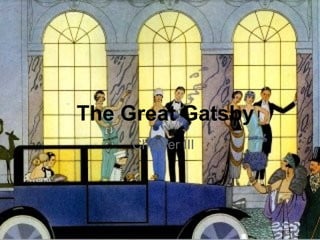
The Great Gatsby
     Chapter III
Question 1
Where is Gatsby's mansion located?
1.East Egg
2.West Egg
3.Park Avenue
4.Kidbrooke
Question 2
What is Gatsby's first name?
1.Ray
2.Trey
3.Jay
4.Gordon
Question 3
What reason does Nick give for Gatsby's
  popularity?
1.People like his dark and mysterious nature
2.He regularly throws lavish parties
3.He once saved a child from a burning
  building
4.He frequently gives money to the poor
Question 4
Who is Owl Eyes?
1.Gatsby's absent father
2.An old man who reveals Gatsby's secret to
  Nick
3.Nick's friend and doctor
4.A man Nick runs across in Gatsby's library
Question 5
At their first meeting,what do Nick and Gatsby
  realise they share in common?
1.They both went to Oxford University
2.They both like champagne
3.They are both from the mid-West
4.They served in the war together
Question 6
What did Gatsby do before moving to Long
  Island?
1.He was a German spy
2.He was an Oxford professor
3.He was a boxer
4.It is unclear
Question 7
What new invention has Gatsby just bought?
1.A helicopter
2.A hydroplane
3.An iPhone 5
4.An orange and lemon juicer
Question 8
What affectation does Gatsby add to the end of
  many of his sentences?
1.Old chap
2.Old dear
3.Old man
4.Old sport
Question 9
What aspect of Gatsby's appearance makes
  the biggest impression on Nick?
1.His haircut
2.His tanned skin
3.His smile
4.His suit
Question 10
What is Jordan Baker 'rotten' at, according to
  Nick?
1.Driving a car
2.Playing golf
3.Applying her make-up
4.Telling lies
Scenes and places - Gatsby's
mansion
p. 41-42
Scenes and places - Gatsby's
mansion
At the beginning of this chapter, Gatsby’s party brings 1920s
wealth and glamour into full focus, showing the upper class at its
most lavishly opulent. The rich, both socialites from East Egg
and their coarser counterparts from West Egg, cavort without
restraint. As his depiction of the differences between East Egg
and West Egg evidences, Fitzgerald is fascinated with the social
hierarchy and mood of America in the 1920s, when a large group
of industrialists, speculators, and businessmen with brand-new
fortunes joined the old, aristocratic families at the top of the
economic ladder. The “new rich” lack the refinement, manners,
and taste of the “old rich” but long to break into the polite society
of the East Eggers. In this scenario, Gatsby is again an enigma
—though he lives in a garishly ostentatious West Egg mansion,
East Eggers freely attend his parties.
Characterisation - Jay Gatsby
p. 45-47
Symbolism - Owl Eyes
Characterisation - Gatsby
p.48-51
Characterisation - Gatsby
•   Fitzgerald has delayed the introduction of the novel’s most important figure
    —Gatsby himself—until the beginning of Chapter 3. The reader has seen
    Gatsby from a distance, heard other characters talk about him, and listened
    to Nick’s thoughts about him, but has not actually met him (nor has Nick).
    Chapter 3 is devoted to the introduction of Gatsby and the lavish, showy
    world he inhabits. Fitzgerald gives Gatsby a suitably grand entrance as the
    aloof host of a spectacularly decadent party. Despite this introduction, this
    chapter continues to heighten the sense of mystery and enigma that
    surrounds Gatsby, as the low profile he maintains seems curiously out of
    place with his lavish expenditures. Just as he stood alone on his lawn in
    Chapter 1, he now stands outside the throng of pleasure-seekers.
•   In his first direct contact with Gatsby, Nick notices his extraordinary smile
    —“one of those rare smiles with a quality of eternal reassurance in it.” Nick’s
    impression of Gatsby emphasizes his optimism and vitality—something
    about him seems remarkably hopeful, and this belief in the brilliance of the
    future impresses Nick, even before he knows what future Gatsby envisions.
Characterisation - Gatsby
•   Many aspects of Gatsby’s world are intriguing because they are slightly
    amiss—for instance, he seems to throw parties at which he knows none of
    his guests. His accent seems affected, and his habit of calling people “old
    sport” is hard to place. One of his guests, Owl Eyes, is surprised to find that
    his books are real and not just empty covers designed to create the
    appearance of a great library. The tone of Nick’s narration suggests that
    many of the inhabitants of East Egg and West Egg use an outward show of
    opulence to cover up their inner corruption and moral decay, but Gatsby
    seems to use his opulence to mask something entirely different and perhaps
    more profound. From this chapter forward, the mystery of Jay Gatsby
    becomes the motivating question of the book, and the unraveling of
    Gatsby’s character becomes one of its central mechanisms. One early clue
    to Gatsby’s character in this chapter is his mysterious conversation with
    Jordan Baker. Though Nick does not know what Gatsby says to her, the fact
    that Jordan now knows something “remarkable” about Gatsby means that a
    part of the solution to the enigma of Gatsby is now loose among Nick’s
    circle of acquaintances.
Voice and point of view – Nick
Carraway
• P.56 - end

Chapter 3

  • 1.
    The Great Gatsby Chapter III
  • 2.
    Question 1 Where isGatsby's mansion located? 1.East Egg 2.West Egg 3.Park Avenue 4.Kidbrooke
  • 3.
    Question 2 What isGatsby's first name? 1.Ray 2.Trey 3.Jay 4.Gordon
  • 4.
    Question 3 What reasondoes Nick give for Gatsby's popularity? 1.People like his dark and mysterious nature 2.He regularly throws lavish parties 3.He once saved a child from a burning building 4.He frequently gives money to the poor
  • 5.
    Question 4 Who isOwl Eyes? 1.Gatsby's absent father 2.An old man who reveals Gatsby's secret to Nick 3.Nick's friend and doctor 4.A man Nick runs across in Gatsby's library
  • 6.
    Question 5 At theirfirst meeting,what do Nick and Gatsby realise they share in common? 1.They both went to Oxford University 2.They both like champagne 3.They are both from the mid-West 4.They served in the war together
  • 7.
    Question 6 What didGatsby do before moving to Long Island? 1.He was a German spy 2.He was an Oxford professor 3.He was a boxer 4.It is unclear
  • 8.
    Question 7 What newinvention has Gatsby just bought? 1.A helicopter 2.A hydroplane 3.An iPhone 5 4.An orange and lemon juicer
  • 9.
    Question 8 What affectationdoes Gatsby add to the end of many of his sentences? 1.Old chap 2.Old dear 3.Old man 4.Old sport
  • 10.
    Question 9 What aspectof Gatsby's appearance makes the biggest impression on Nick? 1.His haircut 2.His tanned skin 3.His smile 4.His suit
  • 11.
    Question 10 What isJordan Baker 'rotten' at, according to Nick? 1.Driving a car 2.Playing golf 3.Applying her make-up 4.Telling lies
  • 12.
    Scenes and places- Gatsby's mansion p. 41-42
  • 13.
    Scenes and places- Gatsby's mansion At the beginning of this chapter, Gatsby’s party brings 1920s wealth and glamour into full focus, showing the upper class at its most lavishly opulent. The rich, both socialites from East Egg and their coarser counterparts from West Egg, cavort without restraint. As his depiction of the differences between East Egg and West Egg evidences, Fitzgerald is fascinated with the social hierarchy and mood of America in the 1920s, when a large group of industrialists, speculators, and businessmen with brand-new fortunes joined the old, aristocratic families at the top of the economic ladder. The “new rich” lack the refinement, manners, and taste of the “old rich” but long to break into the polite society of the East Eggers. In this scenario, Gatsby is again an enigma —though he lives in a garishly ostentatious West Egg mansion, East Eggers freely attend his parties.
  • 14.
    Characterisation - JayGatsby p. 45-47
  • 15.
  • 16.
  • 17.
    Characterisation - Gatsby • Fitzgerald has delayed the introduction of the novel’s most important figure —Gatsby himself—until the beginning of Chapter 3. The reader has seen Gatsby from a distance, heard other characters talk about him, and listened to Nick’s thoughts about him, but has not actually met him (nor has Nick). Chapter 3 is devoted to the introduction of Gatsby and the lavish, showy world he inhabits. Fitzgerald gives Gatsby a suitably grand entrance as the aloof host of a spectacularly decadent party. Despite this introduction, this chapter continues to heighten the sense of mystery and enigma that surrounds Gatsby, as the low profile he maintains seems curiously out of place with his lavish expenditures. Just as he stood alone on his lawn in Chapter 1, he now stands outside the throng of pleasure-seekers. • In his first direct contact with Gatsby, Nick notices his extraordinary smile —“one of those rare smiles with a quality of eternal reassurance in it.” Nick’s impression of Gatsby emphasizes his optimism and vitality—something about him seems remarkably hopeful, and this belief in the brilliance of the future impresses Nick, even before he knows what future Gatsby envisions.
  • 18.
    Characterisation - Gatsby • Many aspects of Gatsby’s world are intriguing because they are slightly amiss—for instance, he seems to throw parties at which he knows none of his guests. His accent seems affected, and his habit of calling people “old sport” is hard to place. One of his guests, Owl Eyes, is surprised to find that his books are real and not just empty covers designed to create the appearance of a great library. The tone of Nick’s narration suggests that many of the inhabitants of East Egg and West Egg use an outward show of opulence to cover up their inner corruption and moral decay, but Gatsby seems to use his opulence to mask something entirely different and perhaps more profound. From this chapter forward, the mystery of Jay Gatsby becomes the motivating question of the book, and the unraveling of Gatsby’s character becomes one of its central mechanisms. One early clue to Gatsby’s character in this chapter is his mysterious conversation with Jordan Baker. Though Nick does not know what Gatsby says to her, the fact that Jordan now knows something “remarkable” about Gatsby means that a part of the solution to the enigma of Gatsby is now loose among Nick’s circle of acquaintances.
  • 19.
    Voice and pointof view – Nick Carraway • P.56 - end