Is Wuthering Heights a Gothic
           Novel?
      Exploring oppositions
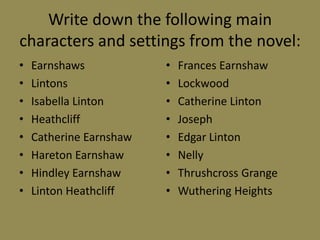
Write down the following main
characters and settings from the novel:
•   Earnshaws            •   Frances Earnshaw
•   Lintons              •   Lockwood
•   Isabella Linton      •   Catherine Linton
•   Heathcliff           •   Joseph
•   Catherine Earnshaw   •   Edgar Linton
•   Hareton Earnshaw     •   Nelly
•   Hindley Earnshaw     •   Thrushcross Grange
•   Linton Heathcliff    •   Wuthering Heights
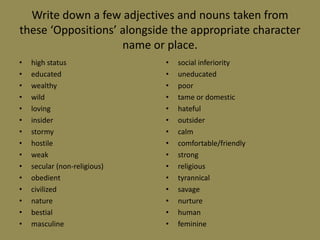
Write down a few adjectives and nouns taken from
these ‘Oppositions’ alongside the appropriate character
                    name or place.
•   high status               •   social inferiority
•   educated                  •   uneducated
•   wealthy                   •   poor
•   wild                      •   tame or domestic
•   loving                    •   hateful
•   insider                   •   outsider
•   stormy                    •   calm
•   hostile                   •   comfortable/friendly
•   weak                      •   strong
•   secular (non-religious)   •   religious
•   obedient                  •   tyrannical
•   civilized                 •   savage
•   nature                    •   nurture
•   bestial                   •   human
•   masculine                 •   feminine
What role(s) do oppositions play
           within the novel?
• Consider:
• the ways in which the characters change and
  develop throughout the novel
• the fact that opposites sometimes attract
• the fact that apparent opposites may have
  more in common than they would like at first
  to admit.
David Daiches’ introduction to the
            1965 edition of WH:
Throughout the novel the homely and the familiar and the wild and extravagant go
together, the former providing a setting for the latter ... We have noted a contrast
between the fireless grate at Thrushcross Grange and the roaring fires of Wuthering
Heights; but even more noticeable in the book is the contrast between the luxury and
comfort of Thrushcross Grange, lying in the soft valley below, and the fierce unpadded
existence at the Heights, which lie exposed to the winds on high moorland...

…this vision of a soft luxury at Thrushcross Grange ... provides the starting point for
that view of the novel which sees it essentially as a carefully patterned weaving of
multiple contrasts between storm and calm. This is the view persuasively argued by
Lord David Cecil in Chapter 5 of his Early Victorian Novelists (1948). Lord David
carefully divides the principal characters in the story into children of calm and children
of storm and their offspring, who are various crosses between the two; offspring of
love combine the best qualities of the parents and offspring of hate (eg Linton
Heathcliff) combine the worst. Children of storm mis-mated to children of calm or
frustrated in their desire to mate with fellow children of storm are driven to destructive
madness; but children of such mis-matings if those mismatings were made in love not
in hate (eg Catherine and Edgar, Hindley and Frances) can themselves mate and
restore harmony between opposing elements. Such harmony is restored by the
marriage of the younger Catherine with Hareton at the end of the novel.
• We are going to explore the ideas of Andrew
  Green, from an essay he wrote entitled Life on
  the Edge – Opposition and Fragmentation in
  Wuthering Heights, from emagazine 31, 2006.
Gothic: a genre of opposition
As has repeatedly been observed by critics, the Gothic is a genre that resides on the borders and
extremes of experience; it thrives on opposition and division and has, at its heart, uncertainty, the
unsettling and the indefi nable. Wuthering Heights is no exception. It deals with questions of
moral, social, religious and personal doubt. To explore these questions, Brontë presents her readers
with a novel of mirror images, doubles and oppositions. Wuthering Heights violently juxtaposes good
and evil; innocence and guilt; freedom and imprisonment; the pursuer and the pursued; the moral and
immoral; the natural and supernatural, and the living and dead. A novel in which such oppositions
remained distinct would present a reassuring, morally certain world. This is not the world of the Gothic
and is not the world of Wuthering Heights: Brontë subjects these oppositions to intense pressure, until
they are revealed to be unstable, each implicated in the other: not only does it become diffi cult to tell
the diff erence between good and evil, moral and immoral but even between living and dead. The
impact of such oppositions and their collapse is profoundly unsettling for the reader. The ambiguities in
the novel lead to an ambivalence in the reader’s attitudes towards the characters and events. This
encapsulates the essentially contradictory and fragmentary nature of the Gothic genre. As David Punter
argues in The Literature of Terror:
             ‘Gothic writers work – consciously or unconsciously – on the fringe of the acceptable, for it
is on this borderland that fear resides. In the best works, the two sides of the border are grafted onto
each other.’

As a result, he suggests, Gothic works are ‘fragmentary, inconsistent, jagged ...’ If Gothic works ‘do not
come out right’, this is because they ‘deal in psychological areas which themselves do not come out
right.’ That is the form through which the Gothic novel enacts its themes. The growing complexity of the
relationships, motives and actions of the characters is both generated by, and refl ected in, the central
structural methods: the cycles of repetition, the echoes set up across and down the generations and the
collapsing oppositions. The behaviours and characteristics descending through the generations of
Earnshaws and the Lintons, create an inescapable vortex of violence and hatred, exaggerated through
the repetition in naming. In conjunction with the complex time scheme, Brontë’s manipulation of the
names ensures that the reader, like Lockwood, is repeatedly destabilised.
The doppelganger and oppositional pairs
A frequent motif in Gothic novels is the ‘double’ or ‘doppelganger’. While the English
term double suggests exact repetition (a twin), the doppelganger is far more sinister,
used to suggest the possibility of the evil side of a character: the monster in
Frankenstein, for example, can be understood as the destructive forces at work within
Victor Frankenstein’s psyche; Mr Hyde, in Robert Louis Stevenson’s novella Dr Jekyll
and Mr Hyde, is the dark uncontrolled force of science within the respectable Dr
Jekyll; in James Hogg’s dark tale of obsession The Private Memoirs and Confessions of
a Justified Sinner, the double is recognisably satanic in provenance.
In Wuthering Heights, Brontë exploits the motif of the double and the doppelganger,
not only in the character but in her presentation of oppositions as inextricably linked.
Lockwood – a narrator we quickly come to recognise as self-absorbed and wholly
unreliable – begins by greeting Heathcliff as his double. He is delighted to meet
another man who is weary of the world:
            ‘Mr Heathcliff and I are such a suitable pair to divide the desolation between
us.’
However, it is immediately apparent to the reader that this ‘pair’ have little in
common: where Lockwood constructs himself within a literary stereotype – sensitive,
disillusioned, bored with society and misanthropic – Heathcliff is the real thing, fuelled
by a burning hatred of society. The reader, like Lockwood himself, shifts to interpret
the two men as opposites: indeed they might be seen to ‘divide’ the world between
them, an interpretation reinforced by their names (wood v. heath). Lockwood
represents acceptable gentility; Heathcliff , of unknown parentage, is brutal without
the patina of civilisation and polished society.
The doppelganger and oppositional pairs (contd.)
The ease with which it is possible to attribute opposite personal characteristics and social values to the
two men, makes the collapse of these oppositions all the more shocking. Throughout the first three
framing chapters this oppositional relationship is questioned and blurred. Through the character of
Lockwood the values of civilised society – the society which sets itself up in opposition to the
raw, uncultivated world of Wuthering Heights – are compromised, revealed as implicated in the violence
it apparently shuns. We see this in Lockwood’s brutal treatment of the dogs; the violence of his
response to his humiliation; the verbs and adverbs used to describe his second visit to the Heights
(‘ejaculated’, ‘grasped’, ‘knocked’, ‘shook’, ‘vehemently’) and most particularly in his rubbing of the
waif’s wrists until they bleed.
             ‘I pulled its wrist onto the broken pane and rubbed it to and fro till the blood ran down and
soaked the bedclothes’
It is an opposition which is repeatedly established throughout the novel only to be undermined: young
Edgar and Isabella Linton fi ght over the dog, pulling it apart; the dogs protecting the superfi cially
civilised Thrushcross Grange attack and seriously injure Catherine *1+; Linton ‘winks’ at the violent
treatment of Catherine by Heathcliff ; Frances is encouraged to pull the hair of Heathcliff as he passes.
All of these examples of violence are taken from the ‘civilised’ world: domestic violence is seen and
accepted by all the characters, including the ‘gentlemanly’ Lockwood, as a normal part of everyday life.
As David Punter suggests, the Gothic novel explores its themes through its structure and this is seen
particularly clearly in the destabilising of conventional oppositions in Wuthering Heights. So too is the
marginal position that the Gothic occupies both in terms of its place among literary genres and its
exploration of liminal spaces – the places on the edge, at the boundary. In Wuthering Heights Brontë
repeatedly ensures these boundaries are crossed or broken: Catherine [1] declares that Heathcliff is
more herself than she is, destabilising the boundary between the self and other; she continues to exert
infl uence after death; windows are shattered, violating the limits society establishes between the
inside and outside, nature and culture, civilised and natural and so on. In this Gothic novel the rules by
which we expect the world and society to operate are not simply broken, they are shown not to apply;
appropriately for a novel of collapsing oppositions, this is both frightening and liberating.
Exploring repetition

Resemblance or Reversal?
What repetitions can you identify?
•   Heathcliff
•   Isabella (Linton) Heathcliff
•   Catherine (Earnshaw) Linton
•   Edgar Linton
•   Hindley Earnshaw
•   Frances Earnshaw
•   Catherine (Linton) (Heathcliff ) Earnshaw
•   Hareton Earnshaw
•   Linton Heathcliff

What is the purpose in repeating the names in this way?
Mrs Dean raised the candle, and I
discerned a soft-featured face, exceedingly
resembling the young lady at the Heights, but
more pensive and amiable in expression.
      (Lockwood narrates, talking about the
portrait of Edgar Linton, p106/p67)
• ‘Now that she’s dead, I see her in Hindley;
  Hindley has exactly her eyes,’ (Isabella to
  Heathcliff , p217/p182)
• That capacity for intense attachments
  reminded me of her mother; still she did not
  resemble her; for she could be soft and mild
  as a dove (Nelly’s narration, regarding
  Catherine [2], p224/p189)
• A pale, delicate, effeminate boy, who might
  have been taken for my master’s younger
  brother, so strong was the resemblance; but
  there was a sickly peevishness in his aspect
  that Edgar Linton never had. (Nelly’s
  narration, describing Linton Heathcliff
  , p235/p200)
• ‘He’s very delicate ... and scarcely likely to
  reach manhood; but this I can say, he does not
  resemble his father ...’ (Nelly to Edgar,
  regarding Linton, p288/p256)
• ‘I know what he suffers now, for
  instance, exactly – it is merely the beginning
  of what he shall suffer, though. And he’ll never
  be able to emerge from his bathos of
  coarseness, and ignorance.’ (Heathcliff to
  Nelly, about Hareton, p253/p219)
• They lifted their eyes together, to encounter
  Mr Heathcliff – perhaps, you have never
  remarked that their eyes are precisely similar,
  and they are those of Catherine Earnshaw.
  (Nelly’s narration, regarding Catherine [2] and
  Hareton, p352/p322)
• ‘Five minutes ago, Hareton seemed a personifi
  cation of my youth, not a human being – ... his
  startling likeness to Catherine connected him
  fearfully with her –’ (Heathcliff to
  Nelly, p353/p323)
Which of these readings of repetition
  do you find the most persuasive?
1.   Repetition is about emphasis. Brontë is pointing up the key ideas
     of the novel by repeating character traits across generations.
2.   Repetition is about the struggle of these characters to find an
     identity for themselves. The constant restrictions put upon them
     by other characters and by society is their prison, and only
     through the next generation can freedom be attained.
3.   The patterns in this novel in relation to the characters’ names and
     traits are as much about difference as about similarity. Brontë only
     provides the overlap of traits to show how one generation differs
     from the other.
4.   The repetitions in the novel are often reminders of things that
     have been lost, and are therefore about illustrating absence, not
     presence.
5.   The patterns of repetition reveal the fact that similar characters
     and situations can have different outcomes – the final outcomes
     for the second generation are more positive and
     optimistic, showing a faith in the impact of positive human values.

Exploring oppositions

  • 1.
    Is Wuthering Heightsa Gothic Novel? Exploring oppositions
  • 2.
    Write down thefollowing main characters and settings from the novel: • Earnshaws • Frances Earnshaw • Lintons • Lockwood • Isabella Linton • Catherine Linton • Heathcliff • Joseph • Catherine Earnshaw • Edgar Linton • Hareton Earnshaw • Nelly • Hindley Earnshaw • Thrushcross Grange • Linton Heathcliff • Wuthering Heights
  • 3.
    Write down afew adjectives and nouns taken from these ‘Oppositions’ alongside the appropriate character name or place. • high status • social inferiority • educated • uneducated • wealthy • poor • wild • tame or domestic • loving • hateful • insider • outsider • stormy • calm • hostile • comfortable/friendly • weak • strong • secular (non-religious) • religious • obedient • tyrannical • civilized • savage • nature • nurture • bestial • human • masculine • feminine
  • 4.
    What role(s) dooppositions play within the novel? • Consider: • the ways in which the characters change and develop throughout the novel • the fact that opposites sometimes attract • the fact that apparent opposites may have more in common than they would like at first to admit.
  • 5.
    David Daiches’ introductionto the 1965 edition of WH: Throughout the novel the homely and the familiar and the wild and extravagant go together, the former providing a setting for the latter ... We have noted a contrast between the fireless grate at Thrushcross Grange and the roaring fires of Wuthering Heights; but even more noticeable in the book is the contrast between the luxury and comfort of Thrushcross Grange, lying in the soft valley below, and the fierce unpadded existence at the Heights, which lie exposed to the winds on high moorland... …this vision of a soft luxury at Thrushcross Grange ... provides the starting point for that view of the novel which sees it essentially as a carefully patterned weaving of multiple contrasts between storm and calm. This is the view persuasively argued by Lord David Cecil in Chapter 5 of his Early Victorian Novelists (1948). Lord David carefully divides the principal characters in the story into children of calm and children of storm and their offspring, who are various crosses between the two; offspring of love combine the best qualities of the parents and offspring of hate (eg Linton Heathcliff) combine the worst. Children of storm mis-mated to children of calm or frustrated in their desire to mate with fellow children of storm are driven to destructive madness; but children of such mis-matings if those mismatings were made in love not in hate (eg Catherine and Edgar, Hindley and Frances) can themselves mate and restore harmony between opposing elements. Such harmony is restored by the marriage of the younger Catherine with Hareton at the end of the novel.
  • 6.
    • We aregoing to explore the ideas of Andrew Green, from an essay he wrote entitled Life on the Edge – Opposition and Fragmentation in Wuthering Heights, from emagazine 31, 2006.
  • 7.
    Gothic: a genreof opposition As has repeatedly been observed by critics, the Gothic is a genre that resides on the borders and extremes of experience; it thrives on opposition and division and has, at its heart, uncertainty, the unsettling and the indefi nable. Wuthering Heights is no exception. It deals with questions of moral, social, religious and personal doubt. To explore these questions, Brontë presents her readers with a novel of mirror images, doubles and oppositions. Wuthering Heights violently juxtaposes good and evil; innocence and guilt; freedom and imprisonment; the pursuer and the pursued; the moral and immoral; the natural and supernatural, and the living and dead. A novel in which such oppositions remained distinct would present a reassuring, morally certain world. This is not the world of the Gothic and is not the world of Wuthering Heights: Brontë subjects these oppositions to intense pressure, until they are revealed to be unstable, each implicated in the other: not only does it become diffi cult to tell the diff erence between good and evil, moral and immoral but even between living and dead. The impact of such oppositions and their collapse is profoundly unsettling for the reader. The ambiguities in the novel lead to an ambivalence in the reader’s attitudes towards the characters and events. This encapsulates the essentially contradictory and fragmentary nature of the Gothic genre. As David Punter argues in The Literature of Terror: ‘Gothic writers work – consciously or unconsciously – on the fringe of the acceptable, for it is on this borderland that fear resides. In the best works, the two sides of the border are grafted onto each other.’ As a result, he suggests, Gothic works are ‘fragmentary, inconsistent, jagged ...’ If Gothic works ‘do not come out right’, this is because they ‘deal in psychological areas which themselves do not come out right.’ That is the form through which the Gothic novel enacts its themes. The growing complexity of the relationships, motives and actions of the characters is both generated by, and refl ected in, the central structural methods: the cycles of repetition, the echoes set up across and down the generations and the collapsing oppositions. The behaviours and characteristics descending through the generations of Earnshaws and the Lintons, create an inescapable vortex of violence and hatred, exaggerated through the repetition in naming. In conjunction with the complex time scheme, Brontë’s manipulation of the names ensures that the reader, like Lockwood, is repeatedly destabilised.
  • 8.
    The doppelganger andoppositional pairs A frequent motif in Gothic novels is the ‘double’ or ‘doppelganger’. While the English term double suggests exact repetition (a twin), the doppelganger is far more sinister, used to suggest the possibility of the evil side of a character: the monster in Frankenstein, for example, can be understood as the destructive forces at work within Victor Frankenstein’s psyche; Mr Hyde, in Robert Louis Stevenson’s novella Dr Jekyll and Mr Hyde, is the dark uncontrolled force of science within the respectable Dr Jekyll; in James Hogg’s dark tale of obsession The Private Memoirs and Confessions of a Justified Sinner, the double is recognisably satanic in provenance. In Wuthering Heights, Brontë exploits the motif of the double and the doppelganger, not only in the character but in her presentation of oppositions as inextricably linked. Lockwood – a narrator we quickly come to recognise as self-absorbed and wholly unreliable – begins by greeting Heathcliff as his double. He is delighted to meet another man who is weary of the world: ‘Mr Heathcliff and I are such a suitable pair to divide the desolation between us.’ However, it is immediately apparent to the reader that this ‘pair’ have little in common: where Lockwood constructs himself within a literary stereotype – sensitive, disillusioned, bored with society and misanthropic – Heathcliff is the real thing, fuelled by a burning hatred of society. The reader, like Lockwood himself, shifts to interpret the two men as opposites: indeed they might be seen to ‘divide’ the world between them, an interpretation reinforced by their names (wood v. heath). Lockwood represents acceptable gentility; Heathcliff , of unknown parentage, is brutal without the patina of civilisation and polished society.
  • 9.
    The doppelganger andoppositional pairs (contd.) The ease with which it is possible to attribute opposite personal characteristics and social values to the two men, makes the collapse of these oppositions all the more shocking. Throughout the first three framing chapters this oppositional relationship is questioned and blurred. Through the character of Lockwood the values of civilised society – the society which sets itself up in opposition to the raw, uncultivated world of Wuthering Heights – are compromised, revealed as implicated in the violence it apparently shuns. We see this in Lockwood’s brutal treatment of the dogs; the violence of his response to his humiliation; the verbs and adverbs used to describe his second visit to the Heights (‘ejaculated’, ‘grasped’, ‘knocked’, ‘shook’, ‘vehemently’) and most particularly in his rubbing of the waif’s wrists until they bleed. ‘I pulled its wrist onto the broken pane and rubbed it to and fro till the blood ran down and soaked the bedclothes’ It is an opposition which is repeatedly established throughout the novel only to be undermined: young Edgar and Isabella Linton fi ght over the dog, pulling it apart; the dogs protecting the superfi cially civilised Thrushcross Grange attack and seriously injure Catherine *1+; Linton ‘winks’ at the violent treatment of Catherine by Heathcliff ; Frances is encouraged to pull the hair of Heathcliff as he passes. All of these examples of violence are taken from the ‘civilised’ world: domestic violence is seen and accepted by all the characters, including the ‘gentlemanly’ Lockwood, as a normal part of everyday life. As David Punter suggests, the Gothic novel explores its themes through its structure and this is seen particularly clearly in the destabilising of conventional oppositions in Wuthering Heights. So too is the marginal position that the Gothic occupies both in terms of its place among literary genres and its exploration of liminal spaces – the places on the edge, at the boundary. In Wuthering Heights Brontë repeatedly ensures these boundaries are crossed or broken: Catherine [1] declares that Heathcliff is more herself than she is, destabilising the boundary between the self and other; she continues to exert infl uence after death; windows are shattered, violating the limits society establishes between the inside and outside, nature and culture, civilised and natural and so on. In this Gothic novel the rules by which we expect the world and society to operate are not simply broken, they are shown not to apply; appropriately for a novel of collapsing oppositions, this is both frightening and liberating.
  • 10.
  • 11.
    What repetitions canyou identify? • Heathcliff • Isabella (Linton) Heathcliff • Catherine (Earnshaw) Linton • Edgar Linton • Hindley Earnshaw • Frances Earnshaw • Catherine (Linton) (Heathcliff ) Earnshaw • Hareton Earnshaw • Linton Heathcliff What is the purpose in repeating the names in this way?
  • 12.
    Mrs Dean raisedthe candle, and I discerned a soft-featured face, exceedingly resembling the young lady at the Heights, but more pensive and amiable in expression. (Lockwood narrates, talking about the portrait of Edgar Linton, p106/p67)
  • 13.
    • ‘Now thatshe’s dead, I see her in Hindley; Hindley has exactly her eyes,’ (Isabella to Heathcliff , p217/p182)
  • 14.
    • That capacityfor intense attachments reminded me of her mother; still she did not resemble her; for she could be soft and mild as a dove (Nelly’s narration, regarding Catherine [2], p224/p189)
  • 15.
    • A pale,delicate, effeminate boy, who might have been taken for my master’s younger brother, so strong was the resemblance; but there was a sickly peevishness in his aspect that Edgar Linton never had. (Nelly’s narration, describing Linton Heathcliff , p235/p200)
  • 16.
    • ‘He’s verydelicate ... and scarcely likely to reach manhood; but this I can say, he does not resemble his father ...’ (Nelly to Edgar, regarding Linton, p288/p256)
  • 17.
    • ‘I knowwhat he suffers now, for instance, exactly – it is merely the beginning of what he shall suffer, though. And he’ll never be able to emerge from his bathos of coarseness, and ignorance.’ (Heathcliff to Nelly, about Hareton, p253/p219)
  • 18.
    • They liftedtheir eyes together, to encounter Mr Heathcliff – perhaps, you have never remarked that their eyes are precisely similar, and they are those of Catherine Earnshaw. (Nelly’s narration, regarding Catherine [2] and Hareton, p352/p322)
  • 19.
    • ‘Five minutesago, Hareton seemed a personifi cation of my youth, not a human being – ... his startling likeness to Catherine connected him fearfully with her –’ (Heathcliff to Nelly, p353/p323)
  • 20.
    Which of thesereadings of repetition do you find the most persuasive? 1. Repetition is about emphasis. Brontë is pointing up the key ideas of the novel by repeating character traits across generations. 2. Repetition is about the struggle of these characters to find an identity for themselves. The constant restrictions put upon them by other characters and by society is their prison, and only through the next generation can freedom be attained. 3. The patterns in this novel in relation to the characters’ names and traits are as much about difference as about similarity. Brontë only provides the overlap of traits to show how one generation differs from the other. 4. The repetitions in the novel are often reminders of things that have been lost, and are therefore about illustrating absence, not presence. 5. The patterns of repetition reveal the fact that similar characters and situations can have different outcomes – the final outcomes for the second generation are more positive and optimistic, showing a faith in the impact of positive human values.