ROMANTICISM
INTRODUCTION
Romanticism-relates to a period of European culture
Romanticism in :
Political history
The Arts –Literature- Painting
WHAT DO YOU THINK OF WHEN YOU HEAR
THE WORD ‘ROMANTIC’?
ROMANTICISM
A HISTORICAL TERM
• While today we think of being romantic in relation to
relationships Romanticism has a history
• The term is associated with a period of European
Cultural History (roughly 1780s to 1840s ie late C18
and first part of C19)
• Romanticism emphasised individual feeling, emotion,
heightened sensibility and awareness of the power of
nature
• So the idea of ‘being Romantic’ is linked to these
ideas and its not only in relationships that the
influence of the Romantic period is still felt today
ROMANTICISM AND POLITICAL
HISTORY
• Romanticism is also understood in relation to challenges to autocratic
aristocratic authority from the growing middle class, the new industrial
working class and -in some European countries- serfs
• ‘Man is born free, and everywhere he is in chains’ Jean Jacques Rousseau
1762
• (1770 American Revolution )
• 1789 Storming of the Bastille
• 1791 French Revolution
• 1848 Year of (European)Revolutions
ROMANTICISM IN THE ARTS
• With its emphasis on individual feeling and challenge to outmoded traditions
Romanticism was very evident in the arts
• Romantic artists challenged what to them seemed outdated conventions to
favour new ways of expressing individual human experience and exploring
the power of nature
KEY THEMES OF ROMANTICISM
IN THE ARTS
• Glorification of Nature
• Interest in ancient times
• Instinct more important than reason
• Equality-Giving voice to the poor and the oppressed
• Individual feeling
• Individual detail as revealing ‘truth’
• The quest for ultimate truth (which is always beyond reach)
• The special role of the artist
THE ROLE OF THE ROMANTIC ARTIST
• The seeker of ultimate truth
• The misunderstood genius
• Heightened sensitivity –
perceives and understand what
others cannot
• The challenger of outdated
convention
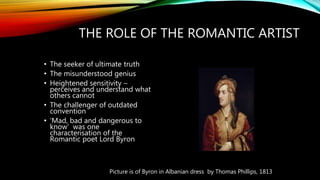
• ‘Mad, bad and dangerous to
know’ was one
characterisation of the
Romantic poet Lord Byron
Picture is of Byron in Albanian dress by Thomas Phillips, 1813
ROMANTICISM AND LITERATURE
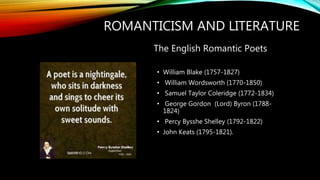
• William Blake (1757-1827)
• William Wordsworth (1770-1850)
• Samuel Taylor Coleridge (1772-1834)
• George Gordon (Lord) Byron (1788-
1824)
• Percy Bysshe Shelley (1792-1822)
• John Keats (1795-1821).
The English Romantic Poets
THE ENGLISH ROMANTIC POETS
• Late C18 William Blake, William Wordsworth and Samuel Taylor
Coleridge turned away from conventions of the past to create
poems of emotional sensitivity that revered nature.
• C19 the second generation Romantic poets Percy Bysshe Shelley,
John Keats and Lord Byron continued the focus on nature and
emphasis on feeling
• Shelley and Byron in particular were known for breaking social
conventions.
• Shelley, Byron and Keats gained a posthumous (after their
death) reputation as ‘Romantic’ as their lives matched the
emerging idea of the Romantic Hero due to their lifestyles, their
travels outside England to ‘romantic’ locations and early deaths
ROMANTICISM AND LITERATURE
As with the poets, Romantic novelists (who often were also poets) emphasised
feeling, often focussing on the lives of the poor and the oppressed
For example, Victor Hugo wrote Notre Dame de Paris/The Hunchback of Notre
Dame 1831 and Les Miserables 1862
The heroes of these works were not the princes and gods of past literature but
outcasts
Esmeralda –the gypsy who is deceived by men who desire her
Quasimodo -the hunchback who tries to rescue Esmeralda
Jean Valjean-the ex-convict who is he main character in Les Miserables
ROMANTICISM AND LITERATURE
• The Gothic Novel –A product of Romanticism
• Often supernatural horror stories with ghosts, demons, or monsters.
• Centre around hidden secrets and repressed desires
• Set in ancient settings –castles-manors- monasteries-abbeys that are haunted or
dangerous.
• Feature fainting ‘damsels in distress’ who require heroic assistance.
THE GOTHIC NOVEL
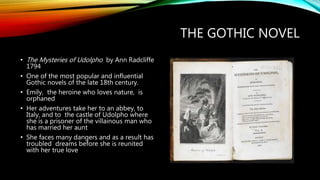
• The Mysteries of Udolpho by Ann Radcliffe
1794
• One of the most popular and influential
Gothic novels of the late 18th century.
• Emily, the heroine who loves nature, is
orphaned
• Her adventures take her to an abbey, to
Italy, and to the castle of Udolpho where
she is a prisoner of the villainous man who
has married her aunt
• She faces many dangers and as a result has
troubled dreams before she is reunited
with her true love
ROMANTICISM AND LITERATURE
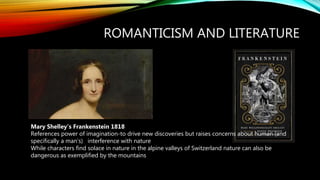
Mary Shelley’s Frankenstein 1818
References power of imagination-to drive new discoveries but raises concerns about human (and
specifically a man’s) interference with nature
While characters find solace in nature in the alpine valleys of Switzerland nature can also be
dangerous as exemplified by the mountains
ROMANTICISM IN VISUAL ARTS
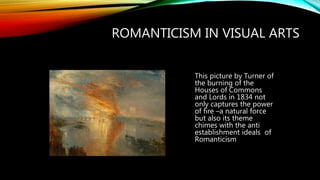
This picture by Turner of
the burning of the
Houses of Commons
and Lords in 1834 not
only captures the power
of fire –a natural force
but also its theme
chimes with the anti
establishment ideals of
Romanticism
ROMANTICISM IN VISUAL ART
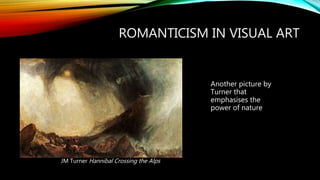
Another picture by
Turner that
emphasises the
power of nature
JM Turner Hannibal Crossing the Alps
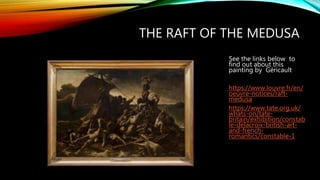
THE RAFT OF THE MEDUSA
See the links below to
find out about this
painting by Géricault
https://www.louvre.fr/en/
oeuvre-notices/raft-
medusa
https://www.tate.org.uk/
whats-on/tate-
britain/exhibition/constab
le-delacroix-british-art-
and-french-
romantics/constable-1
FOR SEMINAR
• What do you understand as key themes in Romanticism?
• How are some of these evident in the painting Raft of the Medusa?

30.11.20 Understanding Performance - Romanticism introduction

  • 1.
    ROMANTICISM INTRODUCTION Romanticism-relates to aperiod of European culture Romanticism in : Political history The Arts –Literature- Painting
  • 2.
    WHAT DO YOUTHINK OF WHEN YOU HEAR THE WORD ‘ROMANTIC’?
  • 3.
    ROMANTICISM A HISTORICAL TERM •While today we think of being romantic in relation to relationships Romanticism has a history • The term is associated with a period of European Cultural History (roughly 1780s to 1840s ie late C18 and first part of C19) • Romanticism emphasised individual feeling, emotion, heightened sensibility and awareness of the power of nature • So the idea of ‘being Romantic’ is linked to these ideas and its not only in relationships that the influence of the Romantic period is still felt today
  • 4.
    ROMANTICISM AND POLITICAL HISTORY •Romanticism is also understood in relation to challenges to autocratic aristocratic authority from the growing middle class, the new industrial working class and -in some European countries- serfs • ‘Man is born free, and everywhere he is in chains’ Jean Jacques Rousseau 1762 • (1770 American Revolution ) • 1789 Storming of the Bastille • 1791 French Revolution • 1848 Year of (European)Revolutions
  • 5.
    ROMANTICISM IN THEARTS • With its emphasis on individual feeling and challenge to outmoded traditions Romanticism was very evident in the arts • Romantic artists challenged what to them seemed outdated conventions to favour new ways of expressing individual human experience and exploring the power of nature
  • 6.
    KEY THEMES OFROMANTICISM IN THE ARTS • Glorification of Nature • Interest in ancient times • Instinct more important than reason • Equality-Giving voice to the poor and the oppressed • Individual feeling • Individual detail as revealing ‘truth’ • The quest for ultimate truth (which is always beyond reach) • The special role of the artist
  • 7.
    THE ROLE OFTHE ROMANTIC ARTIST • The seeker of ultimate truth • The misunderstood genius • Heightened sensitivity – perceives and understand what others cannot • The challenger of outdated convention • ‘Mad, bad and dangerous to know’ was one characterisation of the Romantic poet Lord Byron Picture is of Byron in Albanian dress by Thomas Phillips, 1813
  • 8.
    ROMANTICISM AND LITERATURE •William Blake (1757-1827) • William Wordsworth (1770-1850) • Samuel Taylor Coleridge (1772-1834) • George Gordon (Lord) Byron (1788- 1824) • Percy Bysshe Shelley (1792-1822) • John Keats (1795-1821). The English Romantic Poets
  • 9.
    THE ENGLISH ROMANTICPOETS • Late C18 William Blake, William Wordsworth and Samuel Taylor Coleridge turned away from conventions of the past to create poems of emotional sensitivity that revered nature. • C19 the second generation Romantic poets Percy Bysshe Shelley, John Keats and Lord Byron continued the focus on nature and emphasis on feeling • Shelley and Byron in particular were known for breaking social conventions. • Shelley, Byron and Keats gained a posthumous (after their death) reputation as ‘Romantic’ as their lives matched the emerging idea of the Romantic Hero due to their lifestyles, their travels outside England to ‘romantic’ locations and early deaths
  • 10.
    ROMANTICISM AND LITERATURE Aswith the poets, Romantic novelists (who often were also poets) emphasised feeling, often focussing on the lives of the poor and the oppressed For example, Victor Hugo wrote Notre Dame de Paris/The Hunchback of Notre Dame 1831 and Les Miserables 1862 The heroes of these works were not the princes and gods of past literature but outcasts Esmeralda –the gypsy who is deceived by men who desire her Quasimodo -the hunchback who tries to rescue Esmeralda Jean Valjean-the ex-convict who is he main character in Les Miserables
  • 11.
    ROMANTICISM AND LITERATURE •The Gothic Novel –A product of Romanticism • Often supernatural horror stories with ghosts, demons, or monsters. • Centre around hidden secrets and repressed desires • Set in ancient settings –castles-manors- monasteries-abbeys that are haunted or dangerous. • Feature fainting ‘damsels in distress’ who require heroic assistance.
  • 12.
    THE GOTHIC NOVEL •The Mysteries of Udolpho by Ann Radcliffe 1794 • One of the most popular and influential Gothic novels of the late 18th century. • Emily, the heroine who loves nature, is orphaned • Her adventures take her to an abbey, to Italy, and to the castle of Udolpho where she is a prisoner of the villainous man who has married her aunt • She faces many dangers and as a result has troubled dreams before she is reunited with her true love
  • 13.
    ROMANTICISM AND LITERATURE MaryShelley’s Frankenstein 1818 References power of imagination-to drive new discoveries but raises concerns about human (and specifically a man’s) interference with nature While characters find solace in nature in the alpine valleys of Switzerland nature can also be dangerous as exemplified by the mountains
  • 14.
    ROMANTICISM IN VISUALARTS This picture by Turner of the burning of the Houses of Commons and Lords in 1834 not only captures the power of fire –a natural force but also its theme chimes with the anti establishment ideals of Romanticism
  • 15.
    ROMANTICISM IN VISUALART Another picture by Turner that emphasises the power of nature JM Turner Hannibal Crossing the Alps
  • 16.
    THE RAFT OFTHE MEDUSA See the links below to find out about this painting by Géricault https://www.louvre.fr/en/ oeuvre-notices/raft- medusa https://www.tate.org.uk/ whats-on/tate- britain/exhibition/constab le-delacroix-british-art- and-french- romantics/constable-1
  • 17.
    FOR SEMINAR • Whatdo you understand as key themes in Romanticism? • How are some of these evident in the painting Raft of the Medusa?

Editor's Notes

  • #14 This novel quotes Romantic poem by Coleridge References power of imagination-to drive new discoveries But raises concerns about human (and specifically a man’s) interference with nature While characters find solace in nature in alpine valleys of Switzerland nature can also be dangerous as exemplified by the mountains