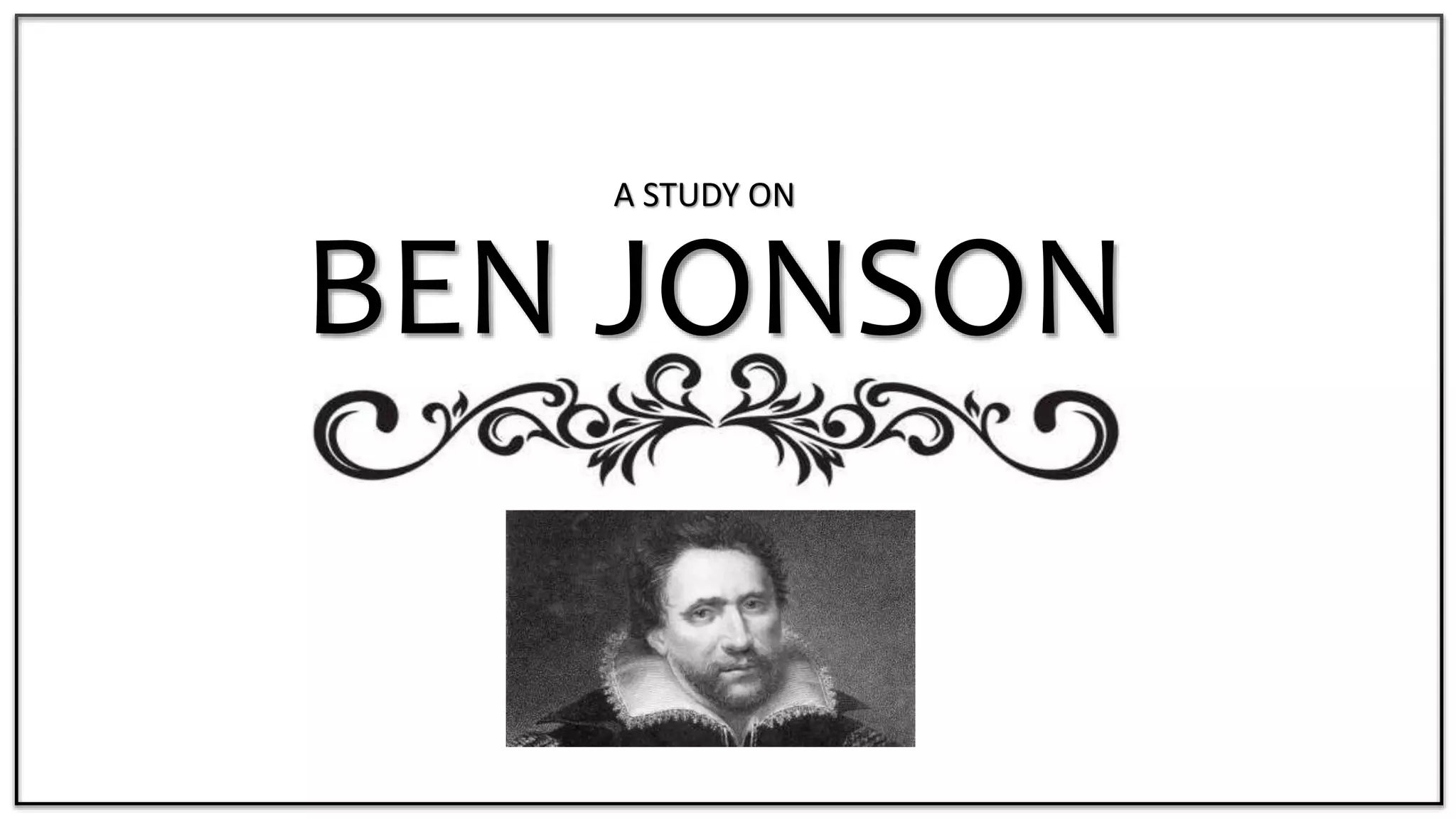
BEN JONSON
A STUDY ON
FAMILY BACKGROUND
• Ben Jonson was born by the name of
‘Benjamin Jonson’ in London on June,
11th, 1572 (two months after his father
died.)
• Jonson's mother then married a bricklayer.
His stepfather made him work in the more
practical business of bricklaying.
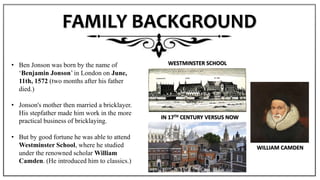
• But by good fortune he was able to attend
Westminster School, where he studied
under the renowned scholar William
Camden. (He introduced him to classics.)
WILLIAM CAMDEN
WESTMINSTER SCHOOL
IN 17TH CENTURY VERSUS NOW
BEFORE LITERARY CAREER
• After a few weeks at Cambridge, Jonson was forced
to take up bricklaying. Later he is found soldiering
in the Netherlands, fighting a duel with an enemy
soldier, killing him, and returning home with heroic
tales to enlarge upon.
• He returned to England about 1592 and married
Anne Lewis on November 14th, 1594.
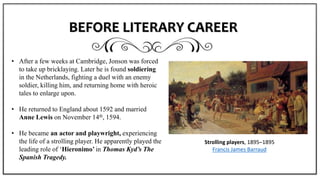
• He became an actor and playwright, experiencing
the life of a strolling player. He apparently played the
leading role of ‘Hieronimo’ in Thomas Kyd’s The
Spanish Tragedy.
Strolling players, 1895–1895
Francis James Barraud
LITERARY CAREER
• Many people thought that English literature, and particularly
drama, had already reached as high as it could when Ben Jonson
began his career. But Jonson helped it gain even higher goals.
• Jonson had begun to write in 1597, perhaps with a play called The
Case is Altered.
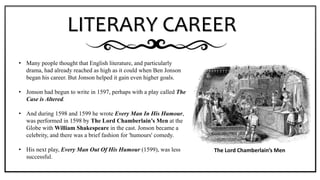
• And during 1598 and 1599 he wrote Every Man In His Humour,
was performed in 1598 by The Lord Chamberlain’s Men at the
Globe with William Shakespeare in the cast. Jonson became a
celebrity, and there was a brief fashion for 'humours' comedy.
• His next play, Every Man Out Of His Humour (1599), was less
successful.
The Lord Chamberlain’s Men
IMPRISONMENT
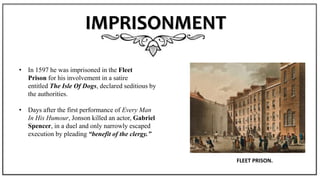
• In 1597 he was imprisoned in the Fleet
Prison for his involvement in a satire
entitled The Isle Of Dogs, declared seditious by
the authorities.
• Days after the first performance of Every Man
In His Humour, Jonson killed an actor, Gabriel
Spencer, in a duel and only narrowly escaped
execution by pleading “benefit of the clergy.”
FLEET PRISON.
IN THE COURT
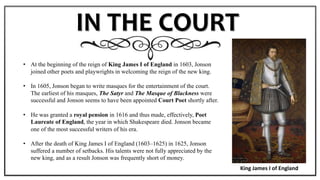
• At the beginning of the reign of King James I of England in 1603, Jonson
joined other poets and playwrights in welcoming the reign of the new king.
• In 1605, Jonson began to write masques for the entertainment of the court.
The earliest of his masques, The Satyr and The Masque of Blackness were
successful and Jonson seems to have been appointed Court Poet shortly after.
• He was granted a royal pension in 1616 and thus made, effectively, Poet
Laureate of England, the year in which Shakespeare died. Jonson became
one of the most successful writers of his era.
• After the death of King James I of England (1603–1625) in 1625, Jonson
suffered a number of setbacks. His talents were not fully appreciated by the
new king, and as a result Jonson was frequently short of money.
King James I of England
LATER LIFE
• His comedies Volpone or the Foxe (1606) and The Alchemist (1610) were among the
most popular and esteemed plays of the time.
• After his personal library burned in 1623, Jonson hit a low point in his life. He fell
out of favor with the court and suffered several strokes, which made writing
extremely arduous.
• Despite these apparent failures, and in spite of his frequent feuds, Jonson was the dean
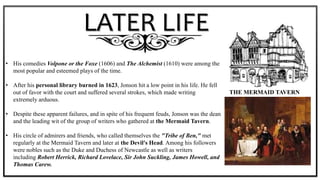
and the leading wit of the group of writers who gathered at the Mermaid Tavern.
• His circle of admirers and friends, who called themselves the "Tribe of Ben," met
regularly at the Mermaid Tavern and later at the Devil's Head. Among his followers
were nobles such as the Duke and Duchess of Newcastle as well as writers
including Robert Herrick, Richard Lovelace, Sir John Suckling, James Howell, and
Thomas Carew.
THE MERMAID TAVERN
BEN JONSON AND HIS
CONTEMPORARIES
• Jonson was friends with many of the writers of his day, and many of his most well-known poems include
tributes to friends such as Shakespeare, John Donne, and Francis Bacon.
• Jonson made many jokes about other people and considered himself superior to others. Jonson's personal
characteristics partly explain why he placed himself in opposition to the spirit of the age. He was extremely
combative. It was almost a necessity for him to quarrel with some person or with some opinion.
• Jonson deliberately took his stand in opposition to “the romantic spirit of the age”. Marlowe and
Shakespeare had disregarded the classical unities and had developed the drama on romantic lines.
• He resolved to follow classical traditions and to stick to unity of time and place in the construction of his
plots.
DEATH
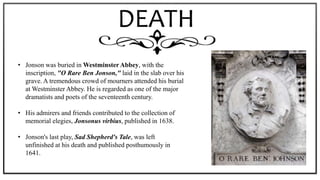
• Jonson was buried in Westminster Abbey, with the
inscription, "O Rare Ben Jonson," laid in the slab over his
grave. A tremendous crowd of mourners attended his burial
at Westminster Abbey. He is regarded as one of the major
dramatists and poets of the seventeenth century.
• His admirers and friends contributed to the collection of
memorial elegies, Jonsonus virbius, published in 1638.
• Jonson's last play, Sad Shepherd's Tale, was left
unfinished at his death and published posthumously in
1641.

Ben Jonson

  • 1.
  • 2.
    FAMILY BACKGROUND • BenJonson was born by the name of ‘Benjamin Jonson’ in London on June, 11th, 1572 (two months after his father died.) • Jonson's mother then married a bricklayer. His stepfather made him work in the more practical business of bricklaying. • But by good fortune he was able to attend Westminster School, where he studied under the renowned scholar William Camden. (He introduced him to classics.) WILLIAM CAMDEN WESTMINSTER SCHOOL IN 17TH CENTURY VERSUS NOW
  • 3.
    BEFORE LITERARY CAREER •After a few weeks at Cambridge, Jonson was forced to take up bricklaying. Later he is found soldiering in the Netherlands, fighting a duel with an enemy soldier, killing him, and returning home with heroic tales to enlarge upon. • He returned to England about 1592 and married Anne Lewis on November 14th, 1594. • He became an actor and playwright, experiencing the life of a strolling player. He apparently played the leading role of ‘Hieronimo’ in Thomas Kyd’s The Spanish Tragedy. Strolling players, 1895–1895 Francis James Barraud
  • 4.
    LITERARY CAREER • Manypeople thought that English literature, and particularly drama, had already reached as high as it could when Ben Jonson began his career. But Jonson helped it gain even higher goals. • Jonson had begun to write in 1597, perhaps with a play called The Case is Altered. • And during 1598 and 1599 he wrote Every Man In His Humour, was performed in 1598 by The Lord Chamberlain’s Men at the Globe with William Shakespeare in the cast. Jonson became a celebrity, and there was a brief fashion for 'humours' comedy. • His next play, Every Man Out Of His Humour (1599), was less successful. The Lord Chamberlain’s Men
  • 5.
    IMPRISONMENT • In 1597he was imprisoned in the Fleet Prison for his involvement in a satire entitled The Isle Of Dogs, declared seditious by the authorities. • Days after the first performance of Every Man In His Humour, Jonson killed an actor, Gabriel Spencer, in a duel and only narrowly escaped execution by pleading “benefit of the clergy.” FLEET PRISON.
  • 6.
    IN THE COURT •At the beginning of the reign of King James I of England in 1603, Jonson joined other poets and playwrights in welcoming the reign of the new king. • In 1605, Jonson began to write masques for the entertainment of the court. The earliest of his masques, The Satyr and The Masque of Blackness were successful and Jonson seems to have been appointed Court Poet shortly after. • He was granted a royal pension in 1616 and thus made, effectively, Poet Laureate of England, the year in which Shakespeare died. Jonson became one of the most successful writers of his era. • After the death of King James I of England (1603–1625) in 1625, Jonson suffered a number of setbacks. His talents were not fully appreciated by the new king, and as a result Jonson was frequently short of money. King James I of England
  • 7.
    LATER LIFE • Hiscomedies Volpone or the Foxe (1606) and The Alchemist (1610) were among the most popular and esteemed plays of the time. • After his personal library burned in 1623, Jonson hit a low point in his life. He fell out of favor with the court and suffered several strokes, which made writing extremely arduous. • Despite these apparent failures, and in spite of his frequent feuds, Jonson was the dean and the leading wit of the group of writers who gathered at the Mermaid Tavern. • His circle of admirers and friends, who called themselves the "Tribe of Ben," met regularly at the Mermaid Tavern and later at the Devil's Head. Among his followers were nobles such as the Duke and Duchess of Newcastle as well as writers including Robert Herrick, Richard Lovelace, Sir John Suckling, James Howell, and Thomas Carew. THE MERMAID TAVERN
  • 8.
    BEN JONSON ANDHIS CONTEMPORARIES • Jonson was friends with many of the writers of his day, and many of his most well-known poems include tributes to friends such as Shakespeare, John Donne, and Francis Bacon. • Jonson made many jokes about other people and considered himself superior to others. Jonson's personal characteristics partly explain why he placed himself in opposition to the spirit of the age. He was extremely combative. It was almost a necessity for him to quarrel with some person or with some opinion. • Jonson deliberately took his stand in opposition to “the romantic spirit of the age”. Marlowe and Shakespeare had disregarded the classical unities and had developed the drama on romantic lines. • He resolved to follow classical traditions and to stick to unity of time and place in the construction of his plots.
  • 9.
    DEATH • Jonson wasburied in Westminster Abbey, with the inscription, "O Rare Ben Jonson," laid in the slab over his grave. A tremendous crowd of mourners attended his burial at Westminster Abbey. He is regarded as one of the major dramatists and poets of the seventeenth century. • His admirers and friends contributed to the collection of memorial elegies, Jonsonus virbius, published in 1638. • Jonson's last play, Sad Shepherd's Tale, was left unfinished at his death and published posthumously in 1641.