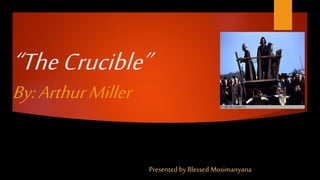
“TheCrucible”
By:ArthurMiller
Presented by Blessed Mosimanyana
REVIEW
Introduction
Arthur Miller’s Biography
Context of the play
Play’s main characters
The plot
INTRODUCTION TO THE PLAY
The presentation will look at the play, “The Crucible” written by Arthur
Miller. “The Crucible” is based on real people and events which occurred
in Salem, Massachusetts, in 1692. Twenty people were killed: nineteen
were hung for convictions of witchcraft, while one man, Giles Corey, was
pressed to death beneath the weight of stones for refusing to submit to
trials.
The play is divided into four acts, which we will explore.
Before we start looking at the play itself, it is useful to explore some of the
background of Arthur Miller, his work and its historical and social context. It
is also necessary to understand the type of society in which the story of
“The Crucible” takes place.
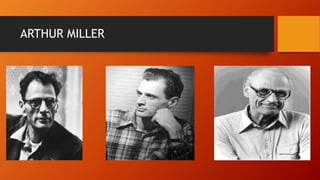
ARTHUR MILLER
ARTHUR MILLER’S BIOGRAPHY
Born 1915 in New York. He studied at the University of Michigan where he won
awards for plays he had written. In the 1940s, two of his best known plays, “All
My Sons” and “Death of Salesman, enjoyed huge success.
American Playwright and Writer. He passed away in 2005.
In 1953 he wrote The Crucible, which uses the Salem witchcraft trials of 1692 to
attack the anti-communist “witch hunts” of the 1950s.
After the publication of the The Crucible, Miller himself was investigated for
possible associations with the communist party.
He refused to give information regarding his colleagues and was found guilty of
contempt of court. His sentence was later overturned.
He passed away in 2005.
THE CONTEXT OF THE PLAY
THE CRUCIBLE CONSISTS OF THESE MAIN
KEYS OF HISTORY:
McCarthyism
Puritanism
Witchcraft
MCCARTHYISM
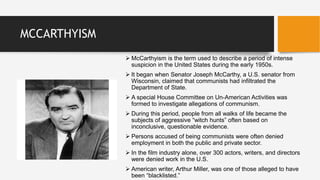
 McCarthyism is the term used to describe a period of intense
suspicion in the United States during the early 1950s.
 It began when Senator Joseph McCarthy, a U.S. senator from
Wisconsin, claimed that communists had infiltrated the
Department of State.
 A special House Committee on Un-American Activities was
formed to investigate allegations of communism.
 During this period, people from all walks of life became the
subjects of aggressive “witch hunts” often based on
inconclusive, questionable evidence.
 Persons accused of being communists were often denied
employment in both the public and private sector.
 In the film industry alone, over 300 actors, writers, and directors
were denied work in the U.S.
 American writer, Arthur Miller, was one of those alleged to have
been “blacklisted.”
PURITANISM
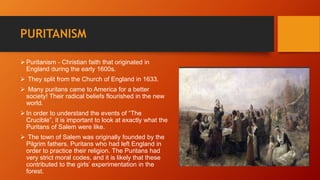
 Puritanism - Christian faith that originated in
England during the early 1600s.
 They split from the Church of England in 1633.
 Many puritans came to America for a better
society! Their radical beliefs flourished in the new
world.
 In order to understand the events of “The
Crucible”, it is important to look at exactly what the
Puritans of Salem were like.
 The town of Salem was originally founded by the
Pilgrim fathers, Puritans who had left England in
order to practice their religion. The Puritans had
very strict moral codes, and it is likely that these
contributed to the girls’ experimentation in the
forest.
PURITANISM
CONTINUED…
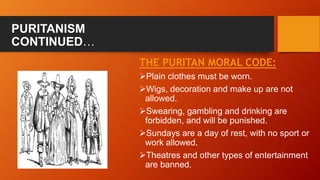
THE PURITAN MORAL CODE:
Plain clothes must be worn.
Wigs, decoration and make up are not
allowed.
Swearing, gambling and drinking are
forbidden, and will be punished.
Sundays are a day of rest, with no sport or
work allowed.
Theatres and other types of entertainment
are banned.
WITCHCRAFT IN SALEM
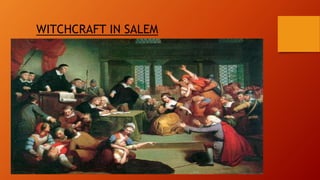
“The Crucible” is set at the time of the Salem witch-hunts. These witch-hunts
took place in America in Salem, Massachusetts in 1692.
In his play, Miller uses the events of the time, and many of the people
originally involved.
Like all Puritans, the residents of Salem believed in witches and in witchcraft.
They considered witchcraft both a sin and a crime.
Reverend Parris’s daughter and Abigail Williams started having fits of anger,
screaming, and hallucination.•
 A doctor examined the girls and concluded that the only explanation for
these bizarre behaviors was witchcraft.
 By the time court was dismissed, 27 people had been convicted, 19 hanged,
and 1 pressed to death.
WITCHCRAFT IN SALEM
Let’s look at the
MAIN
CHARACTERS:
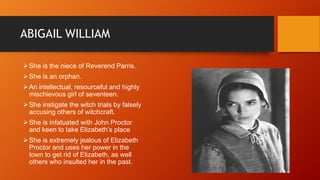
ABIGAIL WILLIAM
She is the niece of Reverend Parris.
She is an orphan.
An intellectual, resourceful and highly
mischievous girl of seventeen.
She instigate the witch trials by falsely
accusing others of witchcraft.
She is infatuated with John Proctor
and keen to take Elizabeth’s place
She is extremely jealous of Elizabeth
Proctor and uses her power in the
town to get rid of Elizabeth, as well
others who insulted her in the past.
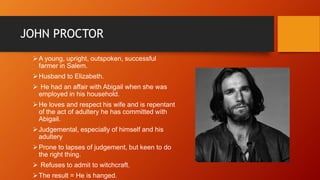
JOHN PROCTOR
A young, upright, outspoken, successful
farmer in Salem.
Husband to Elizabeth.
 He had an affair with Abigail when she was
employed in his household.
He loves and respect his wife and is repentant
of the act of adultery he has committed with
Abigail.
Judgemental, especially of himself and his
adultery
Prone to lapses of judgement, but keen to do
the right thing.
 Refuses to admit to witchcraft.
The result = He is hanged.
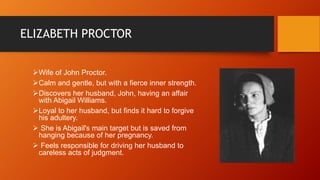
ELIZABETH PROCTOR
Wife of John Proctor.
Calm and gentle, but with a fierce inner strength.
Discovers her husband, John, having an affair
with Abigail Williams.
Loyal to her husband, but finds it hard to forgive
his adultery.
 She is Abigail's main target but is saved from
hanging because of her pregnancy.
 Feels responsible for driving her husband to
careless acts of judgment.
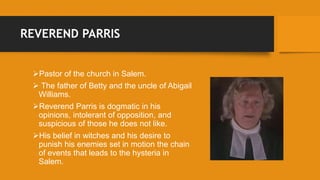
REVEREND PARRIS
Pastor of the church in Salem.
 The father of Betty and the uncle of Abigail
Williams.
Reverend Parris is dogmatic in his
opinions, intolerant of opposition, and
suspicious of those he does not like.
His belief in witches and his desire to
punish his enemies set in motion the chain
of events that leads to the hysteria in
Salem.
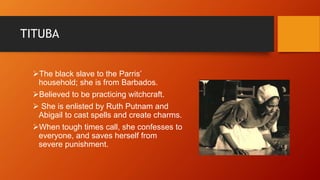
TITUBA
The black slave to the Parris’
household; she is from Barbados.
Believed to be practicing witchcraft.
 She is enlisted by Ruth Putnam and
Abigail to cast spells and create charms.
When tough times call, she confesses to
everyone, and saves herself from
severe punishment.
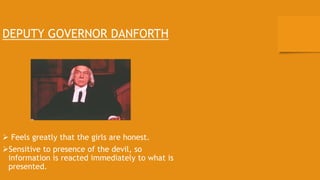
DEPUTY GOVERNOR DANFORTH
 Feels greatly that the girls are honest.
Sensitive to presence of the devil, so
information is reacted immediately to what is
presented.
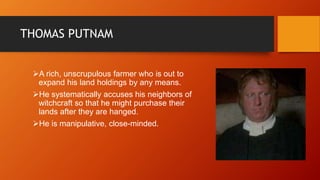
THOMAS PUTNAM
A rich, unscrupulous farmer who is out to
expand his land holdings by any means.
He systematically accuses his neighbors of
witchcraft so that he might purchase their
lands after they are hanged.
He is manipulative, close-minded.
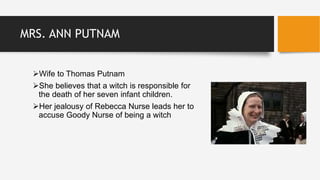
MRS. ANN PUTNAM
Wife to Thomas Putnam
She believes that a witch is responsible for
the death of her seven infant children.
Her jealousy of Rebecca Nurse leads her to
accuse Goody Nurse of being a witch
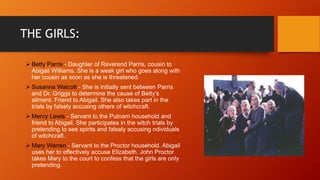
THE GIRLS:
 Betty Parris - Daughter of Reverend Parris, cousin to
Abigail Williams. She is a weak girl who goes along with
her cousin as soon as she is threatened.
 Susanna Walcott - She is initially sent between Parris
and Dr. Griggs to determine the cause of Betty's
ailment. Friend to Abigail. She also takes part in the
trials by falsely accusing others of witchcraft.
 Mercy Lewis - Servant to the Putnam household and
friend to Abigail. She participates in the witch trials by
pretending to see spirits and falsely accusing ndividuals
of witchcraft.
 Mary Warren - Servant to the Proctor household. Abigail
uses her to effectively accuse Elizabeth. John Proctor
takes Mary to the court to confess that the girls are only
pretending.
Now Lets Go Through
tHE PLOT:
ACT I
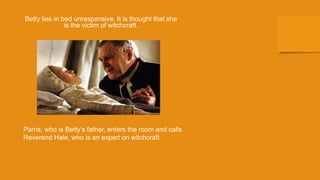
Betty lies in bed unresponsive. It is thought that she
is the victim of witchcraft.
Parris, who is Betty’s father, enters the room and calls
Reverend Hale, who is an expert on witchcraft.
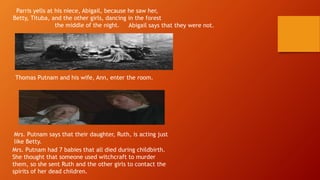
Parris yells at his niece, Abigail, because he saw her,
Betty, Tituba, and the other girls, dancing in the forest
the middle of the night. Abigail says that they were not.
Thomas Putnam and his wife, Ann, enter the room.
Mrs. Putnam says that their daughter, Ruth, is acting just
like Betty.
Mrs. Putnam had 7 babies that all died during childbirth.
She thought that someone used witchcraft to murder
them, so she sent Ruth and the other girls to contact the
spirits of her dead children.
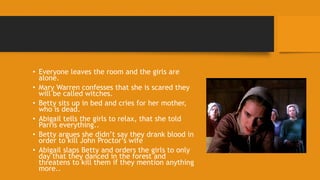
• Everyone leaves the room and the girls are
alone.
• Mary Warren confesses that she is scared they
will be called witches.
• Betty sits up in bed and cries for her mother,
who is dead.
• Abigail tells the girls to relax, that she told
Parris everything..
• Betty argues she didn’t say they drank blood in
order to kill John Proctor’s wife
• Abigail slaps Betty and orders the girls to only
day that they danced in the forest and
threatens to kill them if they mention anything
more..
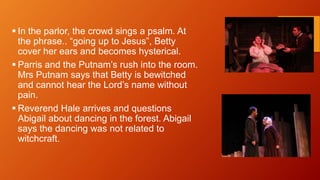
 In the parlor, the crowd sings a psalm. At
the phrase.. “going up to Jesus”, Betty
cover her ears and becomes hysterical.
 Parris and the Putnam’s rush into the room.
Mrs Putnam says that Betty is bewitched
and cannot hear the Lord’s name without
pain.
 Reverend Hale arrives and questions
Abigail about dancing in the forest. Abigail
says the dancing was not related to
witchcraft.
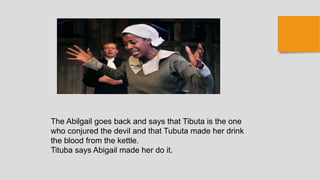
The Abilgail goes back and says that Tibuta is the one
who conjured the devil and that Tubuta made her drink
the blood from the kettle.
Tituba says Abigail made her do it.
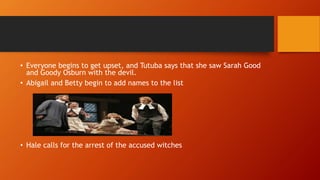
• Everyone begins to get upset, and Tutuba says that she saw Sarah Good
and Goody Osburn with the devil.
• Abigail and Betty begin to add names to the list
• Hale calls for the arrest of the accused witches
ACT TWO
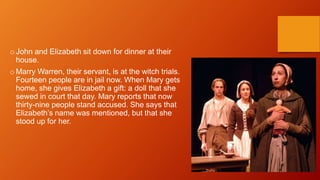
o John and Elizabeth sit down for dinner at their
house.
o Marry Warren, their servant, is at the witch trials.
Fourteen people are in jail now. When Mary gets
home, she gives Elizabeth a gift: a doll that she
sewed in court that day. Mary reports that now
thirty-nine people stand accused. She says that
Elizabeth’s name was mentioned, but that she
stood up for her.
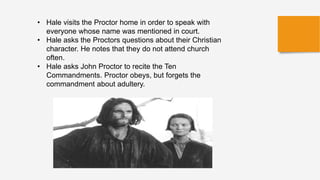
• Hale visits the Proctor home in order to speak with
everyone whose name was mentioned in court.
• Hale asks the Proctors questions about their Christian
character. He notes that they do not attend church
often.
• Hale asks John Proctor to recite the Ten
Commandments. Proctor obeys, but forgets the
commandment about adultery.
• Giles and Francis rush into the Proctor house,
upset because their wives had been arrested.
• Just then, Ezekiel Cheever and Herrick, the town
marshal, arrive with a warrant for Elizabeth’s
arrest. Hale is surprised because Elizabeth had
not been charged with anything yet.
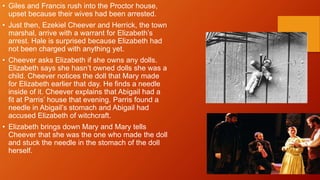
• Cheever asks Elizabeth if she owns any dolls.
Elizabeth says she hasn’t owned dolls she was a
child. Cheever notices the doll that Mary made
for Elizabeth earlier that day. He finds a needle
inside of it. Cheever explains that Abigail had a
fit at Parris’ house that evening. Parris found a
needle in Abigail’s stomach and Abigail had
accused Elizabeth of witchcraft.
• Elizabeth brings down Mary and Mary tells
Cheever that she was the one who made the doll
and stuck the needle in the stomach of the doll
herself.
Elizabeth is arrested and led away.
Proctor becomes angry and rips up the warrant
for Elizabeth’s arrest.
Proctor tells Mary that she has to testify in court.
Mary refuses, saying that Abigail will kill her if
she does,
ACT THREE
oCourt in session. Proctor and Mary enter the room. Mary says
that she and the other girls were only pretending to be affected
by witchcraft.
oParris thinks they all want to overthrow the court.
oProctor says he just wants to free his wife, but Cheever tells the
judge that Proctor ripped up the warrant for Elizabeth’s arrest.
oDanforth questions Proctor about his religious beliefs.
oProctor is told not to worry about Elizabeth’s execution because
she claims to be pregnant and cannot be hanged until after she
delivers.
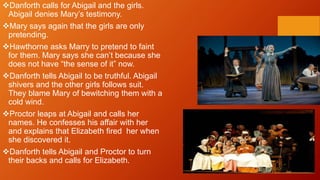
Danforth calls for Abigail and the girls.
Abigail denies Mary’s testimony.
Mary says again that the girls are only
pretending.
Hawthorne asks Marry to pretend to faint
for them. Mary says she can’t because she
does not have “the sense of it” now.
Danforth tells Abigail to be truthful. Abigail
shivers and the other girls follows suit.
They blame Mary of bewitching them with a
cold wind.
Proctor leaps at Abigail and calls her
names. He confesses his affair with her
and explains that Elizabeth fired her when
she discovered it.
Danforth tells Abigail and Proctor to turn
their backs and calls for Elizabeth.
 Danforth asks Elizabeth why she fired Abigail. Elizabeth looks at
Proctor for a clue, but Danforth demands that she look only at
him.
 Elizabeth goes on to say that she thought Proctor liked Abigail,
so she got angry and fired her. Elizabeth is removed from the
room.
 Proctor cries out that he confessed his sin, but it is too late for
Elizabeth to change her story.
• Hale begs Danforth to reconsider, saying that he always thought
Abigail was lying.
• The girls begin screaming that Mary is sending her spirit at them.
• Mary pleads with them to stop, but the girls only repeat her words
exactly as she says them.
• Mary begins to scream too. The courtroom becomes hectic.
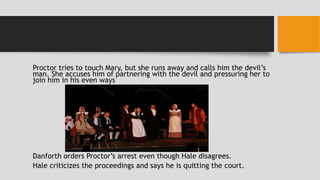
Proctor tries to touch Mary, but she runs away and calls him the devil’s
man. She accuses him of partnering with the devil and pressuring her to
join him in his even ways
Danforth orders Proctor’s arrest even though Hale disagrees.
Hale criticizes the proceedings and says he is quitting the court.
ACT FOUR
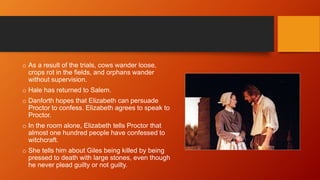
o As a result of the trials, cows wander loose,
crops rot in the fields, and orphans wander
without supervision.
o Hale has returned to Salem.
o Danforth hopes that Elizabeth can persuade
Proctor to confess. Elizabeth agrees to speak to
Proctor.
o In the room alone, Elizabeth tells Proctor that
almost one hundred people have confessed to
witchcraft.
o She tells him about Giles being killed by being
pressed to death with large stones, even though
he never plead guilty or not guilty.
• Proctor asks Elizabeth if she thinks he should confess.
After debating for a while, Proctor agrees to confess .
• Hathorne and Danforth are happy. When Cheever
grabs paper and pen to write the confession, Proctor
hesitates to sign.
• Proctor does not want the confession hung on the
church door. He snatches the paper from Danforth and
rips the confession into two.
• Danforth calls for the marshal.
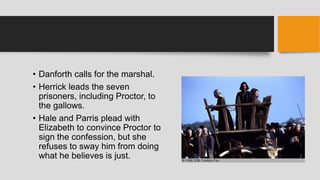
• Herrick leads the seven
prisoners, including Proctor, to
the gallows.
• Hale and Parris plead with
Elizabeth to convince Proctor to
sign the confession, but she
refuses to sway him from doing
what he believes is just.
The End
REFERENCE LIST
Boardworks. (2010). The Crucible. Available from Slideshare at
https://www.slideshare.net/quintus/the-crucible-5185160 (Accessed 17 August 2020).
Frisby, B & Quattro, C. (2012). The Crucible. Available at
https://www.haralson.k12.ga.us/Downloads/The%20Crucible%20Level%202%20PowerPoint.
pptx (Accessed 17 August 2020).
Lukaszek, N & Zach, S. (2013). The Crucible by Arthur Miller. Available from Slideshare at
https://www.slideshare.net/DETfreak/the-crucible-by-nick-and-zach (Accessed 17 August
2020).
The Crucible Act 1 Characters. (2009). Available from Slideshare at
https://www.slideshare.net/CoolTeacher/act-1-characters (Accessed 17 August 2020).
The Crucible. (2014). Available from Slideshare at
https://www.slideshare.net/rainbow_13/the-crucible-41939272 (Accessed 17 August 2020).
Ward, L. (2009). The Crucible. Available from:
https://www.worldofteaching.com/powerpoints/english/The%20Crucible.ppt (Accessed 17
August 2020).

The crucible presentation

  • 1.
  • 2.
    REVIEW Introduction Arthur Miller’s Biography Contextof the play Play’s main characters The plot
  • 3.
    INTRODUCTION TO THEPLAY The presentation will look at the play, “The Crucible” written by Arthur Miller. “The Crucible” is based on real people and events which occurred in Salem, Massachusetts, in 1692. Twenty people were killed: nineteen were hung for convictions of witchcraft, while one man, Giles Corey, was pressed to death beneath the weight of stones for refusing to submit to trials. The play is divided into four acts, which we will explore. Before we start looking at the play itself, it is useful to explore some of the background of Arthur Miller, his work and its historical and social context. It is also necessary to understand the type of society in which the story of “The Crucible” takes place.
  • 4.
  • 5.
    ARTHUR MILLER’S BIOGRAPHY Born1915 in New York. He studied at the University of Michigan where he won awards for plays he had written. In the 1940s, two of his best known plays, “All My Sons” and “Death of Salesman, enjoyed huge success. American Playwright and Writer. He passed away in 2005. In 1953 he wrote The Crucible, which uses the Salem witchcraft trials of 1692 to attack the anti-communist “witch hunts” of the 1950s. After the publication of the The Crucible, Miller himself was investigated for possible associations with the communist party. He refused to give information regarding his colleagues and was found guilty of contempt of court. His sentence was later overturned. He passed away in 2005.
  • 6.
    THE CONTEXT OFTHE PLAY THE CRUCIBLE CONSISTS OF THESE MAIN KEYS OF HISTORY: McCarthyism Puritanism Witchcraft
  • 7.
    MCCARTHYISM  McCarthyism isthe term used to describe a period of intense suspicion in the United States during the early 1950s.  It began when Senator Joseph McCarthy, a U.S. senator from Wisconsin, claimed that communists had infiltrated the Department of State.  A special House Committee on Un-American Activities was formed to investigate allegations of communism.  During this period, people from all walks of life became the subjects of aggressive “witch hunts” often based on inconclusive, questionable evidence.  Persons accused of being communists were often denied employment in both the public and private sector.  In the film industry alone, over 300 actors, writers, and directors were denied work in the U.S.  American writer, Arthur Miller, was one of those alleged to have been “blacklisted.”
  • 8.
    PURITANISM  Puritanism -Christian faith that originated in England during the early 1600s.  They split from the Church of England in 1633.  Many puritans came to America for a better society! Their radical beliefs flourished in the new world.  In order to understand the events of “The Crucible”, it is important to look at exactly what the Puritans of Salem were like.  The town of Salem was originally founded by the Pilgrim fathers, Puritans who had left England in order to practice their religion. The Puritans had very strict moral codes, and it is likely that these contributed to the girls’ experimentation in the forest.
  • 9.
    PURITANISM CONTINUED… THE PURITAN MORALCODE: Plain clothes must be worn. Wigs, decoration and make up are not allowed. Swearing, gambling and drinking are forbidden, and will be punished. Sundays are a day of rest, with no sport or work allowed. Theatres and other types of entertainment are banned.
  • 10.
    WITCHCRAFT IN SALEM “TheCrucible” is set at the time of the Salem witch-hunts. These witch-hunts took place in America in Salem, Massachusetts in 1692. In his play, Miller uses the events of the time, and many of the people originally involved. Like all Puritans, the residents of Salem believed in witches and in witchcraft. They considered witchcraft both a sin and a crime. Reverend Parris’s daughter and Abigail Williams started having fits of anger, screaming, and hallucination.•  A doctor examined the girls and concluded that the only explanation for these bizarre behaviors was witchcraft.  By the time court was dismissed, 27 people had been convicted, 19 hanged, and 1 pressed to death.
  • 11.
  • 12.
    Let’s look atthe MAIN CHARACTERS:
  • 13.
    ABIGAIL WILLIAM She isthe niece of Reverend Parris. She is an orphan. An intellectual, resourceful and highly mischievous girl of seventeen. She instigate the witch trials by falsely accusing others of witchcraft. She is infatuated with John Proctor and keen to take Elizabeth’s place She is extremely jealous of Elizabeth Proctor and uses her power in the town to get rid of Elizabeth, as well others who insulted her in the past.
  • 15.
    JOHN PROCTOR A young,upright, outspoken, successful farmer in Salem. Husband to Elizabeth.  He had an affair with Abigail when she was employed in his household. He loves and respect his wife and is repentant of the act of adultery he has committed with Abigail. Judgemental, especially of himself and his adultery Prone to lapses of judgement, but keen to do the right thing.  Refuses to admit to witchcraft. The result = He is hanged.
  • 17.
    ELIZABETH PROCTOR Wife ofJohn Proctor. Calm and gentle, but with a fierce inner strength. Discovers her husband, John, having an affair with Abigail Williams. Loyal to her husband, but finds it hard to forgive his adultery.  She is Abigail's main target but is saved from hanging because of her pregnancy.  Feels responsible for driving her husband to careless acts of judgment.
  • 18.
    REVEREND PARRIS Pastor ofthe church in Salem.  The father of Betty and the uncle of Abigail Williams. Reverend Parris is dogmatic in his opinions, intolerant of opposition, and suspicious of those he does not like. His belief in witches and his desire to punish his enemies set in motion the chain of events that leads to the hysteria in Salem.
  • 19.
    TITUBA The black slaveto the Parris’ household; she is from Barbados. Believed to be practicing witchcraft.  She is enlisted by Ruth Putnam and Abigail to cast spells and create charms. When tough times call, she confesses to everyone, and saves herself from severe punishment.
  • 20.
    DEPUTY GOVERNOR DANFORTH Feels greatly that the girls are honest. Sensitive to presence of the devil, so information is reacted immediately to what is presented.
  • 21.
    THOMAS PUTNAM A rich,unscrupulous farmer who is out to expand his land holdings by any means. He systematically accuses his neighbors of witchcraft so that he might purchase their lands after they are hanged. He is manipulative, close-minded.
  • 22.
    MRS. ANN PUTNAM Wifeto Thomas Putnam She believes that a witch is responsible for the death of her seven infant children. Her jealousy of Rebecca Nurse leads her to accuse Goody Nurse of being a witch
  • 23.
    THE GIRLS:  BettyParris - Daughter of Reverend Parris, cousin to Abigail Williams. She is a weak girl who goes along with her cousin as soon as she is threatened.  Susanna Walcott - She is initially sent between Parris and Dr. Griggs to determine the cause of Betty's ailment. Friend to Abigail. She also takes part in the trials by falsely accusing others of witchcraft.  Mercy Lewis - Servant to the Putnam household and friend to Abigail. She participates in the witch trials by pretending to see spirits and falsely accusing ndividuals of witchcraft.  Mary Warren - Servant to the Proctor household. Abigail uses her to effectively accuse Elizabeth. John Proctor takes Mary to the court to confess that the girls are only pretending.
  • 24.
    Now Lets GoThrough tHE PLOT:
  • 25.
  • 26.
    Betty lies inbed unresponsive. It is thought that she is the victim of witchcraft. Parris, who is Betty’s father, enters the room and calls Reverend Hale, who is an expert on witchcraft.
  • 27.
    Parris yells athis niece, Abigail, because he saw her, Betty, Tituba, and the other girls, dancing in the forest the middle of the night. Abigail says that they were not. Thomas Putnam and his wife, Ann, enter the room. Mrs. Putnam says that their daughter, Ruth, is acting just like Betty. Mrs. Putnam had 7 babies that all died during childbirth. She thought that someone used witchcraft to murder them, so she sent Ruth and the other girls to contact the spirits of her dead children.
  • 28.
    • Everyone leavesthe room and the girls are alone. • Mary Warren confesses that she is scared they will be called witches. • Betty sits up in bed and cries for her mother, who is dead. • Abigail tells the girls to relax, that she told Parris everything.. • Betty argues she didn’t say they drank blood in order to kill John Proctor’s wife • Abigail slaps Betty and orders the girls to only day that they danced in the forest and threatens to kill them if they mention anything more..
  • 29.
     In theparlor, the crowd sings a psalm. At the phrase.. “going up to Jesus”, Betty cover her ears and becomes hysterical.  Parris and the Putnam’s rush into the room. Mrs Putnam says that Betty is bewitched and cannot hear the Lord’s name without pain.  Reverend Hale arrives and questions Abigail about dancing in the forest. Abigail says the dancing was not related to witchcraft.

  • 30.
    The Abilgail goesback and says that Tibuta is the one who conjured the devil and that Tubuta made her drink the blood from the kettle. Tituba says Abigail made her do it.
  • 31.
    • Everyone beginsto get upset, and Tutuba says that she saw Sarah Good and Goody Osburn with the devil. • Abigail and Betty begin to add names to the list • Hale calls for the arrest of the accused witches
  • 32.
  • 33.
    o John andElizabeth sit down for dinner at their house. o Marry Warren, their servant, is at the witch trials. Fourteen people are in jail now. When Mary gets home, she gives Elizabeth a gift: a doll that she sewed in court that day. Mary reports that now thirty-nine people stand accused. She says that Elizabeth’s name was mentioned, but that she stood up for her.
  • 34.
    • Hale visitsthe Proctor home in order to speak with everyone whose name was mentioned in court. • Hale asks the Proctors questions about their Christian character. He notes that they do not attend church often. • Hale asks John Proctor to recite the Ten Commandments. Proctor obeys, but forgets the commandment about adultery.
  • 35.
    • Giles andFrancis rush into the Proctor house, upset because their wives had been arrested. • Just then, Ezekiel Cheever and Herrick, the town marshal, arrive with a warrant for Elizabeth’s arrest. Hale is surprised because Elizabeth had not been charged with anything yet. • Cheever asks Elizabeth if she owns any dolls. Elizabeth says she hasn’t owned dolls she was a child. Cheever notices the doll that Mary made for Elizabeth earlier that day. He finds a needle inside of it. Cheever explains that Abigail had a fit at Parris’ house that evening. Parris found a needle in Abigail’s stomach and Abigail had accused Elizabeth of witchcraft. • Elizabeth brings down Mary and Mary tells Cheever that she was the one who made the doll and stuck the needle in the stomach of the doll herself.
  • 36.
    Elizabeth is arrestedand led away. Proctor becomes angry and rips up the warrant for Elizabeth’s arrest. Proctor tells Mary that she has to testify in court. Mary refuses, saying that Abigail will kill her if she does,
  • 37.
  • 38.
    oCourt in session.Proctor and Mary enter the room. Mary says that she and the other girls were only pretending to be affected by witchcraft. oParris thinks they all want to overthrow the court. oProctor says he just wants to free his wife, but Cheever tells the judge that Proctor ripped up the warrant for Elizabeth’s arrest. oDanforth questions Proctor about his religious beliefs. oProctor is told not to worry about Elizabeth’s execution because she claims to be pregnant and cannot be hanged until after she delivers.
  • 39.
    Danforth calls forAbigail and the girls. Abigail denies Mary’s testimony. Mary says again that the girls are only pretending. Hawthorne asks Marry to pretend to faint for them. Mary says she can’t because she does not have “the sense of it” now. Danforth tells Abigail to be truthful. Abigail shivers and the other girls follows suit. They blame Mary of bewitching them with a cold wind. Proctor leaps at Abigail and calls her names. He confesses his affair with her and explains that Elizabeth fired her when she discovered it. Danforth tells Abigail and Proctor to turn their backs and calls for Elizabeth.
  • 40.
     Danforth asksElizabeth why she fired Abigail. Elizabeth looks at Proctor for a clue, but Danforth demands that she look only at him.  Elizabeth goes on to say that she thought Proctor liked Abigail, so she got angry and fired her. Elizabeth is removed from the room.  Proctor cries out that he confessed his sin, but it is too late for Elizabeth to change her story.
  • 41.
    • Hale begsDanforth to reconsider, saying that he always thought Abigail was lying. • The girls begin screaming that Mary is sending her spirit at them. • Mary pleads with them to stop, but the girls only repeat her words exactly as she says them. • Mary begins to scream too. The courtroom becomes hectic.
  • 42.
    Proctor tries totouch Mary, but she runs away and calls him the devil’s man. She accuses him of partnering with the devil and pressuring her to join him in his even ways Danforth orders Proctor’s arrest even though Hale disagrees. Hale criticizes the proceedings and says he is quitting the court.
  • 43.
  • 44.
    o As aresult of the trials, cows wander loose, crops rot in the fields, and orphans wander without supervision. o Hale has returned to Salem. o Danforth hopes that Elizabeth can persuade Proctor to confess. Elizabeth agrees to speak to Proctor. o In the room alone, Elizabeth tells Proctor that almost one hundred people have confessed to witchcraft. o She tells him about Giles being killed by being pressed to death with large stones, even though he never plead guilty or not guilty.
  • 45.
    • Proctor asksElizabeth if she thinks he should confess. After debating for a while, Proctor agrees to confess . • Hathorne and Danforth are happy. When Cheever grabs paper and pen to write the confession, Proctor hesitates to sign. • Proctor does not want the confession hung on the church door. He snatches the paper from Danforth and rips the confession into two.
  • 46.
    • Danforth callsfor the marshal. • Herrick leads the seven prisoners, including Proctor, to the gallows. • Hale and Parris plead with Elizabeth to convince Proctor to sign the confession, but she refuses to sway him from doing what he believes is just.
  • 47.
  • 48.
    REFERENCE LIST Boardworks. (2010).The Crucible. Available from Slideshare at https://www.slideshare.net/quintus/the-crucible-5185160 (Accessed 17 August 2020). Frisby, B & Quattro, C. (2012). The Crucible. Available at https://www.haralson.k12.ga.us/Downloads/The%20Crucible%20Level%202%20PowerPoint. pptx (Accessed 17 August 2020). Lukaszek, N & Zach, S. (2013). The Crucible by Arthur Miller. Available from Slideshare at https://www.slideshare.net/DETfreak/the-crucible-by-nick-and-zach (Accessed 17 August 2020). The Crucible Act 1 Characters. (2009). Available from Slideshare at https://www.slideshare.net/CoolTeacher/act-1-characters (Accessed 17 August 2020). The Crucible. (2014). Available from Slideshare at https://www.slideshare.net/rainbow_13/the-crucible-41939272 (Accessed 17 August 2020). Ward, L. (2009). The Crucible. Available from: https://www.worldofteaching.com/powerpoints/english/The%20Crucible.ppt (Accessed 17 August 2020).