A Midsummer Night’s Dream

       An Introduction
Starter
What were the three ways of thinking about
Shakespearean comedy we looked at last lesson?
• Northrop Frye can help us to understand
  Shakespearean comedy through the concept of “green
  worlds” in the play, which reinvigorate the old world
  and allow a new world to emerge

• Barber can help us through the idea of “festive
  comedy,” and the saturnalian pattern which these
  comedies follow

• Bahktin offers us the concept of “carnival” –
  celebration outside the bounds of the conventional
  culture
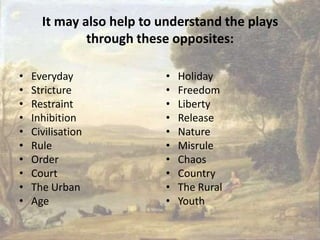
It may also help to understand the plays
              through these opposites:

•   Everyday              •   Holiday
•   Stricture             •   Freedom
•   Restraint             •   Liberty
•   Inhibition            •   Release
•   Civilisation          •   Nature
•   Rule                  •   Misrule
•   Order                 •   Chaos
•   Court                 •   Country
•   The Urban             •   The Rural
•   Age                   •   Youth
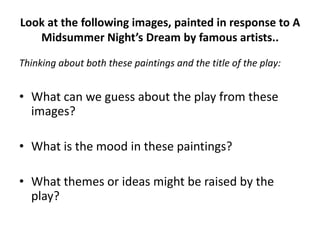
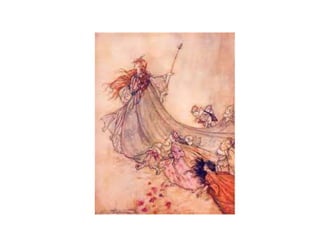
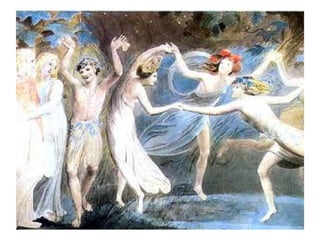
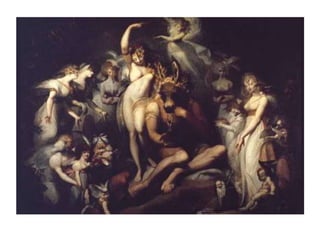
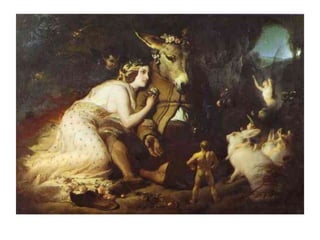
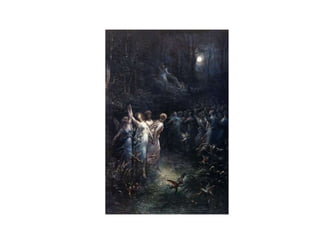
Look at the following images, painted in response to A
   Midsummer Night’s Dream by famous artists..

Thinking about both these paintings and the title of the play:


• What can we guess about the play from these
  images?

• What is the mood in these paintings?

• What themes or ideas might be raised by the
  play?
Look at the following cast of
        characters in the play…


• What might this list suggest about the action,
  mood, themes or ideas in the play?
Dramatis Personae

                Theseus, Duke of Athens
 Hipployta, Queen of the Amazons, betrothed to Theseus
               Lysander, a young courtier
           Demetrius, another young courtier
              Hermia, in love with Lysander
             Helena, in love with Demetrius
                 Egeus, Hermia's father
              Philostrate, Master of Revels

                Oberon, King of the Fairies
               Titania, Queen of the Fairies
               A fairy, in service to Titania
Puck, or Robin Goodfellow, Oberon's jester and lieutenant
         Peaseblossom, a fairy in Titania's service
           Cobweb, a fairy in Titania's service
             Moth, a fairy in Titania's service
         Mustardseed, a fairy in Titania's service

               Peter Quince, a carpenter
                Nick Bottom, a weaver
            Francis Flute, a bellows-mender
                  Tom Snout, a tinker
                      Snug, a joiner
               Robin Starveling, a tailor

      Other fairies attending on Oberon and Titania
     Lords and attendants to Theseus and Hippolyta
Look at the following settings for each scene of the play. What
   might they tell us about the action or ideas in the play?

Act 1, Scene 1: Athens. The palace of Theseus.
Act 1, scene 2: Athens. Quince’s house.

Act 2, scene 1: A wood near Athens.
Act 2, scene 2: Another part of the wood.

Act 3, scene 1: The wood. Titania lying asleep.
Act 3, scene 2: Another part of the wood.

Act 4, scene 1: The same.
Act 4, scene2 : Athens. Quince’s house.

Act 5, scene 1: Athens. The palace of Theseus.
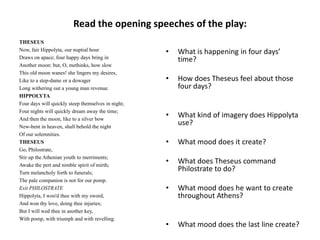
Read the opening speeches of the play:
THESEUS
Now, fair Hippolyta, our nuptial hour               •   What is happening in four days’
Draws on apace; four happy days bring in                time?
Another moon: but, O, methinks, how slow
This old moon wanes! she lingers my desires,
Like to a step-dame or a dowager                    •   How does Theseus feel about those
Long withering out a young man revenue.                 four days?
HIPPOLYTA
Four days will quickly steep themselves in night;
Four nights will quickly dream away the time;
And then the moon, like to a silver bow
                                                    •   What kind of imagery does Hippolyta
New-bent in heaven, shall behold the night
                                                        use?
Of our solemnities.
THESEUS                                             •   What mood does it create?
Go, Philostrate,
Stir up the Athenian youth to merriments;
Awake the pert and nimble spirit of mirth;
                                                    •   What does Theseus command
Turn melancholy forth to funerals;
                                                        Philostrate to do?
The pale companion is not for our pomp.
Exit PHILOSTRATE                                    •   What mood does he want to create
Hippolyta, I woo'd thee with my sword,                  throughout Athens?
And won thy love, doing thee injuries;
But I will wed thee in another key,
With pomp, with triumph and with revelling.
                                                    •   What mood does the last line create?
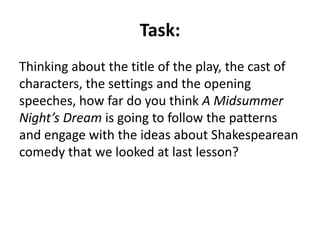
Task:
Thinking about the title of the play, the cast of
characters, the settings and the opening
speeches, how far do you think A Midsummer
Night’s Dream is going to follow the patterns
and engage with the ideas about Shakespearean
comedy that we looked at last lesson?

Midsummer night's dream lesson 1

  • 1.
    A Midsummer Night’sDream An Introduction
  • 2.
    Starter What were thethree ways of thinking about Shakespearean comedy we looked at last lesson? • Northrop Frye can help us to understand Shakespearean comedy through the concept of “green worlds” in the play, which reinvigorate the old world and allow a new world to emerge • Barber can help us through the idea of “festive comedy,” and the saturnalian pattern which these comedies follow • Bahktin offers us the concept of “carnival” – celebration outside the bounds of the conventional culture
  • 3.
    It may alsohelp to understand the plays through these opposites: • Everyday • Holiday • Stricture • Freedom • Restraint • Liberty • Inhibition • Release • Civilisation • Nature • Rule • Misrule • Order • Chaos • Court • Country • The Urban • The Rural • Age • Youth
  • 4.
    Look at thefollowing images, painted in response to A Midsummer Night’s Dream by famous artists.. Thinking about both these paintings and the title of the play: • What can we guess about the play from these images? • What is the mood in these paintings? • What themes or ideas might be raised by the play?
  • 10.
    Look at thefollowing cast of characters in the play… • What might this list suggest about the action, mood, themes or ideas in the play?
  • 11.
    Dramatis Personae Theseus, Duke of Athens Hipployta, Queen of the Amazons, betrothed to Theseus Lysander, a young courtier Demetrius, another young courtier Hermia, in love with Lysander Helena, in love with Demetrius Egeus, Hermia's father Philostrate, Master of Revels Oberon, King of the Fairies Titania, Queen of the Fairies A fairy, in service to Titania Puck, or Robin Goodfellow, Oberon's jester and lieutenant Peaseblossom, a fairy in Titania's service Cobweb, a fairy in Titania's service Moth, a fairy in Titania's service Mustardseed, a fairy in Titania's service Peter Quince, a carpenter Nick Bottom, a weaver Francis Flute, a bellows-mender Tom Snout, a tinker Snug, a joiner Robin Starveling, a tailor Other fairies attending on Oberon and Titania Lords and attendants to Theseus and Hippolyta
  • 12.
    Look at thefollowing settings for each scene of the play. What might they tell us about the action or ideas in the play? Act 1, Scene 1: Athens. The palace of Theseus. Act 1, scene 2: Athens. Quince’s house. Act 2, scene 1: A wood near Athens. Act 2, scene 2: Another part of the wood. Act 3, scene 1: The wood. Titania lying asleep. Act 3, scene 2: Another part of the wood. Act 4, scene 1: The same. Act 4, scene2 : Athens. Quince’s house. Act 5, scene 1: Athens. The palace of Theseus.
  • 13.
    Read the openingspeeches of the play: THESEUS Now, fair Hippolyta, our nuptial hour • What is happening in four days’ Draws on apace; four happy days bring in time? Another moon: but, O, methinks, how slow This old moon wanes! she lingers my desires, Like to a step-dame or a dowager • How does Theseus feel about those Long withering out a young man revenue. four days? HIPPOLYTA Four days will quickly steep themselves in night; Four nights will quickly dream away the time; And then the moon, like to a silver bow • What kind of imagery does Hippolyta New-bent in heaven, shall behold the night use? Of our solemnities. THESEUS • What mood does it create? Go, Philostrate, Stir up the Athenian youth to merriments; Awake the pert and nimble spirit of mirth; • What does Theseus command Turn melancholy forth to funerals; Philostrate to do? The pale companion is not for our pomp. Exit PHILOSTRATE • What mood does he want to create Hippolyta, I woo'd thee with my sword, throughout Athens? And won thy love, doing thee injuries; But I will wed thee in another key, With pomp, with triumph and with revelling. • What mood does the last line create?
  • 14.
    Task: Thinking about thetitle of the play, the cast of characters, the settings and the opening speeches, how far do you think A Midsummer Night’s Dream is going to follow the patterns and engage with the ideas about Shakespearean comedy that we looked at last lesson?