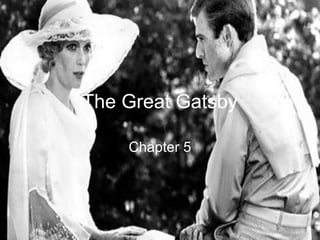
The Great Gatsby

    Chapter 5
Why is Gatsby nervous when he
  meets Nick outside his house?
a) He is eager for Nick to arrange a
   meeting with Daisy

b) He is waiting for a “shipment”

c) He is worried that he has offended Nick

d) He has just killed someone
What happens before Gatsby meets
  Daisy that makes him so anxious?
a) His mother arrives in town

b) Daisy cancels their meeting

c) It rains

d) Nick catches the flu
How does Nick feel about Gatsby’s offer to
compensate him for his help by hiring him?
a) Nick is concerned that the work will be
   illegal
b) Nick is offended that Gatsby is offering to
   pay him for his help
c) Nick appreciates the offer, but regretfully
   declines
d) Nick is overjoyed because he hates his
   current job
What does Gatsby show Daisy that
        makes her cry?
a) His unsent letters to her from the war

b) A picture of his mother

c) His collection of nice shirts

d) A picture of him aged 18 with a
   pompadour hairstyle and a yacht
Why does Nick decide to leave
       Gatsby’s mansion?
a) He has a date with Jordan
b) He feels Gatsby and Daisy have
   forgotten him anyway
c) He doesn’t like the songs that
   Klipspringer is playing
d) Gatsby makes a derogatory joke about
   Nick’s parents
Form and structure
• Chapter 5 is the pivotal chapter of The Great Gatsby, as
  Gatsby’s reunion with Daisy is the hinge on which the novel
  swings.
• Before this event, the story of their relationship exists only in
  prospect, as Gatsby moves toward a dream that no one else
  can discern. Afterwards, the plot shifts its focus to the
  romance between Gatsby and Daisy, and the tensions in their
  relationship actualize themselves.
• After Gatsby’s history with Daisy is revealed, a meeting
  between the two becomes inevitable, and it is highly
  appropriate that the theme of the past’s significance to the
  future is evoked in this chapter.
• As the novel explores ideas of love, excess, and the American
  dream, it becomes clearer and clearer to the reader that
  Gatsby’s emotional frame is out of sync with the passage of
  time. His nervousness about the present and about how
  Daisy’s attitude toward him may have changed causes him to
  knock over Nick’s clock, symbolizing the clumsiness of his
  attempt to stop time and retrieve the past.
Structure: Freytag’s triangle
• According to Freytag, a drama is divided into
  five parts, or acts, which some refer to as
  a dramatic arc: exposition, rising action,
  climax, falling action, and dénouement.
• Although Freytag's analysis of dramatic
  structure is based on five-act plays, it can be
  applied (sometimes in a modified manner) to
  short stories and novels as well.
Freytag’s triangle and The
                 Great Gatsby
Exposition or Introduction (Chapter 1)
The exposition provides the background information needed to properly understand
the story, such as the problem in the beginning of the story, characters, and setting.
Once upon a time...
Rising action (Chapters 2-4)
During rising action, the basic internal conflict is complicated by the introduction of
related secondary conflicts, including various obstacles that often frustrate the
protagonist's attempt to reach his goal. Secondary conflicts can include adversaries
of lesser importance than the story’s antagonist, who may work with the antagonist
or separately, by and for themselves or actions unknown, and also the conflict. A
rising action is the base for the climax.
Climax (Chapter 5)
The third act is that of the climax, or turning point, which marks a change, for the
better or the worse, in the protagonist’s affairs. If the story is a comedy, things will
have gone badly for the protagonist up to this point; now, the tide, so to speak, will
turn, and things will begin to go well for him or her. If the story is a tragedy, the
opposite state of affairs will ensue, with things going from good to bad for the
protagonist. Simply put, this is where the main part happens or the most dramatic
part.
Scenes and places
• p.81 – “The day agreed upon was pouring
  rain.”
• What is significant about the weather on
  the day?
• What technique does Fitzgerald use
  throughout the chapter?
Characterisation
• p.83 – “Gatsby, pale as death, with his hands plunged
    like weights in his coat pockets, was standing in a puddle
    of water glaring tragically into my eyes.”
• p.85 – “he followed me wildly into the kitchen, closed the
    door, and whispered: ‘Oh, God!’ in a miserable way.
[...] ‘You’re acting like a little boy,’ I broke out impatiently.

• How do these extracts contrast the image of Gatsby we
  have been shown so far in the novel?
• What might be significant about this?
Setting
• Look at the description of Gatsby’s
  mansion on p.85-86.
• What might the use of feudal imagery and
  descriptions of peasants and serfs
  suggest about The American Dream?
The American Dream
•   In this chapter, Gatsby’s house is compared several times to that of a
    feudal lord, and his imported clothes, antiques, and luxuries all
    display a nostalgia for the lifestyle of a British aristocrat.
•   Though Nick and Daisy are amazed and dazzled by Gatsby’s splendid
    possessions, a number of things in Nick’s narrative suggest that
    something is not right about this transplantation of an aristocrat’s
    lifestyle into democratic America.
•   For example, Nick notes that the brewer who built the house in which
    Gatsby now lives tried to pay the neighbouring villagers to have their
    roofs thatched, to complement the style of the mansion. They refused,
    Nick says, because Americans are obstinately unwilling to play the
    role of peasants.
•   Thomas Jefferson and the other founding fathers envisioned America
    as a place that would be free of the injustices of class and caste, a
    place where people from humble backgrounds would be free to try to
    improve themselves economically and socially. Chapter 5 suggests
    that this dream of improvement, carried to its logical conclusion,
    results in a superficial imitation of the old European social system that
    America supposedly left behind.
Setting
• P.88-89
p.90 - end
Daisy put her arm through his abruptly, but he
seemed absorbed in what he had just said.
Possibly it had occurred to him that the colossal
significance of that light had now vanished
forever. Compared to the great distance that
separated him from Daisy it had seemed very
near to her, almost touching her. It had seemed
as close as a star to the moon. Now it was
again a green light on a dock. His count of
enchanted objects had diminished by one.
‘Don’t talk so
much, old
sport,’
commanded
Gatsby. ‘Play!’
"Ain't We Got Fun?" (Van &
       Schenck, 1921)
‘Ain’t We Got Fun?’
‘In the morning,
In the evening,
      Ain’t we got fun –’

‘One thing’s sure and nothing’s surer
The rich get richer and the poor get – children.
     In the meantime,
     In between time,
     Ain’t we got fun!’

Chapter 5

  • 1.
  • 2.
    Why is Gatsbynervous when he meets Nick outside his house? a) He is eager for Nick to arrange a meeting with Daisy b) He is waiting for a “shipment” c) He is worried that he has offended Nick d) He has just killed someone
  • 3.
    What happens beforeGatsby meets Daisy that makes him so anxious? a) His mother arrives in town b) Daisy cancels their meeting c) It rains d) Nick catches the flu
  • 4.
    How does Nickfeel about Gatsby’s offer to compensate him for his help by hiring him? a) Nick is concerned that the work will be illegal b) Nick is offended that Gatsby is offering to pay him for his help c) Nick appreciates the offer, but regretfully declines d) Nick is overjoyed because he hates his current job
  • 5.
    What does Gatsbyshow Daisy that makes her cry? a) His unsent letters to her from the war b) A picture of his mother c) His collection of nice shirts d) A picture of him aged 18 with a pompadour hairstyle and a yacht
  • 6.
    Why does Nickdecide to leave Gatsby’s mansion? a) He has a date with Jordan b) He feels Gatsby and Daisy have forgotten him anyway c) He doesn’t like the songs that Klipspringer is playing d) Gatsby makes a derogatory joke about Nick’s parents
  • 7.
    Form and structure •Chapter 5 is the pivotal chapter of The Great Gatsby, as Gatsby’s reunion with Daisy is the hinge on which the novel swings. • Before this event, the story of their relationship exists only in prospect, as Gatsby moves toward a dream that no one else can discern. Afterwards, the plot shifts its focus to the romance between Gatsby and Daisy, and the tensions in their relationship actualize themselves. • After Gatsby’s history with Daisy is revealed, a meeting between the two becomes inevitable, and it is highly appropriate that the theme of the past’s significance to the future is evoked in this chapter. • As the novel explores ideas of love, excess, and the American dream, it becomes clearer and clearer to the reader that Gatsby’s emotional frame is out of sync with the passage of time. His nervousness about the present and about how Daisy’s attitude toward him may have changed causes him to knock over Nick’s clock, symbolizing the clumsiness of his attempt to stop time and retrieve the past.
  • 8.
    Structure: Freytag’s triangle •According to Freytag, a drama is divided into five parts, or acts, which some refer to as a dramatic arc: exposition, rising action, climax, falling action, and dénouement. • Although Freytag's analysis of dramatic structure is based on five-act plays, it can be applied (sometimes in a modified manner) to short stories and novels as well.
  • 10.
    Freytag’s triangle andThe Great Gatsby Exposition or Introduction (Chapter 1) The exposition provides the background information needed to properly understand the story, such as the problem in the beginning of the story, characters, and setting. Once upon a time... Rising action (Chapters 2-4) During rising action, the basic internal conflict is complicated by the introduction of related secondary conflicts, including various obstacles that often frustrate the protagonist's attempt to reach his goal. Secondary conflicts can include adversaries of lesser importance than the story’s antagonist, who may work with the antagonist or separately, by and for themselves or actions unknown, and also the conflict. A rising action is the base for the climax. Climax (Chapter 5) The third act is that of the climax, or turning point, which marks a change, for the better or the worse, in the protagonist’s affairs. If the story is a comedy, things will have gone badly for the protagonist up to this point; now, the tide, so to speak, will turn, and things will begin to go well for him or her. If the story is a tragedy, the opposite state of affairs will ensue, with things going from good to bad for the protagonist. Simply put, this is where the main part happens or the most dramatic part.
  • 11.
    Scenes and places •p.81 – “The day agreed upon was pouring rain.” • What is significant about the weather on the day? • What technique does Fitzgerald use throughout the chapter?
  • 12.
    Characterisation • p.83 –“Gatsby, pale as death, with his hands plunged like weights in his coat pockets, was standing in a puddle of water glaring tragically into my eyes.” • p.85 – “he followed me wildly into the kitchen, closed the door, and whispered: ‘Oh, God!’ in a miserable way. [...] ‘You’re acting like a little boy,’ I broke out impatiently. • How do these extracts contrast the image of Gatsby we have been shown so far in the novel? • What might be significant about this?
  • 13.
    Setting • Look atthe description of Gatsby’s mansion on p.85-86. • What might the use of feudal imagery and descriptions of peasants and serfs suggest about The American Dream?
  • 14.
    The American Dream • In this chapter, Gatsby’s house is compared several times to that of a feudal lord, and his imported clothes, antiques, and luxuries all display a nostalgia for the lifestyle of a British aristocrat. • Though Nick and Daisy are amazed and dazzled by Gatsby’s splendid possessions, a number of things in Nick’s narrative suggest that something is not right about this transplantation of an aristocrat’s lifestyle into democratic America. • For example, Nick notes that the brewer who built the house in which Gatsby now lives tried to pay the neighbouring villagers to have their roofs thatched, to complement the style of the mansion. They refused, Nick says, because Americans are obstinately unwilling to play the role of peasants. • Thomas Jefferson and the other founding fathers envisioned America as a place that would be free of the injustices of class and caste, a place where people from humble backgrounds would be free to try to improve themselves economically and socially. Chapter 5 suggests that this dream of improvement, carried to its logical conclusion, results in a superficial imitation of the old European social system that America supposedly left behind.
  • 15.
  • 16.
    p.90 - end Daisyput her arm through his abruptly, but he seemed absorbed in what he had just said. Possibly it had occurred to him that the colossal significance of that light had now vanished forever. Compared to the great distance that separated him from Daisy it had seemed very near to her, almost touching her. It had seemed as close as a star to the moon. Now it was again a green light on a dock. His count of enchanted objects had diminished by one.
  • 17.
    ‘Don’t talk so much,old sport,’ commanded Gatsby. ‘Play!’
  • 18.
    "Ain't We GotFun?" (Van & Schenck, 1921)
  • 19.
    ‘Ain’t We GotFun?’ ‘In the morning, In the evening, Ain’t we got fun –’ ‘One thing’s sure and nothing’s surer The rich get richer and the poor get – children. In the meantime, In between time, Ain’t we got fun!’