Gaussian Process Latent Variable Model 
(GPLVM) 
James McMurray 
PhD Student 
Department of Empirical Inference 
11/02/2014
Outline of talk 
Introduction 
Why are latent variable models useful? 
De
nition of a latent variable model 
Graphical Model representation 
PCA recap 
Principal Components Analysis (PCA) 
Probabilistic PCA based methods 
Probabilistic PCA (PPCA) 
Dual PPCA 
GPLVM 
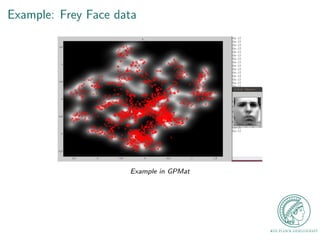
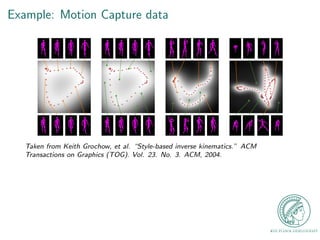
Examples 
Practical points 
Variants 
Conclusion 
Conclusion 
References
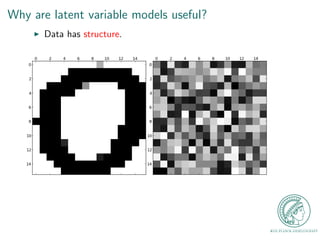
Why are latent variable models useful? 
I Data has structure.
Why are latent variable models useful? 
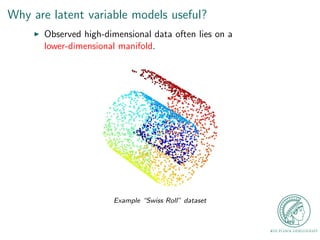
I Observed high-dimensional data often lies on a 
lower-dimensional manifold. 
Example Swiss Roll" dataset
Why are latent variable models useful? 
I The structure in the data means that we don't need such high 
dimensionality to describe it. 
I The lower dimensional space is often easier to work with. 
I Allows for interpolation between observed data points.
De
nition of a latent variable model 
I Assumptions: 
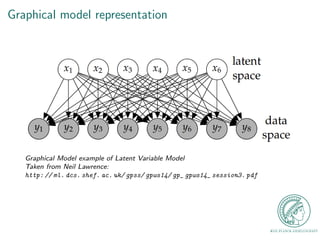
I Assume that the observed variables actually result from a 
smaller set of latent variables. 
I Assume that the observed variables are independent given the 
latent variables. 
I Diers slightly from dimensionality reduction paradigm which 
wishes to
nd a lower-dimensional embedding in the 
high-dimensional space. 
I With the latent variable model we specify the functional form 
of the mapping: 
y = g(x) +  
where x are the latent variables, y are the observed variables 
and  is noise. 
I Obtain dierent latent variable models for dierent 
assumptions on g(x) and
Graphical model representation 
Graphical Model example of Latent Variable Model 
Taken from Neil Lawrence: 
http: // ml. dcs. shef. ac. uk/ gpss/ gpws14/ gp_ gpws14_ session3. pdf
Plan 
Introduction 
Why are latent variable models useful? 
De
nition of a latent variable model 
Graphical Model representation 
PCA recap 
Principal Components Analysis (PCA) 
Probabilistic PCA based methods 
Probabilistic PCA (PPCA) 
Dual PPCA 
GPLVM 
Examples 
Practical points 
Variants 
Conclusion 
Conclusion 
References
Principal Components Analysis (PCA) 
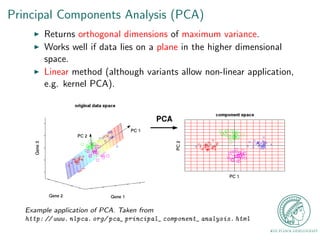
I Returns orthogonal dimensions of maximum variance. 
I Works well if data lies on a plane in the higher dimensional 
space. 
I Linear method (although variants allow non-linear application, 
e.g. kernel PCA). 
Example application of PCA. Taken from 
http: // www. nlpca. org/ pca_ principal_ component_ analysis. html
Plan 
Introduction 
Why are latent variable models useful? 
De
nition of a latent variable model 
Graphical Model representation 
PCA recap 
Principal Components Analysis (PCA) 
Probabilistic PCA based methods 
Probabilistic PCA (PPCA) 
Dual PPCA 
GPLVM 
Examples 
Practical points 
Variants 
Conclusion 
Conclusion 
References
Probabilistic PCA (PPCA) 
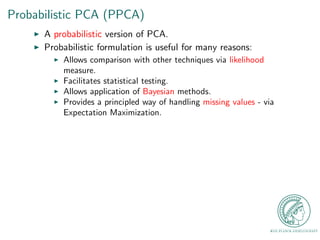
I A probabilistic version of PCA. 
I Probabilistic formulation is useful for many reasons: 
I Allows comparison with other techniques via likelihood 
measure. 
I Facilitates statistical testing. 
I Allows application of Bayesian methods. 
I Provides a principled way of handling missing values - via 
Expectation Maximization.
PPCA De
nition 
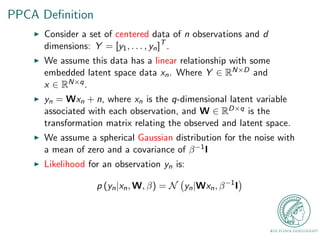
I Consider a set of centered data of n observations and d 
dimensions: Y = [y1; : : : ; yn]T . 
I We assume this data has a linear relationship with some 
embedded latent space data xn. Where Y 2 RND and 
x 2 RNq. 
I yn = Wxn + n, where xn is the q-dimensional latent variable 
associated with each observation, and W 2 RDq is the 
transformation matrix relating the observed and latent space. 
I We assume a spherical Gaussian distribution for the noise with 
a mean of zero and a covariance of
1I 
I Likelihood for an observation yn is: 
p (ynjxn;W;
) = N 
 
ynjWxn;
1I
PPCA Derivation 
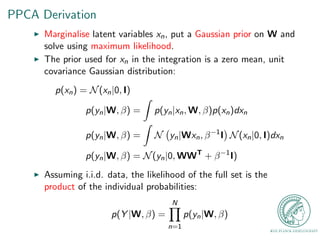
I Marginalise latent variables xn, put a Gaussian prior on W and 
solve using maximum likelihood. 
I The prior used for xn in the integration is a zero mean, unit 
covariance Gaussian distribution: 
p(xn) = N(xnj0; I) 
p(ynjW;
) = 
Z 
p(ynjxn;W;
)p(xn)dxn 
p(ynjW;
) = 
Z 
N 
 
ynjWxn;
1I 
 
N(xnj0; I)dxn 
p(ynjW;
) = N(ynj0;WWT +
1I) 
I Assuming i.i.d. data, the likelihood of the full set is the 
product of the individual probabilities: 
p(Y jW;
) = 
YN 
n=1 
p(ynjW;
)
PPCA Derivation 
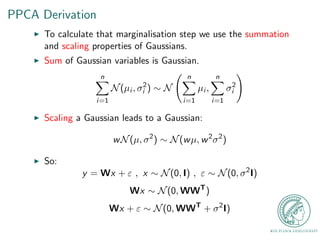
I To calculate that marginalisation step we use the summation 
and scaling properties of Gaussians. 
I Sum of Gaussian variables is Gaussian. 
Xn 
i=1 
N(i ; 2 
i )  N 
  
Xn 
i=1 
i ; 
Xn 
i=1 
2 
i 
! 
I Scaling a Gaussian leads to a Gaussian: 
wN(; 2)  N(w;w22) 
I So: 
y = Wx +  ; x  N(0; I) ;   N(0; 2I) 
Wx  N(0;WWT) 
Wx +   N(0;WWT + 2I)

The Gaussian Process Latent Variable Model (GPLVM)

  • 1.
    Gaussian Process LatentVariable Model (GPLVM) James McMurray PhD Student Department of Empirical Inference 11/02/2014
  • 2.
    Outline of talk Introduction Why are latent variable models useful? De
  • 3.
    nition of alatent variable model Graphical Model representation PCA recap Principal Components Analysis (PCA) Probabilistic PCA based methods Probabilistic PCA (PPCA) Dual PPCA GPLVM Examples Practical points Variants Conclusion Conclusion References
  • 4.
    Why are latentvariable models useful? I Data has structure.
  • 5.
    Why are latentvariable models useful? I Observed high-dimensional data often lies on a lower-dimensional manifold. Example Swiss Roll" dataset
  • 6.
    Why are latentvariable models useful? I The structure in the data means that we don't need such high dimensionality to describe it. I The lower dimensional space is often easier to work with. I Allows for interpolation between observed data points.
  • 7.
  • 8.
    nition of alatent variable model I Assumptions: I Assume that the observed variables actually result from a smaller set of latent variables. I Assume that the observed variables are independent given the latent variables. I Diers slightly from dimensionality reduction paradigm which wishes to
  • 9.
    nd a lower-dimensionalembedding in the high-dimensional space. I With the latent variable model we specify the functional form of the mapping: y = g(x) + where x are the latent variables, y are the observed variables and is noise. I Obtain dierent latent variable models for dierent assumptions on g(x) and
  • 10.
    Graphical model representation Graphical Model example of Latent Variable Model Taken from Neil Lawrence: http: // ml. dcs. shef. ac. uk/ gpss/ gpws14/ gp_ gpws14_ session3. pdf
  • 11.
    Plan Introduction Whyare latent variable models useful? De
  • 12.
    nition of alatent variable model Graphical Model representation PCA recap Principal Components Analysis (PCA) Probabilistic PCA based methods Probabilistic PCA (PPCA) Dual PPCA GPLVM Examples Practical points Variants Conclusion Conclusion References
  • 13.
    Principal Components Analysis(PCA) I Returns orthogonal dimensions of maximum variance. I Works well if data lies on a plane in the higher dimensional space. I Linear method (although variants allow non-linear application, e.g. kernel PCA). Example application of PCA. Taken from http: // www. nlpca. org/ pca_ principal_ component_ analysis. html
  • 14.
    Plan Introduction Whyare latent variable models useful? De
  • 15.
    nition of alatent variable model Graphical Model representation PCA recap Principal Components Analysis (PCA) Probabilistic PCA based methods Probabilistic PCA (PPCA) Dual PPCA GPLVM Examples Practical points Variants Conclusion Conclusion References
  • 16.
    Probabilistic PCA (PPCA) I A probabilistic version of PCA. I Probabilistic formulation is useful for many reasons: I Allows comparison with other techniques via likelihood measure. I Facilitates statistical testing. I Allows application of Bayesian methods. I Provides a principled way of handling missing values - via Expectation Maximization.
  • 17.
  • 18.
    nition I Considera set of centered data of n observations and d dimensions: Y = [y1; : : : ; yn]T . I We assume this data has a linear relationship with some embedded latent space data xn. Where Y 2 RND and x 2 RNq. I yn = Wxn + n, where xn is the q-dimensional latent variable associated with each observation, and W 2 RDq is the transformation matrix relating the observed and latent space. I We assume a spherical Gaussian distribution for the noise with a mean of zero and a covariance of
  • 19.
    1I I Likelihoodfor an observation yn is: p (ynjxn;W;
  • 20.
    ) = N ynjWxn;
  • 21.
  • 22.
    PPCA Derivation IMarginalise latent variables xn, put a Gaussian prior on W and solve using maximum likelihood. I The prior used for xn in the integration is a zero mean, unit covariance Gaussian distribution: p(xn) = N(xnj0; I) p(ynjW;
  • 23.
    ) = Z p(ynjxn;W;
  • 24.
  • 25.
    ) = Z N ynjWxn;
  • 26.
    1I N(xnj0;I)dxn p(ynjW;
  • 27.
  • 28.
    1I) I Assumingi.i.d. data, the likelihood of the full set is the product of the individual probabilities: p(Y jW;
  • 29.
    ) = YN n=1 p(ynjW;
  • 30.
  • 31.
    PPCA Derivation ITo calculate that marginalisation step we use the summation and scaling properties of Gaussians. I Sum of Gaussian variables is Gaussian. Xn i=1 N(i ; 2 i ) N Xn i=1 i ; Xn i=1 2 i ! I Scaling a Gaussian leads to a Gaussian: wN(; 2) N(w;w22) I So: y = Wx + ; x N(0; I) ; N(0; 2I) Wx N(0;WWT) Wx + N(0;WWT + 2I)