Page1
Introduction
The 1960s and 1970s saw a need for alternative fueled vehicles to reduce the
problems of exhaust emissions from internal combustion engines and to reduce
the dependency on imported foreign crude oil. During the years from 1960 to the
present, many attempts to produce practical electric vehicles occurred and
continue to occur.
The purpose of this report is to describe the technology used to produce an
electric vehicle and explain why the electric engine is better than the internal
combustion engine. It includes reasons why the electric vehicle grew rapidly and
the reason it is a necessity to better the world today. The report describes the
most important parts in an electric vehicle and hybrid vehicle. It compares the
electric to the hybrid and internal combustion engine vehicle. It also includes the
future of the electric vehicle.
The overall impact of the electric vehicle ultimately benefits the people.
Compared to gasoline powered vehicles, electric vehicles are considered to be
ninety-seven percent cleaner, producing no tailpipe emissions that can place
particulate matter into the air. Particulate matter, carcinogens released into the
atmosphere by gas-powered vehicles, “can increase asthma conditions, as well as
irritate respiratory systems”.
The paper begins with a history of the electric vehicle, specifically the lows and
highs of production and the reasons for the change. The next section provides a
technical description of an electric vehicle, including the parts, their functions,
and the theory of operation. The following section describes the hybrid car,
including parts, their functions and the theory of operation. Based on this
understanding, I then compare the internal combustion engine, the hybrid
engine, and the electrical engine in terms of efficiency, speed, acceleration,
maintenance, mileage, and cost. The paper concludes with sections on the
advantages and disadvantages of the electric vehicle and its future.
Page2
Electric Vehicle (EV) History
The first electric vehicle (EV) was built between 1832 and 1839, the exact year is
not known, in Scotland by Robert Anderson, who created the first crude electric
carriage. It was not until 1895, after A.L. Ryker built an electric tricycle and
William Morrison built a six passenger wagon, that America paid attention to the
electric vehicle. In 1902 Wood created the Electric Phaeton, which was more than
an electrified horseless carriage and surrey. “The Phaeton had a range of 18 miles,
a top speed of 14 mph and cost $2,000”.
The decline in use and production of the electric vehicle occurred in the 1920s.
Causes of the decline in production include: a better road system, reduced price
of gasoline by the discovery of the Texas crude oil, invention of the electric
starter, and the mass production of the internal combustion engine vehicles.
According to the History of Electric Vehicles, “In 1912, an electric roadster sold for
$1,750, while a gasoline car sold for $650”. By 1935, electric vehicles completely
disappeared.
In the 1960s and 1970s electric vehicles reappeared because internal combustion
vehicles were creating an unhealthy environment for the people in America at
that time.
Page3
Description of an Electric Vehicle
The electric vehicle (EV) is propelled by an electric motor, powered by
rechargeable battery packs, rather than a gasoline engine. From the outside, the
vehicle does not appear to be electric. In most cases, electric cars are created by
converting a gasoline-powered car. Often, the only thing that clues the vehicle is
electric is the fact that it is nearly silent.
Under the hood, the electric car has:
 An electric motor.
 A controller.
 A rechargeable battery.
The electric motor gets its power from a controller and the controller gets its
power from a rechargeable battery.
The electric vehicle operates on an electric/current principle. It uses a battery
pack (batteries) to provide power for the electric motor. The motor then uses the
power (voltage) received from the batteries to rotate a transmission and the
transmission turns the wheels.
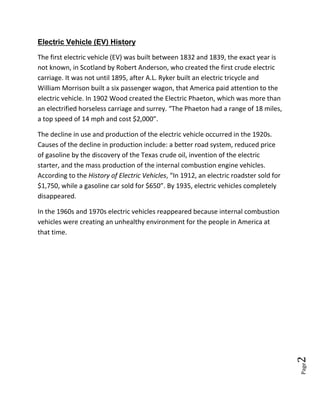
Four main parts make up the electric vehicle: the potentiometer, batteries, direct
current (DC) controller, and motor. See Figure 1.
Figure 1. Parts of an electric vehicle.
Page4
Description of Parts and their Functions
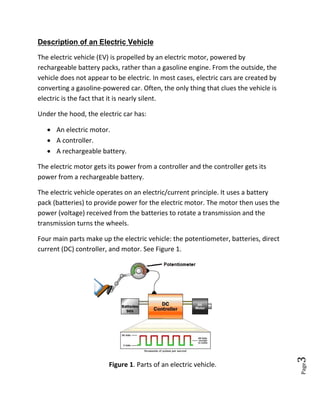
Potentiometer
It is circular in shape and it is hooked to the accelerator pedal. The
potentiometer, also called the variable resistor, provides the signal that tells the
controller how much power is it supposed to deliver.
Figure 2. Potentiometer
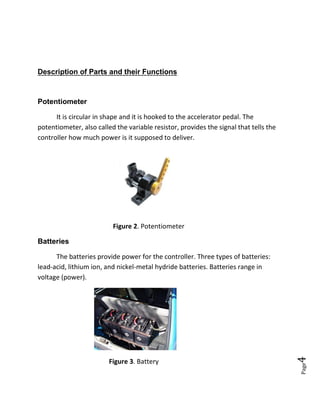
Batteries
The batteries provide power for the controller. Three types of batteries:
lead-acid, lithium ion, and nickel-metal hydride batteries. Batteries range in
voltage (power).
Figure 3. Battery
Page5
DC Controller
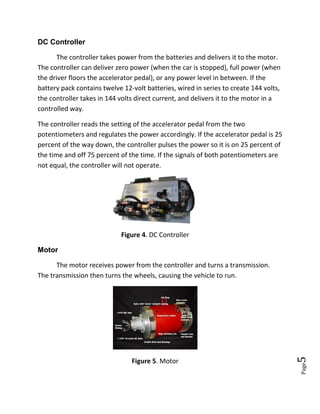
The controller takes power from the batteries and delivers it to the motor.
The controller can deliver zero power (when the car is stopped), full power (when
the driver floors the accelerator pedal), or any power level in between. If the
battery pack contains twelve 12-volt batteries, wired in series to create 144 volts,
the controller takes in 144 volts direct current, and delivers it to the motor in a
controlled way.
The controller reads the setting of the accelerator pedal from the two
potentiometers and regulates the power accordingly. If the accelerator pedal is 25
percent of the way down, the controller pulses the power so it is on 25 percent of
the time and off 75 percent of the time. If the signals of both potentiometers are
not equal, the controller will not operate.
Figure 4. DC Controller
Motor
The motor receives power from the controller and turns a transmission.
The transmission then turns the wheels, causing the vehicle to run.
Figure 5. Motor
Page6
Theory of Operation for EV
When the driver steps on the pedal the potentiometer activates and provides the
signal that tells the controller how much power it is supposed to deliver. There
are two potentiometers for safety. The controller reads the setting of the
accelerator pedal from the potentiometers, regulates the power accordingly,
takes the power from the batteries and delivers it to the motor. The motor
receives the power (voltage) from the controller and uses this power to rotate the
transmission. The transmission then turns the wheels and causes the car to move
forward or backward.
If the driver floors the accelerator pedal, the controller delivers the full battery
voltage to the motor. If the driver takes his/her foot off the accelerator, the
controller delivers zero volts to the motor. For any setting in between, the
controller chops the battery voltage, thousands of times per second to create an
average voltage somewhere between 0 and full battery pack voltage.
Page7
Description of a Hybrid Vehicle
The hybrid vehicle (HV) is powered by both a gasoline engine and electric motor.
The HV runs using power from an internal combustion engine and electric motor.
The engine provides most of the vehicle’s power, and the electric motor provides
additional power when needed, such as accelerating and passing.
The hybrid vehicle operates on a gasoline and electric energy principle. A hybrid
car features a small fuel-efficient gas engine combined with an electric motor that
assists the engine when accelerating. The electric motor is powered by batteries
that recharge automatically while you drive.
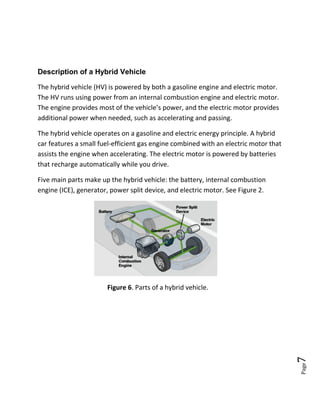
Five main parts make up the hybrid vehicle: the battery, internal combustion
engine (ICE), generator, power split device, and electric motor. See Figure 2.
Figure 6. Parts of a hybrid vehicle.
Page8
Description of Parts and their Functions
Battery
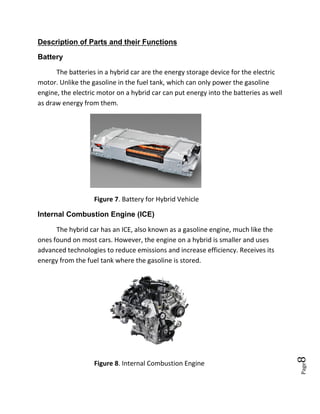
The batteries in a hybrid car are the energy storage device for the electric
motor. Unlike the gasoline in the fuel tank, which can only power the gasoline
engine, the electric motor on a hybrid car can put energy into the batteries as well
as draw energy from them.
Figure 7. Battery for Hybrid Vehicle
Internal Combustion Engine (ICE)
The hybrid car has an ICE, also known as a gasoline engine, much like the
ones found on most cars. However, the engine on a hybrid is smaller and uses
advanced technologies to reduce emissions and increase efficiency. Receives its
energy from the fuel tank where the gasoline is stored.
Figure 8. Internal Combustion Engine
Page9
Generator
The generator is similar to an electric motor, but it acts only to produce
electrical power for the battery.
Figure 9. Generator
Power Split Device
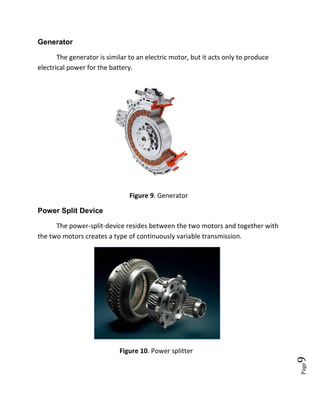
The power-split-device resides between the two motors and together with
the two motors creates a type of continuously variable transmission.
Figure 10. Power splitter
Page10
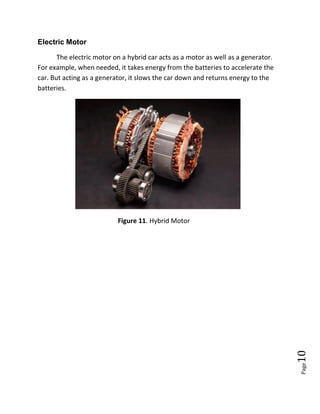
Electric Motor
The electric motor on a hybrid car acts as a motor as well as a generator.
For example, when needed, it takes energy from the batteries to accelerate the
car. But acting as a generator, it slows the car down and returns energy to the
batteries.
Figure 11. Hybrid Motor
Page11
Theory of Operation for Hybrid
When the driver steps on the pedal the generator converts energy from the
engine into electricity and stores it in the battery. The battery then provides
power to the electric motor. The internal combustion engine and electric motor
work simultaneously and each provide power to the power split device. The
power split device combines both powers and uses it to turn the transmission.
The transmission then turns the wheels and propels the vehicle.
The energy used when braking is converted into electricity and stored in the
battery. When braking, the electric motor is reversed so that, instead of using
electricity to turn the wheels, the rotating wheels turn the motor and create
electricity. Using energy from the wheels to turn the motor slows the vehicle
down. When the vehicle is stopped, the gasoline engine and electric motor shut
off automatically so that energy is not wasted in idling. The battery continues to
power auxiliary systems, such as the air conditioning and dashboard displays.
Page12
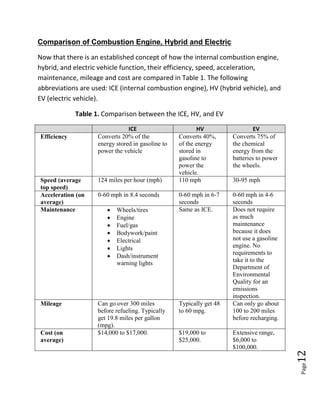
Comparison of Combustion Engine, Hybrid and Electric
Now that there is an established concept of how the internal combustion engine,
hybrid, and electric vehicle function, their efficiency, speed, acceleration,
maintenance, mileage and cost are compared in Table 1. The following
abbreviations are used: ICE (internal combustion engine), HV (hybrid vehicle), and
EV (electric vehicle).
Table 1. Comparison between the ICE, HV, and EV
ICE HV EV
Efficiency Converts 20% of the
energy stored in gasoline to
power the vehicle
Converts 40%,
of the energy
stored in
gasoline to
power the
vehicle.
Converts 75% of
the chemical
energy from the
batteries to power
the wheels.
Speed (average
top speed)
124 miles per hour (mph) 110 mph 30-95 mph
Acceleration (on
average)
0-60 mph in 8.4 seconds 0-60 mph in 6-7
seconds
0-60 mph in 4-6
seconds
Maintenance  Wheels/tires
 Engine
 Fuel/gas
 Bodywork/paint
 Electrical
 Lights
 Dash/instrument
warning lights
Same as ICE. Does not require
as much
maintenance
because it does
not use a gasoline
engine. No
requirements to
take it to the
Department of
Environmental
Quality for an
emissions
inspection.
Mileage Can go over 300 miles
before refueling. Typically
get 19.8 miles per gallon
(mpg).
Typically get 48
to 60 mpg.
Can only go about
100 to 200 miles
before recharging.
Cost (on
average)
$14,000 to $17,000. $19,000 to
$25,000.
Extensive range,
$6,000 to
$100,000.
Page13
Automotive Industries in INDIA
The automotive industry in India is one of the larger markets in the world and had
previously been one of the fastest growing globally,but is now seeing flat or
negative growth rates.India’s passenger cars and commercial vehicles
manufacturing industry is the sixth largest in the world,with an annual production
of more than 3.9 millions units.
Chennai is home to around 35-40% of India’s total automobile industry and
for this reason it is known as the Detroit of Asia.It is on the way to becoming
world’s largest Auto hub by 2016 with a capacity of over 3 millions cars annually.
The majority of India’s car manufacturing industries is based around three
clusters in the south,west and north.The southern cluster consisting of Chennai is
the biggest wih 35% of the revenue share.The western hub near Mumbai and
Pune contributes 33% of the market and the northern cluster around the National
Capital Region contributes 32%.Chennai,with the India operations of
Ford,Hyundai,Renault,Mitsubishi,Nissan,BMW,Hindustan Motors,Daimler.
Chennai accounts for 60% of the country;s automotive exports.Gurgaon
and Manesar in Haryana from the northern cluster where the country’s largest
car manufacturer Maruti Suzuki is based.The Chakan corridor near
Pune,Maharastra is the western cluster with the companies like General
Motors,Volkswagen,Skoda,Mahindra and Mahindra,Tata Motors,Mercedes Benz,
Land Rovers,Jaguar Cars,Fiat and Force Motors having assembly plants in the
area.Nasik has a major base of Mahindra & Mahindra with an UV assembly unit
and an Engine assembly unit.Aurangabad with Audi,Scoda and Volkswagen also
forms parts of the western cluster.Another emerging cluster is in the state of
Gujrat with manufacturing facility of General Motors in Halol and further planned
for Tata Nano at their plant in Sanand.Ford,Maruti Suzuki and Peugeot-Citroen
plants are also set to come up in Gujrat.Kolkata with Hindustan Motors,Noida
with Honda,Bangalore with Toyota are some of the other automotive
manufacturing regions around the country.
Page14
Electric Vehicle and Hybrid Vehicle (xEV) Industry
During April 2012 Indian government has planned to unveil the roadmap for the
development of domestic electric and hybrid vehicles (xEV) in the country.A
discussion between various stakeholders including Government,industries and
the academia has taken place.The final contours of the policy formed after this
set of discussions.Ministries such as petroleum,Finance,Road Transport and
Power are involved in developing a broad framework for the sector.Along with
these ministries big auto industrialists name such as Mr.Anand Mahindra (vice
chairman,managing director of Mahindra & Mahindra) and Mr.Vikram Kirloskar
(vice chairman of Toyota) are also involved in the task.Government has also
proposed to set up a Rs. 740 crores R&D fund for the sector in the 12th
five year
plan during 2012-2017. The idea is to reduce high cost of key imported
components such as the batteries and electric motors and develop such
capabilities locally.
Electric car manufacturers in India
 Ajanta Group
 Hero Electric (YO Bikes)
 Mahindra REVA
 Tara International
 Chevrolet Beat
 Tata (Indica Vesta)
Page15
Advantages and Disadvantages of the EV
The greatest challenge EVs face deal with the rechargeable battery. Most EVs can
only go about 100–200 miles before recharging; fully recharging the battery pack
can take four to eight hours. Battery packs are heavy, expensive, may need to be
replaced, and take up considerable vehicle space [5]. Overall, the electric vehicle
has more advantages than disadvantages. Advantages include no tailpipe
emissions, which leads to a reduction in global warming and unhealthy people.
Table 2 summarizes the advantages and disadvantages of the EV.
Table 2. Advantages and Disadvantages of the EV
Advantages Disadvantages
Fuel can be harnessed from any
source of electricity, which is
available in most homes and
businesses
Limited in the distance that can be
driven before the complete failure of
the battery.
It reduces hydrocarbon and carbon
monoxide, responsible for many
environmental problems, by 98%.
Accessories, such as air conditioning
and radios drain the battery.
Also reduces pollution. Heavier car due to the electric motors,
batteries, chargers, and controllers.
Does not produce emissions.
Important in urban cities, where
cleaner air is much needed.
More expensive because of cost of the
parts.
Page16
Some More Advantages :
 Emissions
Compared to gasoline powered vehicles, electric vehicles are considered
to be ninety-seven percent cleaner, producing no tailpipe emissions that can
place particulate matter into the air.
 Global Warming: Ozone Layer
The process of carbon dioxide emitted into the atmosphere, also known
as global warming, diminishes the Earth’s ozone layer, which is what occurs
at this time. A factor that makes electric vehicles clean is their ability to use
half the number of parts a gasoline powered vehicle does, including gasoline
and oil.
 Affected People: Sickness
Particulate matter, carcinogens released into the atmosphere by gas-
powered vehicles, “can increase asthma conditions, as well as irritate
respiratory systems”. The carbon dioxide released into the atmosphere by
internal combustion vehicles reduces the ozone layer, which absorbs ninety-
seven to ninety-nine percent of the sun’s high frequency ultraviolet light.
According to Ozone Layer, “Every one percent decrease in the earths ozone
shield is projected to increase the amount of UV light exposure to the lower
atmosphere by two percent”. Ultraviolet light, produced by the sun, is
extremely harmful to life on Earth. UV light damages the skin, causing skin
cancer. It also hurts the eyes and the marine life.
Page17
Future of the EV
Future electric cars will most likely carry lithium-ion phosphate (LiFePO4)
batteries that are now becoming popular in other countries. The LiFePO4 batteries
are rechargeable and powerful and are being used in electric bikes and scooters.
Electric cars will most likely adopt this technology in the future.
Another technology that is likely for future electric cars is the increased use of
supercapacitors and ultracapacitors for storing and delivering electrical charge.
Many of these batteries are currently being used in conjunction with hybrid car
prototypes, so these are expected in the electric car future markets as well.
If the developers of future electric cars can create vehicles with a range of
300 miles per charge, a charging time of five to ten minutes, and safety in
operating the vehicles, the market is wide open for them. Researchers are working
on improved battery technologies to increase driving range and decrease
recharging time, weight, and cost. These factors will ultimately determine the
future of EVs.
Page18
Conclusion
As seen in this report, the electric vehicle has many advantages and benefits
over the internal combustion engine and hybrid vehicle. It is cleaner and much
more efficient; however, it also has disadvantages. It is heavier, limited to the
distance it can travel before recharge, and costs more. The future of the EV relies
on its battery. If researchers can produce or find the “super battery”, the EV’s
future is promising. As of today, each vehicle has its own characteristic that makes
it better than the other. Only time and technological improvements will tell which
vehicle will excel in the future.
Page19
References
 Electric Vehicles (EVs).(2009) Retrieved January 31, 2010 from
http://www.fueleconomy.gov/feg/evtech.shtml.
 Future Electric Cars. (2007) Retrieved January 29, 2010 from
http://www.future-car.ghnet/future-electric-cars.html.
 Electric Cars: Effect on the Environment. (1998) Retrieved January
31, 2010 from http://library.thinkquest.org/20463/environment.html.
 How Hybrids Work. (2009) Retrieved February 20, 2010 from
http://www.fueleconomy.gov/feg/hybridtech.shtml.
 Wikipedia
 Modern Automobiles community from Google+

The Electric Vehicle

  • 1.
    Page1 Introduction The 1960s and1970s saw a need for alternative fueled vehicles to reduce the problems of exhaust emissions from internal combustion engines and to reduce the dependency on imported foreign crude oil. During the years from 1960 to the present, many attempts to produce practical electric vehicles occurred and continue to occur. The purpose of this report is to describe the technology used to produce an electric vehicle and explain why the electric engine is better than the internal combustion engine. It includes reasons why the electric vehicle grew rapidly and the reason it is a necessity to better the world today. The report describes the most important parts in an electric vehicle and hybrid vehicle. It compares the electric to the hybrid and internal combustion engine vehicle. It also includes the future of the electric vehicle. The overall impact of the electric vehicle ultimately benefits the people. Compared to gasoline powered vehicles, electric vehicles are considered to be ninety-seven percent cleaner, producing no tailpipe emissions that can place particulate matter into the air. Particulate matter, carcinogens released into the atmosphere by gas-powered vehicles, “can increase asthma conditions, as well as irritate respiratory systems”. The paper begins with a history of the electric vehicle, specifically the lows and highs of production and the reasons for the change. The next section provides a technical description of an electric vehicle, including the parts, their functions, and the theory of operation. The following section describes the hybrid car, including parts, their functions and the theory of operation. Based on this understanding, I then compare the internal combustion engine, the hybrid engine, and the electrical engine in terms of efficiency, speed, acceleration, maintenance, mileage, and cost. The paper concludes with sections on the advantages and disadvantages of the electric vehicle and its future.
  • 2.
    Page2 Electric Vehicle (EV)History The first electric vehicle (EV) was built between 1832 and 1839, the exact year is not known, in Scotland by Robert Anderson, who created the first crude electric carriage. It was not until 1895, after A.L. Ryker built an electric tricycle and William Morrison built a six passenger wagon, that America paid attention to the electric vehicle. In 1902 Wood created the Electric Phaeton, which was more than an electrified horseless carriage and surrey. “The Phaeton had a range of 18 miles, a top speed of 14 mph and cost $2,000”. The decline in use and production of the electric vehicle occurred in the 1920s. Causes of the decline in production include: a better road system, reduced price of gasoline by the discovery of the Texas crude oil, invention of the electric starter, and the mass production of the internal combustion engine vehicles. According to the History of Electric Vehicles, “In 1912, an electric roadster sold for $1,750, while a gasoline car sold for $650”. By 1935, electric vehicles completely disappeared. In the 1960s and 1970s electric vehicles reappeared because internal combustion vehicles were creating an unhealthy environment for the people in America at that time.
  • 3.
    Page3 Description of anElectric Vehicle The electric vehicle (EV) is propelled by an electric motor, powered by rechargeable battery packs, rather than a gasoline engine. From the outside, the vehicle does not appear to be electric. In most cases, electric cars are created by converting a gasoline-powered car. Often, the only thing that clues the vehicle is electric is the fact that it is nearly silent. Under the hood, the electric car has:  An electric motor.  A controller.  A rechargeable battery. The electric motor gets its power from a controller and the controller gets its power from a rechargeable battery. The electric vehicle operates on an electric/current principle. It uses a battery pack (batteries) to provide power for the electric motor. The motor then uses the power (voltage) received from the batteries to rotate a transmission and the transmission turns the wheels. Four main parts make up the electric vehicle: the potentiometer, batteries, direct current (DC) controller, and motor. See Figure 1. Figure 1. Parts of an electric vehicle.
  • 4.
    Page4 Description of Partsand their Functions Potentiometer It is circular in shape and it is hooked to the accelerator pedal. The potentiometer, also called the variable resistor, provides the signal that tells the controller how much power is it supposed to deliver. Figure 2. Potentiometer Batteries The batteries provide power for the controller. Three types of batteries: lead-acid, lithium ion, and nickel-metal hydride batteries. Batteries range in voltage (power). Figure 3. Battery
  • 5.
    Page5 DC Controller The controllertakes power from the batteries and delivers it to the motor. The controller can deliver zero power (when the car is stopped), full power (when the driver floors the accelerator pedal), or any power level in between. If the battery pack contains twelve 12-volt batteries, wired in series to create 144 volts, the controller takes in 144 volts direct current, and delivers it to the motor in a controlled way. The controller reads the setting of the accelerator pedal from the two potentiometers and regulates the power accordingly. If the accelerator pedal is 25 percent of the way down, the controller pulses the power so it is on 25 percent of the time and off 75 percent of the time. If the signals of both potentiometers are not equal, the controller will not operate. Figure 4. DC Controller Motor The motor receives power from the controller and turns a transmission. The transmission then turns the wheels, causing the vehicle to run. Figure 5. Motor
  • 6.
    Page6 Theory of Operationfor EV When the driver steps on the pedal the potentiometer activates and provides the signal that tells the controller how much power it is supposed to deliver. There are two potentiometers for safety. The controller reads the setting of the accelerator pedal from the potentiometers, regulates the power accordingly, takes the power from the batteries and delivers it to the motor. The motor receives the power (voltage) from the controller and uses this power to rotate the transmission. The transmission then turns the wheels and causes the car to move forward or backward. If the driver floors the accelerator pedal, the controller delivers the full battery voltage to the motor. If the driver takes his/her foot off the accelerator, the controller delivers zero volts to the motor. For any setting in between, the controller chops the battery voltage, thousands of times per second to create an average voltage somewhere between 0 and full battery pack voltage.
  • 7.
    Page7 Description of aHybrid Vehicle The hybrid vehicle (HV) is powered by both a gasoline engine and electric motor. The HV runs using power from an internal combustion engine and electric motor. The engine provides most of the vehicle’s power, and the electric motor provides additional power when needed, such as accelerating and passing. The hybrid vehicle operates on a gasoline and electric energy principle. A hybrid car features a small fuel-efficient gas engine combined with an electric motor that assists the engine when accelerating. The electric motor is powered by batteries that recharge automatically while you drive. Five main parts make up the hybrid vehicle: the battery, internal combustion engine (ICE), generator, power split device, and electric motor. See Figure 2. Figure 6. Parts of a hybrid vehicle.
  • 8.
    Page8 Description of Partsand their Functions Battery The batteries in a hybrid car are the energy storage device for the electric motor. Unlike the gasoline in the fuel tank, which can only power the gasoline engine, the electric motor on a hybrid car can put energy into the batteries as well as draw energy from them. Figure 7. Battery for Hybrid Vehicle Internal Combustion Engine (ICE) The hybrid car has an ICE, also known as a gasoline engine, much like the ones found on most cars. However, the engine on a hybrid is smaller and uses advanced technologies to reduce emissions and increase efficiency. Receives its energy from the fuel tank where the gasoline is stored. Figure 8. Internal Combustion Engine
  • 9.
    Page9 Generator The generator issimilar to an electric motor, but it acts only to produce electrical power for the battery. Figure 9. Generator Power Split Device The power-split-device resides between the two motors and together with the two motors creates a type of continuously variable transmission. Figure 10. Power splitter
  • 10.
    Page10 Electric Motor The electricmotor on a hybrid car acts as a motor as well as a generator. For example, when needed, it takes energy from the batteries to accelerate the car. But acting as a generator, it slows the car down and returns energy to the batteries. Figure 11. Hybrid Motor
  • 11.
    Page11 Theory of Operationfor Hybrid When the driver steps on the pedal the generator converts energy from the engine into electricity and stores it in the battery. The battery then provides power to the electric motor. The internal combustion engine and electric motor work simultaneously and each provide power to the power split device. The power split device combines both powers and uses it to turn the transmission. The transmission then turns the wheels and propels the vehicle. The energy used when braking is converted into electricity and stored in the battery. When braking, the electric motor is reversed so that, instead of using electricity to turn the wheels, the rotating wheels turn the motor and create electricity. Using energy from the wheels to turn the motor slows the vehicle down. When the vehicle is stopped, the gasoline engine and electric motor shut off automatically so that energy is not wasted in idling. The battery continues to power auxiliary systems, such as the air conditioning and dashboard displays.
  • 12.
    Page12 Comparison of CombustionEngine, Hybrid and Electric Now that there is an established concept of how the internal combustion engine, hybrid, and electric vehicle function, their efficiency, speed, acceleration, maintenance, mileage and cost are compared in Table 1. The following abbreviations are used: ICE (internal combustion engine), HV (hybrid vehicle), and EV (electric vehicle). Table 1. Comparison between the ICE, HV, and EV ICE HV EV Efficiency Converts 20% of the energy stored in gasoline to power the vehicle Converts 40%, of the energy stored in gasoline to power the vehicle. Converts 75% of the chemical energy from the batteries to power the wheels. Speed (average top speed) 124 miles per hour (mph) 110 mph 30-95 mph Acceleration (on average) 0-60 mph in 8.4 seconds 0-60 mph in 6-7 seconds 0-60 mph in 4-6 seconds Maintenance  Wheels/tires  Engine  Fuel/gas  Bodywork/paint  Electrical  Lights  Dash/instrument warning lights Same as ICE. Does not require as much maintenance because it does not use a gasoline engine. No requirements to take it to the Department of Environmental Quality for an emissions inspection. Mileage Can go over 300 miles before refueling. Typically get 19.8 miles per gallon (mpg). Typically get 48 to 60 mpg. Can only go about 100 to 200 miles before recharging. Cost (on average) $14,000 to $17,000. $19,000 to $25,000. Extensive range, $6,000 to $100,000.
  • 13.
    Page13 Automotive Industries inINDIA The automotive industry in India is one of the larger markets in the world and had previously been one of the fastest growing globally,but is now seeing flat or negative growth rates.India’s passenger cars and commercial vehicles manufacturing industry is the sixth largest in the world,with an annual production of more than 3.9 millions units. Chennai is home to around 35-40% of India’s total automobile industry and for this reason it is known as the Detroit of Asia.It is on the way to becoming world’s largest Auto hub by 2016 with a capacity of over 3 millions cars annually. The majority of India’s car manufacturing industries is based around three clusters in the south,west and north.The southern cluster consisting of Chennai is the biggest wih 35% of the revenue share.The western hub near Mumbai and Pune contributes 33% of the market and the northern cluster around the National Capital Region contributes 32%.Chennai,with the India operations of Ford,Hyundai,Renault,Mitsubishi,Nissan,BMW,Hindustan Motors,Daimler. Chennai accounts for 60% of the country;s automotive exports.Gurgaon and Manesar in Haryana from the northern cluster where the country’s largest car manufacturer Maruti Suzuki is based.The Chakan corridor near Pune,Maharastra is the western cluster with the companies like General Motors,Volkswagen,Skoda,Mahindra and Mahindra,Tata Motors,Mercedes Benz, Land Rovers,Jaguar Cars,Fiat and Force Motors having assembly plants in the area.Nasik has a major base of Mahindra & Mahindra with an UV assembly unit and an Engine assembly unit.Aurangabad with Audi,Scoda and Volkswagen also forms parts of the western cluster.Another emerging cluster is in the state of Gujrat with manufacturing facility of General Motors in Halol and further planned for Tata Nano at their plant in Sanand.Ford,Maruti Suzuki and Peugeot-Citroen plants are also set to come up in Gujrat.Kolkata with Hindustan Motors,Noida with Honda,Bangalore with Toyota are some of the other automotive manufacturing regions around the country.
  • 14.
    Page14 Electric Vehicle andHybrid Vehicle (xEV) Industry During April 2012 Indian government has planned to unveil the roadmap for the development of domestic electric and hybrid vehicles (xEV) in the country.A discussion between various stakeholders including Government,industries and the academia has taken place.The final contours of the policy formed after this set of discussions.Ministries such as petroleum,Finance,Road Transport and Power are involved in developing a broad framework for the sector.Along with these ministries big auto industrialists name such as Mr.Anand Mahindra (vice chairman,managing director of Mahindra & Mahindra) and Mr.Vikram Kirloskar (vice chairman of Toyota) are also involved in the task.Government has also proposed to set up a Rs. 740 crores R&D fund for the sector in the 12th five year plan during 2012-2017. The idea is to reduce high cost of key imported components such as the batteries and electric motors and develop such capabilities locally. Electric car manufacturers in India  Ajanta Group  Hero Electric (YO Bikes)  Mahindra REVA  Tara International  Chevrolet Beat  Tata (Indica Vesta)
  • 15.
    Page15 Advantages and Disadvantagesof the EV The greatest challenge EVs face deal with the rechargeable battery. Most EVs can only go about 100–200 miles before recharging; fully recharging the battery pack can take four to eight hours. Battery packs are heavy, expensive, may need to be replaced, and take up considerable vehicle space [5]. Overall, the electric vehicle has more advantages than disadvantages. Advantages include no tailpipe emissions, which leads to a reduction in global warming and unhealthy people. Table 2 summarizes the advantages and disadvantages of the EV. Table 2. Advantages and Disadvantages of the EV Advantages Disadvantages Fuel can be harnessed from any source of electricity, which is available in most homes and businesses Limited in the distance that can be driven before the complete failure of the battery. It reduces hydrocarbon and carbon monoxide, responsible for many environmental problems, by 98%. Accessories, such as air conditioning and radios drain the battery. Also reduces pollution. Heavier car due to the electric motors, batteries, chargers, and controllers. Does not produce emissions. Important in urban cities, where cleaner air is much needed. More expensive because of cost of the parts.
  • 16.
    Page16 Some More Advantages:  Emissions Compared to gasoline powered vehicles, electric vehicles are considered to be ninety-seven percent cleaner, producing no tailpipe emissions that can place particulate matter into the air.  Global Warming: Ozone Layer The process of carbon dioxide emitted into the atmosphere, also known as global warming, diminishes the Earth’s ozone layer, which is what occurs at this time. A factor that makes electric vehicles clean is their ability to use half the number of parts a gasoline powered vehicle does, including gasoline and oil.  Affected People: Sickness Particulate matter, carcinogens released into the atmosphere by gas- powered vehicles, “can increase asthma conditions, as well as irritate respiratory systems”. The carbon dioxide released into the atmosphere by internal combustion vehicles reduces the ozone layer, which absorbs ninety- seven to ninety-nine percent of the sun’s high frequency ultraviolet light. According to Ozone Layer, “Every one percent decrease in the earths ozone shield is projected to increase the amount of UV light exposure to the lower atmosphere by two percent”. Ultraviolet light, produced by the sun, is extremely harmful to life on Earth. UV light damages the skin, causing skin cancer. It also hurts the eyes and the marine life.
  • 17.
    Page17 Future of theEV Future electric cars will most likely carry lithium-ion phosphate (LiFePO4) batteries that are now becoming popular in other countries. The LiFePO4 batteries are rechargeable and powerful and are being used in electric bikes and scooters. Electric cars will most likely adopt this technology in the future. Another technology that is likely for future electric cars is the increased use of supercapacitors and ultracapacitors for storing and delivering electrical charge. Many of these batteries are currently being used in conjunction with hybrid car prototypes, so these are expected in the electric car future markets as well. If the developers of future electric cars can create vehicles with a range of 300 miles per charge, a charging time of five to ten minutes, and safety in operating the vehicles, the market is wide open for them. Researchers are working on improved battery technologies to increase driving range and decrease recharging time, weight, and cost. These factors will ultimately determine the future of EVs.
  • 18.
    Page18 Conclusion As seen inthis report, the electric vehicle has many advantages and benefits over the internal combustion engine and hybrid vehicle. It is cleaner and much more efficient; however, it also has disadvantages. It is heavier, limited to the distance it can travel before recharge, and costs more. The future of the EV relies on its battery. If researchers can produce or find the “super battery”, the EV’s future is promising. As of today, each vehicle has its own characteristic that makes it better than the other. Only time and technological improvements will tell which vehicle will excel in the future.
  • 19.
    Page19 References  Electric Vehicles(EVs).(2009) Retrieved January 31, 2010 from http://www.fueleconomy.gov/feg/evtech.shtml.  Future Electric Cars. (2007) Retrieved January 29, 2010 from http://www.future-car.ghnet/future-electric-cars.html.  Electric Cars: Effect on the Environment. (1998) Retrieved January 31, 2010 from http://library.thinkquest.org/20463/environment.html.  How Hybrids Work. (2009) Retrieved February 20, 2010 from http://www.fueleconomy.gov/feg/hybridtech.shtml.  Wikipedia  Modern Automobiles community from Google+