Knowledge Corridor, Raisan, Gandhinagar-382007,Gujarat

Hybrid Vehicle
By
Karan C. Prajapati
Rachit Sagar
Ravi Patel
Introduction
 IC

engine invented by Nicholas Otto in 1861
 Automobile Technology in 20th Century
Focus on Petrol and Diesel Engine.
 Automobile

Technology in 21st Century

Focus on Hybrid Electric Vehicle, Hybrid Solar
Vehicle and Plug-In Hybrid Electric Vehicle.
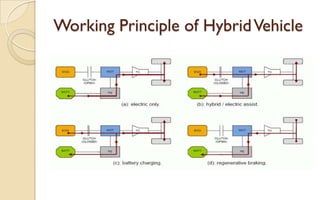
Working Principle of Hybrid Vehicle
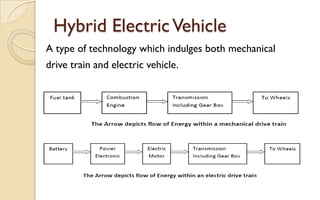
Hybrid Electric Vehicle
A type of technology which indulges both mechanical

drive train and electric vehicle.
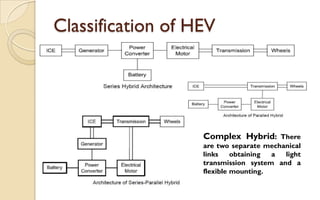
Classification of HEV

Complex Hybrid:

There
are two separate mechanical
links
obtaining
a
light
transmission system and a
flexible mounting.
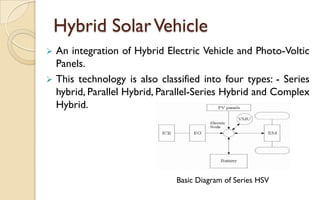
Hybrid Solar Vehicle
An integration of Hybrid Electric Vehicle and Photo-Voltic
Panels.
 This technology is also classified into four types: - Series
hybrid, Parallel Hybrid, Parallel-Series Hybrid and Complex
Hybrid.


Basic Diagram of Series HSV
Plug-In Hybrid Electric Vehicle


Next Version of Hybrid Electric Vehicle
1) it can be plugged in to an electrical outlet to be
charged and
2) has some range that can be travelled on the
energy it stored while plugged in
3) gasoline-independent for daily commuting
4) can also be multi-fuel supplemented by
diesel, biodiesel or hydrogen
CASE STUDY OF TOYOTA PRIUS
SERIES
Why Prius?
 Came

out too early (1997), much before
environmental awareness became a
mainstream issue.
 Till now the most successful hybrid car ever
made (Highest sales and best mileage).
 Has inculcated an intelligent Hybrid Synergy
Drive (HSD) rather than going on
mainstream functioning directly.
First Generation Prius
Challenges while making the first
generation Prius.
 Life of Battery (7-10 years)
 Need for hybrid system
 High Performance engine for charging
the battery.
Solutions: The battery pack is always charged
between 40%-60% for maximum
efficiency.
 The introduction of the “Toyota Hybrid
System”.
 Introduction of the Double Overhead
Cam-Shaft (DOHC) engine in the vehicle.
Benefits of DOHC engine
 DOHC stands for Double Overhead Cam
shaft engine.
 DOHC allows the engine to have four
valves per cylinder. Hence higher power is
produced as more air can be sucked and
exhaust cam be removed at higher rate
resulting in decrease in cycle completion
time.
Working of Toyota Hybrid System
Components
 Petrol Engine
 Two Motor Generators
 (MG1 & MG2).
 Power Control Unit
 (PCU).
 Power Split Device
 Battery
Working
 When the car starts it solely runs on
Electric Motor (MG2).
 When the car achieve higher speed the
petrol engine comes into play.
 The engine also operates a generator with
the help of a power split device which in
turn drives the electric motor MG2.
 This power splitting is controlled by the
power control unit which manages the
power for the maximum efficiency.
 During

braking the motor acts as a
generator and the energy recovered is
stored in the battery.
 The battery doesn‟t need any external
charging.
 If the battery is drained, the car is run on
the petrol engine in “stand mode” which
charges the battery.
Advantages
 Very

less noise pollution at low speeds.
 Lower level of CO2 emissions.
 High mileage
City driving 5.6 L/100 km (17.8km/L)
Highway driving 5.7 L/100 km (17.5km/L)
Combined driving5.7 L/100 km (17.5km/L)
Drawbacks
 The

reversing of the car was difficult at
steeps.
 The rides where jerky at times.
Second generation: Hybrid
Synergy Drive (HSD)
 It

has an all electric Air conditioner. Hence the
engine can be turned off during standby cooling.
 Torque of electrical motor is increased up to 14
%.
 Inferior electrical losses.
 Improved charge capacity of the generator
(500V).
 New HV battery with superior power density
and 14% weight reduction.
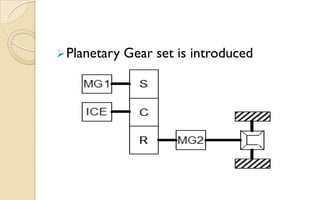
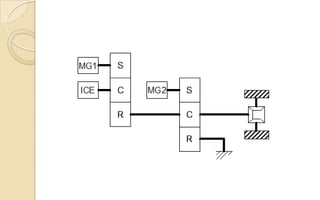
 Planetary

Gear set is introduced
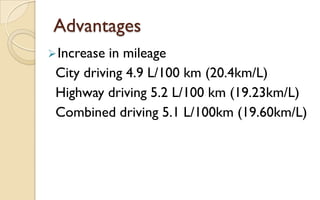
Advantages
 Increase

in mileage
City driving 4.9 L/100 km (20.4km/L)
Highway driving 5.2 L/100 km (19.23km/L)
Combined driving 5.1 L/100km (19.60km/L)
Third generation: Hybrid
synergy drive (HSD)
 The

internal combustion engine is a new
more powerful 1.8-litre VVT-i Atkinson cycle
petrol engine.
 The electric motor MG2 is 20% more
powerful (60kW vs. 50 kW) and 33%
smaller.
 The Ni-MH battery power has been
increased to a maximum 27kW (+2kW), and
has reduced size.
 The

PCU is 36% lighter, faster switching and
cooling is employed for improved efficiency.
 The Ni-MH battery power has been
increased to a maximum 27kW (+2kW), and
has reduced size.
 The third generation Prius also has a
planetary gear set called the „motor speed
gear reduction‟ for the MG1.
Advantages
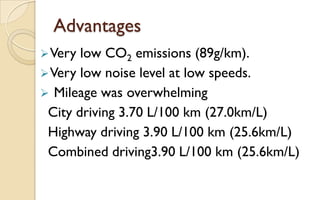
 Very

low CO2 emissions (89g/km).
 Very low noise level at low speeds.
 Mileage was overwhelming
City driving 3.70 L/100 km (27.0km/L)
Highway driving 3.90 L/100 km (25.6km/L)
Combined driving3.90 L/100 km (25.6km/L)
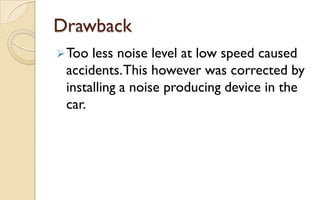
Drawback
 Too

less noise level at low speed caused
accidents. This however was corrected by
installing a noise producing device in the
car.
Plug-In Hybrid Electric Vehicle
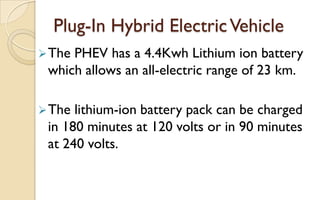
 The

PHEV has a 4.4Kwh Lithium ion battery
which allows an all-electric range of 23 km.

 The

lithium-ion battery pack can be charged
in 180 minutes at 120 volts or in 90 minutes
at 240 volts.
Advantages
 The

Prius plug-in releases only 49gm CO2
emissions.
 Same mileage as that of 3rd generation
Prius.
 It has an all electric efficiency of
2.5L/100km (40km/L).
 The Battery can be charges at any outlet.
Advantages of Hybrid Vehicles
Hybrid cars use no energy during idle state, they
turn off and use less than petrol engines at low
speeds.
 At lower speeds i.e. in traffic no smog is emitted
maintaining its sustainable advantage.
 Hybrid cars offers greater mileage than other
cars.
 Noise pollution and emission of CO2 are
considerably reduced.

Drawbacks of Hybrid Vehicles
Hybrid cars are more expensive than normal
cars.
 Hybrid cars are much more complex in
construction and working than the IC engine
cars.
 Hybrid cars offer larger repair bills.
 Batteries are not yet much advanced so as the
car could run for a larger distance on batteries
itself.
(Toyota is researching on making higher capacity
Li-ion batteries)

Its not about what you want…..
Its about how bad you want it

THANK YOU

Hybrid Vehicle

  • 1.
    Knowledge Corridor, Raisan,Gandhinagar-382007,Gujarat Hybrid Vehicle By Karan C. Prajapati Rachit Sagar Ravi Patel
  • 2.
    Introduction  IC engine inventedby Nicholas Otto in 1861  Automobile Technology in 20th Century Focus on Petrol and Diesel Engine.  Automobile Technology in 21st Century Focus on Hybrid Electric Vehicle, Hybrid Solar Vehicle and Plug-In Hybrid Electric Vehicle.
  • 3.
    Working Principle ofHybrid Vehicle
  • 4.
    Hybrid Electric Vehicle Atype of technology which indulges both mechanical drive train and electric vehicle.
  • 5.
    Classification of HEV ComplexHybrid: There are two separate mechanical links obtaining a light transmission system and a flexible mounting.
  • 6.
    Hybrid Solar Vehicle Anintegration of Hybrid Electric Vehicle and Photo-Voltic Panels.  This technology is also classified into four types: - Series hybrid, Parallel Hybrid, Parallel-Series Hybrid and Complex Hybrid.  Basic Diagram of Series HSV
  • 7.
    Plug-In Hybrid ElectricVehicle  Next Version of Hybrid Electric Vehicle 1) it can be plugged in to an electrical outlet to be charged and 2) has some range that can be travelled on the energy it stored while plugged in 3) gasoline-independent for daily commuting 4) can also be multi-fuel supplemented by diesel, biodiesel or hydrogen
  • 8.
    CASE STUDY OFTOYOTA PRIUS SERIES
  • 9.
    Why Prius?  Came outtoo early (1997), much before environmental awareness became a mainstream issue.  Till now the most successful hybrid car ever made (Highest sales and best mileage).  Has inculcated an intelligent Hybrid Synergy Drive (HSD) rather than going on mainstream functioning directly.
  • 10.
    First Generation Prius Challengeswhile making the first generation Prius.  Life of Battery (7-10 years)  Need for hybrid system  High Performance engine for charging the battery.
  • 11.
    Solutions: The batterypack is always charged between 40%-60% for maximum efficiency.  The introduction of the “Toyota Hybrid System”.  Introduction of the Double Overhead Cam-Shaft (DOHC) engine in the vehicle.
  • 12.
    Benefits of DOHCengine  DOHC stands for Double Overhead Cam shaft engine.  DOHC allows the engine to have four valves per cylinder. Hence higher power is produced as more air can be sucked and exhaust cam be removed at higher rate resulting in decrease in cycle completion time.
  • 13.
    Working of ToyotaHybrid System Components  Petrol Engine  Two Motor Generators  (MG1 & MG2).  Power Control Unit  (PCU).  Power Split Device  Battery
  • 14.
    Working  When thecar starts it solely runs on Electric Motor (MG2).  When the car achieve higher speed the petrol engine comes into play.  The engine also operates a generator with the help of a power split device which in turn drives the electric motor MG2.  This power splitting is controlled by the power control unit which manages the power for the maximum efficiency.
  • 15.
     During braking themotor acts as a generator and the energy recovered is stored in the battery.  The battery doesn‟t need any external charging.  If the battery is drained, the car is run on the petrol engine in “stand mode” which charges the battery.
  • 16.
    Advantages  Very less noisepollution at low speeds.  Lower level of CO2 emissions.  High mileage City driving 5.6 L/100 km (17.8km/L) Highway driving 5.7 L/100 km (17.5km/L) Combined driving5.7 L/100 km (17.5km/L)
  • 17.
    Drawbacks  The reversing ofthe car was difficult at steeps.  The rides where jerky at times.
  • 18.
    Second generation: Hybrid SynergyDrive (HSD)  It has an all electric Air conditioner. Hence the engine can be turned off during standby cooling.  Torque of electrical motor is increased up to 14 %.  Inferior electrical losses.  Improved charge capacity of the generator (500V).  New HV battery with superior power density and 14% weight reduction.
  • 19.
  • 20.
    Advantages  Increase in mileage Citydriving 4.9 L/100 km (20.4km/L) Highway driving 5.2 L/100 km (19.23km/L) Combined driving 5.1 L/100km (19.60km/L)
  • 21.
    Third generation: Hybrid synergydrive (HSD)  The internal combustion engine is a new more powerful 1.8-litre VVT-i Atkinson cycle petrol engine.  The electric motor MG2 is 20% more powerful (60kW vs. 50 kW) and 33% smaller.  The Ni-MH battery power has been increased to a maximum 27kW (+2kW), and has reduced size.
  • 22.
     The PCU is36% lighter, faster switching and cooling is employed for improved efficiency.  The Ni-MH battery power has been increased to a maximum 27kW (+2kW), and has reduced size.  The third generation Prius also has a planetary gear set called the „motor speed gear reduction‟ for the MG1.
  • 24.
    Advantages  Very low CO2emissions (89g/km).  Very low noise level at low speeds.  Mileage was overwhelming City driving 3.70 L/100 km (27.0km/L) Highway driving 3.90 L/100 km (25.6km/L) Combined driving3.90 L/100 km (25.6km/L)
  • 25.
    Drawback  Too less noiselevel at low speed caused accidents. This however was corrected by installing a noise producing device in the car.
  • 26.
    Plug-In Hybrid ElectricVehicle  The PHEV has a 4.4Kwh Lithium ion battery which allows an all-electric range of 23 km.  The lithium-ion battery pack can be charged in 180 minutes at 120 volts or in 90 minutes at 240 volts.
  • 27.
    Advantages  The Prius plug-inreleases only 49gm CO2 emissions.  Same mileage as that of 3rd generation Prius.  It has an all electric efficiency of 2.5L/100km (40km/L).  The Battery can be charges at any outlet.
  • 28.
    Advantages of HybridVehicles Hybrid cars use no energy during idle state, they turn off and use less than petrol engines at low speeds.  At lower speeds i.e. in traffic no smog is emitted maintaining its sustainable advantage.  Hybrid cars offers greater mileage than other cars.  Noise pollution and emission of CO2 are considerably reduced. 
  • 29.
    Drawbacks of HybridVehicles Hybrid cars are more expensive than normal cars.  Hybrid cars are much more complex in construction and working than the IC engine cars.  Hybrid cars offer larger repair bills.  Batteries are not yet much advanced so as the car could run for a larger distance on batteries itself. (Toyota is researching on making higher capacity Li-ion batteries) 
  • 30.
    Its not aboutwhat you want….. Its about how bad you want it THANK YOU