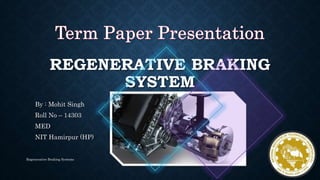
REGENERATIVE BRAKING
SYSTEM
By : Mohit Singh
Roll No – 14303
MED
NIT Hamirpur (HP)
Regenerative Braking Systems
CONTENTS
REGENERATIVE BRAKING SYSTEMS
Conventional braking System
Regenerative Braking System
Principle of Working
Project Design
Calculations
Analysis
Future Scope
CONVENTIONAL BRAKING SYSTEM
• Friction is used for braking.
• Excessive heat energy is created
during braking.
• This heat energy dissipates into the
air wasting as much as the vehicle
80% of the vehicle generated
power
• Conventional Braking reduced
fuel efficiency.
Regenerative Braking Systems
RBS
Regenerative braking means recapturing
the kinetic energy of the vehicle motion
and turning into another energy during
braking.
Commonly, kinetic energy is converted
into electric energy
This energy is stored in storage battery
and used later to power the vehicle in
hybrid or fully electric vehicles.
Regenerative Braking Systems
HISTORY
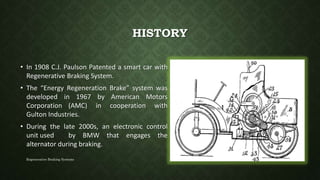
• In 1908 C.J. Paulson Patented a smart car with
Regenerative Braking System.
• The “Energy Regeneration Brake” system was
developed in 1967 by American Motors
Corporation (AMC) in cooperation with
Gulton Industries.
• During the late 2000s, an electronic control
unit used by BMW that engages the
alternator during braking.
Regenerative Braking Systems
 By applying brakes, the electric motors coupled
with drive wheels, rotated in reverse mode
slowing down the car’s wheels.
 A properly designed motor becomes an electric
generator, converting into electrical energy.
 This energy is feeding back into storage battery
and used to accelerate the vehicle.
Regenerative Braking Systems
Why do we need it?
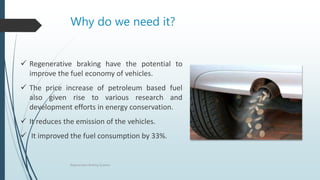
 Regenerative braking have the potential to
improve the fuel economy of vehicles.
 The price increase of petroleum based fuel
also given rise to various research and
development efforts in energy conservation.
 It reduces the emission of the vehicles.
 It improved the fuel consumption by 33%.
Regenerative Braking Systems
IN FOUR WHEELERS
• A vehicle which contains two such sources of propulsion is known as hybrid system.
• A hybrid vehicle consist a series and a parallel circuit of motor and the ICE.
Regenerative Braking Systems
TYPES OF RBS
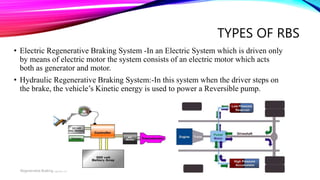
• Electric Regenerative Braking System -In an Electric System which is driven only
by means of electric motor the system consists of an electric motor which acts
both as generator and motor.
• Hydraulic Regenerative Braking System:-In this system when the driver steps on
the brake, the vehicle’s Kinetic energy is used to power a Reversible pump.
Regenerative Braking Systems
Project Design – For Two Wheelers
 Here we aspire to improve two wheeler BSFC
 New design, patents under process by TVS
 No single commercial two wheeler with RBS
 The design consists of a brake rotor on rear wheel
shaft
Regenerative Braking Systems
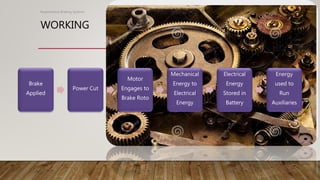
WORKING
Brake
Applied
Power Cut
Motor
Engages to
Brake Roto
Mechanical
Energy to
Electrical
Energy
Electrical
Energy
Stored in
Battery
Energy
used to
Run
Auxiliaries
Regenerative Braking Systems
Results
Regenerative Braking Systems
Speed (KMPH)
Time(s) Non
RBS
Time(s)
RBS
Distance (m)
Non RBS
Distance(m)
RBS Current(mA)
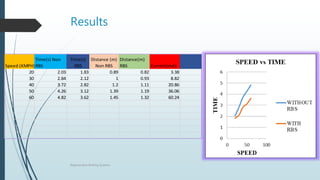
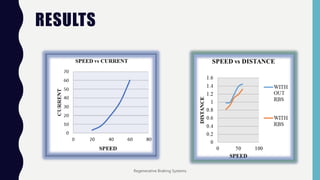
20 2.03 1.83 0.89 0.82 3.38
30 2.84 2.12 1 0.93 8.82
40 3.72 2.82 1.2 1.11 20.86
50 4.26 3.12 1.39 1.19 36.06
60 4.82 3.62 1.45 1.32 60.24
RESULTS
Regenerative Braking Systems
FUTURE IMPLEMENTATION
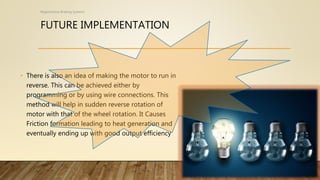
• There is also an idea of making the motor to run in
reverse. This can be achieved either by
programming or by using wire connections. This
method will help in sudden reverse rotation of
motor with that of the wheel rotation. It Causes
Friction formation leading to heat generation and
eventually ending up with good output efficiency
Regenerative Braking Systems
Current Uses
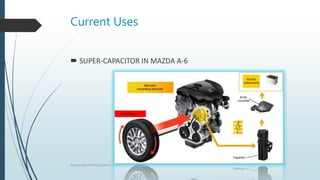
 SUPER-CAPACITOR IN MAZDA A-6
Regenerative Braking Systems
Current uses
Regenerative Braking Systems
Jaipur Metro uses
the Regenerative
Braking System &
saves 35% of
Electricity.
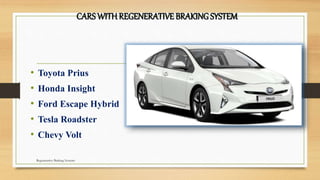
• Toyota Prius
• Honda Insight
• Ford Escape Hybrid
• Tesla Roadster
• Chevy Volt
Regenerative Braking Systems
CARS WITHREGENERATIVE BRAKING SYSTEM
• Regenerative braking is an effective method of improving
vehicle efficiency and longevity
• Is already in use in many EVs
• The technology to do it exists and is often well worth it
• Mostly dependent on the wider adoption of EVs or further
development of hydraulic regeneration systems
[1] Sergio Vazquez, Srdjan Lukic, Eduardo Galvan, Leopoldo G. Franquelo, Juan M.
Carrasco and Jose I. Leon, “Recent Advances on Energy Storage Systems”, IEEE
Transaction on Industrial Electronics, Dec 2010
[2] Kuruppu Sandun, “Implementaion and Performance Evauation of Regenerative
Braking System Coupled Ultra capacitor for a Brushless DC Hub Motor Driven Electric
Tricycle”, College of Technology Master Theses, Paper 3 (2010)
[3] Cibulka,J, “Kinetic Energy Recovery System by Means of Flywheel Energy Storage”,
ISSN 1846-5900,3(2009)
[4] M.Rakesh, P.V.R.L. Narasimham, “Different Braking Techniques Employed to a
Brushless DC Motor Drive Used in Locomotives”, International Electrical Engineering
Journal (IEEJ) Vol.3 No.2, pp.784-790 ISSN 2078-2365 (2012)
[5] Qingsheng Shi, Chenghui Zhang, and Naxin Cui, D. Jin and S. Lin, “An Improved
Electrical Vehicle Regenerative Braking Strategy Research”, Advances in CSIE, Vol. 2,
AISC 169,pp.637-642, 2012
REFERENCES

Regenerative braking system

  • 1.
    REGENERATIVE BRAKING SYSTEM By :Mohit Singh Roll No – 14303 MED NIT Hamirpur (HP) Regenerative Braking Systems
  • 2.
    CONTENTS REGENERATIVE BRAKING SYSTEMS Conventionalbraking System Regenerative Braking System Principle of Working Project Design Calculations Analysis Future Scope
  • 3.
    CONVENTIONAL BRAKING SYSTEM •Friction is used for braking. • Excessive heat energy is created during braking. • This heat energy dissipates into the air wasting as much as the vehicle 80% of the vehicle generated power • Conventional Braking reduced fuel efficiency. Regenerative Braking Systems
  • 4.
    RBS Regenerative braking meansrecapturing the kinetic energy of the vehicle motion and turning into another energy during braking. Commonly, kinetic energy is converted into electric energy This energy is stored in storage battery and used later to power the vehicle in hybrid or fully electric vehicles. Regenerative Braking Systems
  • 5.
    HISTORY • In 1908C.J. Paulson Patented a smart car with Regenerative Braking System. • The “Energy Regeneration Brake” system was developed in 1967 by American Motors Corporation (AMC) in cooperation with Gulton Industries. • During the late 2000s, an electronic control unit used by BMW that engages the alternator during braking. Regenerative Braking Systems
  • 6.
     By applyingbrakes, the electric motors coupled with drive wheels, rotated in reverse mode slowing down the car’s wheels.  A properly designed motor becomes an electric generator, converting into electrical energy.  This energy is feeding back into storage battery and used to accelerate the vehicle. Regenerative Braking Systems
  • 7.
    Why do weneed it?  Regenerative braking have the potential to improve the fuel economy of vehicles.  The price increase of petroleum based fuel also given rise to various research and development efforts in energy conservation.  It reduces the emission of the vehicles.  It improved the fuel consumption by 33%. Regenerative Braking Systems
  • 8.
    IN FOUR WHEELERS •A vehicle which contains two such sources of propulsion is known as hybrid system. • A hybrid vehicle consist a series and a parallel circuit of motor and the ICE. Regenerative Braking Systems
  • 9.
    TYPES OF RBS •Electric Regenerative Braking System -In an Electric System which is driven only by means of electric motor the system consists of an electric motor which acts both as generator and motor. • Hydraulic Regenerative Braking System:-In this system when the driver steps on the brake, the vehicle’s Kinetic energy is used to power a Reversible pump. Regenerative Braking Systems
  • 10.
    Project Design –For Two Wheelers  Here we aspire to improve two wheeler BSFC  New design, patents under process by TVS  No single commercial two wheeler with RBS  The design consists of a brake rotor on rear wheel shaft Regenerative Braking Systems
  • 11.
    WORKING Brake Applied Power Cut Motor Engages to BrakeRoto Mechanical Energy to Electrical Energy Electrical Energy Stored in Battery Energy used to Run Auxiliaries Regenerative Braking Systems
  • 12.
    Results Regenerative Braking Systems Speed(KMPH) Time(s) Non RBS Time(s) RBS Distance (m) Non RBS Distance(m) RBS Current(mA) 20 2.03 1.83 0.89 0.82 3.38 30 2.84 2.12 1 0.93 8.82 40 3.72 2.82 1.2 1.11 20.86 50 4.26 3.12 1.39 1.19 36.06 60 4.82 3.62 1.45 1.32 60.24
  • 13.
  • 14.
    FUTURE IMPLEMENTATION • Thereis also an idea of making the motor to run in reverse. This can be achieved either by programming or by using wire connections. This method will help in sudden reverse rotation of motor with that of the wheel rotation. It Causes Friction formation leading to heat generation and eventually ending up with good output efficiency Regenerative Braking Systems
  • 15.
    Current Uses  SUPER-CAPACITORIN MAZDA A-6 Regenerative Braking Systems
  • 16.
    Current uses Regenerative BrakingSystems Jaipur Metro uses the Regenerative Braking System & saves 35% of Electricity.
  • 17.
    • Toyota Prius •Honda Insight • Ford Escape Hybrid • Tesla Roadster • Chevy Volt Regenerative Braking Systems CARS WITHREGENERATIVE BRAKING SYSTEM
  • 18.
    • Regenerative brakingis an effective method of improving vehicle efficiency and longevity • Is already in use in many EVs • The technology to do it exists and is often well worth it • Mostly dependent on the wider adoption of EVs or further development of hydraulic regeneration systems
  • 19.
    [1] Sergio Vazquez,Srdjan Lukic, Eduardo Galvan, Leopoldo G. Franquelo, Juan M. Carrasco and Jose I. Leon, “Recent Advances on Energy Storage Systems”, IEEE Transaction on Industrial Electronics, Dec 2010 [2] Kuruppu Sandun, “Implementaion and Performance Evauation of Regenerative Braking System Coupled Ultra capacitor for a Brushless DC Hub Motor Driven Electric Tricycle”, College of Technology Master Theses, Paper 3 (2010) [3] Cibulka,J, “Kinetic Energy Recovery System by Means of Flywheel Energy Storage”, ISSN 1846-5900,3(2009) [4] M.Rakesh, P.V.R.L. Narasimham, “Different Braking Techniques Employed to a Brushless DC Motor Drive Used in Locomotives”, International Electrical Engineering Journal (IEEJ) Vol.3 No.2, pp.784-790 ISSN 2078-2365 (2012) [5] Qingsheng Shi, Chenghui Zhang, and Naxin Cui, D. Jin and S. Lin, “An Improved Electrical Vehicle Regenerative Braking Strategy Research”, Advances in CSIE, Vol. 2, AISC 169,pp.637-642, 2012 REFERENCES