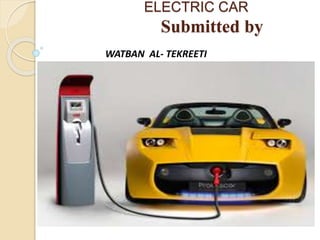




ELECTRIC CAR
Submitted by
WATBAN AL- TEKREETI
content
 INTRODUCTION
 The first road vehicle achieving a speed of
more than 100 km/h
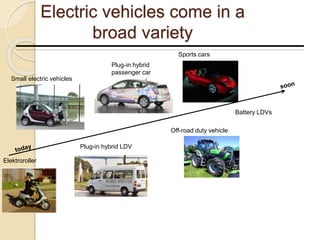
 Electric vehicles come in a broad variety
 BENEFITS
 Historical development of electric cars
 When can we buy eletcric vehicles?
 Economic aspects of e-cars
 Electric vehicles produced in 2010
 How does an electric vehicle work?
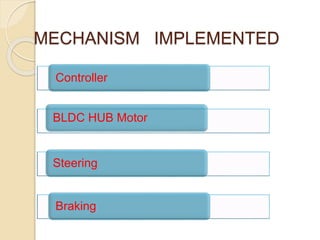
 MECHANISM IMPLEMENTED
 Conclusions
INTRODUCTION
ELECTRIC CAR
 An electric car is an automobile that is
propelled by one electric motor or more,
using electrical energy stored in the
batteries or another storage device.
Electric motors give electric cars instant
torque, creating strong and smooth
acceleration.
 The German Flocken Elektrowagen, built
in 1888, was the world’s first electric car.
Electric cars were also popular in the late
19th century and early 20th century.
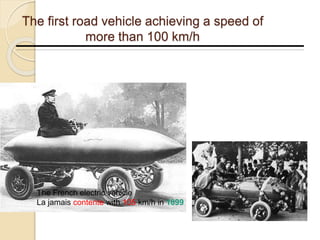
The first road vehicle achieving a speed of
more than 100 km/h
The French electric vehicle
La jamais contente with 105 km/h in 1899
Electric vehicles come in a
broad variety
Plug-in hybrid
passenger car
Small electric vehicles
Plug-in hybrid LDV
Battery LDVs
Elektroroller
Sports cars
Off-road duty vehicle
Benefits of electric cars over internal
combustion engines automobiles include a
significant reduction of local air pollution, as
they do not emit tailpipe pollutants, in many
cases, a large reduction in total greenhouse
gas and other emissions.
Less dependency on foreign oil, which in
several countries is cause for concern for
vulnerability to oil price volatility and supply
disruption.
Electric vehicles show significant reductions
in overall well-wheel global carbon
emissions due to highly carbon intensive
production in mining, pumping, refining and
the efficiencies obtained with gasoline.
BENEFITs
Historical development of electric cars
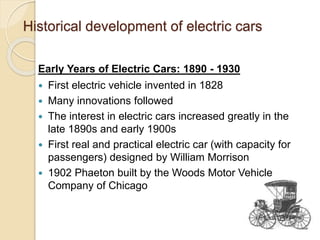
Early Years of Electric Cars: 1890 - 1930
 First electric vehicle invented in 1828
 Many innovations followed
 The interest in electric cars increased greatly in the
late 1890s and early 1900s
 First real and practical electric car (with capacity for
passengers) designed by William Morrison
 1902 Phaeton built by the Woods Motor Vehicle
Company of Chicago
Historical development of electric
cars
Decline of Electric Cars: 1930 – 1990
 The electric car declined in popularity
because of the following reasons:
◦ Better system of roads  need for longer-
range vehicles
◦ Reduction in price of gasoline  gasoline was
affordable to the average consumer
◦ Invention of the electric starter disposed of the
need for the hand crank.
◦ Initiation of mass production of internal
combustion engine vehicles by Henry Ford.
Historical development of electric
cars
 The mid-1930s until the 1960s: dead years for
electric vehicle development and for their
application as personal transportation
 In the 1960s and 1970s: imperative necessity for
alternative-fueled vehicles  renewed interest
on electric vehicles
 The first electric truck, the Battronic Truck,
constructed in the early 1960s.
 The companies Sebring-Vanguard and Elcar
Corporation = leaders in the electric car
production
Historical development of electric
cars
The Revival: 1990s
 Efforts by the governments to more stringent air
emissions requirements and regulations requiring
reductions in gasoline use and Zero Emission
Vehicle requirements from several states  revival
 Electric conversions of familiar gasoline powered
vehicles as well as electric vehicles designed from
the ground up became available
(reached highway speeds with ranges of 50 to 150 miles
between recharging)
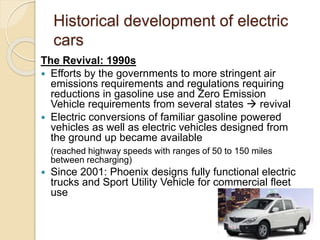
 Since 2001: Phoenix designs fully functional electric
trucks and Sport Utility Vehicle for commercial fleet
use
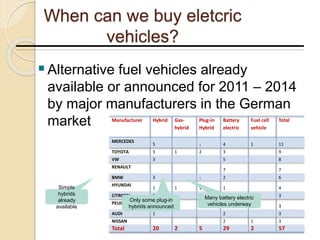
Alternative fuel vehicles already
available or announced for 2011 – 2014
by major manufacturers in the German
market
When can we buy eletcric
vehicles?
Manufacturer Hybrid Gas-
hybrid
Plug-in
Hybrid
Battery
electric
Fuel cell
vehicle
Total
MERCEDES
5 1 4 1 11
TOYOTA 3 1 2 3 9
VW 3 5 8
RENAULT
7 7
BMW 3 1 2 6
HYUNDAI
1 1 1 1 4
CITROEN 2 1 3
PEUGEOT
1 2 3
AUDI 1 2 3
NISSAN 2 1 3
Total 20 2 5 29 2 57
Simple
hybrids
already
available
Only some plug-in
hybrids announced
Many battery electric
vehicles underway
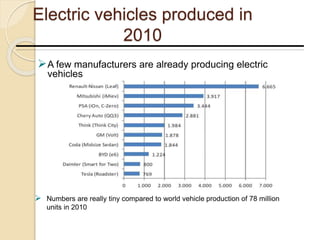
A few manufacturers are already producing electric
vehicles
Electric vehicles produced in
2010
 Numbers are really tiny compared to world vehicle production of 78 million
units in 2010
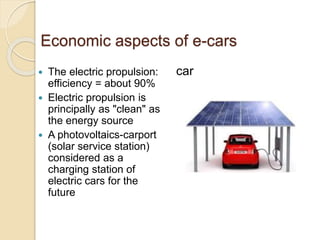
Economic aspects of e-cars
car The electric propulsion:
efficiency = about 90%
 Electric propulsion is
principally as "clean" as
the energy source
 A photovoltaics-carport
(solar service station)
considered as a
charging station of
electric cars for the
future
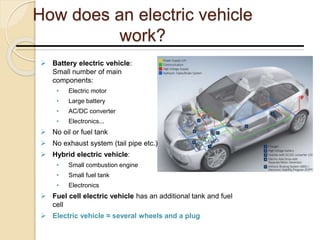
How does an electric vehicle
work?
 Battery electric vehicle:
Small number of main
components:
• Electric motor
• Large battery
• AC/DC converter
• Electronics...
 No oil or fuel tank
 No exhaust system (tail pipe etc.)
 Hybrid electric vehicle:
• Small combustion engine
• Small fuel tank
• Electronics
 Fuel cell electric vehicle has an additional tank and fuel
cell
 Electric vehicle ≈ several wheels and a plug
Electric Vehicles
 Electricity is unique among the alternative
fuels in that mechanical power is derived
directly from it, whereas the other alternative
fuels release stored chemical energy
through combustion to provide mechanical
power.
 Batteries commonly provide electricity used
to power vehicles, but fuel cells are also
being explored. Batteries are energy storage
devices, but unlike batteries, fuel cells
convert chemical energy to electricity.
 The maintenance costs for EVs is less-EVs
have fewer moving parts to service and 17
MECHANISM IMPLEMENTED
Controller
BLDC HUB Motor
Steering
Braking
CONTROLLER
 The electric vehicle controller is the
electronic package that operates
between the batteries and the motors
to control the vehicle’s speed and
acceleration.
 The controller transform dc from the
battery current into ac and regulates
the energy flow from the battery.
 The controller will also reverse the
motor rotation and convert the motor
into a generator
BLDC Hub MOTOr
 Brushless DC motor are more
synchronous motors that are powered by
a DC electric source via power supply
which produces an AC electric signal to
drive the motor.
 It produces higher efficiency and a lower
susceptibility to mechanical wear.
 It has several advantages including more
torque per weight, more torque per watt,
reduced noise, increased reliability and
longer lifetime.
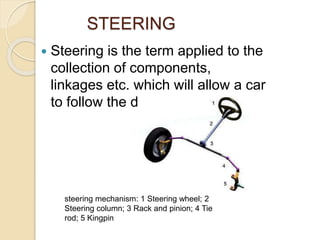
STEERING
 Steering is the term applied to the
collection of components,
linkages etc. which will allow a car
to follow the desired course.
steering mechanism: 1 Steering wheel; 2
Steering column; 3 Rack and pinion; 4 Tie
rod; 5 Kingpin
BRAKING
Four drum brakes(two rear and two
front) are the brakes planned to
assemble in the electric car.
 Rear brakes are to be engaged
using foot brake system
Front brakes are also to be
engaged using foot brake
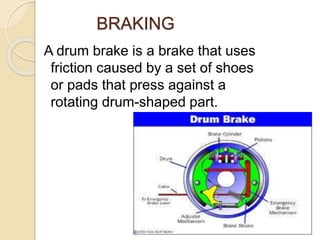
BRAKING
A drum brake is a brake that uses
friction caused by a set of shoes
or pads that press against a
rotating drum-shaped part.
PRACTICAL
DEVELOPMENT
The project is planned to complete in
4 stages
STAGE 1
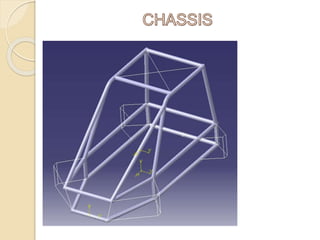
Chassis of our electric car will be the
modified chassis of electric car
brought in working condition.
STAGE 2
Then the steering mechanism along
with axle and wheel setup will be
installed.
PRACTICAL
DEVELOPMENT
STAGE 3
After this, motor, battery,
controller will be assembled to
function properly
STAGE 4
At the end brakes, light, seat and
other accessories will help to
accomplish our electric car
MATERIALS REQUIRED
 Mild steel rods
 Tyre
 Drum brake
 Steering
 BLDC motor
 Batteries
 Controller
 Seat
 Axle
 Head light
 Indicators
 Nuts and bolts
 Wheel hub
 Ignition key
 Throttles
 Electrical
Equipments
MATERIALS REQUIRED
 Battery
 Horn
 Connecting wires
 Pipe tubes
 Tool box
 Ignition Key Barrel
 Voltage Regulator
 CDI - Capacitor
discharge ignition
 Light and cut-out
switch
 Starter Motor
 Thermo fan
 Relay
 Tail light
 Brake oil
 Wiring accessories
 Other Accessories
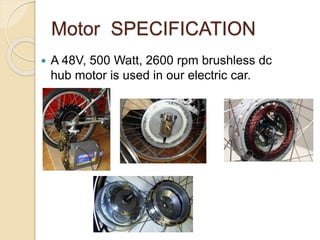
Motor SPECIFICATION
 A 48V, 500 Watt, 2600 rpm brushless dc
hub motor is used in our electric car.
SUSPENSION
SPECIFICATION
Suspension to be used are
Double wishbone Macpherson
suspension(front suspension)
SUSPENSION
SPECIFICATION
A -arm Macpherson suspension(rear
suspension)
OTHER
SPECIFICATIONS
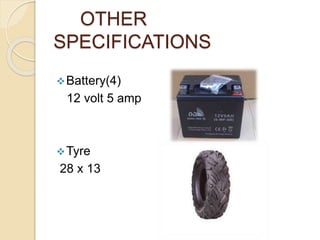
Battery(4)
12 volt 5 amp
Tyre
28 x 13
ESTIMATED COST AND
TIME
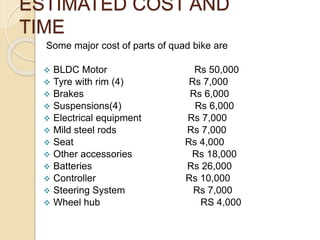
Some major cost of parts of quad bike are
 BLDC Motor Rs 50,000
 Tyre with rim (4) Rs 7,000
 Brakes Rs 6,000
 Suspensions(4) Rs 6,000
 Electrical equipment Rs 7,000
 Mild steel rods Rs 7,000
 Seat Rs 4,000
 Other accessories Rs 18,000
 Batteries Rs 26,000
 Controller Rs 10,000
 Steering System Rs 7,000
 Wheel hub RS 4,000
ESTIMATED COST AND
TIME
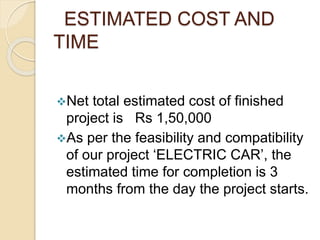
Net total estimated cost of finished
project is Rs 1,50,000
As per the feasibility and compatibility
of our project ‘ELECTRIC CAR’, the
estimated time for completion is 3
months from the day the project starts.
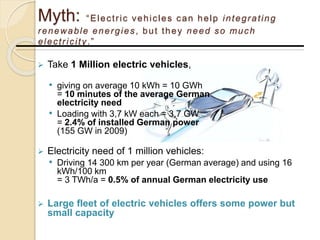
 Take 1 Million electric vehicles,
• giving on average 10 kWh = 10 GWh
= 10 minutes of the average German
electricity need
• Loading with 3,7 kW each = 3,7 GW
= 2.4% of installed German power
(155 GW in 2009)
 Electricity need of 1 million vehicles:
• Driving 14 300 km per year (German average) and using 16
kWh/100 km
= 3 TWh/a = 0.5% of annual German electricity use
 Large fleet of electric vehicles offers some power but
small capacity
Myth: “Electric vehicles can help integrating
renewable energies, but they need so much
electricity.”
Conclusion & Outlook
 Huge potential for the further emerging of electric
cars
 Although there are still problems, it is important to
push this technology  R&D
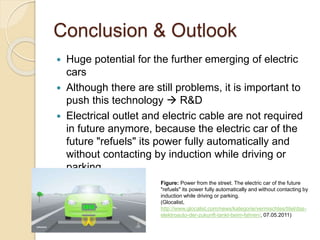
 Electrical outlet and electric cable are not required
in future anymore, because the electric car of the
future "refuels" its power fully automatically and
without contacting by induction while driving or
parking.
Figure: Power from the street. The electric car of the future
"refuels" its power fully automatically and without contacting by
induction while driving or parking.
(Glocalist,
http://www.glocalist.com/news/kategorie/vermischtes/titel/das-
elektroauto-der-zukunft-tankt-beim-fahren/, 07.05.2011)
Conclusions
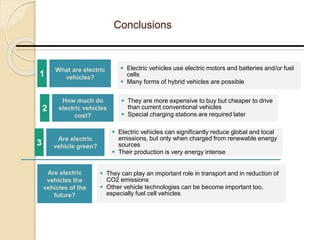
2
How much do
electric vehicles
cost?
 They are more expensive to buy but cheaper to drive
than current conventional vehicles
 Special charging stations are required later
3
Are electric
vehicle green?
 Electric vehicles can significantly reduce global and local
emissions, but only when charged from renewable energy
sources
 Their production is very energy intense
1
What are electric
vehicles?
 Electric vehicles use electric motors and batteries and/or fuel
cells
 Many forms of hybrid vehicles are possible
Are electric
vehicles the
vehicles of the
future?
 They can play an important role in transport and in reduction of
CO2 emissions
 Other vehicle technologies can be become important too,
especially fuel cell vehicles
sources
Sources from where equipments will be
purchased
Pal automobiles, Trinath mandir, Cuttack
Chhatra bazaar, Cuttack
Zobra lines ,Cuttack
Laxmisagar, Bhubaneswar
Hardware shop, near big bazaar,
Bhubaneswar
NS Power, Bhubaneswar
 http://www.getenergysmart.org/Files/HydrogenEducation/8Hydr
ogenProductionCoal.pdf
 www.getenergysmart.orgA/Files/HydrogenEducation/6Hy
drogenProductionSteamMethaneReforming.pdf
 http://www.getenergysmart.org/Files/HydrogenEducation/
5HydrogenProductionOverview.pdf
 http://www.getenergysmart.org/Files/HydrogenEducation/
7HydrogenProductionNuclear.pdf
 www.whitehouse.gov/news/releases/2006/01/20060131-
6.html
 http://archives.cnn.com/2001/TECH/science/03/16/hydrog
en.cars/
 http://www.fossil.energy.gov/programs/powersystems/ga
sification/howgasificationworks.html
 http://www.ca.sandia.gov/hydrogen/research/production/
electrolysis.html
 http://www.chewonkih2.org/docs/PEM%20vs%20Alkaline.
pdf
 http://www.princeton.edu/~benziger/PEMFC.pdf
sources

Electric car

  • 1.
  • 2.
    content  INTRODUCTION  Thefirst road vehicle achieving a speed of more than 100 km/h  Electric vehicles come in a broad variety  BENEFITS  Historical development of electric cars  When can we buy eletcric vehicles?  Economic aspects of e-cars  Electric vehicles produced in 2010  How does an electric vehicle work?  MECHANISM IMPLEMENTED  Conclusions
  • 3.
    INTRODUCTION ELECTRIC CAR  Anelectric car is an automobile that is propelled by one electric motor or more, using electrical energy stored in the batteries or another storage device. Electric motors give electric cars instant torque, creating strong and smooth acceleration.  The German Flocken Elektrowagen, built in 1888, was the world’s first electric car. Electric cars were also popular in the late 19th century and early 20th century.
  • 4.
    The first roadvehicle achieving a speed of more than 100 km/h The French electric vehicle La jamais contente with 105 km/h in 1899
  • 6.
    Electric vehicles comein a broad variety Plug-in hybrid passenger car Small electric vehicles Plug-in hybrid LDV Battery LDVs Elektroroller Sports cars Off-road duty vehicle
  • 8.
    Benefits of electriccars over internal combustion engines automobiles include a significant reduction of local air pollution, as they do not emit tailpipe pollutants, in many cases, a large reduction in total greenhouse gas and other emissions. Less dependency on foreign oil, which in several countries is cause for concern for vulnerability to oil price volatility and supply disruption. Electric vehicles show significant reductions in overall well-wheel global carbon emissions due to highly carbon intensive production in mining, pumping, refining and the efficiencies obtained with gasoline. BENEFITs
  • 9.
    Historical development ofelectric cars Early Years of Electric Cars: 1890 - 1930  First electric vehicle invented in 1828  Many innovations followed  The interest in electric cars increased greatly in the late 1890s and early 1900s  First real and practical electric car (with capacity for passengers) designed by William Morrison  1902 Phaeton built by the Woods Motor Vehicle Company of Chicago
  • 10.
    Historical development ofelectric cars Decline of Electric Cars: 1930 – 1990  The electric car declined in popularity because of the following reasons: ◦ Better system of roads  need for longer- range vehicles ◦ Reduction in price of gasoline  gasoline was affordable to the average consumer ◦ Invention of the electric starter disposed of the need for the hand crank. ◦ Initiation of mass production of internal combustion engine vehicles by Henry Ford.
  • 11.
    Historical development ofelectric cars  The mid-1930s until the 1960s: dead years for electric vehicle development and for their application as personal transportation  In the 1960s and 1970s: imperative necessity for alternative-fueled vehicles  renewed interest on electric vehicles  The first electric truck, the Battronic Truck, constructed in the early 1960s.  The companies Sebring-Vanguard and Elcar Corporation = leaders in the electric car production
  • 12.
    Historical development ofelectric cars The Revival: 1990s  Efforts by the governments to more stringent air emissions requirements and regulations requiring reductions in gasoline use and Zero Emission Vehicle requirements from several states  revival  Electric conversions of familiar gasoline powered vehicles as well as electric vehicles designed from the ground up became available (reached highway speeds with ranges of 50 to 150 miles between recharging)  Since 2001: Phoenix designs fully functional electric trucks and Sport Utility Vehicle for commercial fleet use
  • 13.
    Alternative fuel vehiclesalready available or announced for 2011 – 2014 by major manufacturers in the German market When can we buy eletcric vehicles? Manufacturer Hybrid Gas- hybrid Plug-in Hybrid Battery electric Fuel cell vehicle Total MERCEDES 5 1 4 1 11 TOYOTA 3 1 2 3 9 VW 3 5 8 RENAULT 7 7 BMW 3 1 2 6 HYUNDAI 1 1 1 1 4 CITROEN 2 1 3 PEUGEOT 1 2 3 AUDI 1 2 3 NISSAN 2 1 3 Total 20 2 5 29 2 57 Simple hybrids already available Only some plug-in hybrids announced Many battery electric vehicles underway
  • 14.
    A few manufacturersare already producing electric vehicles Electric vehicles produced in 2010  Numbers are really tiny compared to world vehicle production of 78 million units in 2010
  • 15.
    Economic aspects ofe-cars car The electric propulsion: efficiency = about 90%  Electric propulsion is principally as "clean" as the energy source  A photovoltaics-carport (solar service station) considered as a charging station of electric cars for the future
  • 16.
    How does anelectric vehicle work?  Battery electric vehicle: Small number of main components: • Electric motor • Large battery • AC/DC converter • Electronics...  No oil or fuel tank  No exhaust system (tail pipe etc.)  Hybrid electric vehicle: • Small combustion engine • Small fuel tank • Electronics  Fuel cell electric vehicle has an additional tank and fuel cell  Electric vehicle ≈ several wheels and a plug
  • 17.
    Electric Vehicles  Electricityis unique among the alternative fuels in that mechanical power is derived directly from it, whereas the other alternative fuels release stored chemical energy through combustion to provide mechanical power.  Batteries commonly provide electricity used to power vehicles, but fuel cells are also being explored. Batteries are energy storage devices, but unlike batteries, fuel cells convert chemical energy to electricity.  The maintenance costs for EVs is less-EVs have fewer moving parts to service and 17
  • 18.
  • 19.
    CONTROLLER  The electricvehicle controller is the electronic package that operates between the batteries and the motors to control the vehicle’s speed and acceleration.  The controller transform dc from the battery current into ac and regulates the energy flow from the battery.  The controller will also reverse the motor rotation and convert the motor into a generator
  • 20.
    BLDC Hub MOTOr Brushless DC motor are more synchronous motors that are powered by a DC electric source via power supply which produces an AC electric signal to drive the motor.  It produces higher efficiency and a lower susceptibility to mechanical wear.  It has several advantages including more torque per weight, more torque per watt, reduced noise, increased reliability and longer lifetime.
  • 21.
    STEERING  Steering isthe term applied to the collection of components, linkages etc. which will allow a car to follow the desired course. steering mechanism: 1 Steering wheel; 2 Steering column; 3 Rack and pinion; 4 Tie rod; 5 Kingpin
  • 22.
    BRAKING Four drum brakes(tworear and two front) are the brakes planned to assemble in the electric car.  Rear brakes are to be engaged using foot brake system Front brakes are also to be engaged using foot brake
  • 23.
    BRAKING A drum brakeis a brake that uses friction caused by a set of shoes or pads that press against a rotating drum-shaped part.
  • 24.
    PRACTICAL DEVELOPMENT The project isplanned to complete in 4 stages STAGE 1 Chassis of our electric car will be the modified chassis of electric car brought in working condition. STAGE 2 Then the steering mechanism along with axle and wheel setup will be installed.
  • 25.
    PRACTICAL DEVELOPMENT STAGE 3 After this,motor, battery, controller will be assembled to function properly STAGE 4 At the end brakes, light, seat and other accessories will help to accomplish our electric car
  • 26.
    MATERIALS REQUIRED  Mildsteel rods  Tyre  Drum brake  Steering  BLDC motor  Batteries  Controller  Seat  Axle  Head light  Indicators  Nuts and bolts  Wheel hub  Ignition key  Throttles  Electrical Equipments
  • 27.
    MATERIALS REQUIRED  Battery Horn  Connecting wires  Pipe tubes  Tool box  Ignition Key Barrel  Voltage Regulator  CDI - Capacitor discharge ignition  Light and cut-out switch  Starter Motor  Thermo fan  Relay  Tail light  Brake oil  Wiring accessories  Other Accessories
  • 28.
    Motor SPECIFICATION  A48V, 500 Watt, 2600 rpm brushless dc hub motor is used in our electric car.
  • 30.
    SUSPENSION SPECIFICATION Suspension to beused are Double wishbone Macpherson suspension(front suspension)
  • 31.
  • 32.
  • 33.
    ESTIMATED COST AND TIME Somemajor cost of parts of quad bike are  BLDC Motor Rs 50,000  Tyre with rim (4) Rs 7,000  Brakes Rs 6,000  Suspensions(4) Rs 6,000  Electrical equipment Rs 7,000  Mild steel rods Rs 7,000  Seat Rs 4,000  Other accessories Rs 18,000  Batteries Rs 26,000  Controller Rs 10,000  Steering System Rs 7,000  Wheel hub RS 4,000
  • 34.
    ESTIMATED COST AND TIME Nettotal estimated cost of finished project is Rs 1,50,000 As per the feasibility and compatibility of our project ‘ELECTRIC CAR’, the estimated time for completion is 3 months from the day the project starts.
  • 35.
     Take 1Million electric vehicles, • giving on average 10 kWh = 10 GWh = 10 minutes of the average German electricity need • Loading with 3,7 kW each = 3,7 GW = 2.4% of installed German power (155 GW in 2009)  Electricity need of 1 million vehicles: • Driving 14 300 km per year (German average) and using 16 kWh/100 km = 3 TWh/a = 0.5% of annual German electricity use  Large fleet of electric vehicles offers some power but small capacity Myth: “Electric vehicles can help integrating renewable energies, but they need so much electricity.”
  • 36.
    Conclusion & Outlook Huge potential for the further emerging of electric cars  Although there are still problems, it is important to push this technology  R&D  Electrical outlet and electric cable are not required in future anymore, because the electric car of the future "refuels" its power fully automatically and without contacting by induction while driving or parking. Figure: Power from the street. The electric car of the future "refuels" its power fully automatically and without contacting by induction while driving or parking. (Glocalist, http://www.glocalist.com/news/kategorie/vermischtes/titel/das- elektroauto-der-zukunft-tankt-beim-fahren/, 07.05.2011)
  • 37.
    Conclusions 2 How much do electricvehicles cost?  They are more expensive to buy but cheaper to drive than current conventional vehicles  Special charging stations are required later 3 Are electric vehicle green?  Electric vehicles can significantly reduce global and local emissions, but only when charged from renewable energy sources  Their production is very energy intense 1 What are electric vehicles?  Electric vehicles use electric motors and batteries and/or fuel cells  Many forms of hybrid vehicles are possible Are electric vehicles the vehicles of the future?  They can play an important role in transport and in reduction of CO2 emissions  Other vehicle technologies can be become important too, especially fuel cell vehicles
  • 38.
    sources Sources from whereequipments will be purchased Pal automobiles, Trinath mandir, Cuttack Chhatra bazaar, Cuttack Zobra lines ,Cuttack Laxmisagar, Bhubaneswar Hardware shop, near big bazaar, Bhubaneswar NS Power, Bhubaneswar
  • 39.
     http://www.getenergysmart.org/Files/HydrogenEducation/8Hydr ogenProductionCoal.pdf  www.getenergysmart.orgA/Files/HydrogenEducation/6Hy drogenProductionSteamMethaneReforming.pdf http://www.getenergysmart.org/Files/HydrogenEducation/ 5HydrogenProductionOverview.pdf  http://www.getenergysmart.org/Files/HydrogenEducation/ 7HydrogenProductionNuclear.pdf  www.whitehouse.gov/news/releases/2006/01/20060131- 6.html  http://archives.cnn.com/2001/TECH/science/03/16/hydrog en.cars/  http://www.fossil.energy.gov/programs/powersystems/ga sification/howgasificationworks.html  http://www.ca.sandia.gov/hydrogen/research/production/ electrolysis.html  http://www.chewonkih2.org/docs/PEM%20vs%20Alkaline. pdf  http://www.princeton.edu/~benziger/PEMFC.pdf sources