UNIT - 5
ELECTRIC AND
HYBRID VEHICLES
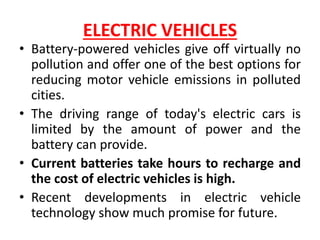
ELECTRIC VEHICLES
• Battery-powered vehicles give off virtually no
pollution and offer one of the best options for
reducing motor vehicle emissions in polluted
cities.
• The driving range of today's electric cars is
limited by the amount of power and the
battery can provide.
• Current batteries take hours to recharge and
the cost of electric vehicles is high.
• Recent developments in electric vehicle
technology show much promise for future.
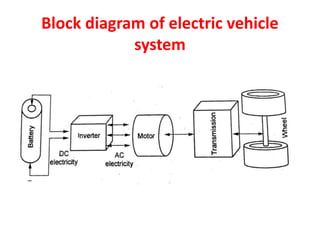
Block diagram of electric vehicle
system
BATTERIES
• The batteries are essential and important part
of the EV system. Batteries replace IC engine
of the vehicle.
(i) Lead-Acid batteries:
• Lead-acid batteries can be designed to be high
power, inexpensive, safe and reliable. But low
specific energy, poor cold temperature
performance and short calendar and cycle life
are still barriers to their use.
(ii) Nickel-cadmium batteries:
• Although nickel-cadmium batteries used in many
electronic consumer products have high specific energy
and better life cycle than lead-acid batteries, they do
not deliver sufficient power and they are not being
considered for EV applications.
(iii) Nickel-metal hydride batteries:
• Nickel-metal hydride batteries have a much longer life
cycle than lead acid batteries and they are safe and
abuse-tolerant. These batteries have been used
successfully in producing electric vehicles. The main
challenges with nickel-metal hydride batteries are their
high cost high self-discharge and heat generation at
high temperatures, need to control losses of hydrogen
and low cell efficiency
(iv) Lithium ion batteries
• The lithium ion batteries have high specific power, high-
energy efficiency, good high temperature performance and
low self-discharge. Components of lithium-ion batteries
could also be recycled. These characteristics make lithium
ion batteries suitable for EV applications. However, further
development is needed in improvement of calendar and
cycle life, higher degree of cell and battery safety, abuse
tolerance and acceptable cost.
(v) Lithium polymer batteries:
• Lithium polymer batteries with high specific energy initially
developed for EV applications also love the potential to
provide high specific power for EV applications. The other
key characteristics of the lithium polymer are safety, good
cycle and calendar life. The battery could be commercially
viable if the cost is lowered and increased specific power
batteries are developed.
BATTERY CHARGER
Batteries are replenished by the battery chargers.
The battery charger converts AC power available
on our electricity network to DC power stored in
a battery.
It controls the voltage level of the battery cells by
adjusting the rate of charge.
It will also monitor the cell temperatures and
control the charge to keep the battery healthy.
Some EVs have on-board chargers whereas others
plug into a charger located outside the vehicle.
Electric motors
The core element of the EV, apart from
batteries, is an electric motor.
The electric motors used for automotive
applications should have characteristics such
as high starting torque, high power density,
good efficiency, etc.
Brushless DC Motors (BLDC)
These motors have traction characteristics
such as high starting torque, high efficiency
around 95-98%, etc.
They are suitable for high power density
design approach.
Therefore, they are the most preferred motors
for the electric vehicle application due to its
traction characteristics.
The main drawback is high cost due to
permanent magnets.
Permanent Magnet Synchronous
Motor (PMSM)
This motor is also similar to BLDC motor and it has
traction characteristics such as high-power density and
high efficiency.
The difference is that PMSM has sinusoidal back EMP
PMSM is the best choice for high performance
applications like cars, buses as it is available with
higher power ratings.
Most of the automotive manufacturers use PMSM
motors for their hybrid and electric vehicles.
For example, Toyota Prius, Chevrolet Bolt EV, Ford
Focus Electric, Honda Accord, BMW i3, etc. use PMSM
motor for propulsion.
Three Phase AC Induction Motors
The induction motors do not have high starting
toque similar to DC series motors.
But this characteristic can be altered by using
various control techniques and the maximum
torque is made available at the starting of the
motor.
Induction motors are the preferred choice for
performance oriented electric vehicles due to its
cheap cost.
Mahindra Reva e20 uses a three phase induction
motor for its propulsion
Inverter
Inverter is a device that converts DC power to
AC power used in an electric vehicle motor.
The inverter can change the speed at which
the motor rotates by adjusting the frequency
of the alternating current.
It can also increase or decrease the power or
torque of the motor by adjusting the
amplitude of the signal.
Controller
The controller is like the brain of a vehicle,
managing all of its parameters.
It controls the rate of charge using
information from the battery.
It also translates pressure on the accelerator
pedal to adjust the speed in the motor
inverter.
Working principle of EVs
The inverter (power electronic) takes direct
current (DC) electricity from battery and
converts it to alternating current (AC)
electricity and sends it to the motor.
The electric motor (electric machine) uses AC
current to create torque (mechanical power)
to power the wheels for propulsion.
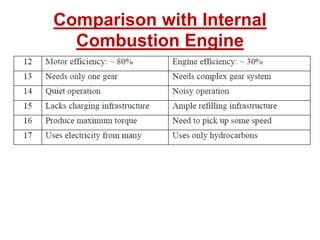
Comparison with Internal
Combustion Engine
Comparison with Internal
Combustion Engine
Advantages or Merits of
Electric Vehicles
• There is no pollution due to
emission. i.e., zero emission.
• It ensures smooth operation. i.e.,
vibration and noise is less.
• Cost of operation is less.
• Less maintenance is required.
• It is easy to start the vehicle.
• It takes up less space on the road.
So, they help to reduce traffic
congestion.
Limitations of Electric
Vehicles
• 1. It has less initial torque.
• 2. It is more expensive.
• 3. Frequent recharging of
battery is needed and also
battery charging needs
moretime.
• 4. The performance is poor.
• 5. Less variety of vehicles is
available in the market.
HYBRID VEHICLES
The word hybrid means,
something is mixed together
from two things.
Hybrid electric vehicles (HEVs)
typically combine IC engine of a
conventional vehicle with the
battery and electric motor of an
electric vehicle.
The combination offers low
emissions, power, range and
convenient fueling of
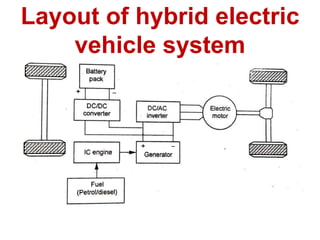
Layout of hybrid electric
vehicle system
Working principle of hybrid
vehicles
Hybrid electric vehicles are powered by an
internal combustion engine and one or more
electric motors, which uses energy stored in
batteries.
A hybrid electric vehicle cannot be plugged in
to charge the battery.
Instead, the battery is charged through
regenerative braking and by the internal
combustion engine.
HEVs typically consist of an electrical storage
device, such as a battery, flywheel, or an
ultracapacitor.
They also combine this energy storage source
with a mechanical device, like an internal-
combustion engine (ICE), gas turbine, or a fuel
cell.
This combination reduces both fuel
consumption and tailpipe emissions.
4 different types of Parallel hybrid
vehicles
Understanding Hybrid Vehicles: The 4 Main Types
1. Mild Hybrids. One of the newest innovations in
hybrid technology is that of a “mild” hybrid
system
2. Full Hybrids
3. Plug-In Hybrids
4. Electric Vehicles with Range Extender Hybrids.
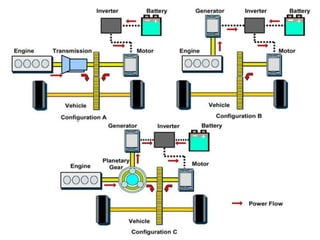
Two types of hybrid configurations
are considered:
(A) parallel;
(B) series; and
(C) power-split (parallel/series).
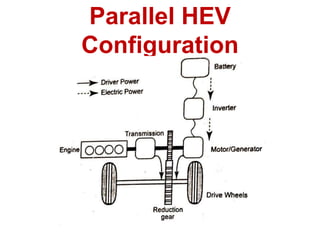
Parallel HEV
Configuration
Parallel HEV Configuration
• The vehicle can be powered by the gasoline
engine working alone, the electric motor by
itself, or by both energy converters working
together.
• Power distribution between the engine and
motor is designed so that the engine can run
in its optimum operating range as much as
possible.
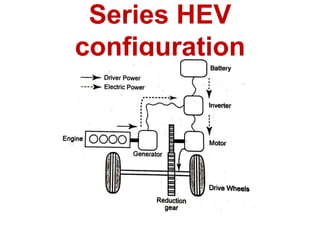
Series HEV
configuration
Series HEV
configuration
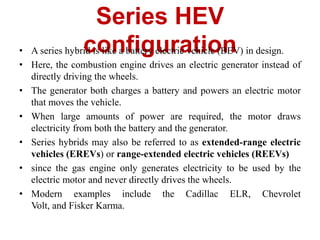
• A series hybrid is like a battery electric vehicle (BEV) in design.
• Here, the combustion engine drives an electric generator instead of
directly driving the wheels.
• The generator both charges a battery and powers an electric motor
that moves the vehicle.
• When large amounts of power are required, the motor draws
electricity from both the battery and the generator.
• Series hybrids may also be referred to as extended-range electric
vehicles (EREVs) or range-extended electric vehicles (REEVs)
• since the gas engine only generates electricity to be used by the
electric motor and never directly drives the wheels.
• Modern examples include the Cadillac ELR, Chevrolet
Volt, and Fisker Karma.
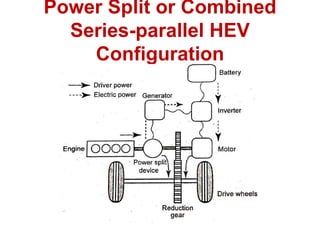
Power Split or Combined
Series-parallel HEV
Configuration
Power Split or Combined Series-
parallel HEV Configuration
• The vehicle can be powered by the gasoline
engine working alone, the electric motor by
itself, or by both energy converters working
together.
• Power distribution between the engine and
motor is designed so that the engine can run
in its optimum operating range as much as
possible.
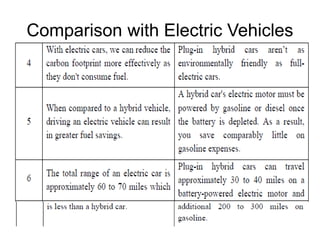
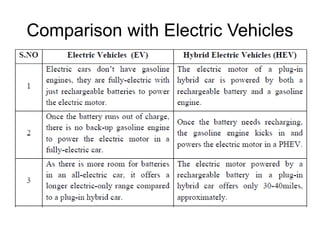
Comparison with Electric Vehicles
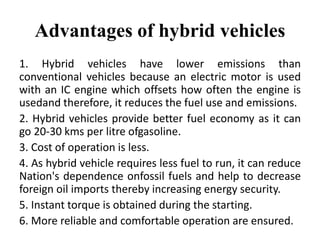
Advantages of hybrid vehicles
1. Hybrid vehicles have lower emissions than
conventional vehicles because an electric motor is used
with an IC engine which offsets how often the engine is
usedand therefore, it reduces the fuel use and emissions.
2. Hybrid vehicles provide better fuel economy as it can
go 20-30 kms per litre ofgasoline.
3. Cost of operation is less.
4. As hybrid vehicle requires less fuel to run, it can reduce
Nation's dependence onfossil fuels and help to decrease
foreign oil imports thereby increasing energy security.
5. Instant torque is obtained during the starting.
6. More reliable and comfortable operation are ensured.
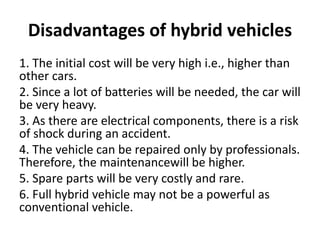
Disadvantages of hybrid vehicles
1. The initial cost will be very high i.e., higher than
other cars.
2. Since a lot of batteries will be needed, the car will
be very heavy.
3. As there are electrical components, there is a risk
of shock during an accident.
4. The vehicle can be repaired only by professionals.
Therefore, the maintenancewill be higher.
5. Spare parts will be very costly and rare.
6. Full hybrid vehicle may not be a powerful as
conventional vehicle.
Thank
you

UNIT-V-ELECTRIC AND HYBRID VEHICLES.pptx

  • 1.
    UNIT - 5 ELECTRICAND HYBRID VEHICLES
  • 2.
    ELECTRIC VEHICLES • Battery-poweredvehicles give off virtually no pollution and offer one of the best options for reducing motor vehicle emissions in polluted cities. • The driving range of today's electric cars is limited by the amount of power and the battery can provide. • Current batteries take hours to recharge and the cost of electric vehicles is high. • Recent developments in electric vehicle technology show much promise for future.
  • 3.
    Block diagram ofelectric vehicle system
  • 4.
    BATTERIES • The batteriesare essential and important part of the EV system. Batteries replace IC engine of the vehicle. (i) Lead-Acid batteries: • Lead-acid batteries can be designed to be high power, inexpensive, safe and reliable. But low specific energy, poor cold temperature performance and short calendar and cycle life are still barriers to their use.
  • 5.
    (ii) Nickel-cadmium batteries: •Although nickel-cadmium batteries used in many electronic consumer products have high specific energy and better life cycle than lead-acid batteries, they do not deliver sufficient power and they are not being considered for EV applications. (iii) Nickel-metal hydride batteries: • Nickel-metal hydride batteries have a much longer life cycle than lead acid batteries and they are safe and abuse-tolerant. These batteries have been used successfully in producing electric vehicles. The main challenges with nickel-metal hydride batteries are their high cost high self-discharge and heat generation at high temperatures, need to control losses of hydrogen and low cell efficiency
  • 6.
    (iv) Lithium ionbatteries • The lithium ion batteries have high specific power, high- energy efficiency, good high temperature performance and low self-discharge. Components of lithium-ion batteries could also be recycled. These characteristics make lithium ion batteries suitable for EV applications. However, further development is needed in improvement of calendar and cycle life, higher degree of cell and battery safety, abuse tolerance and acceptable cost. (v) Lithium polymer batteries: • Lithium polymer batteries with high specific energy initially developed for EV applications also love the potential to provide high specific power for EV applications. The other key characteristics of the lithium polymer are safety, good cycle and calendar life. The battery could be commercially viable if the cost is lowered and increased specific power batteries are developed.
  • 7.
    BATTERY CHARGER Batteries arereplenished by the battery chargers. The battery charger converts AC power available on our electricity network to DC power stored in a battery. It controls the voltage level of the battery cells by adjusting the rate of charge. It will also monitor the cell temperatures and control the charge to keep the battery healthy. Some EVs have on-board chargers whereas others plug into a charger located outside the vehicle.
  • 8.
    Electric motors The coreelement of the EV, apart from batteries, is an electric motor. The electric motors used for automotive applications should have characteristics such as high starting torque, high power density, good efficiency, etc.
  • 9.
    Brushless DC Motors(BLDC) These motors have traction characteristics such as high starting torque, high efficiency around 95-98%, etc. They are suitable for high power density design approach. Therefore, they are the most preferred motors for the electric vehicle application due to its traction characteristics. The main drawback is high cost due to permanent magnets.
  • 10.
    Permanent Magnet Synchronous Motor(PMSM) This motor is also similar to BLDC motor and it has traction characteristics such as high-power density and high efficiency. The difference is that PMSM has sinusoidal back EMP PMSM is the best choice for high performance applications like cars, buses as it is available with higher power ratings. Most of the automotive manufacturers use PMSM motors for their hybrid and electric vehicles. For example, Toyota Prius, Chevrolet Bolt EV, Ford Focus Electric, Honda Accord, BMW i3, etc. use PMSM motor for propulsion.
  • 11.
    Three Phase ACInduction Motors The induction motors do not have high starting toque similar to DC series motors. But this characteristic can be altered by using various control techniques and the maximum torque is made available at the starting of the motor. Induction motors are the preferred choice for performance oriented electric vehicles due to its cheap cost. Mahindra Reva e20 uses a three phase induction motor for its propulsion
  • 12.
    Inverter Inverter is adevice that converts DC power to AC power used in an electric vehicle motor. The inverter can change the speed at which the motor rotates by adjusting the frequency of the alternating current. It can also increase or decrease the power or torque of the motor by adjusting the amplitude of the signal.
  • 13.
    Controller The controller islike the brain of a vehicle, managing all of its parameters. It controls the rate of charge using information from the battery. It also translates pressure on the accelerator pedal to adjust the speed in the motor inverter.
  • 14.
    Working principle ofEVs The inverter (power electronic) takes direct current (DC) electricity from battery and converts it to alternating current (AC) electricity and sends it to the motor. The electric motor (electric machine) uses AC current to create torque (mechanical power) to power the wheels for propulsion.
  • 15.
  • 16.
  • 17.
    Advantages or Meritsof Electric Vehicles • There is no pollution due to emission. i.e., zero emission. • It ensures smooth operation. i.e., vibration and noise is less. • Cost of operation is less. • Less maintenance is required. • It is easy to start the vehicle. • It takes up less space on the road. So, they help to reduce traffic congestion.
  • 18.
    Limitations of Electric Vehicles •1. It has less initial torque. • 2. It is more expensive. • 3. Frequent recharging of battery is needed and also battery charging needs moretime. • 4. The performance is poor. • 5. Less variety of vehicles is available in the market.
  • 19.
    HYBRID VEHICLES The wordhybrid means, something is mixed together from two things. Hybrid electric vehicles (HEVs) typically combine IC engine of a conventional vehicle with the battery and electric motor of an electric vehicle. The combination offers low emissions, power, range and convenient fueling of
  • 20.
    Layout of hybridelectric vehicle system
  • 21.
    Working principle ofhybrid vehicles Hybrid electric vehicles are powered by an internal combustion engine and one or more electric motors, which uses energy stored in batteries. A hybrid electric vehicle cannot be plugged in to charge the battery. Instead, the battery is charged through regenerative braking and by the internal combustion engine.

  • 22.
    HEVs typically consistof an electrical storage device, such as a battery, flywheel, or an ultracapacitor. They also combine this energy storage source with a mechanical device, like an internal- combustion engine (ICE), gas turbine, or a fuel cell. This combination reduces both fuel consumption and tailpipe emissions.
  • 23.
    4 different typesof Parallel hybrid vehicles Understanding Hybrid Vehicles: The 4 Main Types 1. Mild Hybrids. One of the newest innovations in hybrid technology is that of a “mild” hybrid system 2. Full Hybrids 3. Plug-In Hybrids 4. Electric Vehicles with Range Extender Hybrids.
  • 24.
    Two types ofhybrid configurations are considered: (A) parallel; (B) series; and (C) power-split (parallel/series).
  • 26.
  • 27.
    Parallel HEV Configuration •The vehicle can be powered by the gasoline engine working alone, the electric motor by itself, or by both energy converters working together. • Power distribution between the engine and motor is designed so that the engine can run in its optimum operating range as much as possible.
  • 28.
  • 29.
    Series HEV configuration • Aseries hybrid is like a battery electric vehicle (BEV) in design. • Here, the combustion engine drives an electric generator instead of directly driving the wheels. • The generator both charges a battery and powers an electric motor that moves the vehicle. • When large amounts of power are required, the motor draws electricity from both the battery and the generator. • Series hybrids may also be referred to as extended-range electric vehicles (EREVs) or range-extended electric vehicles (REEVs) • since the gas engine only generates electricity to be used by the electric motor and never directly drives the wheels. • Modern examples include the Cadillac ELR, Chevrolet Volt, and Fisker Karma.
  • 30.
    Power Split orCombined Series-parallel HEV Configuration
  • 31.
    Power Split orCombined Series- parallel HEV Configuration • The vehicle can be powered by the gasoline engine working alone, the electric motor by itself, or by both energy converters working together. • Power distribution between the engine and motor is designed so that the engine can run in its optimum operating range as much as possible.
  • 32.
  • 33.
  • 34.
    Advantages of hybridvehicles 1. Hybrid vehicles have lower emissions than conventional vehicles because an electric motor is used with an IC engine which offsets how often the engine is usedand therefore, it reduces the fuel use and emissions. 2. Hybrid vehicles provide better fuel economy as it can go 20-30 kms per litre ofgasoline. 3. Cost of operation is less. 4. As hybrid vehicle requires less fuel to run, it can reduce Nation's dependence onfossil fuels and help to decrease foreign oil imports thereby increasing energy security. 5. Instant torque is obtained during the starting. 6. More reliable and comfortable operation are ensured.
  • 35.
    Disadvantages of hybridvehicles 1. The initial cost will be very high i.e., higher than other cars. 2. Since a lot of batteries will be needed, the car will be very heavy. 3. As there are electrical components, there is a risk of shock during an accident. 4. The vehicle can be repaired only by professionals. Therefore, the maintenancewill be higher. 5. Spare parts will be very costly and rare. 6. Full hybrid vehicle may not be a powerful as conventional vehicle.
  • 36.