TECHNOINDIA, SALTLAKE
DEPARTMENT OF ELECTRICAL ENGINEERING
ELECTRICAL MACHINE-II [EE-501]
SUBMITTED BY:
• SPANDAN PAUL (ROLL: 13001616037)
• SOURADEEP MULLICK (ROLL: 13001616038)
• SIDDHARTHA BASU (ROLL: 13001616042)
• SHAKYA ACHARYA (ROLL: 13001616046)
• SAYANTAN KUMAR CHATTOPADHYAY (ROLL: 13001616047)
• SAYAN SARKAR (ROLL:13001616049)
PRESENTATION
ON
SINGLE PHASE
COMPENSATED MOTOR
 INTRODUCTION
 COMMUTATION IN AC MACHINE
 COMPENSATION IN AC MACHINE
 COMPENSATED AC SERIES MOTOR
 UNIVERSAL COMPENSATED MOTOR
 REPULSION MOTOR
 ADVANTAGES
 CONCLUSION
INTRODUCTION
Historically, heavy duty commutator motors are known to
cause problems like brush sparking, chatter, excessive wear
or chipping overtime. To address this, modern AC
commutator motors use an auxiliary structure called
Compensated Winding.
Compensated winding is embedded in the pole faces of a
commutating alternating-current machine and connected in
series with the armature, the magnetic field of
the winding neutralizing the cross-magnetizing field of
armature reaction.
The resultant motor was found to have significantly lower
stator field distortion. In case of series motors, the stability
of the motor is also benefited on sudden load shifts. Further
improvements on the power factor of the motor can be done
by adjusting the field reactance or decreasing the ampere
turns of the field winding.
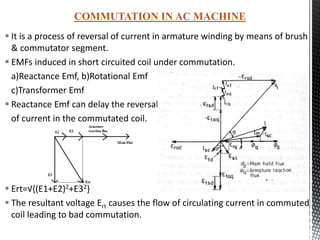
 It is a process of reversal of current in armature winding by means of brush
& commutator segment.
 EMFs induced in short circuited coil under commutation.
a)Reactance Emf, b)Rotational Emf
c)Transformer Emf
 Reactance Emf can delay the reversal
of current in the commutated coil.
 Ert=√{(E1+E2)2+E32}
 The resultant voltage Ert causes the flow of circulating current in commuted
coil leading to bad commutation.
COMMUTATION IN AC MACHINE
COMPENSATION IN AC MACHINE
 Compensation required for- a) better p.f, b) better speed torque
characteristics, c)improved commutation
 The low p.f. in uncompensated motor is due to the presence of
transformer emf(Etaq) caused by armature reaction flux.
 This emf can be reduced or eliminated by means of a
compensating winding suitably distributed in the stator slots.
 The compensating winding ATs neutralise the armature reaction
mmf completely, then armature reaction flux will be 0, and Etaq is
eliminated resulting in improved pf.
COMPENSATED AC SERIES MOTOR
AC series motors are also known as the modified DC series motor as
their construction is very similar to that of the DC series motor except
their poles and yokes are thinly laminated for better magnetic properties.
Compensation is necessary because:
 Increase in power factor;
 Improve commutation;
 High speed-torque characteristics.
On the basis of the usage of compensating winding we have two types of
motor and they are written below:
1. Conductively compensated type of motors.
2. Inductively compensated type of motors.
Conductively Compensated Type
of Motors
Inductively Compensated Type of
Motors
In this type of motor, the
compensating winding is
connected in series with the
armature circuit. The winding is
put in the stator slots. The axis of
the compensating winding is 90o
(electrical) with main field axis.
In this type of motor, the
compensating winding has no
interconnection with the armature
circuit of the motor . A
transformer action will take place
as the armature winding will act as
primary winding of the
transformer and the
compensation winding will acts as
a secondary winding. The current
in the compensating winding will
be in phase opposition to the
current in the armature winding.
UNIVERSALCOMPENSATEDMOTOR
The universal motor is a type of electric
motor that can operate on either AC or DC
power and uses an electromagnet as its stator
to create its magnetic field . It is
a commutated series-wound motor where
the stator's field coils are connected in series
with the rotor windings through a commutator.
Not all series wound motors
operate well on AC current . If
an ordinary series wound DC
motor were connected to an AC
supply, it would run very poorly.
The universal motor is modified
in several ways to allow for
proper AC supply operation.
There is a compensating
winding typically added, along
with laminated pole pieces, as
opposed to the solid pole pieces
found in DC motors . A
universal motor's armature
typically has far more coils and
plates than a DC motor, and
hence fewer windings per coil.
This reduces the inductance.
REPULSION MOTOR
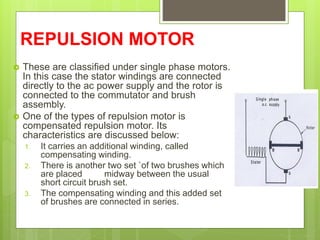
 These are classified under single phase motors.
In this case the stator windings are connected
directly to the ac power supply and the rotor is
connected to the commutator and brush
assembly.
 One of the types of repulsion motor is
compensated repulsion motor. Its
characteristics are discussed below:
1. It carries an additional winding, called
compensating winding.
2. There is another two set `of two brushes which
are placed midway between the usual
short circuit brush set.
3. The compensating winding and this added set
of brushes are connected in series.
ADVANTAGES
 High speed-torque characteristics.
 Improve commutation.
 Increase in power factor.
DISADVANTAGES
 Compensated motors on occasion, have been known to run slow,
overheat, or even fail to start.
 Cost and maintenance of these types of motor is very high.
CONCLUSION
The study of standard single phase compensated motors reveal a general
increase in efficiency and longevity of the magnetic parts of motors due to
substantial
decrease in the cross-magnetizing field due to armature reaction. This is
particularly prominent in the case of heavy duty induction motors, where power
ratings exceed 200KW or more (e.g, traction motors, Class C & Class D motors
used in industries).
Practical use suggests that compensated motors provide higher starting
torque and improved power factor for longer use.
The only prominent drawback of using compensated motors is their
significant increment in running costs and maintainance, which is pretty petty
against the advantages offered; hence it can be concluded that modern industries
and heavy appliances demand the use of compensated motors.
THANK YOU

Single phase compensated motor

  • 1.
    TECHNOINDIA, SALTLAKE DEPARTMENT OFELECTRICAL ENGINEERING ELECTRICAL MACHINE-II [EE-501] SUBMITTED BY: • SPANDAN PAUL (ROLL: 13001616037) • SOURADEEP MULLICK (ROLL: 13001616038) • SIDDHARTHA BASU (ROLL: 13001616042) • SHAKYA ACHARYA (ROLL: 13001616046) • SAYANTAN KUMAR CHATTOPADHYAY (ROLL: 13001616047) • SAYAN SARKAR (ROLL:13001616049)
  • 2.
  • 3.
     INTRODUCTION  COMMUTATIONIN AC MACHINE  COMPENSATION IN AC MACHINE  COMPENSATED AC SERIES MOTOR  UNIVERSAL COMPENSATED MOTOR  REPULSION MOTOR  ADVANTAGES  CONCLUSION
  • 4.
    INTRODUCTION Historically, heavy dutycommutator motors are known to cause problems like brush sparking, chatter, excessive wear or chipping overtime. To address this, modern AC commutator motors use an auxiliary structure called Compensated Winding. Compensated winding is embedded in the pole faces of a commutating alternating-current machine and connected in series with the armature, the magnetic field of the winding neutralizing the cross-magnetizing field of armature reaction. The resultant motor was found to have significantly lower stator field distortion. In case of series motors, the stability of the motor is also benefited on sudden load shifts. Further improvements on the power factor of the motor can be done by adjusting the field reactance or decreasing the ampere turns of the field winding.
  • 5.
     It isa process of reversal of current in armature winding by means of brush & commutator segment.  EMFs induced in short circuited coil under commutation. a)Reactance Emf, b)Rotational Emf c)Transformer Emf  Reactance Emf can delay the reversal of current in the commutated coil.  Ert=√{(E1+E2)2+E32}  The resultant voltage Ert causes the flow of circulating current in commuted coil leading to bad commutation. COMMUTATION IN AC MACHINE
  • 6.
    COMPENSATION IN ACMACHINE  Compensation required for- a) better p.f, b) better speed torque characteristics, c)improved commutation  The low p.f. in uncompensated motor is due to the presence of transformer emf(Etaq) caused by armature reaction flux.  This emf can be reduced or eliminated by means of a compensating winding suitably distributed in the stator slots.  The compensating winding ATs neutralise the armature reaction mmf completely, then armature reaction flux will be 0, and Etaq is eliminated resulting in improved pf.
  • 7.
    COMPENSATED AC SERIESMOTOR AC series motors are also known as the modified DC series motor as their construction is very similar to that of the DC series motor except their poles and yokes are thinly laminated for better magnetic properties. Compensation is necessary because:  Increase in power factor;  Improve commutation;  High speed-torque characteristics. On the basis of the usage of compensating winding we have two types of motor and they are written below: 1. Conductively compensated type of motors. 2. Inductively compensated type of motors.
  • 8.
    Conductively Compensated Type ofMotors Inductively Compensated Type of Motors In this type of motor, the compensating winding is connected in series with the armature circuit. The winding is put in the stator slots. The axis of the compensating winding is 90o (electrical) with main field axis. In this type of motor, the compensating winding has no interconnection with the armature circuit of the motor . A transformer action will take place as the armature winding will act as primary winding of the transformer and the compensation winding will acts as a secondary winding. The current in the compensating winding will be in phase opposition to the current in the armature winding.
  • 9.
    UNIVERSALCOMPENSATEDMOTOR The universal motoris a type of electric motor that can operate on either AC or DC power and uses an electromagnet as its stator to create its magnetic field . It is a commutated series-wound motor where the stator's field coils are connected in series with the rotor windings through a commutator.
  • 10.
    Not all serieswound motors operate well on AC current . If an ordinary series wound DC motor were connected to an AC supply, it would run very poorly. The universal motor is modified in several ways to allow for proper AC supply operation. There is a compensating winding typically added, along with laminated pole pieces, as opposed to the solid pole pieces found in DC motors . A universal motor's armature typically has far more coils and plates than a DC motor, and hence fewer windings per coil. This reduces the inductance.
  • 11.
    REPULSION MOTOR  Theseare classified under single phase motors. In this case the stator windings are connected directly to the ac power supply and the rotor is connected to the commutator and brush assembly.  One of the types of repulsion motor is compensated repulsion motor. Its characteristics are discussed below: 1. It carries an additional winding, called compensating winding. 2. There is another two set `of two brushes which are placed midway between the usual short circuit brush set. 3. The compensating winding and this added set of brushes are connected in series.
  • 12.
    ADVANTAGES  High speed-torquecharacteristics.  Improve commutation.  Increase in power factor. DISADVANTAGES  Compensated motors on occasion, have been known to run slow, overheat, or even fail to start.  Cost and maintenance of these types of motor is very high.
  • 13.
    CONCLUSION The study ofstandard single phase compensated motors reveal a general increase in efficiency and longevity of the magnetic parts of motors due to substantial decrease in the cross-magnetizing field due to armature reaction. This is particularly prominent in the case of heavy duty induction motors, where power ratings exceed 200KW or more (e.g, traction motors, Class C & Class D motors used in industries). Practical use suggests that compensated motors provide higher starting torque and improved power factor for longer use. The only prominent drawback of using compensated motors is their significant increment in running costs and maintainance, which is pretty petty against the advantages offered; hence it can be concluded that modern industries and heavy appliances demand the use of compensated motors.
  • 14.