Electric Vehicle
DR.S.CHITRA SELVI
ASSISTANT PROFESSOR
DEPARTMENT OF EEE
UNIVERSITY COLLEGE OF ENGINEERING
THIRUKKUVALAI-610204
Why EV?
1.Pollution:
According to DOE (USA)[5]
• Transportation accounts for one third of all energy usage.
• Use of 10% of ZEV cuts 1 million tons/year of air pollutants
• With 100% EV - CO2 emission would be cut by half 2.Capital Cost and Maintenance Cost:
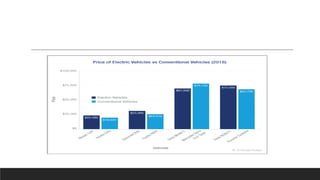
• EV has a more capital cost
• But life cycle cost of EV is lesser than ICEV
2.Capital Cost and Maintenance Cost:
• EV has a more capital cost
• But life cycle cost of EV is lesser than ICEV
3.Availability of Fuel
Fast depletion of fossil fuel and dependence on middle east countries for fuel.
4.Well to Wheel Efficiency
The EV is found to have a better WTW efficiency than ICE
It starts replacing conventional vehicle In USA, Europe and Asia. With revolutionized perspective and
competitive price (Entry range).
EV is a smart choice for any end user, however, an extra effort is required to enhance the range of
autonomy and vary applications [1].
History of the Electric Vehicle
The history of the electric vehicle began in the mid-19th century.
1832: Robert Anderson invents a non –rechargeable electric carriage.
1835: Thomas Davenport builds the first practical electric vehicle.
1976: General Electric was chosen to construct a parallel-hybrid sedan, and Toyota built its first hybrid
car.
Electric Vehicle (EV)
•An electric drive vehicle, or simply electric vehicle (EV), is a vehicle based on one or multiple motors
(electric or traction) to ensure propulsion.
•Electric vehicle is an automobile propelled by one or more electric motors, drawing power from an
onboard source of electricity.
•Electric cars are mechanically simpler and more durable than gasoline-powered cars.
•They produce less pollution than do gasoline-powered cars.
•An electric car stores its energy on board-typically in batteries, but alternatively with capacitors or
flywheel storage devices.
EVs can be classified on the basis of their attributes such as
i) charging time,
ii) driving range,
iii) the maximum load it can carry.
Of these attributes, the two most important characteristics of an electric vehicle of concern to the
consumer are:-
1. Driving range (i.e. the maximum distance an EV can run when fully charged)
2. Charging time of batteries (i.e. the time required to fully charge the battery) and Charging time depends
on the input power characteristics (i.e. input voltage and current), battery type, and battery capacity.
Need Of Electric Vehicle
•Electric Vehicle (EV) technology is gaining ground and popularity rapidly.
•With depletion of oil reserves and a world characterized by smog, noise and all kinds of pollutants,
governments and communities are awakening to the several benefits of EV technology.
•Zero emission vehicles are almost noiseless and can be charged at home or work, saving commuters
endless queues at petrol stations.
•Charging at night when consumption is low, allows for efficient use of electricity.
•EVs are easier to service and maintain due to the absence of spark plugs, clutch and gears. Ideal for
"stop - start" city driving conditions, EVs are extremely reliable and easy to drive.
•With the innumerable advantages of EVs, companies in developed countries have spent huge amounts
amounts to develop electric cars that can travel longer distances, providing high levels of comfort.
•In spite of this technology being available now, the cost of electric vehicles to suit driving
requirements in these developed countries is prohibitively high.
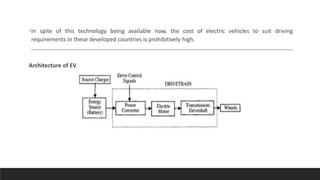
Architecture of EV
Components of an EV
Battery
•It powers the electric motor. Its capacity is defined in Ah.
•The design of battery includes complex calculations which determines various battery parameters.
•The choice of batteries depends on the energy density, weight and costs.
•Electric cycles and low range mopeds have simple battery units while electric cars deploy a large
number of batteries.
•Traditionally, most electric vehicles have used lead-acid batteries due to their mature technology, easy
easy availability, and low cost.
•However, since the 1990s battery technologies have evolved significantly and several new types of
batteries have been developed.
•More recently, batteries using combinations of lithium ion and its variations are gaining widespread
acceptance due to
•better efficiency,
•reduced weight,
•lower charging time,
•better power output,
•longer lifetime, and reduced environmental implications from battery disposal.
The following four types of batteries are commonly used today in EVs: 1) Lead Acid, 2) Nickel
Cadmium (NiCd), 3) Nickel Metal Hydride (NiMH), and 4) Lithium-ion (Li-ion). Lithium-ion batteries
have higher specific energy relative to the other battery types.
In the future, technology innovations with Li-ion and other battery technologies are expected to
result in batteries with much higher specific energy and lower costs.
Power Convertor
The electrical energy stored in battery is fixed DC which should be converted to either variable DC or
Variable AC which depends on the type of electric motor used for power the wheels.
Electric Motor
DC series, Induction motors were used at the earlier stage. Now the cope has shifted special electrical
machines
Clutch
The engine must be decoupled from the wheels to shift from low speed to high speed gears vice versa, this
is done by the clutch.
Transmission
The gearbox is also called as transmission which allows transfer of power from engine to wheels.
Drivetrain
The combination of Electric motor, Clutch, Gearbox is referred to as drivetrain
EVs can be categorized as follows:
(1) Battery Electric Vehicle (BEV)
(2) Hybrid Electric Vehicle (HEV)
(3) Plug-in Hybrid Electric Vehicle (PHEV)
(4) Fuel Cell Electric Vehicle (FCEV)
Battery Electric Vehicle (BEV)
•EVs with only batteries to provide power to the drive train are known as BEVs.
•BEVs have to rely solely on the energy stored in their battery packs
•Therefore the range of such vehicles depends directly on the battery capacity.
•Typically they can cover 100 km–250 km on one charge [3], whereas the top-tier models can go a lot
further, from 300 km to 500 km [3].
•These ranges depend on driving condition and style, vehicle configurations, road conditions, climate,
battery type and age.
•Once depleted, charging the battery pack takes quite a lot of time compared to refueling a
conventional ICE (internal combustion engine) vehicle.
•Charging time depends on the charger configuration, its infrastructure and operating power level.
Advantages of BEVs
•Its simple construction, operation and convenience.
•These do not produce any greenhouse gas (GHG)
•Do not create any noise and therefore beneficial to the environment.
•Electric propulsion provides instant and high torques, even at low speeds. These advantages, coupled
with their limitation of range, makes them the perfect vehicle to use in urban areas
Hybrid Electric Vehicle (HEV)
HEVs employ both an ICE and an electrical power train to power the vehicle.
The combination of these two can come in different forms which are discussed later.
An HEV uses the electric propulsion system when the power demand is low.
It is a great advantage in low speed conditions like urban areas.
It also reduces the fuel consumption as the engine stays totally off during idling Energies. This feature
also reduces the GHG emission.
An Hybrid Electric Vehicle (HEV) uses both a conventional internal combustion engine and an electric
source.
This mainly facilitates regenerative braking.
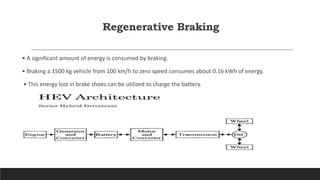
Regenerative Braking
• A significant amount of energy is consumed by braking.
• Braking a 1500 kg vehicle from 100 km/h to zero speed consumes about 0.16 kWh of energy.
• This energy lost in brake shoes can be utilized to charge the battery.
Series Hybrid Drivetrain
IC engine and Battery operate in series
i. The IC engine is fueled by diesel or petrol which acts as a prime mover to an on board electric generator
which generates electricity and charges the battery through a power converter.
ii. The electric energy stored in the battery is used to drive the electric motor which provides the full
propulsion power.
• Advantage
Simplicity of control algorithms used to control the power converters and hence achieving speed control of
electric motors
• Disadvantage
Power train components has to be rated for the full rating.
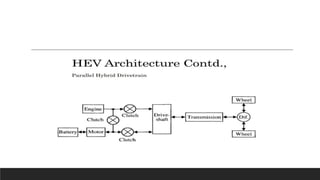
IC engine and battery operate in parallel
i. Based on the rating of the IC engine and battery, electric motor the propulsion power is shared
between the sources
ii. The battery can be charged through wheels by increasing the power output of the IC engine by using
using the control algorithm for regenerative braking.
• Advantage
Reduction in size of drive train components
• Disadvantage
Power blending from two sources becomes difficult and it requires additional mechanical equipment
like planetary gear arrangement.
When higher speed is needed, the HEV switches to the ICE. The two drive trains can also work
together to improve the performance.
Hybrid power systems are used extensively to reduce or to completely remove turbo lag in
turbocharged cars, like the Acura NSX.
It also enhances performance by filling the gaps between gear shifts and providing speed boosts when
required.
Plug-In Hybrid Electric Vehicle (PHEV)
It uses both an ICE and an electrical power train, like a HEV,
But the difference between them is that the PHEV uses electric propulsion as the main driving force.
So these vehicles require a bigger battery capacity than HEVs.
PHEVs start in ‘all electric’ mode, runs on electricity and when the batteries are low in charge, it calls on the
ICE to provide a boost or to charge up the battery pack.
The ICE is used here to extend the range. PHEVs can charge their batteries directly from the grid (which
HEVs cannot); they also have the facility to utilize regenerative braking.
PHEVs’ ability to run solely on electricity for most of the time makes its carbon footprint smaller than the
HEVs.
They consume less fuel as well and thus reduce the associated cost.
PHEVs are charge depleting HEV
• They operate in fully electric mode up to certain distance and then as a regular hybrid vehicle
for longer distances.
• It has a large rated storage system compared to HEVs
• It has to be plugged in for recharging the battery
Fuel Cell Electric Vehicle (FCEV)
Hydrogen is the fuel of choice for FCVs to carry out this reaction, so they are often called ‘hydrogen fuel cell
vehicles’.
Electricity generated from the fuel cells goes to an electric motor which drives the wheels.
FCVs only produce water as a byproduct of its power generating process which is ejected out of the car
through the tailpipes.
An advantage of such vehicles is they can produce their own electricity which emits no carbon, enabling it to
to reduce its carbon footprint further than any other EV.
Another major advantage is refilling these vehicles takes the same amount of time required to fill a
conventional vehicle at a gas pump.
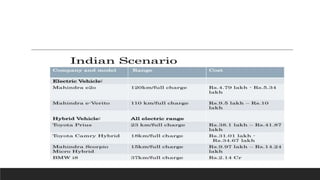
Present scenario in India
National Mission for Electric Mobility (NMEM)
• Government of India approved the National Mission on Electric Mobility in 2011.
• As part of the mission, Department of Heavy Industries has formulated a scheme namely
FAME – India Faster Adoption and Manufacturing of Hybrid & Electric Vehicles in India.
Phase - 1 Proposed to be implemented in 2 year period of 2015 -2017 Focus on four Major Areas
• Technology Development
• Demand Creation
• Pilot Projects
• Charging Infrastructure
Current Status of NMEM
• To promote eco-friendly vehicles, the government has been offering incentives on electric and hybrid
vehicles of up to Rs.29,000 for bikes and Rs.1.38 lakh for cars under the FAME India scheme.
• In Budget 2017-18, Rs.175 crore has been earmarked for the FAME India scheme.
On 23rd February 2017 a meeting was scheduled by Govt., of India to discuss several factors including ,
i. Higher cost of vehicles
ii. Power outages
iii. Lack of charging infrastructure
iv. Dearth of facilities for eco-friendly disposal of batteries to curb pollution
Global leaders in terms of total units sold
1. Renault – Nissan
2. Mitsubishi
3. General Motors
4. Toyota
5. Tesla
6. Ford & BMW ,Volkswagen
References
[1] B. Ganji and A. Z. Kouzani, "A study on look-ahead control and energy management strategies in
hybrid electric vehicles," 2010 8th IEEE International Conference on Control and Automation (ICCA),
2010, pp. 388-392.
[2] Chan, C.C. The state of the art of electric and hybrid vehicles. Proc. IEEE 2002, 90, 247–275.
[3] Grunditz, E.A.; Thiringer, T. Performance Analysis of Current BEVs Based on a Comprehensive
Review of Specifications. IEEE Trans. Transp. Electr. 2016, 2, 270–289.
[4] Hongjun Chen, Fei Lu, Fujuan Guo, “Power Management System Design for Small Size Solar-
Electric Vehicle”, 2012 IEEE 7th International Power Electronics and Motion Control Conference - ECCE
Asia, 2012, pp. 2658-2662.
[5] Krishnakumar R V “ELECTRIC VEHICLES: An Alternate Urban Commuting”

ELECTRIC VEHICLE NEW SIMPLER PRESENTSTION.pptx

  • 1.
    Electric Vehicle DR.S.CHITRA SELVI ASSISTANTPROFESSOR DEPARTMENT OF EEE UNIVERSITY COLLEGE OF ENGINEERING THIRUKKUVALAI-610204
  • 2.
    Why EV? 1.Pollution: According toDOE (USA)[5] • Transportation accounts for one third of all energy usage. • Use of 10% of ZEV cuts 1 million tons/year of air pollutants • With 100% EV - CO2 emission would be cut by half 2.Capital Cost and Maintenance Cost: • EV has a more capital cost • But life cycle cost of EV is lesser than ICEV
  • 3.
    2.Capital Cost andMaintenance Cost: • EV has a more capital cost • But life cycle cost of EV is lesser than ICEV 3.Availability of Fuel Fast depletion of fossil fuel and dependence on middle east countries for fuel. 4.Well to Wheel Efficiency The EV is found to have a better WTW efficiency than ICE
  • 4.
    It starts replacingconventional vehicle In USA, Europe and Asia. With revolutionized perspective and competitive price (Entry range). EV is a smart choice for any end user, however, an extra effort is required to enhance the range of autonomy and vary applications [1]. History of the Electric Vehicle The history of the electric vehicle began in the mid-19th century. 1832: Robert Anderson invents a non –rechargeable electric carriage. 1835: Thomas Davenport builds the first practical electric vehicle. 1976: General Electric was chosen to construct a parallel-hybrid sedan, and Toyota built its first hybrid car.
  • 5.
    Electric Vehicle (EV) •Anelectric drive vehicle, or simply electric vehicle (EV), is a vehicle based on one or multiple motors (electric or traction) to ensure propulsion. •Electric vehicle is an automobile propelled by one or more electric motors, drawing power from an onboard source of electricity. •Electric cars are mechanically simpler and more durable than gasoline-powered cars. •They produce less pollution than do gasoline-powered cars. •An electric car stores its energy on board-typically in batteries, but alternatively with capacitors or flywheel storage devices.
  • 6.
    EVs can beclassified on the basis of their attributes such as i) charging time, ii) driving range, iii) the maximum load it can carry. Of these attributes, the two most important characteristics of an electric vehicle of concern to the consumer are:- 1. Driving range (i.e. the maximum distance an EV can run when fully charged) 2. Charging time of batteries (i.e. the time required to fully charge the battery) and Charging time depends on the input power characteristics (i.e. input voltage and current), battery type, and battery capacity.
  • 7.
    Need Of ElectricVehicle •Electric Vehicle (EV) technology is gaining ground and popularity rapidly. •With depletion of oil reserves and a world characterized by smog, noise and all kinds of pollutants, governments and communities are awakening to the several benefits of EV technology. •Zero emission vehicles are almost noiseless and can be charged at home or work, saving commuters endless queues at petrol stations. •Charging at night when consumption is low, allows for efficient use of electricity. •EVs are easier to service and maintain due to the absence of spark plugs, clutch and gears. Ideal for "stop - start" city driving conditions, EVs are extremely reliable and easy to drive. •With the innumerable advantages of EVs, companies in developed countries have spent huge amounts amounts to develop electric cars that can travel longer distances, providing high levels of comfort.
  • 8.
    •In spite ofthis technology being available now, the cost of electric vehicles to suit driving requirements in these developed countries is prohibitively high. Architecture of EV
  • 9.
    Components of anEV Battery •It powers the electric motor. Its capacity is defined in Ah. •The design of battery includes complex calculations which determines various battery parameters. •The choice of batteries depends on the energy density, weight and costs. •Electric cycles and low range mopeds have simple battery units while electric cars deploy a large number of batteries. •Traditionally, most electric vehicles have used lead-acid batteries due to their mature technology, easy easy availability, and low cost.
  • 10.
    •However, since the1990s battery technologies have evolved significantly and several new types of batteries have been developed. •More recently, batteries using combinations of lithium ion and its variations are gaining widespread acceptance due to •better efficiency, •reduced weight, •lower charging time, •better power output, •longer lifetime, and reduced environmental implications from battery disposal.
  • 11.
    The following fourtypes of batteries are commonly used today in EVs: 1) Lead Acid, 2) Nickel Cadmium (NiCd), 3) Nickel Metal Hydride (NiMH), and 4) Lithium-ion (Li-ion). Lithium-ion batteries have higher specific energy relative to the other battery types. In the future, technology innovations with Li-ion and other battery technologies are expected to result in batteries with much higher specific energy and lower costs. Power Convertor The electrical energy stored in battery is fixed DC which should be converted to either variable DC or Variable AC which depends on the type of electric motor used for power the wheels. Electric Motor DC series, Induction motors were used at the earlier stage. Now the cope has shifted special electrical machines Clutch The engine must be decoupled from the wheels to shift from low speed to high speed gears vice versa, this is done by the clutch.
  • 12.
    Transmission The gearbox isalso called as transmission which allows transfer of power from engine to wheels. Drivetrain The combination of Electric motor, Clutch, Gearbox is referred to as drivetrain EVs can be categorized as follows: (1) Battery Electric Vehicle (BEV) (2) Hybrid Electric Vehicle (HEV) (3) Plug-in Hybrid Electric Vehicle (PHEV) (4) Fuel Cell Electric Vehicle (FCEV)
  • 13.
    Battery Electric Vehicle(BEV) •EVs with only batteries to provide power to the drive train are known as BEVs. •BEVs have to rely solely on the energy stored in their battery packs •Therefore the range of such vehicles depends directly on the battery capacity. •Typically they can cover 100 km–250 km on one charge [3], whereas the top-tier models can go a lot further, from 300 km to 500 km [3]. •These ranges depend on driving condition and style, vehicle configurations, road conditions, climate, battery type and age.
  • 14.
    •Once depleted, chargingthe battery pack takes quite a lot of time compared to refueling a conventional ICE (internal combustion engine) vehicle. •Charging time depends on the charger configuration, its infrastructure and operating power level. Advantages of BEVs •Its simple construction, operation and convenience. •These do not produce any greenhouse gas (GHG) •Do not create any noise and therefore beneficial to the environment. •Electric propulsion provides instant and high torques, even at low speeds. These advantages, coupled with their limitation of range, makes them the perfect vehicle to use in urban areas
  • 15.
    Hybrid Electric Vehicle(HEV) HEVs employ both an ICE and an electrical power train to power the vehicle. The combination of these two can come in different forms which are discussed later. An HEV uses the electric propulsion system when the power demand is low. It is a great advantage in low speed conditions like urban areas.
  • 16.
    It also reducesthe fuel consumption as the engine stays totally off during idling Energies. This feature also reduces the GHG emission. An Hybrid Electric Vehicle (HEV) uses both a conventional internal combustion engine and an electric source. This mainly facilitates regenerative braking.
  • 17.
    Regenerative Braking • Asignificant amount of energy is consumed by braking. • Braking a 1500 kg vehicle from 100 km/h to zero speed consumes about 0.16 kWh of energy. • This energy lost in brake shoes can be utilized to charge the battery.
  • 18.
    Series Hybrid Drivetrain ICengine and Battery operate in series i. The IC engine is fueled by diesel or petrol which acts as a prime mover to an on board electric generator which generates electricity and charges the battery through a power converter. ii. The electric energy stored in the battery is used to drive the electric motor which provides the full propulsion power. • Advantage Simplicity of control algorithms used to control the power converters and hence achieving speed control of electric motors • Disadvantage Power train components has to be rated for the full rating.
  • 20.
    IC engine andbattery operate in parallel i. Based on the rating of the IC engine and battery, electric motor the propulsion power is shared between the sources ii. The battery can be charged through wheels by increasing the power output of the IC engine by using using the control algorithm for regenerative braking. • Advantage Reduction in size of drive train components • Disadvantage Power blending from two sources becomes difficult and it requires additional mechanical equipment like planetary gear arrangement.
  • 21.
    When higher speedis needed, the HEV switches to the ICE. The two drive trains can also work together to improve the performance. Hybrid power systems are used extensively to reduce or to completely remove turbo lag in turbocharged cars, like the Acura NSX. It also enhances performance by filling the gaps between gear shifts and providing speed boosts when required.
  • 22.
    Plug-In Hybrid ElectricVehicle (PHEV) It uses both an ICE and an electrical power train, like a HEV, But the difference between them is that the PHEV uses electric propulsion as the main driving force. So these vehicles require a bigger battery capacity than HEVs.
  • 23.
    PHEVs start in‘all electric’ mode, runs on electricity and when the batteries are low in charge, it calls on the ICE to provide a boost or to charge up the battery pack. The ICE is used here to extend the range. PHEVs can charge their batteries directly from the grid (which HEVs cannot); they also have the facility to utilize regenerative braking. PHEVs’ ability to run solely on electricity for most of the time makes its carbon footprint smaller than the HEVs. They consume less fuel as well and thus reduce the associated cost.
  • 24.
    PHEVs are chargedepleting HEV • They operate in fully electric mode up to certain distance and then as a regular hybrid vehicle for longer distances. • It has a large rated storage system compared to HEVs • It has to be plugged in for recharging the battery
  • 25.
    Fuel Cell ElectricVehicle (FCEV) Hydrogen is the fuel of choice for FCVs to carry out this reaction, so they are often called ‘hydrogen fuel cell vehicles’. Electricity generated from the fuel cells goes to an electric motor which drives the wheels. FCVs only produce water as a byproduct of its power generating process which is ejected out of the car through the tailpipes. An advantage of such vehicles is they can produce their own electricity which emits no carbon, enabling it to to reduce its carbon footprint further than any other EV. Another major advantage is refilling these vehicles takes the same amount of time required to fill a conventional vehicle at a gas pump.
  • 26.
    Present scenario inIndia National Mission for Electric Mobility (NMEM) • Government of India approved the National Mission on Electric Mobility in 2011. • As part of the mission, Department of Heavy Industries has formulated a scheme namely FAME – India Faster Adoption and Manufacturing of Hybrid & Electric Vehicles in India. Phase - 1 Proposed to be implemented in 2 year period of 2015 -2017 Focus on four Major Areas • Technology Development • Demand Creation • Pilot Projects • Charging Infrastructure
  • 27.
    Current Status ofNMEM • To promote eco-friendly vehicles, the government has been offering incentives on electric and hybrid vehicles of up to Rs.29,000 for bikes and Rs.1.38 lakh for cars under the FAME India scheme. • In Budget 2017-18, Rs.175 crore has been earmarked for the FAME India scheme. On 23rd February 2017 a meeting was scheduled by Govt., of India to discuss several factors including , i. Higher cost of vehicles ii. Power outages iii. Lack of charging infrastructure iv. Dearth of facilities for eco-friendly disposal of batteries to curb pollution
  • 28.
    Global leaders interms of total units sold 1. Renault – Nissan 2. Mitsubishi 3. General Motors 4. Toyota 5. Tesla 6. Ford & BMW ,Volkswagen
  • 33.
    References [1] B. Ganjiand A. Z. Kouzani, "A study on look-ahead control and energy management strategies in hybrid electric vehicles," 2010 8th IEEE International Conference on Control and Automation (ICCA), 2010, pp. 388-392. [2] Chan, C.C. The state of the art of electric and hybrid vehicles. Proc. IEEE 2002, 90, 247–275. [3] Grunditz, E.A.; Thiringer, T. Performance Analysis of Current BEVs Based on a Comprehensive Review of Specifications. IEEE Trans. Transp. Electr. 2016, 2, 270–289. [4] Hongjun Chen, Fei Lu, Fujuan Guo, “Power Management System Design for Small Size Solar- Electric Vehicle”, 2012 IEEE 7th International Power Electronics and Motion Control Conference - ECCE Asia, 2012, pp. 2658-2662. [5] Krishnakumar R V “ELECTRIC VEHICLES: An Alternate Urban Commuting”