Government College of Engineering Chandrapur
Department of Mechanical Engineering
Tittle : Autonomous Connected Electric Vehicle
Guided by : S.W.Burande
Name of Student :Pranay D Ghatode
 Basics of Automobile
 Introduction to EV
 Types of EV
 Components of EV
 Comparison of EV & Conventional Vehicle
 Advantage
 Future Scope
CONTENTS
Basics of automobile
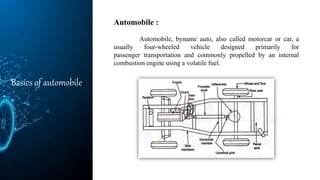
Automobile :
Automobile, byname auto, also called motorcar or car, a
usually four-wheeled vehicle designed primarily for
passenger transportation and commonly propelled by an internal
combustion engine using a volatile fuel.
 Engine : It is a Source of power.
 Frame & Chassis : It supports the Engine, wheel, body, braking
system, steering, etc.
 Transmission : It transmit power from engine to wheel. It consists
of clutch, gearbox, propeller shaft, axle, differential.
 Vehicle body : It is the main supporting structure of a vehicle, to
which all other components are attached. (BIW)
 Accessories : consists of Light, AC, wiper,
 Gear box :,The purpose of a gearbox is to increase or reduce
speed. As a result, torque output will be the inverse of the speed
function etc.
 Clutch :The purpose of a clutch is to transmit torque from a
rotating driving motor to a transmission. Clutches require a mode
of actuation in order to break the transmission of torque.
Introduction
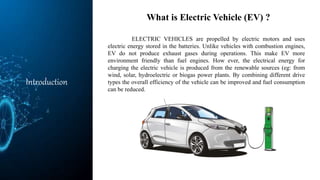
ELECTRIC VEHICLES are propelled by electric motors and uses
electric energy stored in the batteries. Unlike vehicles with combustion engines,
EV do not produce exhaust gases during operations. This make EV more
environment friendly than fuel engines. How ever, the electrical energy for
charging the electric vehicle is produced from the renewable sources (eg: from
wind, solar, hydroelectric or biogas power plants. By combining different drive
types the overall efficiency of the vehicle can be improved and fuel consumption
can be reduced.
What is Electric Vehicle (EV) ?
Need
of
electric vehicle
 Contributes To Cleaner Air
 To Preserve The Fossil Fuels
 Less Maintenance.
 More Efficient.
 Cost Effective.
Types
of
electric vehicle
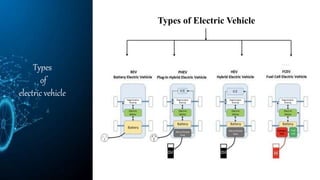
Types of Electric Vehicle
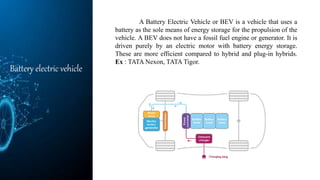
Battery electric vehicle
A Battery Electric Vehicle or BEV is a vehicle that uses a
battery as the sole means of energy storage for the propulsion of the
vehicle. A BEV does not have a fossil fuel engine or generator. It is
driven purely by an electric motor with battery energy storage.
These are more efficient compared to hybrid and plug-in hybrids.
Ex : TATA Nexon, TATA Tigor.
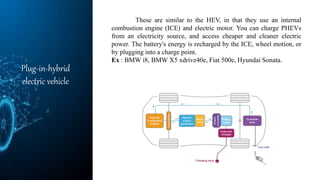
These are similar to the HEV, in that they use an internal
combustion engine (ICE) and electric motor. You can charge PHEVs
from an electricity source, and access cheaper and cleaner electric
power. The battery's energy is recharged by the ICE, wheel motion, or
by plugging into a charge point.
Ex : BMW i8, BMW X5 xdrive40e, Fiat 500e, Hyundai Sonata.
Plug-in-hybrid
electric vehicle
Hybrid
electric
vehicle
These are known as HEV’s. These vehicles have both an
internal combustion engine and an electric motor. The electric battery
however, is only charged by the ICE, the motion of the wheels or a
combination of both. There is no charging connector. Ex Engine,
Electric motor, Battery pack with controller & inverter, Fuel tank,
Control module
Types of Hybrid Electric Vehicle
 Series Hybrid Electric Vehicle
 Parallel Hybrid Electric Vehicle
 Series Parallel Hybrid Electric Vehicle
Series
hybrid electric vehicle
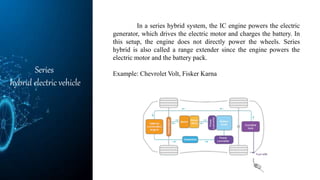
In a series hybrid system, the IC engine powers the electric
generator, which drives the electric motor and charges the battery. In
this setup, the engine does not directly power the wheels. Series
hybrid is also called a range extender since the engine powers the
electric motor and the battery pack.
Example: Chevrolet Volt, Fisker Karna
Parallel hybrid electric
vehicle
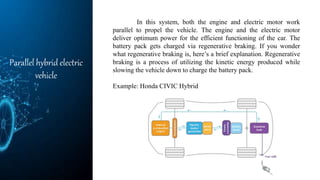
In this system, both the engine and electric motor work
parallel to propel the vehicle. The engine and the electric motor
deliver optimum power for the efficient functioning of the car. The
battery pack gets charged via regenerative braking. If you wonder
what regenerative braking is, here’s a brief explanation. Regenerative
braking is a process of utilizing the kinetic energy produced while
slowing the vehicle down to charge the battery pack.
Example: Honda CIVIC Hybrid
Series parallel hybrid
electric vehicle
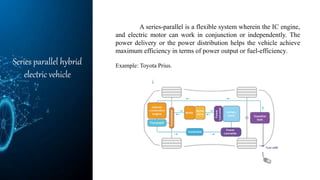
A series-parallel is a flexible system wherein the IC engine,
and electric motor can work in conjunction or independently. The
power delivery or the power distribution helps the vehicle achieve
maximum efficiency in terms of power output or fuel-efficiency.
Example: Toyota Prius.
Fuel cell electric vehicle
Fuel Cell Electric Vehicles (FCEVs), also known as fuel cell
vehicles (FCVs) or Zero Emission Vehicle, are types of electric cars that
employ fuel cell technology to generate the electricity required to run the
vehicle. In this type of vehicles, the chemical energy of the fuel is converted
directly into electric energy.
Union Minister of Road Transport & Highways Nitin Gadkari
will be inaugurating a pilot project for Hydrogen based advanced Fuel Cell
Electric Vehicle (FCEV) in New Delhi. The minister will also demonstrate
Toyota Mirai FCEV.
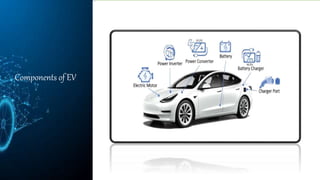
Components of EV
2. DC-DC Converter
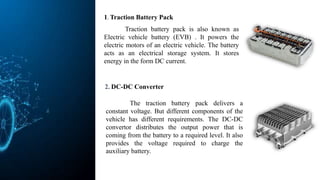
1. Traction Battery Pack
Traction battery pack is also known as
Electric vehicle battery (EVB) . It powers the
electric motors of an electric vehicle. The battery
acts as an electrical storage system. It stores
energy in the form DC current.
The traction battery pack delivers a
constant voltage. But different components of the
vehicle has different requirements. The DC-DC
convertor distributes the output power that is
coming from the battery to a required level. It also
provides the voltage required to charge the
auxiliary battery.
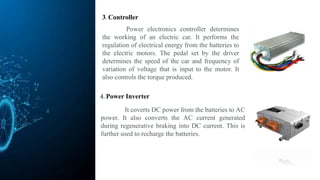
4. Power Inverter
3. Controller
Power electronics controller determines
the working of an electric car. It performs the
regulation of electrical energy from the batteries to
the electric motors. The pedal set by the driver
determines the speed of the car and frequency of
variation of voltage that is input to the motor. It
also controls the torque produced.
It coverts DC power from the batteries to AC
power. It also converts the AC current generated
during regenerative braking into DC current. This is
further used to recharge the batteries.
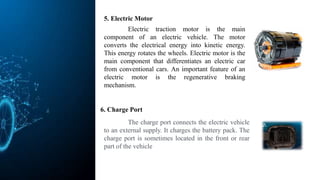
6. Charge Port
5. Electric Motor
Electric traction motor is the main
component of an electric vehicle. The motor
converts the electrical energy into kinetic energy.
This energy rotates the wheels. Electric motor is the
main component that differentiates an electric car
from conventional cars. An important feature of an
electric motor is the regenerative braking
mechanism.
The charge port connects the electric vehicle
to an external supply. It charges the battery pack. The
charge port is sometimes located in the front or rear
part of the vehicle
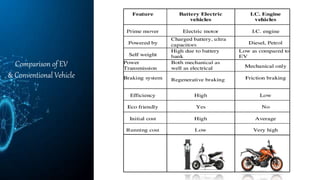
Comparison of EV
& Conventional Vehicle
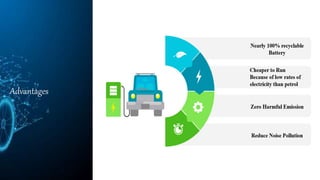
Advantages
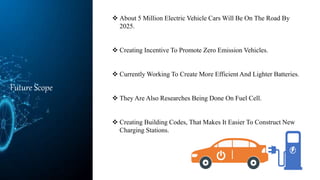
Future Scope
 About 5 Million Electric Vehicle Cars Will Be On The Road By
2025.
 Creating Incentive To Promote Zero Emission Vehicles.
 Currently Working To Create More Efficient And Lighter Batteries.
 They Are Also Researches Being Done On Fuel Cell.
 Creating Building Codes, That Makes It Easier To Construct New
Charging Stations.
Positive Outcomes
On Environment
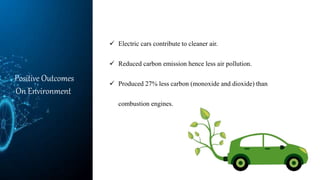
 Electric cars contribute to cleaner air.
 Reduced carbon emission hence less air pollution.
 Produced 27% less carbon (monoxide and dioxide) than
combustion engines.
Thank you