Building Union Catalogue
Virtual vs. Physical Approach
Recall and Precision
www.naseej.com
Recall illustrates the confidence that a search returns all the information you
are interested in.
Precision, is the confidence that the results of your search are relevant.
Web users are used to low recall and precision
 Achieving high precision and recall when searching unstructured or semi-
structured data is a very difficult task.
Librarians and library OPAC users are used to, and require very high recall and
precision, especially recall.
 Great care and consistent rules (such as AACR2) applied in creating structured
catalogue records.
 Different Indexes Techniques are used to achieve high recall.
 Recall is a real problem for Arabic Language! (Requires Special Arabic Indexer)
Arabic Recall Requirements
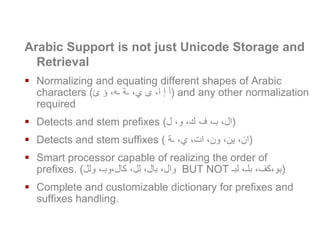
Arabic Support is not just Unicode Storage and
Retrieval
 Normalizing and equating different shapes of Arabic
characters (‫ئ‬ ‫ؤ‬ ،‫ـه‬ ‫ـة‬ ،‫ي‬ ‫ى‬ ،‫ا‬ ‫إ‬ ‫)أ‬ and any other normalization
required
 Detects and stem prefixes (‫ل‬ ،‫و‬ ،‫ك‬ ،‫فـ‬ ،‫بـ‬ ،‫)ال‬
 Detects and stem suffixes ( ‫ـة‬ ،‫ي‬ ،‫ات‬ ،‫ون‬ ،‫ين‬ ،‫)ان‬
 Smart processor capable of realizing the order of
prefixes. (‫ولل‬ ،‫كال،وبـ‬ ،‫لل‬ ،‫بال‬ ،‫وال‬ BUT NOT ‫لبـ‬ ،‫بلـ‬ ،‫)بو،كف‬
 Complete and customizable dictionary for prefixes and
suffixes handling.
www.naseej.com
www.naseejcom
Essential Processes for UC
There are four essential processes for delivering
effective Union Catalogues: (4C)
Collect a knowledgebase of all members
Catalogues
Connect people with answers using the
best method
Correct the knowledgebase to maintain
accuracy
Control collections and workflows to
optimize value
Purposes of Union Catalogues
www.naseej.com
 Unified point of discovery
 larger resources are better exposed in general
(single shop versus row of shops versus mall)
 comprehensive resources are more attractive to
users
• more likely to use; more likely to contribute via WIKI
 Ease load on local OPAC
 Provide identity to a library cooperative
Discovery and Exposure
www.naseejcom
Purposes of Union Catalogues
Increasing delivery options
 Resource sharing
 Sharing of users
 Your users find resources elsewhere
 Other’s users find your resources
 Delivery becoming increasingly separated
from discovery
 Increasing delivery options
 Digitization on demand, reference look-up, purchase,
resolution
 Union catalogues need to link to multiple providers
www.naseejcom
Purposes of Union Catalogues
Librarians Perspective
Unified Efforts and Standards
 Unify Standards
 Unify Cataloguing efforts
 Unify Systems
 Minimize Cost
 Consistent Recall and Precision
Union Catalogue Models
www.naseej.com
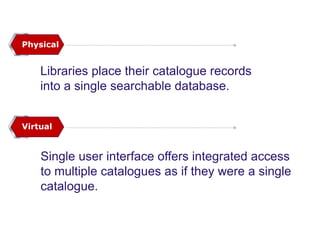
Physical
Virtual
Single user interface offers integrated access
to multiple catalogues as if they were a single
catalogue.
Libraries place their catalogue records
into a single searchable database.
Physical UC – MODEL 1
www.naseej.com
I- Union catalogue is the main catalogue for the participating libraries.
(Consortia Approach – Single System)
Jordanian Public Universities Libraries (JOPULS), OHIOLink, Oxford
University Union Catalogue (OLIS).
• Benefits:
 Centralizes the cost of technical support.
 Minimize Cataloging Cost sharing Bibliographic Records.
 Consistent indexing and Searching policy.
 Real-time locally volatile information such as circulation information
• Problems:
 Problems in merging libraries which already have their own library systems.
 Requires a greater degree of collaboration in terms of cataloguing and
indexing policies.
 Requires increase in network speed and reliability; Difficult for
geographically dispersed unions.
Physical UC – Model 2
www.naseej.com
II- Records are exported from local catalogues to the union catalogue .
COPAC service in the U.K (over 70 UK and Irish academic, national & specialist catalogues)
OCLC WorldCat
• Benefits:
 Centralizes the cost of technical support.
 Consistent indexing and Searching policy.
 More freedom for libraries to adopt different Cataloging standards
• Problems:
 Insists on Minimal Standards (MARC).
 Can’t benefit Libraries with NO LIS
 Duplicate records ; worse search experience.
 Latency in updating Union Catalogue.
 Large discrepancy between actual holdings and the Union Catalogue.
 Cannot address locally volatile information such as circulation information.
Physical UC – Model 3
www.naseej.com
III- Records are catalogued on union and imported to local catalogue .
OCLC Cooperative Online Resource Cataloging (CORC) Project
Partially Adopted by ARUC (ARUC is a mixture of models 2-3)
• Benefits:
 Centralizes the cost of technical support.
 Consistent indexing and Searching policy.
 Better Quality of records (Maintained Standards)
• Problems:
 Insists on Minimal Standards (MARC).
 Some Discrepancy between actual holdings and the Union Catalogue.
 Difficult to address locally volatile information such as circulation information.
Physical UC – Model 4
www.naseej.com
IV- Dynamic Updates of both union and local catalogue .
Commercial Databases Systems
Z3950 Catalogue Update Service
Dynamic Proxy Update to both Union and Local Catalogues
• Benefits:
 Consistent Updates to both Local and Union Catalogue
 Consistent indexing and Searching polices on Union Catalogue
• Problems:
 Quality of records (No Maintained Standards)
 Duplicate records ; worse search experience.
 Difficult to Adopt by Academic Libraries.
 Difficult to maintain and update
Virtual Approach
www.naseej.com
Local Catalogues are maintained as is
User Interface to search all Catalogues as if searching a single Catalogue
(Federated Search to Online Catalogues)
• Benefits:
 Easier to Implement
 Less Time and efforts required
 Real time searching and retrieval in All Catalogues (Higher Accuracy)
• Problems:
 Different Cataloging, Indexing and Searching Policies
 Inconsistent Indexing/searching based on Local OPACs
 Requires Online Accessible Catalogues for all Members
 Slower in Retrieving results
 Depends on Availability of local OPACs
Which Model to Select?
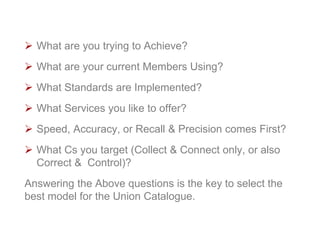
 What are you trying to Achieve?
 What are your current Members Using?
 What Standards are Implemented?
 What Services you like to offer?
 Speed, Accuracy, or Recall & Precision comes First?
 What Cs you target (Collect & Connect only, or also
Correct & Control)?
Answering the Above questions is the key to select the
best model for the Union Catalogue.
www.naseej.com
Select Virtual Model Approach
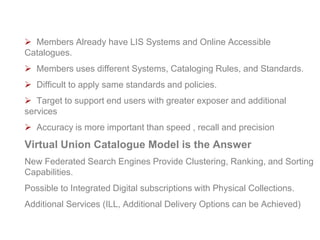
 Members Already have LIS Systems and Online Accessible
Catalogues.
 Members uses different Systems, Cataloging Rules, and Standards.
 Difficult to apply same standards and policies.
 Target to support end users with greater exposer and additional
services
 Accuracy is more important than speed , recall and precision
Virtual Union Catalogue Model is the Answer
New Federated Search Engines Provide Clustering, Ranking, and Sorting
Capabilities.
Possible to Integrated Digital subscriptions with Physical Collections.
Additional Services (ILL, Additional Delivery Options can be Achieved)
www.naseej.com
Select Physical Model Approach
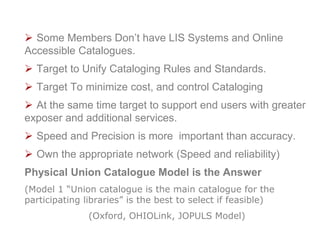
 Some Members Don’t have LIS Systems and Online
Accessible Catalogues.
 Target to Unify Cataloging Rules and Standards.
 Target To minimize cost, and control Cataloging
 At the same time target to support end users with greater
exposer and additional services.
 Speed and Precision is more important than accuracy.
 Own the appropriate network (Speed and reliability)
Physical Union Catalogue Model is the Answer
(Model 1 “Union catalogue is the main catalogue for the
participating libraries” is the best to select if feasible)
(Oxford, OHIOLink, JOPULS Model)
www.naseej.com

Union Catalogues

  • 1.
    Building Union Catalogue Virtualvs. Physical Approach
  • 2.
    Recall and Precision www.naseej.com Recallillustrates the confidence that a search returns all the information you are interested in. Precision, is the confidence that the results of your search are relevant. Web users are used to low recall and precision  Achieving high precision and recall when searching unstructured or semi- structured data is a very difficult task. Librarians and library OPAC users are used to, and require very high recall and precision, especially recall.  Great care and consistent rules (such as AACR2) applied in creating structured catalogue records.  Different Indexes Techniques are used to achieve high recall.  Recall is a real problem for Arabic Language! (Requires Special Arabic Indexer)
  • 3.
    Arabic Recall Requirements ArabicSupport is not just Unicode Storage and Retrieval  Normalizing and equating different shapes of Arabic characters (‫ئ‬ ‫ؤ‬ ،‫ـه‬ ‫ـة‬ ،‫ي‬ ‫ى‬ ،‫ا‬ ‫إ‬ ‫)أ‬ and any other normalization required  Detects and stem prefixes (‫ل‬ ،‫و‬ ،‫ك‬ ،‫فـ‬ ،‫بـ‬ ،‫)ال‬  Detects and stem suffixes ( ‫ـة‬ ،‫ي‬ ،‫ات‬ ،‫ون‬ ،‫ين‬ ،‫)ان‬  Smart processor capable of realizing the order of prefixes. (‫ولل‬ ،‫كال،وبـ‬ ،‫لل‬ ،‫بال‬ ،‫وال‬ BUT NOT ‫لبـ‬ ،‫بلـ‬ ،‫)بو،كف‬  Complete and customizable dictionary for prefixes and suffixes handling. www.naseej.com
  • 4.
    www.naseejcom Essential Processes forUC There are four essential processes for delivering effective Union Catalogues: (4C) Collect a knowledgebase of all members Catalogues Connect people with answers using the best method Correct the knowledgebase to maintain accuracy Control collections and workflows to optimize value
  • 5.
    Purposes of UnionCatalogues www.naseej.com  Unified point of discovery  larger resources are better exposed in general (single shop versus row of shops versus mall)  comprehensive resources are more attractive to users • more likely to use; more likely to contribute via WIKI  Ease load on local OPAC  Provide identity to a library cooperative Discovery and Exposure
  • 6.
    www.naseejcom Purposes of UnionCatalogues Increasing delivery options  Resource sharing  Sharing of users  Your users find resources elsewhere  Other’s users find your resources  Delivery becoming increasingly separated from discovery  Increasing delivery options  Digitization on demand, reference look-up, purchase, resolution  Union catalogues need to link to multiple providers
  • 7.
    www.naseejcom Purposes of UnionCatalogues Librarians Perspective Unified Efforts and Standards  Unify Standards  Unify Cataloguing efforts  Unify Systems  Minimize Cost  Consistent Recall and Precision
  • 8.
    Union Catalogue Models www.naseej.com Physical Virtual Singleuser interface offers integrated access to multiple catalogues as if they were a single catalogue. Libraries place their catalogue records into a single searchable database.
  • 9.
    Physical UC –MODEL 1 www.naseej.com I- Union catalogue is the main catalogue for the participating libraries. (Consortia Approach – Single System) Jordanian Public Universities Libraries (JOPULS), OHIOLink, Oxford University Union Catalogue (OLIS). • Benefits:  Centralizes the cost of technical support.  Minimize Cataloging Cost sharing Bibliographic Records.  Consistent indexing and Searching policy.  Real-time locally volatile information such as circulation information • Problems:  Problems in merging libraries which already have their own library systems.  Requires a greater degree of collaboration in terms of cataloguing and indexing policies.  Requires increase in network speed and reliability; Difficult for geographically dispersed unions.
  • 10.
    Physical UC –Model 2 www.naseej.com II- Records are exported from local catalogues to the union catalogue . COPAC service in the U.K (over 70 UK and Irish academic, national & specialist catalogues) OCLC WorldCat • Benefits:  Centralizes the cost of technical support.  Consistent indexing and Searching policy.  More freedom for libraries to adopt different Cataloging standards • Problems:  Insists on Minimal Standards (MARC).  Can’t benefit Libraries with NO LIS  Duplicate records ; worse search experience.  Latency in updating Union Catalogue.  Large discrepancy between actual holdings and the Union Catalogue.  Cannot address locally volatile information such as circulation information.
  • 11.
    Physical UC –Model 3 www.naseej.com III- Records are catalogued on union and imported to local catalogue . OCLC Cooperative Online Resource Cataloging (CORC) Project Partially Adopted by ARUC (ARUC is a mixture of models 2-3) • Benefits:  Centralizes the cost of technical support.  Consistent indexing and Searching policy.  Better Quality of records (Maintained Standards) • Problems:  Insists on Minimal Standards (MARC).  Some Discrepancy between actual holdings and the Union Catalogue.  Difficult to address locally volatile information such as circulation information.
  • 12.
    Physical UC –Model 4 www.naseej.com IV- Dynamic Updates of both union and local catalogue . Commercial Databases Systems Z3950 Catalogue Update Service Dynamic Proxy Update to both Union and Local Catalogues • Benefits:  Consistent Updates to both Local and Union Catalogue  Consistent indexing and Searching polices on Union Catalogue • Problems:  Quality of records (No Maintained Standards)  Duplicate records ; worse search experience.  Difficult to Adopt by Academic Libraries.  Difficult to maintain and update
  • 13.
    Virtual Approach www.naseej.com Local Cataloguesare maintained as is User Interface to search all Catalogues as if searching a single Catalogue (Federated Search to Online Catalogues) • Benefits:  Easier to Implement  Less Time and efforts required  Real time searching and retrieval in All Catalogues (Higher Accuracy) • Problems:  Different Cataloging, Indexing and Searching Policies  Inconsistent Indexing/searching based on Local OPACs  Requires Online Accessible Catalogues for all Members  Slower in Retrieving results  Depends on Availability of local OPACs
  • 14.
    Which Model toSelect?  What are you trying to Achieve?  What are your current Members Using?  What Standards are Implemented?  What Services you like to offer?  Speed, Accuracy, or Recall & Precision comes First?  What Cs you target (Collect & Connect only, or also Correct & Control)? Answering the Above questions is the key to select the best model for the Union Catalogue. www.naseej.com
  • 15.
    Select Virtual ModelApproach  Members Already have LIS Systems and Online Accessible Catalogues.  Members uses different Systems, Cataloging Rules, and Standards.  Difficult to apply same standards and policies.  Target to support end users with greater exposer and additional services  Accuracy is more important than speed , recall and precision Virtual Union Catalogue Model is the Answer New Federated Search Engines Provide Clustering, Ranking, and Sorting Capabilities. Possible to Integrated Digital subscriptions with Physical Collections. Additional Services (ILL, Additional Delivery Options can be Achieved) www.naseej.com
  • 16.
    Select Physical ModelApproach  Some Members Don’t have LIS Systems and Online Accessible Catalogues.  Target to Unify Cataloging Rules and Standards.  Target To minimize cost, and control Cataloging  At the same time target to support end users with greater exposer and additional services.  Speed and Precision is more important than accuracy.  Own the appropriate network (Speed and reliability) Physical Union Catalogue Model is the Answer (Model 1 “Union catalogue is the main catalogue for the participating libraries” is the best to select if feasible) (Oxford, OHIOLink, JOPULS Model) www.naseej.com