Impact of Information and Communication
Technology (ICT) on Libraries

Asif Waheed
M.Phil (LIS) Student
Table of Contents
1.
2.
3.
4.
5.
6.
7.
8.
9.
10.

Information, Communication: Definitions
What is Information & Communication Technology (ICT)?
Component of ICT
Technologies in Libraries
Why ICT in Libraries?
Functions in ICT based library systems.
ICT-Based User Services
Impact of ICT-Based User Services
ICT in Libraries: various challenges
Conclusion
Information
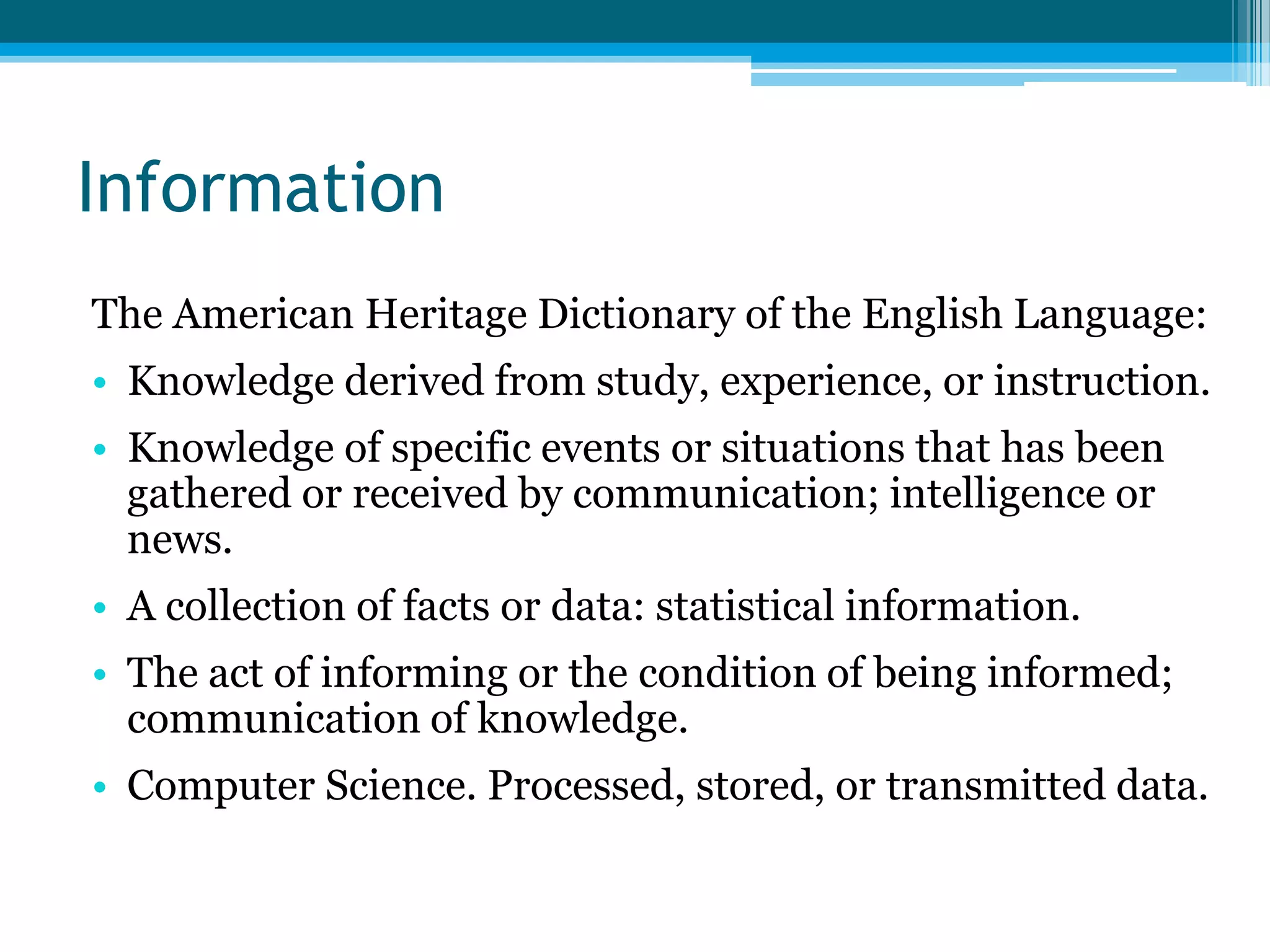
The American Heritage Dictionary of the English Language:
• Knowledge derived from study, experience, or instruction.
• Knowledge of specific events or situations that has been
gathered or received by communication; intelligence or
news.
• A collection of facts or data: statistical information.
• The act of informing or the condition of being informed;
communication of knowledge.
• Computer Science. Processed, stored, or transmitted data.
Communication
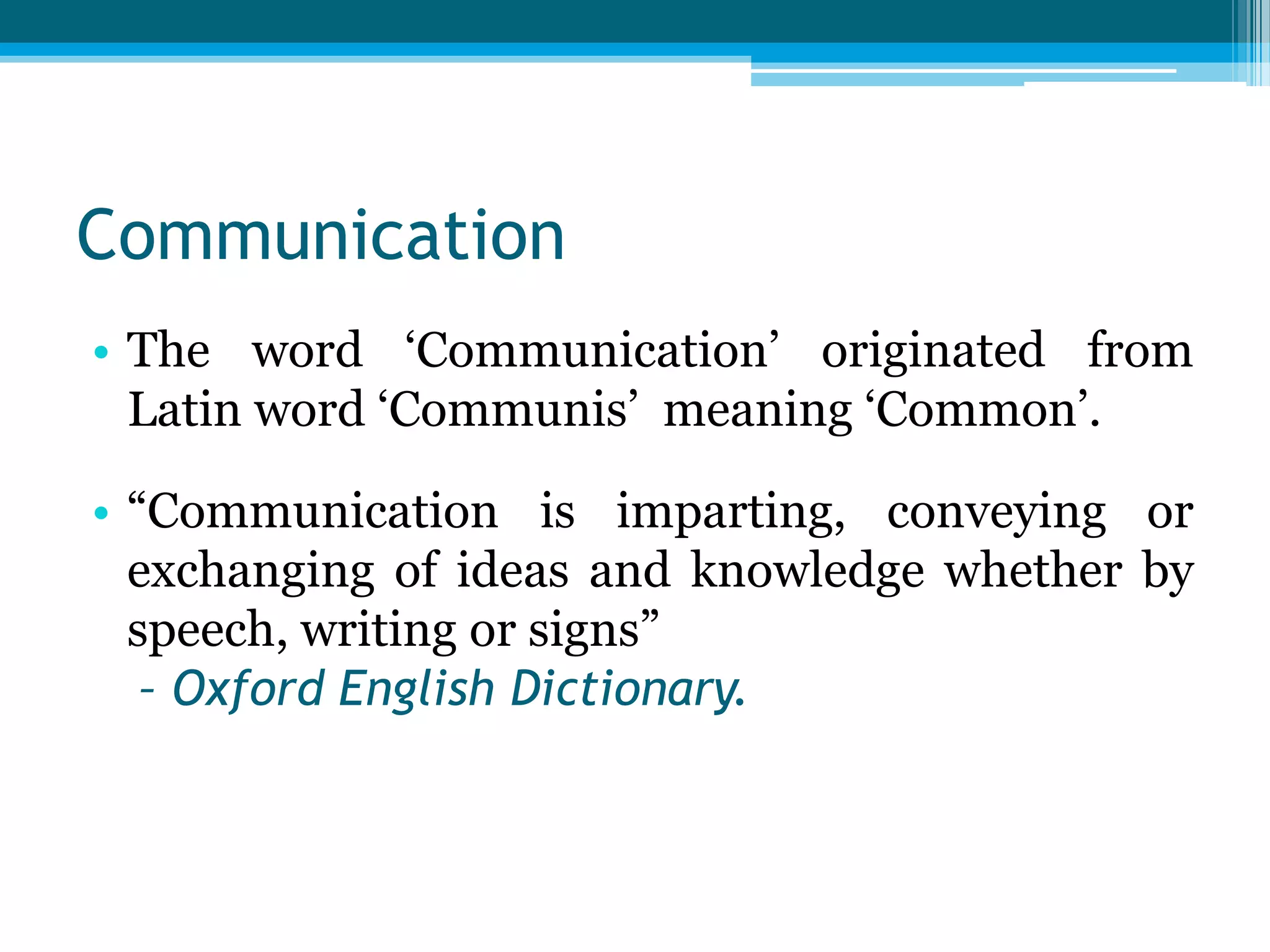
• The word „Communication‟ originated from
Latin word „Communis‟ meaning „Common‟.
• “Communication is imparting, conveying or
exchanging of ideas and knowledge whether by
speech, writing or signs”
– Oxford English Dictionary.
What is Information & Communication
Technology (ICT)?
• Information and Communication Technology
(ICT) is a diverse set of technological tools and

resources used to communicate and to
create, disseminate, store and manage
information.
Component of ICT in Libraries
1. Computer Technology
2. Communication Technology
3. Reprographic, Micrographic and Printing
Technology
Computer Technology
Computer Technology can be divided into two categories:Computer Hardware
A computer is an electronic device that processes
data, converting it into information that is useful to
people.
Computer Software
Software consists of the step-by-step instruction that
tell the computer what to do.
Computer Technology…cont.
• Computer hardware that can further be divided into
following categories:▫ Computers for Organizations





Network Servers
Mainframe Computers
Minicomputers
Supercomputers

▫ Computers for Individual Users






Desktop computers
Workstations
Notebook computers
Handheld computers
Smart phones
Computer Technology…cont.
• Computer software that can also be divided into
following categories:▫ System software
 Windows/Linux/Unix

▫ Application software






Word processing software
Spreadsheet software
Presentation software
Graphic and Multimedia software
Database Management Softwares
Communication Technology
• Communication or telecommunication technologies are
used to transmit information in the form of signals
between

remote

locations,

using

electronic

electromagnetic media as carriers of signals.

or
Communication Technology…cont.
• Communication technologies comprises of the following:▫ Audio technology
▫ Audio-visual technology (Motion Picture, TV, Cable Television
System, Videodisc, Videotext)

▫
▫
▫
▫
▫
▫
▫
▫
▫

Telephone
Cell phone or mobile phone
FAX (facsimile transmission)
E-mail
Voice mail
Teleconference
Satellite technology
Internet (WWW, Remote access, VPN etc.)
Network technology (LAN, WAN, MAN etc.)
Reproduction Technology
• The term reprographic is used to identify that
field of information processing which concern
with technologies and equipment for the
reproduction of documents
▫ Micrographic technology (Microfilm, Microfiche
etc.)
▫ Printing technology
▫ Photocopying technology
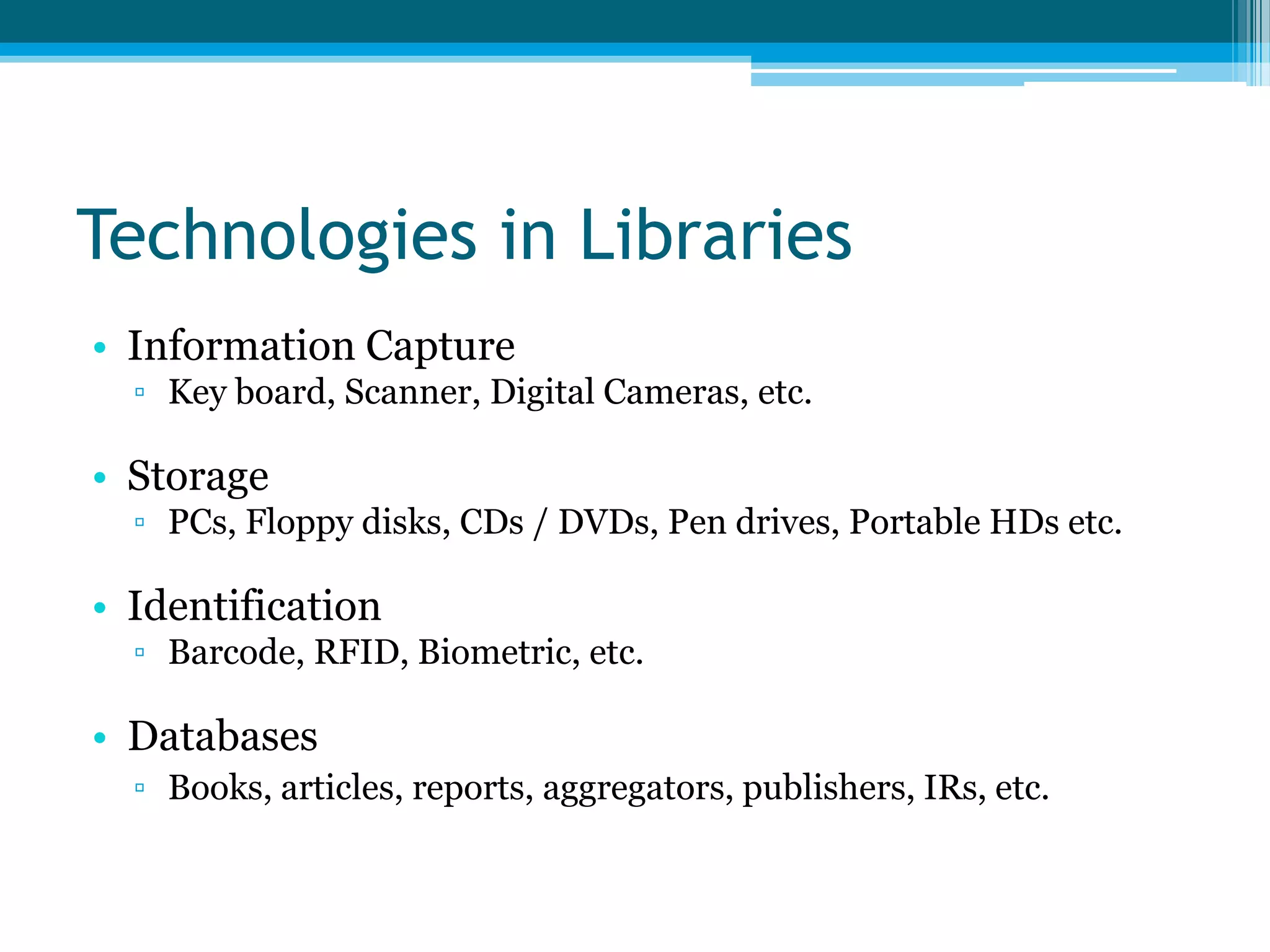
Technologies in Libraries
• Information Capture
▫ Key board, Scanner, Digital Cameras, etc.

• Storage
▫ PCs, Floppy disks, CDs / DVDs, Pen drives, Portable HDs etc.

• Identification
▫ Barcode, RFID, Biometric, etc.

• Databases
▫ Books, articles, reports, aggregators, publishers, IRs, etc.
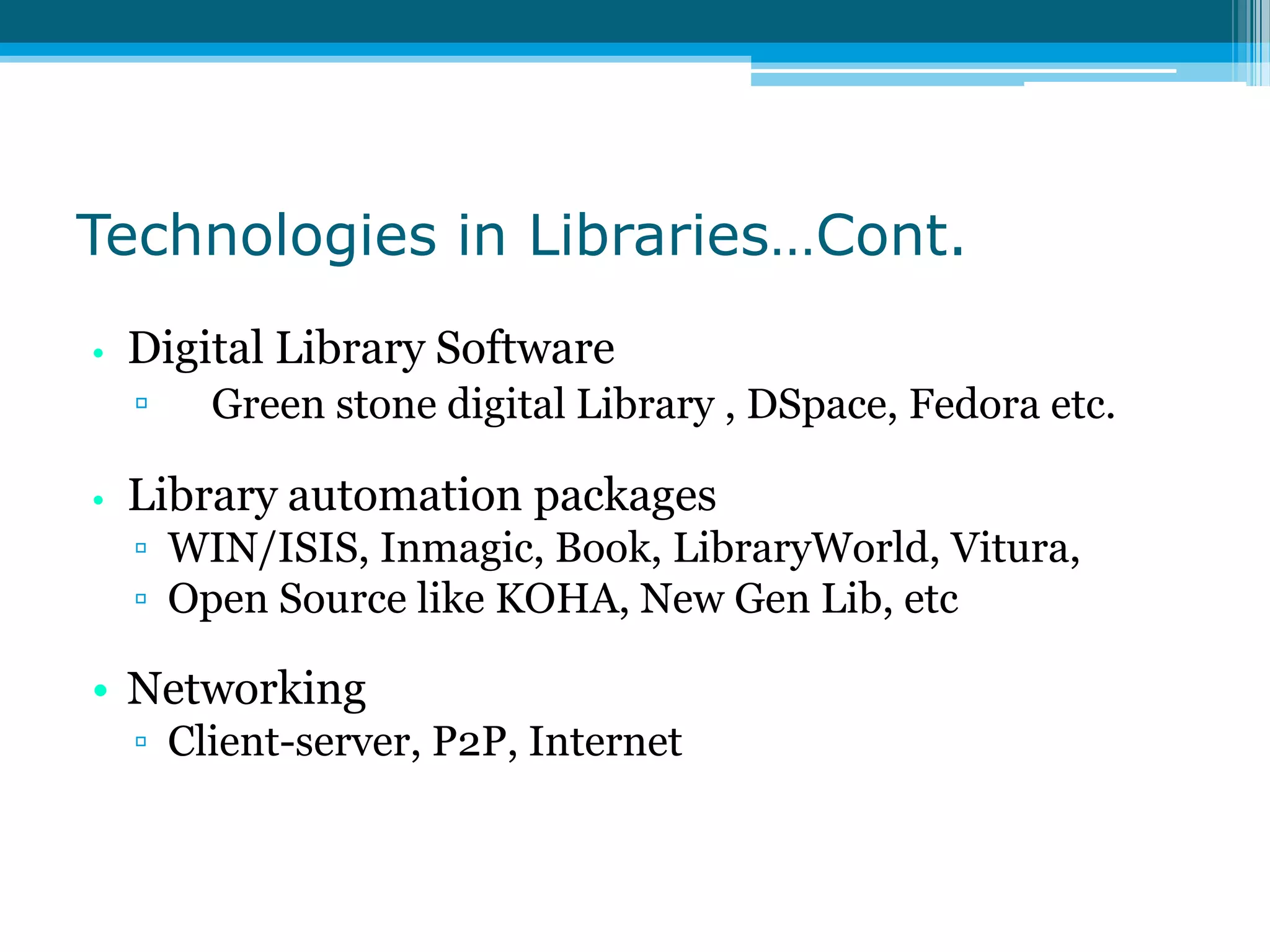
Technologies in Libraries…Cont.
•

Digital Library Software
▫ Green stone digital Library , DSpace, Fedora etc.

•

Library automation packages
▫ WIN/ISIS, Inmagic, Book, LibraryWorld, Vitura,
▫ Open Source like KOHA, New Gen Lib, etc

• Networking
▫ Client-server, P2P, Internet
Why ICT in Libraries?
•
•
•
•
•
•
•

Speed
Storage
Accuracy
Reliability
Ease of use
Repetitiveness
Compactness
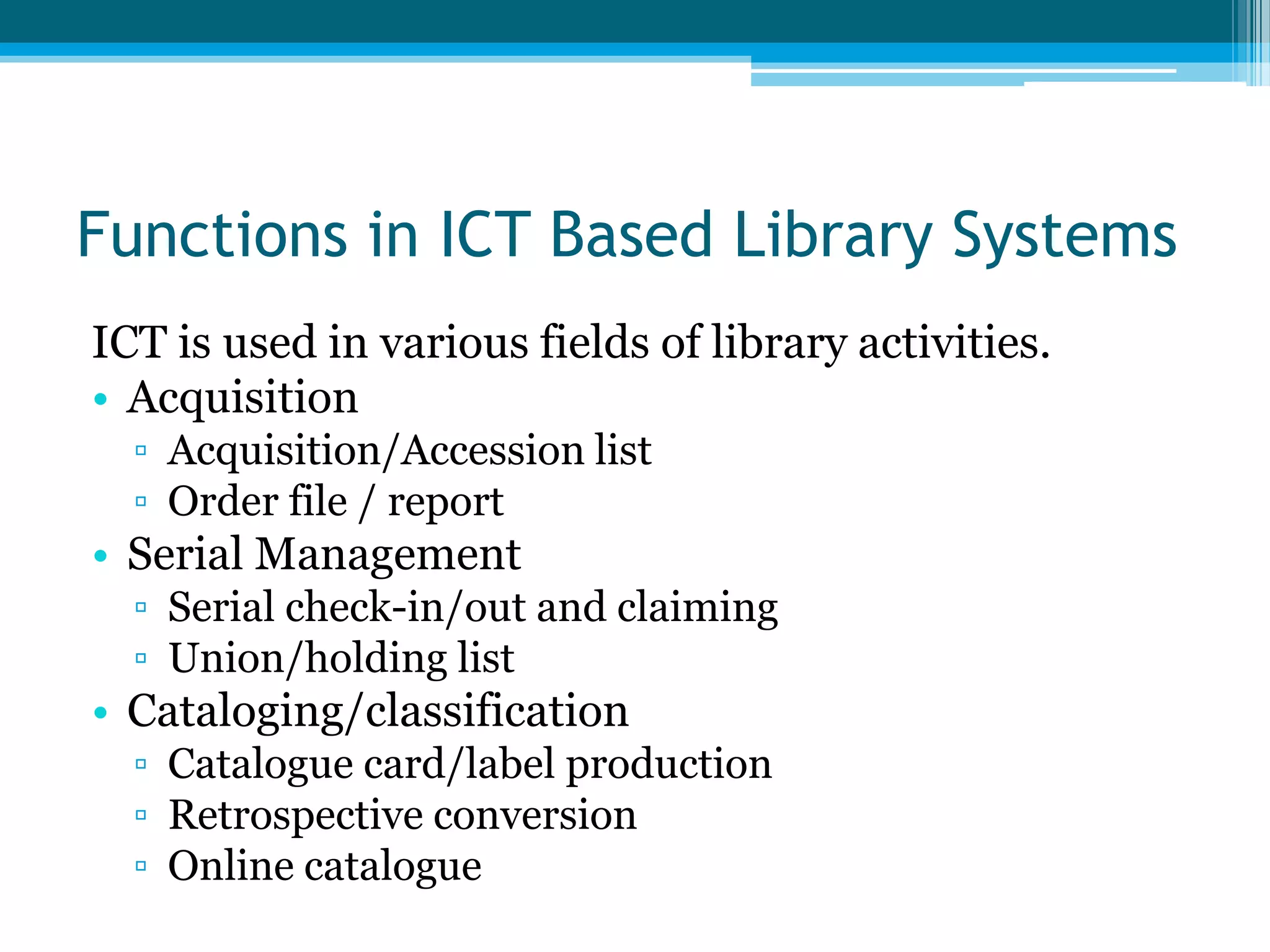
Functions in ICT Based Library Systems
ICT is used in various fields of library activities.
• Acquisition
▫ Acquisition/Accession list
▫ Order file / report

• Serial Management
▫ Serial check-in/out and claiming
▫ Union/holding list

• Cataloging/classification
▫ Catalogue card/label production
▫ Retrospective conversion
▫ Online catalogue
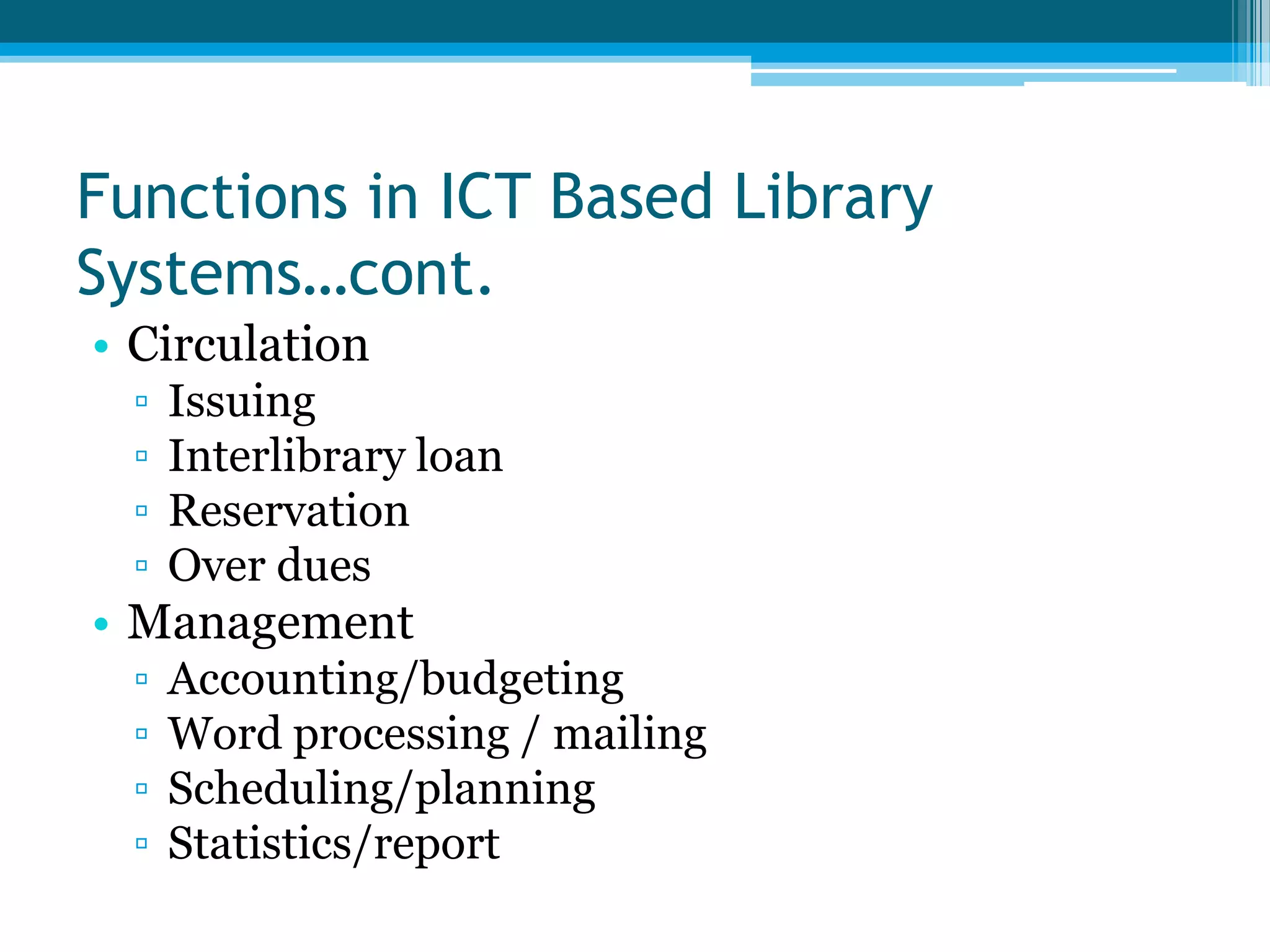
Functions in ICT Based Library
Systems…cont.
• Circulation
▫
▫
▫
▫

Issuing
Interlibrary loan
Reservation
Over dues

• Management
▫
▫
▫
▫

Accounting/budgeting
Word processing / mailing
Scheduling/planning
Statistics/report
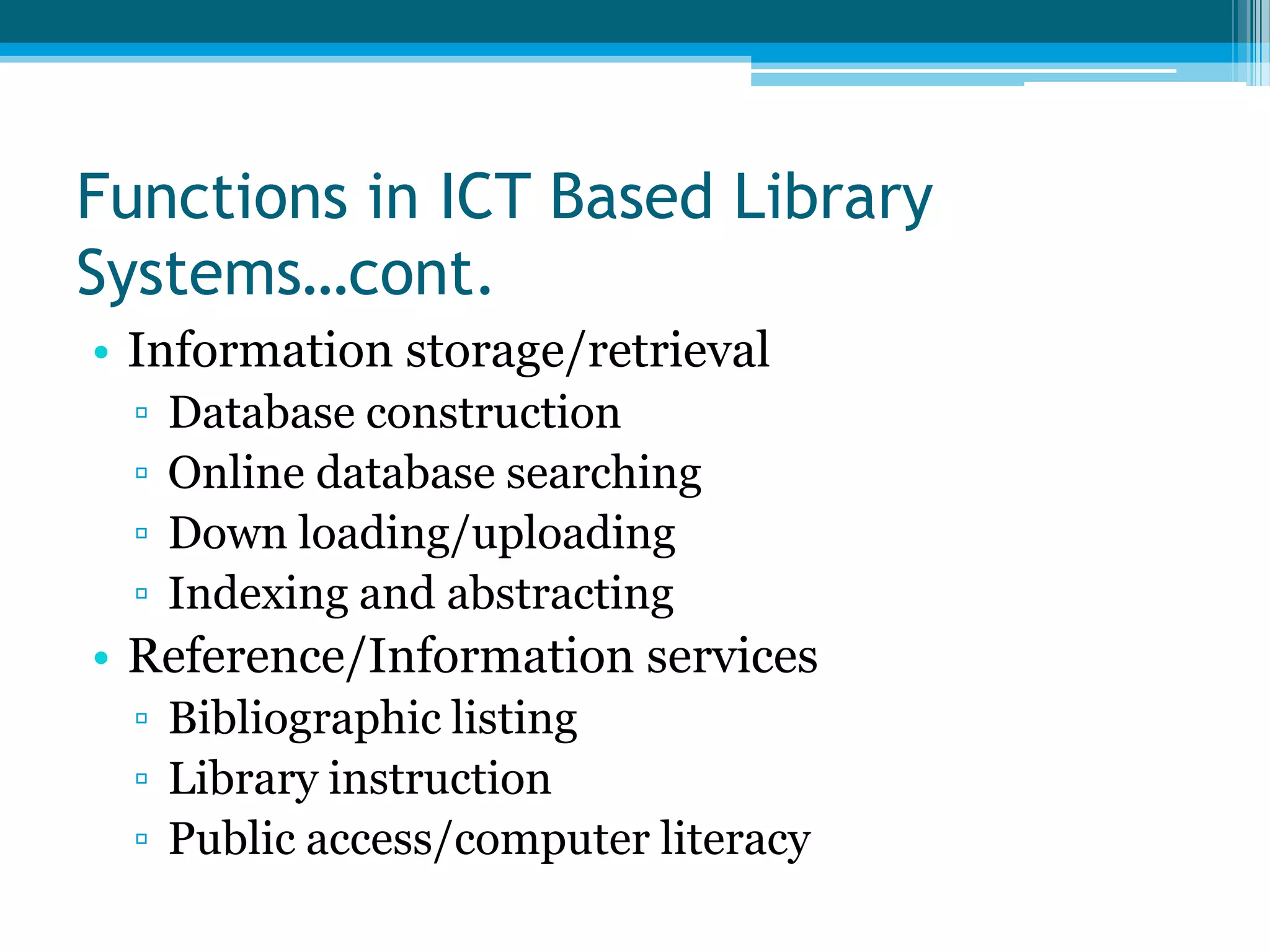
Functions in ICT Based Library
Systems…cont.
• Information storage/retrieval
▫
▫
▫
▫

Database construction
Online database searching
Down loading/uploading
Indexing and abstracting

• Reference/Information services
▫ Bibliographic listing
▫ Library instruction
▫ Public access/computer literacy
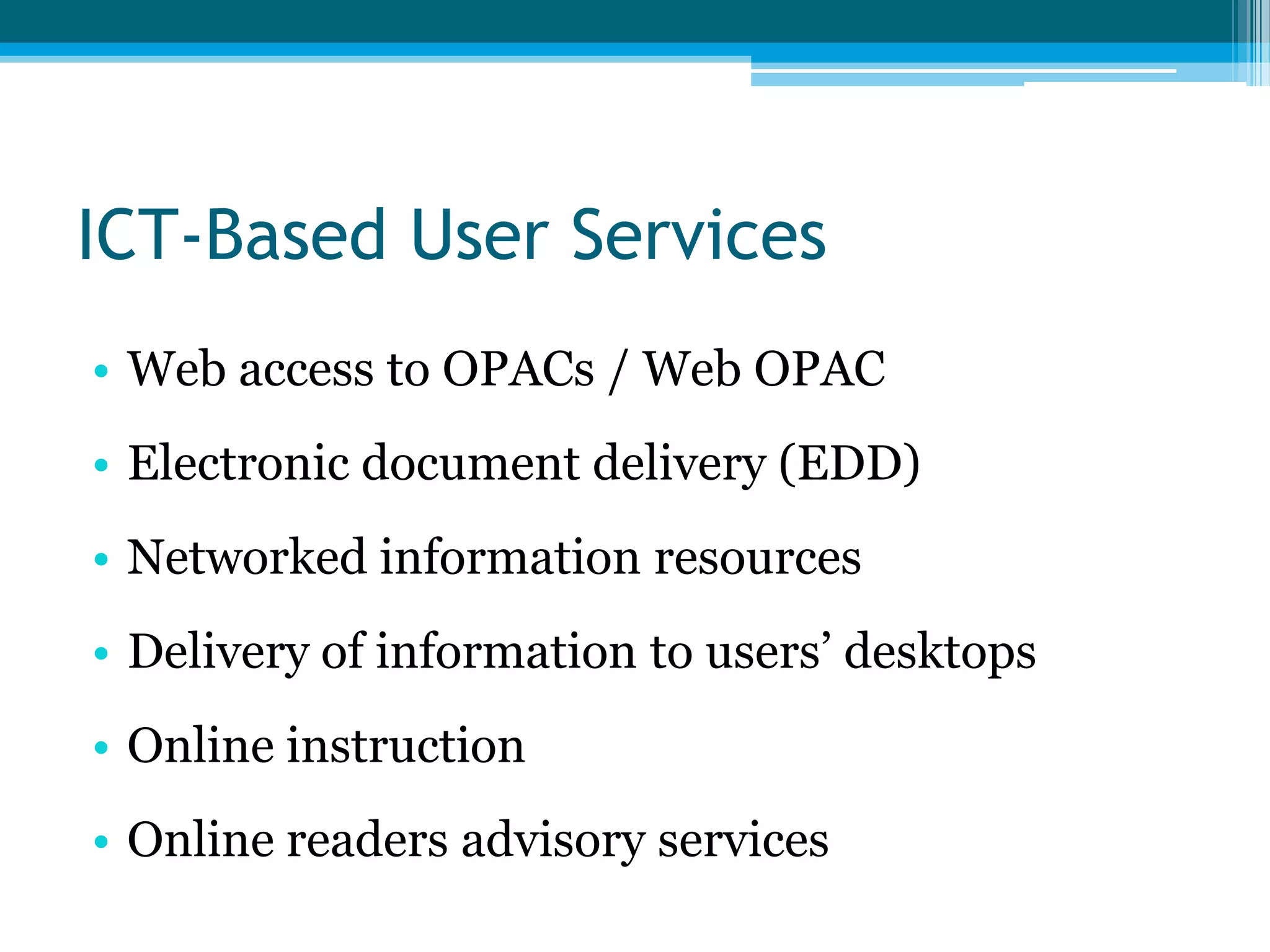
ICT-Based User Services
• Web access to OPACs / Web OPAC
• Electronic document delivery (EDD)

• Networked information resources
• Delivery of information to users‟ desktops
• Online instruction
• Online readers advisory services
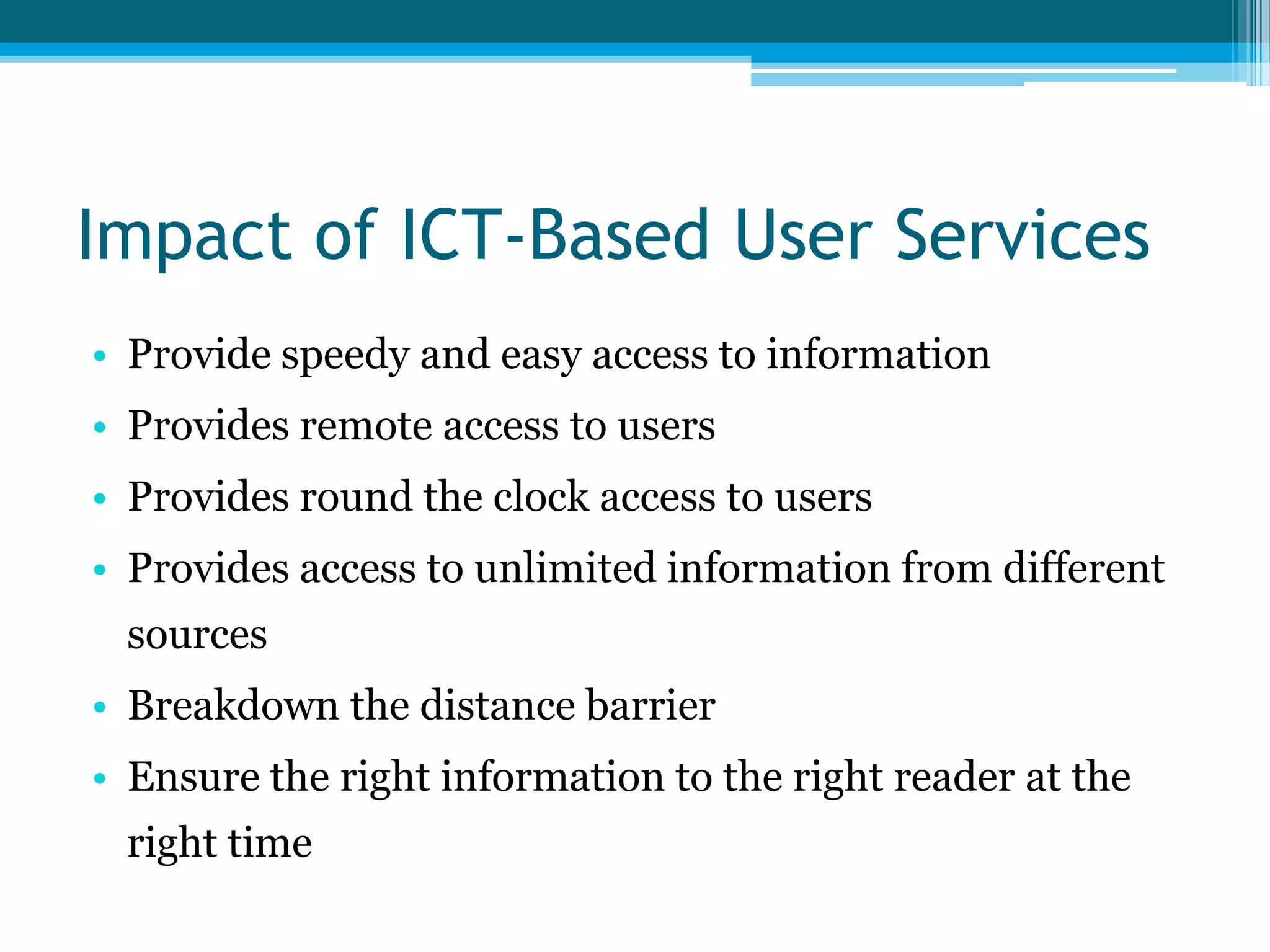
Impact of ICT-Based User Services
• Provide speedy and easy access to information
• Provides remote access to users
• Provides round the clock access to users

• Provides access to unlimited information from different
sources
• Breakdown the distance barrier

• Ensure the right information to the right reader at the
right time
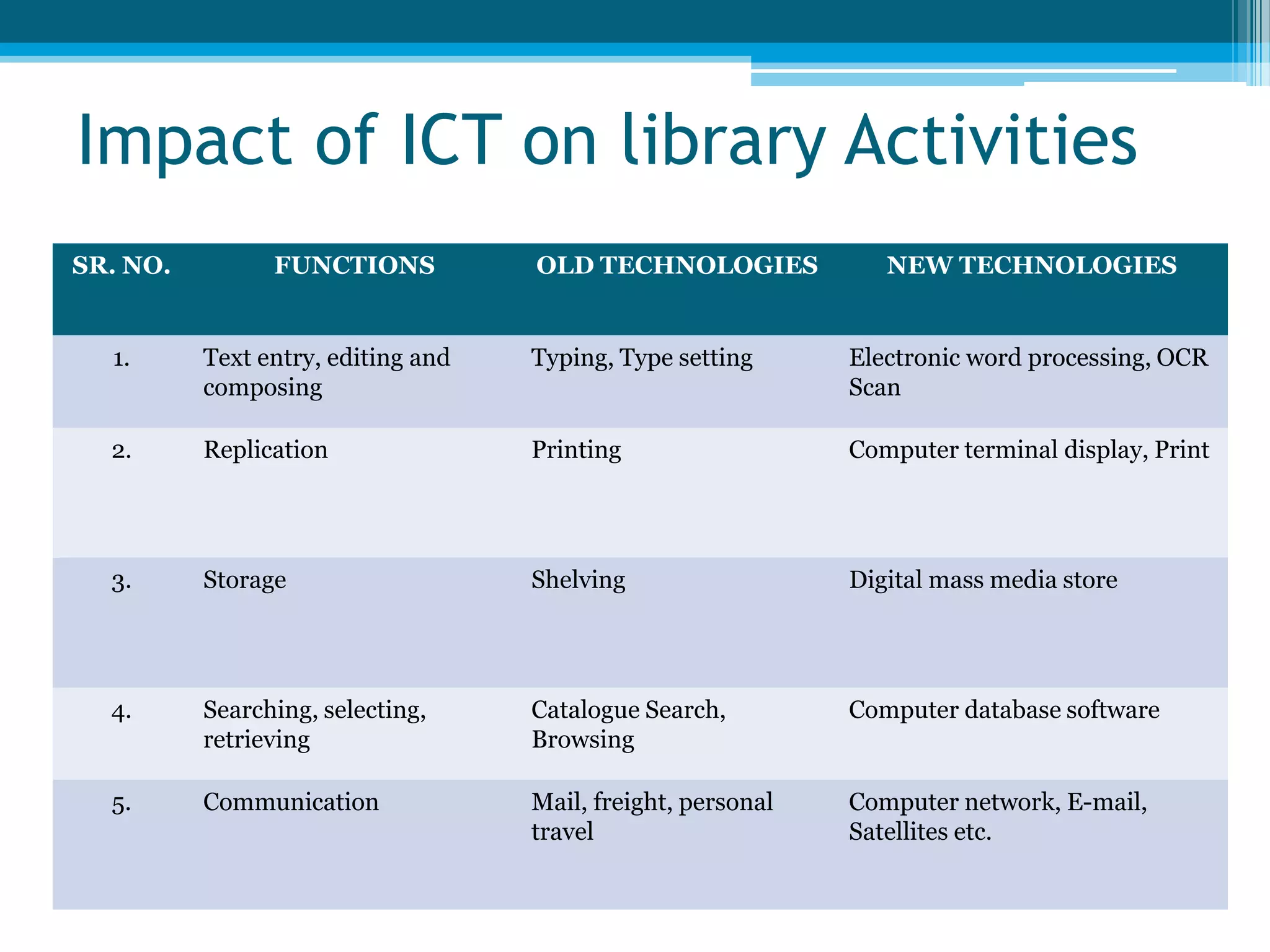
Impact of ICT on library Activities
SR. NO.

FUNCTIONS

OLD TECHNOLOGIES

NEW TECHNOLOGIES

1.

Text entry, editing and
composing

Typing, Type setting

Electronic word processing, OCR
Scan

2.

Replication

Printing

Computer terminal display, Print

3.

Storage

Shelving

Digital mass media store

4.

Searching, selecting,
retrieving

Catalogue Search,
Browsing

Computer database software

5.

Communication

Mail, freight, personal
travel

Computer network, E-mail,
Satellites etc.
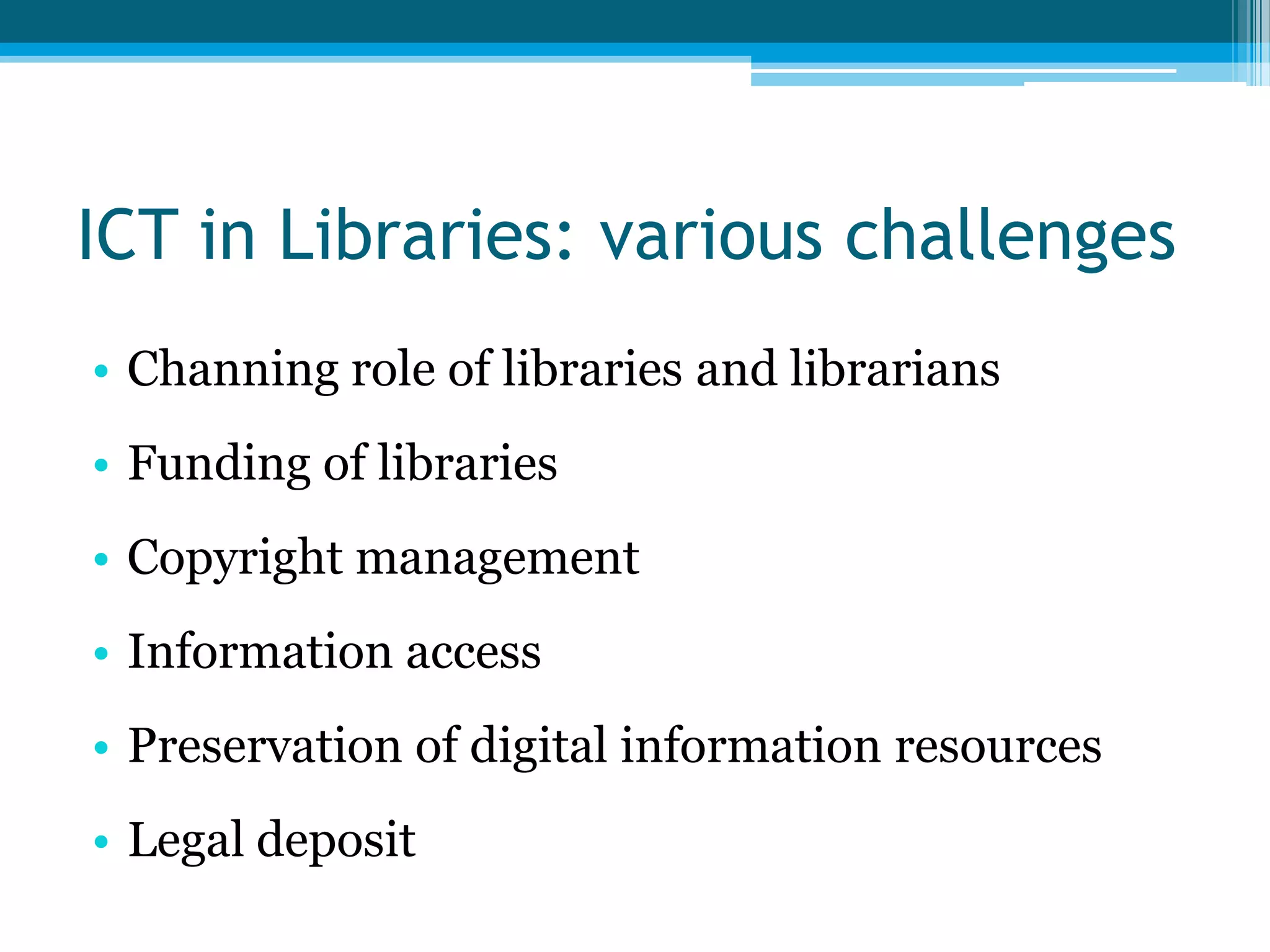
ICT in Libraries: various challenges
• Channing role of libraries and librarians
• Funding of libraries

• Copyright management
• Information access
• Preservation of digital information resources
• Legal deposit
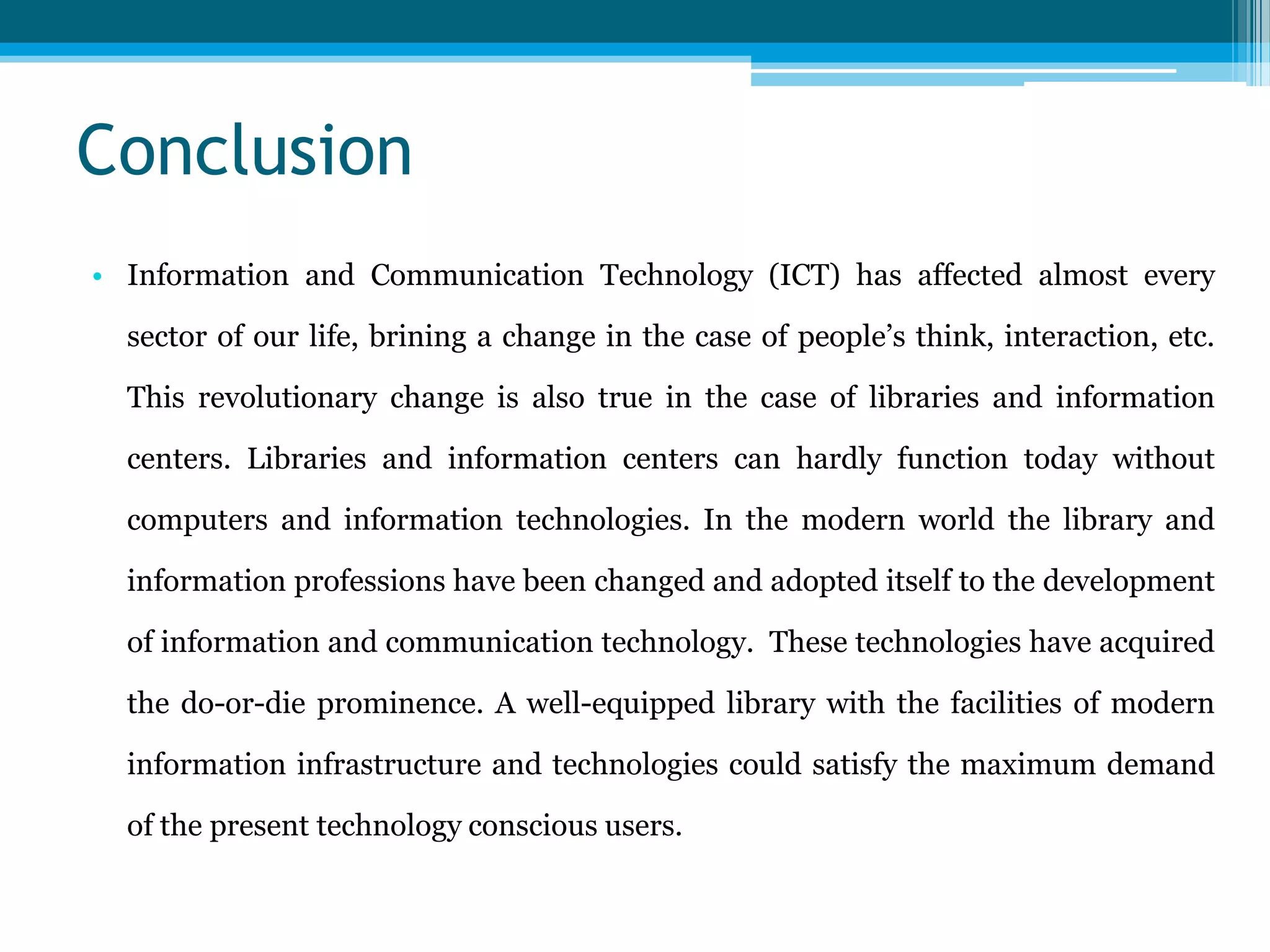
Conclusion
• Information and Communication Technology (ICT) has affected almost every

sector of our life, brining a change in the case of people‟s think, interaction, etc.
This revolutionary change is also true in the case of libraries and information
centers. Libraries and information centers can hardly function today without
computers and information technologies. In the modern world the library and
information professions have been changed and adopted itself to the development
of information and communication technology. These technologies have acquired
the do-or-die prominence. A well-equipped library with the facilities of modern

information infrastructure and technologies could satisfy the maximum demand
of the present technology conscious users.
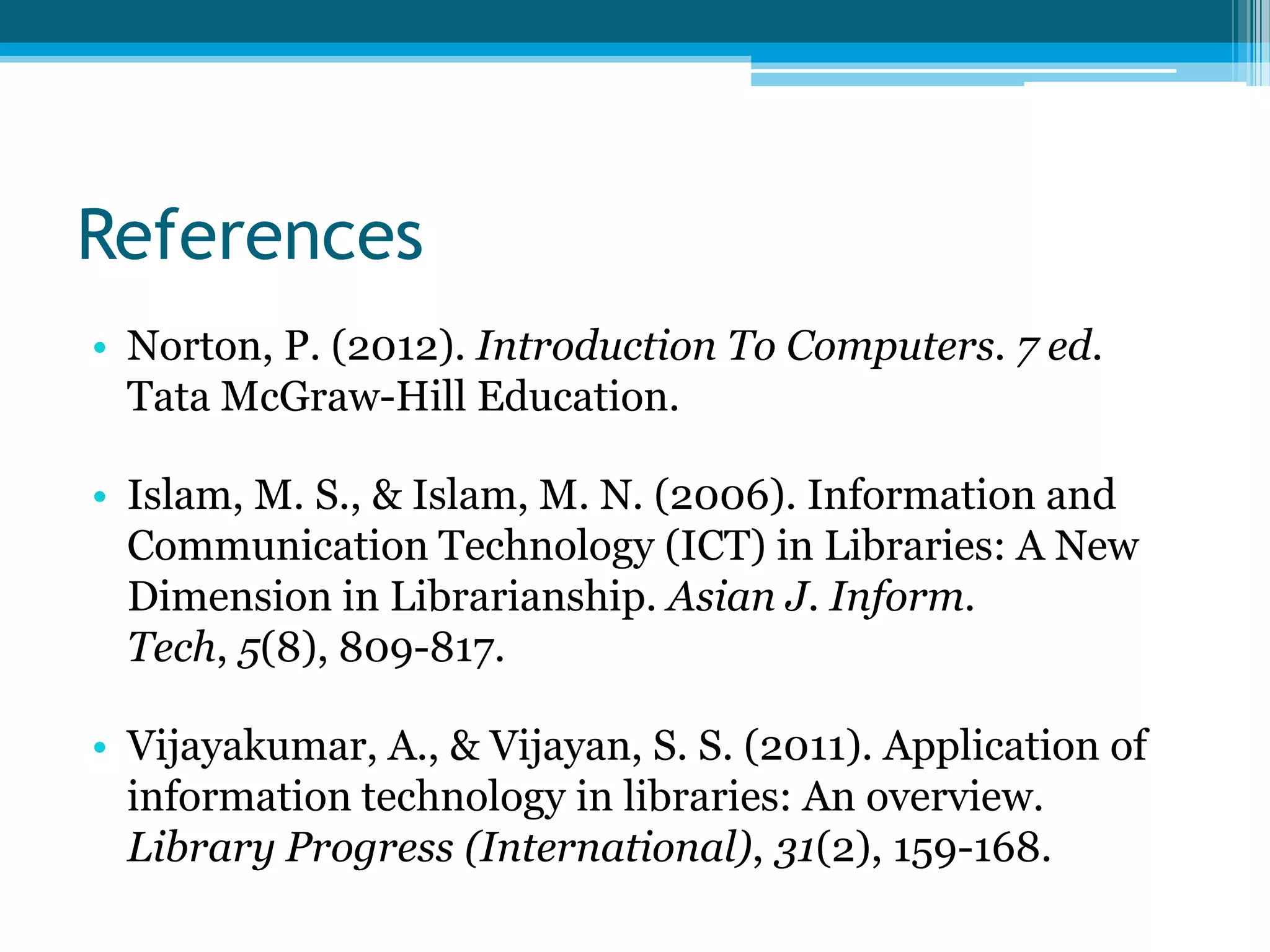
References
• Norton, P. (2012). Introduction To Computers. 7 ed.
Tata McGraw-Hill Education.
• Islam, M. S., & Islam, M. N. (2006). Information and
Communication Technology (ICT) in Libraries: A New
Dimension in Librarianship. Asian J. Inform.
Tech, 5(8), 809-817.

• Vijayakumar, A., & Vijayan, S. S. (2011). Application of
information technology in libraries: An overview.
Library Progress (International), 31(2), 159-168.
Impact of ICT on libraries

Impact of ICT on libraries

  • 1.
    Impact of Informationand Communication Technology (ICT) on Libraries Asif Waheed M.Phil (LIS) Student
  • 2.
    Table of Contents 1. 2. 3. 4. 5. 6. 7. 8. 9. 10. Information,Communication: Definitions What is Information & Communication Technology (ICT)? Component of ICT Technologies in Libraries Why ICT in Libraries? Functions in ICT based library systems. ICT-Based User Services Impact of ICT-Based User Services ICT in Libraries: various challenges Conclusion
  • 3.
    Information The American HeritageDictionary of the English Language: • Knowledge derived from study, experience, or instruction. • Knowledge of specific events or situations that has been gathered or received by communication; intelligence or news. • A collection of facts or data: statistical information. • The act of informing or the condition of being informed; communication of knowledge. • Computer Science. Processed, stored, or transmitted data.
  • 4.
    Communication • The word„Communication‟ originated from Latin word „Communis‟ meaning „Common‟. • “Communication is imparting, conveying or exchanging of ideas and knowledge whether by speech, writing or signs” – Oxford English Dictionary.
  • 5.
    What is Information& Communication Technology (ICT)? • Information and Communication Technology (ICT) is a diverse set of technological tools and resources used to communicate and to create, disseminate, store and manage information.
  • 6.
    Component of ICTin Libraries 1. Computer Technology 2. Communication Technology 3. Reprographic, Micrographic and Printing Technology
  • 7.
    Computer Technology Computer Technologycan be divided into two categories:Computer Hardware A computer is an electronic device that processes data, converting it into information that is useful to people. Computer Software Software consists of the step-by-step instruction that tell the computer what to do.
  • 8.
    Computer Technology…cont. • Computerhardware that can further be divided into following categories:▫ Computers for Organizations     Network Servers Mainframe Computers Minicomputers Supercomputers ▫ Computers for Individual Users      Desktop computers Workstations Notebook computers Handheld computers Smart phones
  • 9.
    Computer Technology…cont. • Computersoftware that can also be divided into following categories:▫ System software  Windows/Linux/Unix ▫ Application software      Word processing software Spreadsheet software Presentation software Graphic and Multimedia software Database Management Softwares
  • 10.
    Communication Technology • Communicationor telecommunication technologies are used to transmit information in the form of signals between remote locations, using electronic electromagnetic media as carriers of signals. or
  • 11.
    Communication Technology…cont. • Communicationtechnologies comprises of the following:▫ Audio technology ▫ Audio-visual technology (Motion Picture, TV, Cable Television System, Videodisc, Videotext) ▫ ▫ ▫ ▫ ▫ ▫ ▫ ▫ ▫ Telephone Cell phone or mobile phone FAX (facsimile transmission) E-mail Voice mail Teleconference Satellite technology Internet (WWW, Remote access, VPN etc.) Network technology (LAN, WAN, MAN etc.)
  • 12.
    Reproduction Technology • Theterm reprographic is used to identify that field of information processing which concern with technologies and equipment for the reproduction of documents ▫ Micrographic technology (Microfilm, Microfiche etc.) ▫ Printing technology ▫ Photocopying technology
  • 13.
    Technologies in Libraries •Information Capture ▫ Key board, Scanner, Digital Cameras, etc. • Storage ▫ PCs, Floppy disks, CDs / DVDs, Pen drives, Portable HDs etc. • Identification ▫ Barcode, RFID, Biometric, etc. • Databases ▫ Books, articles, reports, aggregators, publishers, IRs, etc.
  • 14.
    Technologies in Libraries…Cont. • DigitalLibrary Software ▫ Green stone digital Library , DSpace, Fedora etc. • Library automation packages ▫ WIN/ISIS, Inmagic, Book, LibraryWorld, Vitura, ▫ Open Source like KOHA, New Gen Lib, etc • Networking ▫ Client-server, P2P, Internet
  • 15.
    Why ICT inLibraries? • • • • • • • Speed Storage Accuracy Reliability Ease of use Repetitiveness Compactness
  • 16.
    Functions in ICTBased Library Systems ICT is used in various fields of library activities. • Acquisition ▫ Acquisition/Accession list ▫ Order file / report • Serial Management ▫ Serial check-in/out and claiming ▫ Union/holding list • Cataloging/classification ▫ Catalogue card/label production ▫ Retrospective conversion ▫ Online catalogue
  • 17.
    Functions in ICTBased Library Systems…cont. • Circulation ▫ ▫ ▫ ▫ Issuing Interlibrary loan Reservation Over dues • Management ▫ ▫ ▫ ▫ Accounting/budgeting Word processing / mailing Scheduling/planning Statistics/report
  • 18.
    Functions in ICTBased Library Systems…cont. • Information storage/retrieval ▫ ▫ ▫ ▫ Database construction Online database searching Down loading/uploading Indexing and abstracting • Reference/Information services ▫ Bibliographic listing ▫ Library instruction ▫ Public access/computer literacy
  • 19.
    ICT-Based User Services •Web access to OPACs / Web OPAC • Electronic document delivery (EDD) • Networked information resources • Delivery of information to users‟ desktops • Online instruction • Online readers advisory services
  • 20.
    Impact of ICT-BasedUser Services • Provide speedy and easy access to information • Provides remote access to users • Provides round the clock access to users • Provides access to unlimited information from different sources • Breakdown the distance barrier • Ensure the right information to the right reader at the right time
  • 21.
    Impact of ICTon library Activities SR. NO. FUNCTIONS OLD TECHNOLOGIES NEW TECHNOLOGIES 1. Text entry, editing and composing Typing, Type setting Electronic word processing, OCR Scan 2. Replication Printing Computer terminal display, Print 3. Storage Shelving Digital mass media store 4. Searching, selecting, retrieving Catalogue Search, Browsing Computer database software 5. Communication Mail, freight, personal travel Computer network, E-mail, Satellites etc.
  • 22.
    ICT in Libraries:various challenges • Channing role of libraries and librarians • Funding of libraries • Copyright management • Information access • Preservation of digital information resources • Legal deposit
  • 23.
    Conclusion • Information andCommunication Technology (ICT) has affected almost every sector of our life, brining a change in the case of people‟s think, interaction, etc. This revolutionary change is also true in the case of libraries and information centers. Libraries and information centers can hardly function today without computers and information technologies. In the modern world the library and information professions have been changed and adopted itself to the development of information and communication technology. These technologies have acquired the do-or-die prominence. A well-equipped library with the facilities of modern information infrastructure and technologies could satisfy the maximum demand of the present technology conscious users.
  • 24.
    References • Norton, P.(2012). Introduction To Computers. 7 ed. Tata McGraw-Hill Education. • Islam, M. S., & Islam, M. N. (2006). Information and Communication Technology (ICT) in Libraries: A New Dimension in Librarianship. Asian J. Inform. Tech, 5(8), 809-817. • Vijayakumar, A., & Vijayan, S. S. (2011). Application of information technology in libraries: An overview. Library Progress (International), 31(2), 159-168.