The cell Learning objective: Compare The structure of Prokaryotic cell and Eukaryotic cell The cell
All living things are made up of cells.  The cell is the basic unit of life. Based on the organization of their cellular structures, all living cells can be divided into two groups: prokaryotic and eukaryotic.  Animals, plants, fungi, protozoans, and algae all possess  eukaryotic   cell types . Only bacteria have  prokaryotic cell types .
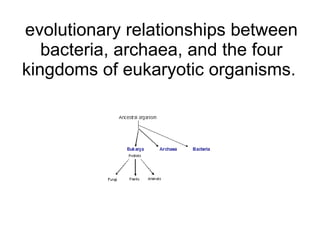
evolutionary relationships between bacteria, archaea, and the four kingdoms of eukaryotic organisms.
Prokaryotic Cell
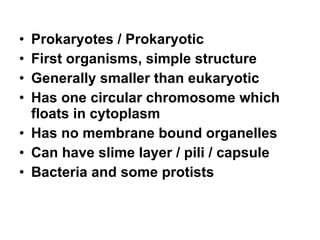
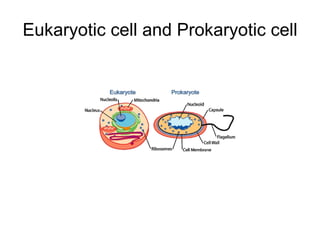
Prokaryotes / Prokaryotic First organisms, simple structure Generally smaller than eukaryotic Has one circular chromosome which floats in cytoplasm Has no membrane bound organelles Can have slime layer / pili / capsule Bacteria and some protists
Eukaryotic cell (Plant & animal cell)
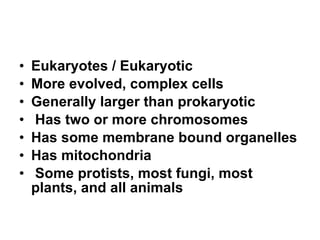
Eukaryotes / Eukaryotic More evolved, complex cells Generally larger than prokaryotic Has two or more chromosomes Has some membrane bound organelles Has mitochondria Some protists, most fungi, most plants, and all animals
Summary
Mitotic or meiotic  By fission or budding Cell division Present Absent Cell Organelles Present Absent Nucleolus More than one linear  Single circular  Chromosome Surrounded by a nuclear membrane  Not surrounded by nuclear membrane  Nuclear region Generally large (5-100m)  Generally small (1-10m)  Size Eukaryotic cell   Prokaryotic cell   Parameter
Eukaryotic cell and Prokaryotic cell
Reference from: <http://en.wikibooks.org/wiki/Human_Physiology/Cell_physiology <http://www.egurucool.com/academics/ess/webarea/samples/10114708/758/34_36_1_8_2.html

The Cell

  • 1.
    The cell Learningobjective: Compare The structure of Prokaryotic cell and Eukaryotic cell The cell
  • 2.
    All living thingsare made up of cells. The cell is the basic unit of life. Based on the organization of their cellular structures, all living cells can be divided into two groups: prokaryotic and eukaryotic. Animals, plants, fungi, protozoans, and algae all possess eukaryotic cell types . Only bacteria have prokaryotic cell types .
  • 3.
    evolutionary relationships betweenbacteria, archaea, and the four kingdoms of eukaryotic organisms.
  • 4.
  • 5.
    Prokaryotes / ProkaryoticFirst organisms, simple structure Generally smaller than eukaryotic Has one circular chromosome which floats in cytoplasm Has no membrane bound organelles Can have slime layer / pili / capsule Bacteria and some protists
  • 6.
    Eukaryotic cell (Plant& animal cell)
  • 7.
    Eukaryotes / EukaryoticMore evolved, complex cells Generally larger than prokaryotic Has two or more chromosomes Has some membrane bound organelles Has mitochondria Some protists, most fungi, most plants, and all animals
  • 8.
  • 9.
    Mitotic or meiotic By fission or budding Cell division Present Absent Cell Organelles Present Absent Nucleolus More than one linear Single circular Chromosome Surrounded by a nuclear membrane Not surrounded by nuclear membrane Nuclear region Generally large (5-100m) Generally small (1-10m) Size Eukaryotic cell Prokaryotic cell Parameter
  • 10.
    Eukaryotic cell andProkaryotic cell
  • 11.
    Reference from: <http://en.wikibooks.org/wiki/Human_Physiology/Cell_physiology<http://www.egurucool.com/academics/ess/webarea/samples/10114708/758/34_36_1_8_2.html