12 | Science, Technology,
Engineering, and Mathematics
(STEM)
General Biology 1
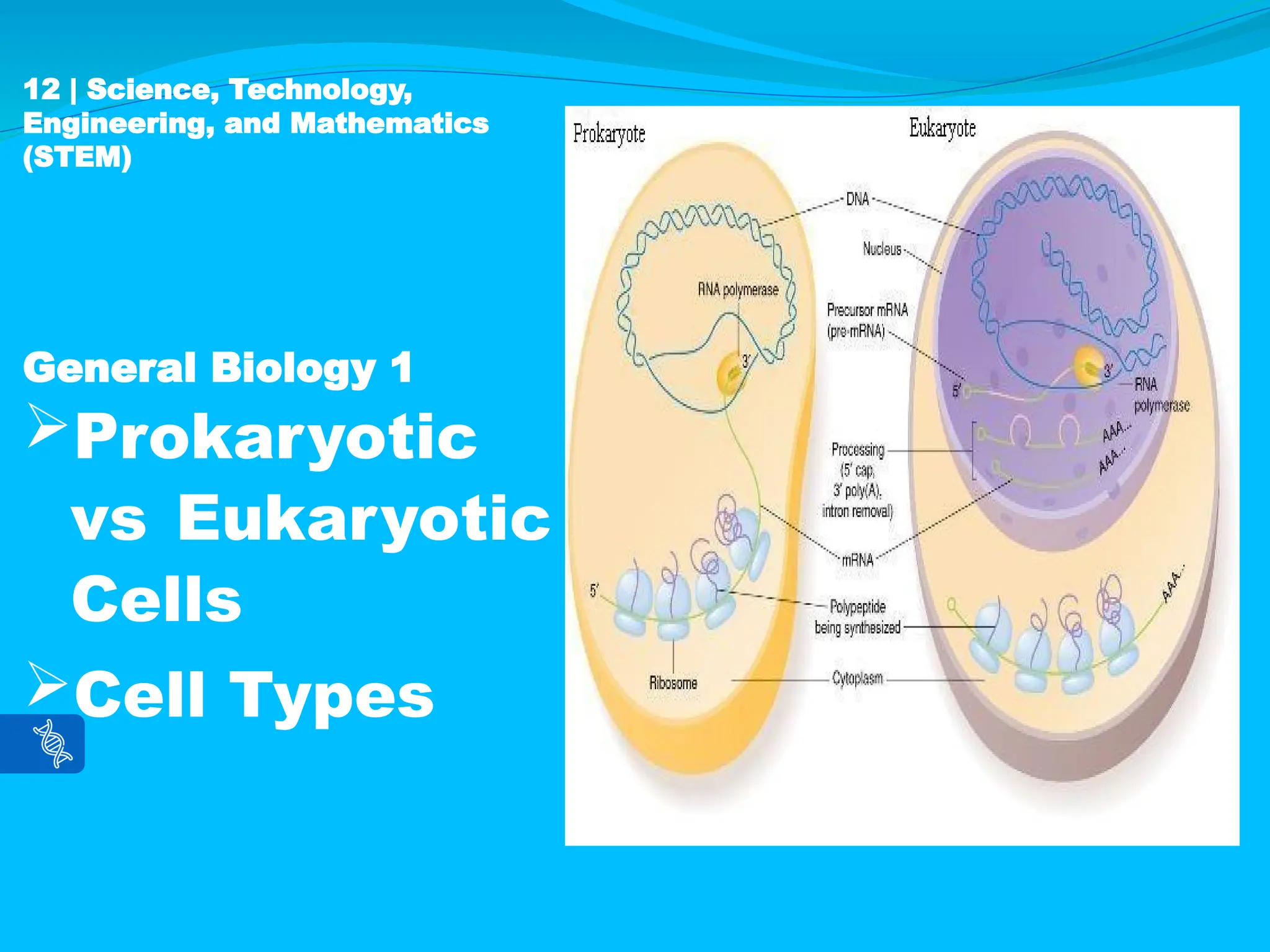
Prokaryotic
vs Eukaryotic
Cells
Cell Types
REVIEW
1. This organelle is for
protein synthesis and it is
present in prokaryotes and
eukaryotes
 A. Cytoplasm
B. Centrosome
C. Ribosome
D. Golgi body
1. This organelle is for
protein synthesis and it is
present in prokaryotes and
eukaryotes
 A. Cytoplasm
B. Centrosome
C. Ribosome
D. Golgi body
2. Provide turgor to plant cells
as fluid inside the central
vacuoles; site of metabolic
reaction; medium where which
organelle are found and it is
like a jelly like fluid
A. Cytoskeleton
B Chloroplast
C. Cytoplasm
2. Provide turgor to plant cells
as fluid inside the central
vacuoles; site of metabolic
reaction; medium where which
organelle are found and it is
like a jelly like fluid
A. Cytoskeleton
B Chloroplast
C. Cytoplasm
3. He observed box-shape which
called cells under a microscope.
A.Robert Hooke
B. Francesco Redi
C. Anton van Leeuwenhoek
3. He observed cork cells under
a microscope
A.Robert Hooke
B. Francesco Redi
C. Anton van Leeuwenhoek
4. The _________ is a
basic unit of life
A. Oganism
B. Cell
C. Tissue
D. Organ
4. The _________ is a
basic unit of life
A. Oganism
B. Cell
C. Tissue
D. Organ
Also known as
single cell
organism
Also known as
single cell organism
PROKARYOTES
Prepared by: ERNIE JAY N ALELOJO, LPT
Prokaryotes
and Eukaryotes
Considering the images, what
kind of home would you choose
and how would you characterize
a "perfect" house”?
1.. Compare and contrast the features of prokaryotic
and eukaryotic cells; and
2. Determine the different types of cells and their
functions
3. appreciate the complexity and diversity of cells by
expressing curiosity about the different types of
cells
At the end of this course, the
learners are expected to:
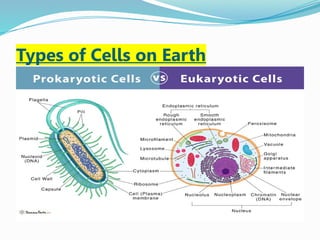
Cells fall into one of two broad
categories: prokaryotic and eukaryotic.
The single-celled organisms of the
domains Bacteria and Archaea are
classified as prokaryotes (pro = before;
karyon– = nucleus). Animal cells, plant
cells, fungi, and protists are eukaryotes
introduction
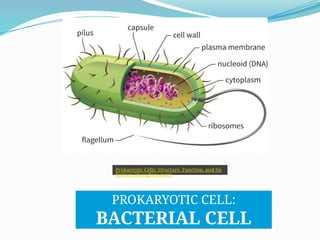
PROKARYOTIC CELL
 . It is a simple and single-celled organism that
lack of nucleus and membrane-bound
organelles.
 The DNA of the prokaryotes organism is found
in a central region of the cell called
NUCLEOID.
 Typical prokaryotic cells range from 0.1 to 5.0 μm
in diameter
PROKARYOTIC CELL
• This can be compared to a studio-type
of a condominium unit because of the
lack of compartments.
 Prokaryotic organisms are
metabolically diverse because they
can utilize different nutrients and
energy sources and they can inhabit all
types of environment on Earth.
Prokaryotic Cells: Structure, Function, and De
finition (thoughtco.com)
PROKARYOTIC CELL:
BACTERIAL CELL
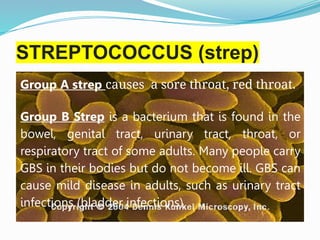
STREPTOCOCCUS (strep)
Group A strep causes a sore throat, red throat.
Group B Strep is a bacterium that is found in the
bowel, genital tract, urinary tract, throat, or
respiratory tract of some adults. Many people carry
GBS in their bodies but do not become ill. GBS can
cause mild disease in adults, such as urinary tract
infections (bladder infections)
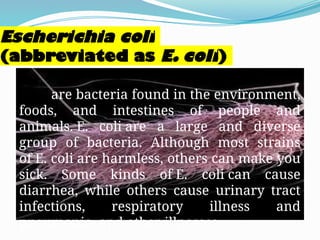
Escherichia coli
(abbreviated as E. coli)
are bacteria found in the environment,
foods, and intestines of people and
animals. E. coli are a large and diverse
group of bacteria. Although most strains
of E. coli are harmless, others can make you
sick. Some kinds of E. coli can cause
diarrhea, while others cause urinary tract
infections, respiratory illness and
pneumonia, and other illnesses
EUKARYOTIC CELL
.
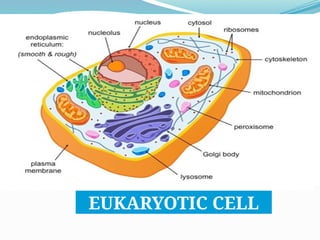
 . The word eukaryotic means “true kernel” or “true
nucleus,” alluding to the presence of the membrane-
bound nucleus in these cells
 The eukaryotic cell has a nuclear membrane that
surrounds the nucleus, in which the well-
defined chromosomes or bodies containing the
hereditary material are located.
 This also contains organelles.
 Organelles are small, specialized structures in cells
which operate like organs by carrying out specific tasks.
EUKARYOTIC CELL
This is comparable to a mansion
which has several rooms or
compartments.
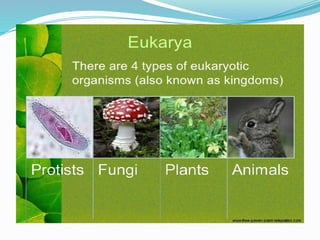
Domain Eukarya which includes
protists, fungi, plants, and
animals are examples of
eukaryotes.
What is a Plant Cell? - Answered -
Twinkl teaching Wiki
EUKARYOTIC CELL
Distinguish Features of Prokaryotic and
Eukaryotic Cell
Continued…
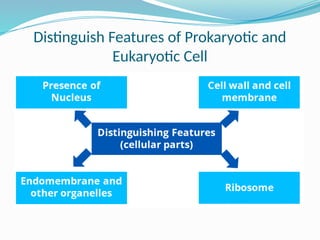
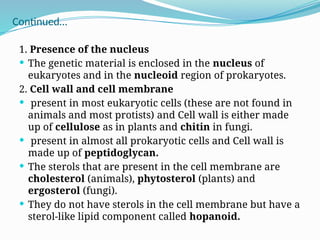
1. Presence of the nucleus
 The genetic material is enclosed in the nucleus of
eukaryotes and in the nucleoid region of prokaryotes.
2. Cell wall and cell membrane
 present in most eukaryotic cells (these are not found in
animals and most protists) and Cell wall is either made
up of cellulose as in plants and chitin in fungi.
 present in almost all prokaryotic cells and Cell wall is
made up of peptidoglycan.
 The sterols that are present in the cell membrane are
cholesterol (animals), phytosterol (plants) and
ergosterol (fungi).
 They do not have sterols in the cell membrane but have a
sterol-like lipid component called hopanoid.
Continued…
3. Endomembrane and other organelles
 Endomembrane system include the rough and
smooth endoplasmic reticulum, Golgi apparatus,
lysosome, endosome, and vacuole.
 It is present in eukaryotic cells, but not in
prokaryotic cells.
4. Ribosome
 Ribosome can be found in the cytoplasm, outer
nuclear membrane, rough endoplasmic reticulum,
mitochondrion, and chloroplast in eukaryotes.
 all ribosome of prokaryotic cell are found in the
cytoplasm.
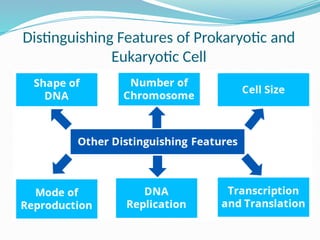
Distinguishing Features of Prokaryotic and
Eukaryotic Cell
Continued…
5. Shape of DNA
 In eukaryotes, it has one covalent, closed, circular
DNA
 prokaryotes have more than one linear DNA with
histone.
6. Number of Chromosomes
 Eukaryote has more than one chromosome so
histones are essential in packaging DNA into
nucleosomes and helping it to condense into
chromatin
 most prokaryotes have only one chromosome and
an extrachromosomal DNA called a plasmid
Continued…
7. Mode of Reproduction
 In eukaryotic cells, individual cells reproduce
through mitosis and meiosis
 most prokaryotic cells reproduce through binary
fission and some reproduce through spores.
8. DNA Replication
 Eukaryotic cells have multiple points of origin
and use unidirectional replication within the
nucleus.
Continued…
In prokaryotes, DNA replication
occurs in two opposing directions
at the same time in the
cytoplasm.
Prokaryotes continuously replicate
their short DNA.
Continued…
9. Transcription and Translation
In eukaryotes, the transcription
occurs in the nucleus and in
prokaryotes, the translation
occurs in the cytoplasm.
In prokaryotes, transcription and
translation can be done at the same
time in the cytoplasm
if NO 1/4
TANONG!
Love Time
Title: Bacterial Culture
Objective:
This instructional guide will walk you
through the process of culturing bacteria, allowing
you to grow and study bacterial colonies in a
controlled laboratory environment.
LAB
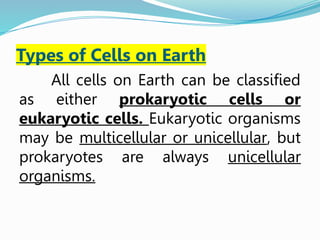
Types of Cells on Earth
All cells on Earth can be classified
as either prokaryotic cells or
eukaryotic cells. Eukaryotic organisms
may be multicellular or unicellular, but
prokaryotes are always unicellular
organisms.
Types of Cells on Earth
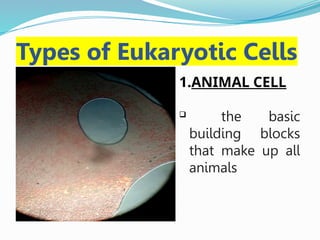
Types of Eukaryotic Cells
1.ANIMAL CELL
 the basic
building blocks
that make up all
animals
Types of Eukaryotic Cells
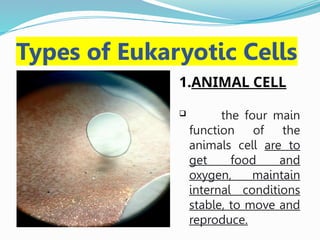
1.ANIMAL CELL
 the four main
function of the
animals cell are to
get food and
oxygen, maintain
internal conditions
stable, to move and
reproduce.
Types of Eukaryotic Cells
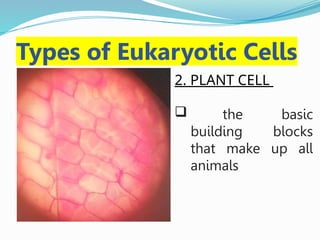
 2. 2. PLANT CELL
 the basic
building blocks
that make up all
animals
Types of Eukaryotic Cells
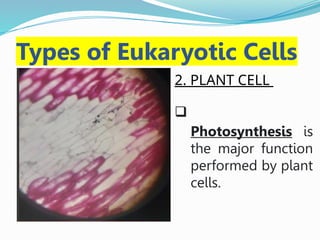
 2. 2. PLANT CELL

Photosynthesis is
the major function
performed by plant
cells.

Prokaryotic vs Eukaryotic Cells and Cell Types

  • 1.
    12 | Science,Technology, Engineering, and Mathematics (STEM) General Biology 1 Prokaryotic vs Eukaryotic Cells Cell Types
  • 2.
  • 3.
    1. This organelleis for protein synthesis and it is present in prokaryotes and eukaryotes  A. Cytoplasm B. Centrosome C. Ribosome D. Golgi body
  • 4.
    1. This organelleis for protein synthesis and it is present in prokaryotes and eukaryotes  A. Cytoplasm B. Centrosome C. Ribosome D. Golgi body
  • 5.
    2. Provide turgorto plant cells as fluid inside the central vacuoles; site of metabolic reaction; medium where which organelle are found and it is like a jelly like fluid A. Cytoskeleton B Chloroplast C. Cytoplasm
  • 6.
    2. Provide turgorto plant cells as fluid inside the central vacuoles; site of metabolic reaction; medium where which organelle are found and it is like a jelly like fluid A. Cytoskeleton B Chloroplast C. Cytoplasm
  • 7.
    3. He observedbox-shape which called cells under a microscope. A.Robert Hooke B. Francesco Redi C. Anton van Leeuwenhoek
  • 8.
    3. He observedcork cells under a microscope A.Robert Hooke B. Francesco Redi C. Anton van Leeuwenhoek
  • 9.
    4. The _________is a basic unit of life A. Oganism B. Cell C. Tissue D. Organ
  • 10.
    4. The _________is a basic unit of life A. Oganism B. Cell C. Tissue D. Organ
  • 11.
    Also known as singlecell organism
  • 12.
    Also known as singlecell organism PROKARYOTES
  • 13.
    Prepared by: ERNIEJAY N ALELOJO, LPT Prokaryotes and Eukaryotes
  • 14.
    Considering the images,what kind of home would you choose and how would you characterize a "perfect" house”?
  • 15.
    1.. Compare andcontrast the features of prokaryotic and eukaryotic cells; and 2. Determine the different types of cells and their functions 3. appreciate the complexity and diversity of cells by expressing curiosity about the different types of cells At the end of this course, the learners are expected to:
  • 16.
    Cells fall intoone of two broad categories: prokaryotic and eukaryotic. The single-celled organisms of the domains Bacteria and Archaea are classified as prokaryotes (pro = before; karyon– = nucleus). Animal cells, plant cells, fungi, and protists are eukaryotes introduction
  • 17.
    PROKARYOTIC CELL  .It is a simple and single-celled organism that lack of nucleus and membrane-bound organelles.  The DNA of the prokaryotes organism is found in a central region of the cell called NUCLEOID.  Typical prokaryotic cells range from 0.1 to 5.0 μm in diameter
  • 18.
    PROKARYOTIC CELL • Thiscan be compared to a studio-type of a condominium unit because of the lack of compartments.  Prokaryotic organisms are metabolically diverse because they can utilize different nutrients and energy sources and they can inhabit all types of environment on Earth.
  • 19.
    Prokaryotic Cells: Structure,Function, and De finition (thoughtco.com) PROKARYOTIC CELL: BACTERIAL CELL
  • 20.
    STREPTOCOCCUS (strep) Group Astrep causes a sore throat, red throat. Group B Strep is a bacterium that is found in the bowel, genital tract, urinary tract, throat, or respiratory tract of some adults. Many people carry GBS in their bodies but do not become ill. GBS can cause mild disease in adults, such as urinary tract infections (bladder infections)
  • 21.
    Escherichia coli (abbreviated asE. coli) are bacteria found in the environment, foods, and intestines of people and animals. E. coli are a large and diverse group of bacteria. Although most strains of E. coli are harmless, others can make you sick. Some kinds of E. coli can cause diarrhea, while others cause urinary tract infections, respiratory illness and pneumonia, and other illnesses
  • 22.
    EUKARYOTIC CELL .  .The word eukaryotic means “true kernel” or “true nucleus,” alluding to the presence of the membrane- bound nucleus in these cells  The eukaryotic cell has a nuclear membrane that surrounds the nucleus, in which the well- defined chromosomes or bodies containing the hereditary material are located.  This also contains organelles.  Organelles are small, specialized structures in cells which operate like organs by carrying out specific tasks.
  • 23.
    EUKARYOTIC CELL This iscomparable to a mansion which has several rooms or compartments. Domain Eukarya which includes protists, fungi, plants, and animals are examples of eukaryotes.
  • 24.
    What is aPlant Cell? - Answered - Twinkl teaching Wiki EUKARYOTIC CELL
  • 26.
    Distinguish Features ofProkaryotic and Eukaryotic Cell
  • 27.
    Continued… 1. Presence ofthe nucleus  The genetic material is enclosed in the nucleus of eukaryotes and in the nucleoid region of prokaryotes. 2. Cell wall and cell membrane  present in most eukaryotic cells (these are not found in animals and most protists) and Cell wall is either made up of cellulose as in plants and chitin in fungi.  present in almost all prokaryotic cells and Cell wall is made up of peptidoglycan.  The sterols that are present in the cell membrane are cholesterol (animals), phytosterol (plants) and ergosterol (fungi).  They do not have sterols in the cell membrane but have a sterol-like lipid component called hopanoid.
  • 28.
    Continued… 3. Endomembrane andother organelles  Endomembrane system include the rough and smooth endoplasmic reticulum, Golgi apparatus, lysosome, endosome, and vacuole.  It is present in eukaryotic cells, but not in prokaryotic cells. 4. Ribosome  Ribosome can be found in the cytoplasm, outer nuclear membrane, rough endoplasmic reticulum, mitochondrion, and chloroplast in eukaryotes.  all ribosome of prokaryotic cell are found in the cytoplasm.
  • 29.
    Distinguishing Features ofProkaryotic and Eukaryotic Cell
  • 30.
    Continued… 5. Shape ofDNA  In eukaryotes, it has one covalent, closed, circular DNA  prokaryotes have more than one linear DNA with histone. 6. Number of Chromosomes  Eukaryote has more than one chromosome so histones are essential in packaging DNA into nucleosomes and helping it to condense into chromatin  most prokaryotes have only one chromosome and an extrachromosomal DNA called a plasmid
  • 31.
    Continued… 7. Mode ofReproduction  In eukaryotic cells, individual cells reproduce through mitosis and meiosis  most prokaryotic cells reproduce through binary fission and some reproduce through spores. 8. DNA Replication  Eukaryotic cells have multiple points of origin and use unidirectional replication within the nucleus.
  • 32.
    Continued… In prokaryotes, DNAreplication occurs in two opposing directions at the same time in the cytoplasm. Prokaryotes continuously replicate their short DNA.
  • 33.
    Continued… 9. Transcription andTranslation In eukaryotes, the transcription occurs in the nucleus and in prokaryotes, the translation occurs in the cytoplasm. In prokaryotes, transcription and translation can be done at the same time in the cytoplasm
  • 34.
  • 35.
    Love Time Title: BacterialCulture Objective: This instructional guide will walk you through the process of culturing bacteria, allowing you to grow and study bacterial colonies in a controlled laboratory environment. LAB
  • 36.
    Types of Cellson Earth All cells on Earth can be classified as either prokaryotic cells or eukaryotic cells. Eukaryotic organisms may be multicellular or unicellular, but prokaryotes are always unicellular organisms.
  • 37.
  • 38.
    Types of EukaryoticCells 1.ANIMAL CELL  the basic building blocks that make up all animals
  • 39.
    Types of EukaryoticCells 1.ANIMAL CELL  the four main function of the animals cell are to get food and oxygen, maintain internal conditions stable, to move and reproduce.
  • 40.
    Types of EukaryoticCells  2. 2. PLANT CELL  the basic building blocks that make up all animals
  • 41.
    Types of EukaryoticCells  2. 2. PLANT CELL  Photosynthesis is the major function performed by plant cells.

Editor's Notes

  • #1 Contentment sept 29 cell Competence sept 26 Temperance sept 20
  • #17  capsule like organis micrometers (μmm
  • #18 Archaea- a group of micro-organisms that some how leaves in the extreme environments, for example at high pressures, salt concentrations or temperatures. These types of organisms are called extremophiles. halophiles (salty environments e.g Halobacteriaceae), Psychrophiles  (cold environments), and thermophiles (hot environments/ e.gMethanopyrus kandleri ).
  • #19 Flagellum- locomotion Pili used to exchanged genetic material during reproduction called conjunction While the fimbriae are bristle-like short fibers occurring on the bacterial surface, Pili are long hair-like tubular microfibers found on the surface of bacteria. 
  • #20   Strep is short for Streptococcus, a type of bacteria. There are several types. Two of them cause most of the strep infections in people: group A and group B. Group A strep causes: Strep throat - a sore, red throat. Group B Streptococcus is is a bacterium that is found in the bowel, genital tract, urinary tract, throat, or respiratory tract of some adults. Many people carry GBS in their bodies but do not become ill. GBS can cause mild disease in adults, such as urinary tract infections (bladder infections)
  • #21 Escherichia coli (abbreviated as E. coli) are bacteria found in the environment, foods, and intestines of people and animals. E. coli are a large and diverse group of bacteria. Although most strains of E. coli are harmless, others can make you sick. Some kinds of E. coli can cause diarrhea, while others cause urinary tract infections, respiratory illness and pneumonia, and other illnesses
  • #23 Deoxyribonucleic acid (abbreviated DNA) mitochondrial DNA Chloroplast DNA (cpDNA) Both called cellular dna
  • #27 Peptidoglycan consists of sugar Sterols are a subgroup of steroids to which cholesterol belongs. Chitin and cellulose are both made from glucose
  • #28 Endomembrane it is a system or a group of membranes and organelle that works together to modify package and transport lipids and protein Example: protein synthesis process in the ribosome and the modified xah ni rER sometimes c ER xah is recognize if ok ang protein or hindi pag hindi din I modified nya theres is attached of carbohydrate will happen here after all protein will go directly sa GB for packaging and labelling, ore carbo attachment after synthesis is complete, it will exit via transport vesicle and exit in the plasma membrane. The the body will use the protein.. The protein will use the body or with in the cell
  • #30 Deoxyribonucleic acid  t-a c-g Ribonucleic acid u-a histone is a protein that provides structural support for a chromosome Down syndrome results when abnormal cell division involving chromosome 21 occurs. In humans, each cell normally contains 23 pairs of chromosomes, for a total of 46. Twenty-two of these pairs, called autosomes, look the same in both males and females. The 23rd pair, the sex chromosomes, differ between males and females. Babies with Down syndrome have an extra copy of one of these chromosomes, chromosome 21. A medical term for having an extra copy of a chromosome is 'trisomy. ' Down syndrome is also referred to as Trisomy 21 Plasmids carry genes for replicating their DNA, transferring themselves from one host cell to another, and for a variety of phenotypes. 
  • #31 binary fission, asexual reproduction by a separation of the body into two new bodies. (duplicate//division into two) Mitosis Interphase Prophase Metaphase Anaphase Telophase Cytokinesis Mitosis is the process of chromosomes dividing into two daughter cells Meiosis BIRTH
  • #32 binary fission, asexual reproduction by a separation of the body into two new bodies. (duplicate//division into two)  binary fission, budding, vegetative propagation,  grown from the old parts of another plant like roots, shoots and leaves, without involving any reproductive organ, spore formation (sporogenesis), fragmentation, the process or state of breaking or being broken into small or separate parts. parthenogenesis, a reproductive strategy that involves development of a female (rarely a male) gamete (sex cell) without fertilization.  and apomixis. 
  • #33 Transcription- is the process of making an RNA copy of a gene's DNA sequence. This copy, called messenger RNA (mRNA), carries the gene's protein information encoded in DNA. is the synthesis of a protein Transcription is the first step of the gene expression. It is the process of producing a mRNA molecule from a DNA template. NUCLEUS HAPPED Translation is the second step of gene expression. Moreover, it is the process of converting mRNA molecule into an amino acid sequence of a protein. It occurs in the cell organelle called ribosomes present in the cytoplasm of the cell. 
  • #36 Yeasts and algae are examples of unicellular eukaryotes. Unlike prokaryote cells, eukaryote cells have organelles, cell organs fulfilling important functions in the cell. This is why these cells are for the most part larger than prokaryote cells.
  • #37 Yeasts and algae are examples of unicellular eukaryotes. Unlike prokaryote cells, eukaryote cells have organelles, cell organs fulfilling important functions in the cell. This is why these cells are for the most part larger than prokaryote cells.
  • #38  are the basic building blocks that make up all animals, including birds, fish, reptiles, mammals, and amphibians. Like eukaryotic cells, they contain membrane-bound organelles (such as a nucleus, mitochondria, Golgi apparatus, and endoplasmic reticulum), and are surrounded by a plasma membrane. The four main functions of animals are to get food and oxygen, maintain internal conditions stable, to move and reproduce.
  • #39 absorption mostly happen sa small intestine The jejunum absorbs most of your nutrients: carbohydrates, fats, minerals, proteins, and vitamins. The lowest part of your small intestine is the ileum. This is where the final parts of digestive absorption take place. Homeostasis ph 7.35 to 7.45 average 7.4 (bp= 120/80) sugar less than 100 mg/dL
  • #41 It is the process of preparing food by the plants, by utilizing sunlight, carbon dioxide and water. Autotrophs- an organism that can prodan organism that can produce its own food using light, water, carbon dioxide, or other chemicals.uce its own food using light, water, carbon dioxide, or other chemicals.