The Breast
 By
 Ali Faris
definition
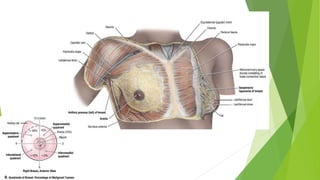
 The breast is that part of the pectoral region extending from
the 2nd to the 6th ribs and from the lateral edge of the sternum
to the midaxillary line. An axillary tail arises from the upper
lateral quadrant of the breast & extends posterolaterally to
the axilla over the 2nd & 3rd ribs deep to pectoralis major.
 The breast extends from 2nd to the 6th ribs and intercostal
spaces.
 The breasts, although strictly speaking, are not anatomically part
of the upper limb; they are situated in the pectoral region and
their blood supply and lymphatic drainage is largely into the
armpit. Their clinical importance cannot be overemphasized.
Structure of the breast
 Breasts are present in both sexes. In males and immature females, they are similar in
structure .
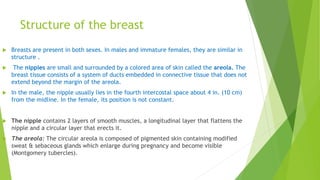
 The nipples are small and surrounded by a colored area of skin called the areola. The
breast tissue consists of a system of ducts embedded in connective tissue that does not
extend beyond the margin of the areola.
 In the male, the nipple usually lies in the fourth intercostal space about 4 in. (10 cm)
from the midline. In the female, its position is not constant.
 The nipple contains 2 layers of smooth muscles, a longitudinal layer that flattens the
nipple and a circular layer that erects it.
 The areola: The circular areola is composed of pigmented skin containing modified
sweat & sebaceous glands which enlarge during pregnancy and become visible
(Montgomery tubercles).
Structure of the breast
 At puberty in females, the breasts gradually enlarge and assume their
hemispherical shape under the influence of the ovarian hormones.
 The ducts elongate, but the increased size of the glands is mainly from the
deposition of fat.
 The greater part of the breast lies in the superficial fascia.
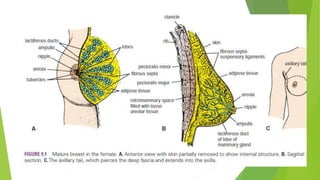
 A small part, called the axillary tail extends upward and laterally, pierces the
deep fascia at the lower border of the pectoralis major muscle, and enters the
axilla.
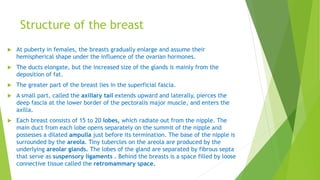
 Each breast consists of 15 to 20 lobes, which radiate out from the nipple. The
main duct from each lobe opens separately on the summit of the nipple and
possesses a dilated ampulla just before its termination. The base of the nipple is
surrounded by the areola. Tiny tubercles on the areola are produced by the
underlying areolar glands. The lobes of the gland are separated by fibrous septa
that serve as suspensory ligaments . Behind the breasts is a space filled by loose
connective tissue called the retromammary space.
Posterior relation of the breast:
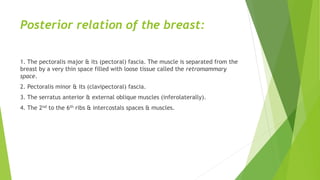
1. The pectoralis major & its (pectoral) fascia. The muscle is separated from the
breast by a very thin space filled with loose tissue called the retromammary
space.
2. Pectoralis minor & its (clavipectoral) fascia.
3. The serratus anterior & external oblique muscles (inferolaterally).
4. The 2nd to the 6th ribs & intercostals spaces & muscles.
The changes of the breast during the
pregnancy
 Pregnancy
 Early In the early months of pregnancy, there is a rapid increase in
length and branching in the duct system .The secretory alveoli
develop at the ends of the smaller ducts, and the connective tissue
becomes filled with expanding and budding secretory alveoli. The
vascularity of the connective tissue also increases to provide
adequate nourishment for the developing gland. The nipple enlarges,
and the areola becomes darker and more extensive as a result of
increased deposits of melanin pigment in the epidermis. The areolar
glands enlarge and become more active. Late During the second half
of pregnancy, the growth process slows. The breasts, however,
continue to enlarge, mostly because of the distention of the
secretory alveoli with the fluid secretion called colostrum.
 .
The changes of the breast during the
postweaning
 Postweaning : Once the baby has been weaned, the
breasts return to their inactive state. The remaining milk
is absorbed, the secretory alveoli shrink, and most of
them disappear. The interlobular connective tissue
thickens. The breasts and the nipples shrink and return
nearly to their original size. The pigmentation of the
areola fades, but the area never lightens to its original
color.
The changes of the breast during the
postmenopause
 Postmenopause
 After the menopause, the breast atrophies (Fig. 9.2). Most
of the secretory alveoli disappear, leaving behind the
ducts. The amount of adipose tissue may increase or
decrease. The breasts tend to shrink in size and become
more pendulous. The atrophy after menopause is caused
by the absence of ovarian estrogens and progesterone.
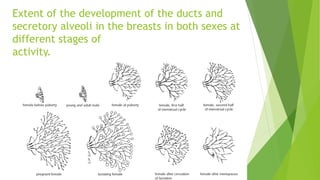
Extent of the development of the ducts and
secretory alveoli in the breasts in both sexes at
different stages of
activity.
Blood supply of the breast:
The breast is supplied by perforating branches from the following arteries:
 Internal thoracic artery (medially).
 Lateral thoracic artery (Laterally)
 Anterior intercostals arteries. (anteriorly)
 Thoracoacrmial artery. (superiorly)
 Posterior intercostal arteries. (inferolaterally)
 Veins
 The veins correspond to the arteries.
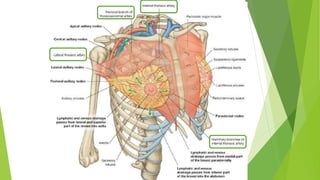
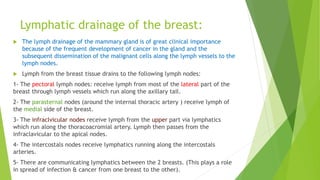
Lymphatic drainage of the breast:
 The lymph drainage of the mammary gland is of great clinical importance
because of the frequent development of cancer in the gland and the
subsequent dissemination of the malignant cells along the lymph vessels to the
lymph nodes.
 Lymph from the breast tissue drains to the following lymph nodes:
1- The pectoral lymph nodes: receive lymph from most of the lateral part of the
breast through lymph vessels which run along the axillary tail.
2- The parasternal nodes (around the internal thoracic artery ) receive lymph of
the medial side of the breast.
3- The infraclvicular nodes receive lymph from the upper part via lymphatics
which run along the thoracoacromial artery. Lymph then passes from the
infraclavicular to the apical nodes.
4- The intercostals nodes receive lymphatics running along the intercostals
arteries.
5- There are communicating lymphatics between the 2 breasts. (This plays a role
in spread of infection & cancer from one breast to the other).
Lymph Drainage
 The lymph drainage of the mammary gland is of great clinical importance
because of the frequent development of cancer in the gland and the
subsequent dissemination of the malignant cells along the lymph vessels to
the lymph nodes. The lateral quadrants of the breast drain into the anterior
axillary or pectoral group of nodes (Fig. 9.3) (situated just posterior to the
lower border of the pectoralis major muscle). The medial quadrants drain by
means of vessels that pierce the intercostal spaces and enter the internal
thoracic group of nodes (situated within the thoracic cavity along the course
of the internal thoracic artery). A few lymph vessels follow the posterior
intercostal arteries and drain posteriorly into the posterior intercostal nodes
(situated along the course of the posterior intercostal arteries); some vessels
communicate with the lymph vessels of the opposite breast and with those of
the anterior abdominal wall.

The Breast

  • 1.
  • 2.
    definition  The breastis that part of the pectoral region extending from the 2nd to the 6th ribs and from the lateral edge of the sternum to the midaxillary line. An axillary tail arises from the upper lateral quadrant of the breast & extends posterolaterally to the axilla over the 2nd & 3rd ribs deep to pectoralis major.  The breast extends from 2nd to the 6th ribs and intercostal spaces.  The breasts, although strictly speaking, are not anatomically part of the upper limb; they are situated in the pectoral region and their blood supply and lymphatic drainage is largely into the armpit. Their clinical importance cannot be overemphasized.
  • 4.
    Structure of thebreast  Breasts are present in both sexes. In males and immature females, they are similar in structure .  The nipples are small and surrounded by a colored area of skin called the areola. The breast tissue consists of a system of ducts embedded in connective tissue that does not extend beyond the margin of the areola.  In the male, the nipple usually lies in the fourth intercostal space about 4 in. (10 cm) from the midline. In the female, its position is not constant.  The nipple contains 2 layers of smooth muscles, a longitudinal layer that flattens the nipple and a circular layer that erects it.  The areola: The circular areola is composed of pigmented skin containing modified sweat & sebaceous glands which enlarge during pregnancy and become visible (Montgomery tubercles).
  • 5.
    Structure of thebreast  At puberty in females, the breasts gradually enlarge and assume their hemispherical shape under the influence of the ovarian hormones.  The ducts elongate, but the increased size of the glands is mainly from the deposition of fat.  The greater part of the breast lies in the superficial fascia.  A small part, called the axillary tail extends upward and laterally, pierces the deep fascia at the lower border of the pectoralis major muscle, and enters the axilla.  Each breast consists of 15 to 20 lobes, which radiate out from the nipple. The main duct from each lobe opens separately on the summit of the nipple and possesses a dilated ampulla just before its termination. The base of the nipple is surrounded by the areola. Tiny tubercles on the areola are produced by the underlying areolar glands. The lobes of the gland are separated by fibrous septa that serve as suspensory ligaments . Behind the breasts is a space filled by loose connective tissue called the retromammary space.
  • 7.
    Posterior relation ofthe breast: 1. The pectoralis major & its (pectoral) fascia. The muscle is separated from the breast by a very thin space filled with loose tissue called the retromammary space. 2. Pectoralis minor & its (clavipectoral) fascia. 3. The serratus anterior & external oblique muscles (inferolaterally). 4. The 2nd to the 6th ribs & intercostals spaces & muscles.
  • 8.
    The changes ofthe breast during the pregnancy  Pregnancy  Early In the early months of pregnancy, there is a rapid increase in length and branching in the duct system .The secretory alveoli develop at the ends of the smaller ducts, and the connective tissue becomes filled with expanding and budding secretory alveoli. The vascularity of the connective tissue also increases to provide adequate nourishment for the developing gland. The nipple enlarges, and the areola becomes darker and more extensive as a result of increased deposits of melanin pigment in the epidermis. The areolar glands enlarge and become more active. Late During the second half of pregnancy, the growth process slows. The breasts, however, continue to enlarge, mostly because of the distention of the secretory alveoli with the fluid secretion called colostrum.  .
  • 9.
    The changes ofthe breast during the postweaning  Postweaning : Once the baby has been weaned, the breasts return to their inactive state. The remaining milk is absorbed, the secretory alveoli shrink, and most of them disappear. The interlobular connective tissue thickens. The breasts and the nipples shrink and return nearly to their original size. The pigmentation of the areola fades, but the area never lightens to its original color.
  • 10.
    The changes ofthe breast during the postmenopause  Postmenopause  After the menopause, the breast atrophies (Fig. 9.2). Most of the secretory alveoli disappear, leaving behind the ducts. The amount of adipose tissue may increase or decrease. The breasts tend to shrink in size and become more pendulous. The atrophy after menopause is caused by the absence of ovarian estrogens and progesterone.
  • 11.
    Extent of thedevelopment of the ducts and secretory alveoli in the breasts in both sexes at different stages of activity.
  • 12.
    Blood supply ofthe breast: The breast is supplied by perforating branches from the following arteries:  Internal thoracic artery (medially).  Lateral thoracic artery (Laterally)  Anterior intercostals arteries. (anteriorly)  Thoracoacrmial artery. (superiorly)  Posterior intercostal arteries. (inferolaterally)  Veins  The veins correspond to the arteries.
  • 14.
    Lymphatic drainage ofthe breast:  The lymph drainage of the mammary gland is of great clinical importance because of the frequent development of cancer in the gland and the subsequent dissemination of the malignant cells along the lymph vessels to the lymph nodes.  Lymph from the breast tissue drains to the following lymph nodes: 1- The pectoral lymph nodes: receive lymph from most of the lateral part of the breast through lymph vessels which run along the axillary tail. 2- The parasternal nodes (around the internal thoracic artery ) receive lymph of the medial side of the breast. 3- The infraclvicular nodes receive lymph from the upper part via lymphatics which run along the thoracoacromial artery. Lymph then passes from the infraclavicular to the apical nodes. 4- The intercostals nodes receive lymphatics running along the intercostals arteries. 5- There are communicating lymphatics between the 2 breasts. (This plays a role in spread of infection & cancer from one breast to the other).
  • 15.
    Lymph Drainage  Thelymph drainage of the mammary gland is of great clinical importance because of the frequent development of cancer in the gland and the subsequent dissemination of the malignant cells along the lymph vessels to the lymph nodes. The lateral quadrants of the breast drain into the anterior axillary or pectoral group of nodes (Fig. 9.3) (situated just posterior to the lower border of the pectoralis major muscle). The medial quadrants drain by means of vessels that pierce the intercostal spaces and enter the internal thoracic group of nodes (situated within the thoracic cavity along the course of the internal thoracic artery). A few lymph vessels follow the posterior intercostal arteries and drain posteriorly into the posterior intercostal nodes (situated along the course of the posterior intercostal arteries); some vessels communicate with the lymph vessels of the opposite breast and with those of the anterior abdominal wall.