Breast/Mammary Gland
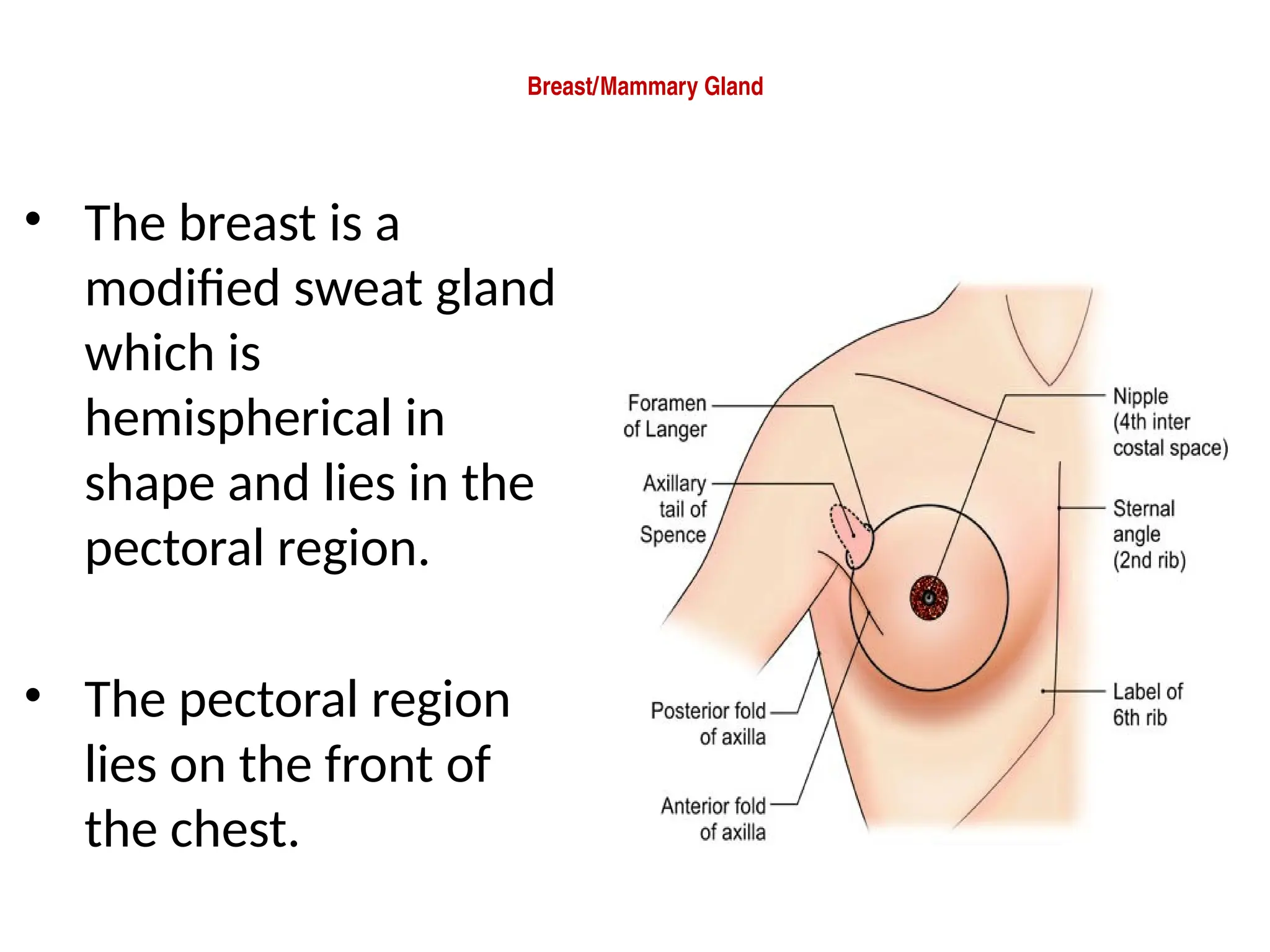
• Thebreast is a
modified sweat gland
which is
hemispherical in
shape and lies in the
pectoral region.
• The pectoral region
lies on the front of
the chest.
2.
• Cancer ofbreast is extremely common hence its
anatomy is of great practical importance.
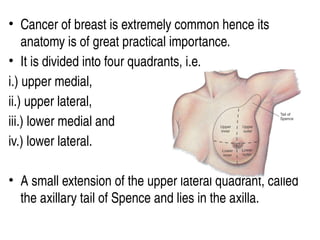
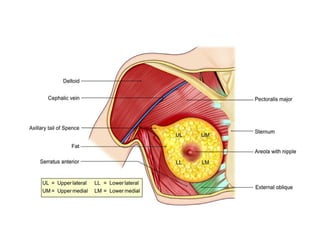
• It is divided into four quadrants, i.e.
i.) upper medial,
ii.) upper lateral,
iii.) lower medial and
iv.) lower lateral.
• A small extension of the upper lateral quadrant, called
the axillary tail of Spence and lies in the axilla.
3.
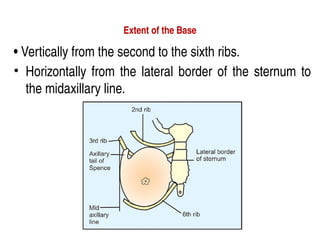
Extent of theBase
• Vertically from the second to the sixth ribs.
• Horizontally from the lateral border of the sternum to
the midaxillary line.
4.
Deep Relations
• Thebreast lies on the deep fascia (pectoral fascia)
• There are the parts of three muscles:
i.) Pectoralis major,
ii.) Serratus anterior, and
iii.) External oblique muscle of the abdomen.
6.
Structure of theBreast
Skin
• Nipple is the conical projection in the skin of breast.
• It is present just below the centre of the breast at the
level of the fourth intercostal space and 10 cm from
the midline.
• The skin surrounding the base of the nipple is
pigmented and forms a circular area called the areola.
8.
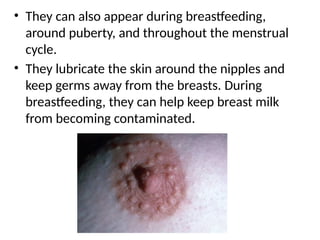
Montgomery tubercles
• Theyare small, oil-producing glands that appear
as bumps around the nipple and areola.
• They are named after William Fetherstone
Montgomery, an Irish obstetrician who first
described them in 1837.
• Montgomery tubercles are normal and can be an
early sign of pregnancy.
9.
• They canalso appear during breastfeeding,
around puberty, and throughout the menstrual
cycle.
• They lubricate the skin around the nipples and
keep germs away from the breasts. During
breastfeeding, they can help keep breast milk
from becoming contaminated.
10.
Parenchyma
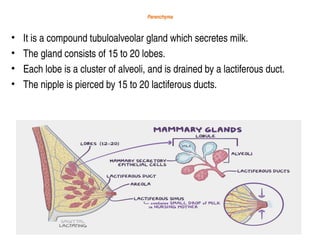
• It isa compound tubuloalveolar gland which secretes milk.
• The gland consists of 15 to 20 lobes.
• Each lobe is a cluster of alveoli, and is drained by a lactiferous duct.
• The nipple is pierced by 15 to 20 lactiferous ducts.
11.
Stroma
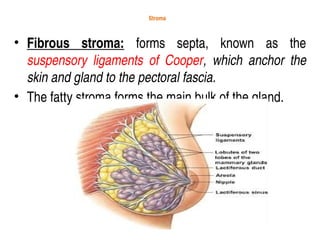
• Fibrous stroma:forms septa, known as the
suspensory ligaments of Cooper, which anchor the
skin and gland to the pectoral fascia.
• The fatty stroma forms the main bulk of the gland.
LYMPHATIC DRAINAGE
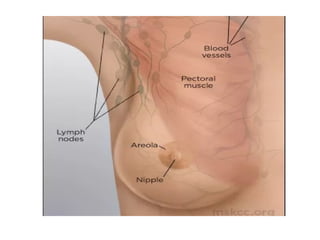
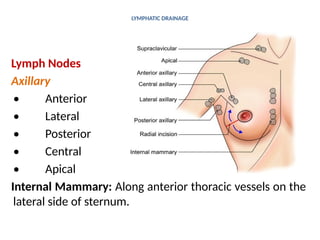
Lymph Nodes
Axillary
•Anterior
• Lateral
• Posterior
• Central
• Apical
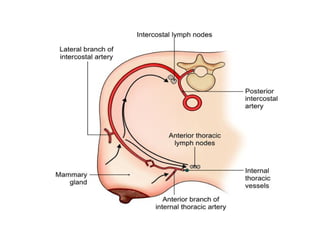
Internal Mammary: Along anterior thoracic vessels on the
lateral side of sternum.
14.
Lymphatic Vessels
• Superficiallymphatics drain the 4 quadrants of
skin over the breast except for the nipple and
areola.
• The lymphatics pass radially to the
surrounding lymph nodes (axillary, internal
mammary, supraclavicular and cephalic).
15.
• About 75%of the lymph from the breast drains into
the axillary nodes;
• 20% into the internal mammary nodes
• 5% into the posterior intercostal nodes.
16.
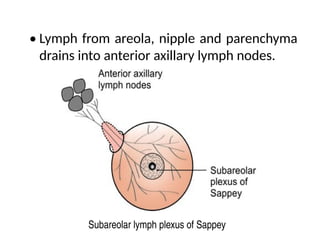
Subareolar lymph plexusof Sappey
• Lymph from areola, nipple and parenchyma
drains into anterior axillary lymph nodes.