Cold Fronts
Cold Fronts
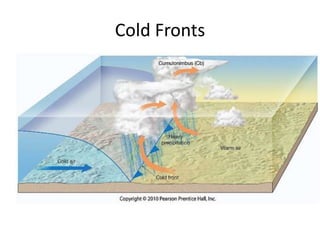
• When cold, continental polar air advances into
  a region that is occupied by warmer air, this
  condition results in a cold front.
• As it happens with warm fronts, the area of
  the cold front (and warm front) nearest the
  ground moves more slowly due to friction as
  compared to the air that is aloft.
• Thus, the cold front steepens as it moves.
Cold Fronts
• On average, cold fronts are about twice as
  steep as warm fronts.
• In addition, cold fronts advance at speeds of
  20 to 35 miles per hour compared to 15 to 20
  miles per hour with warm fronts.
• These two differences, steepness and rate of
  movement account for the more violent
  nature of cold fronts.
Cold Fronts
• The arrival of cold fronts is sometimes
  preceded by alto-cumulus clouds.
• As the front advances, mainly from the west
  and northwest, towering clouds can often be
  seen in the distance.
• Close to the front, a band of dark, ominous
  clouds foretells the ensuing weather.
Cold Fronts
• The forceful lifting of warm, moist air along
  the cold front is often so rapid that the
  released latent heat increases the air’s
  buoyancy.
• Heavy downpours and vigorous wind gusts
  that are associated with mature
  cumulonimbus clouds frequently result.
Cold Fronts
• Because a cold front produces roughly the
  same amount of lifting as a warm front but
  over a shorter distance, the precipitation
  intensity is greater, but of shorter duration.
• Marked temperature drop and windshift from
  the southwest to the northwest usually
  accompanies the front’s passing.
Cold Fronts
• The sharp temperature contrast and
  sometimes violent weather along cold fronts
  are symbolized on a weather map by a blue
  line with blue triangular points extending into
  the warm air mass.
Cold Fronts
Cold Fronts
• Most often, the weather behind a cold front is
  dominated by subsiding air within a
  continental polar air mass.
• Thus, the drop in temperature is accompanied
  by clearing that begins soon after the front
  passes.
• Although the effect is a fair amount of cooling
  of air aloft, the effect near ground level is
  relatively minor.
Cold Fronts
• In winter, the long, cloudless nights that follow
  the passage of a cold front result in radiation
  cooling that reduces surfaces temperatures.
• When a cold front moves over a relatively
  warm surface, radiation emitted from the
  Earth can heat the lower atmosphere enough
  to produce shallow convection.
• This can result in low cumulus or
  stratocumulus clouds behind the front.

Cold fronts

  • 1.
  • 2.
    Cold Fronts • Whencold, continental polar air advances into a region that is occupied by warmer air, this condition results in a cold front. • As it happens with warm fronts, the area of the cold front (and warm front) nearest the ground moves more slowly due to friction as compared to the air that is aloft. • Thus, the cold front steepens as it moves.
  • 3.
    Cold Fronts • Onaverage, cold fronts are about twice as steep as warm fronts. • In addition, cold fronts advance at speeds of 20 to 35 miles per hour compared to 15 to 20 miles per hour with warm fronts. • These two differences, steepness and rate of movement account for the more violent nature of cold fronts.
  • 4.
    Cold Fronts • Thearrival of cold fronts is sometimes preceded by alto-cumulus clouds. • As the front advances, mainly from the west and northwest, towering clouds can often be seen in the distance. • Close to the front, a band of dark, ominous clouds foretells the ensuing weather.
  • 5.
    Cold Fronts • Theforceful lifting of warm, moist air along the cold front is often so rapid that the released latent heat increases the air’s buoyancy. • Heavy downpours and vigorous wind gusts that are associated with mature cumulonimbus clouds frequently result.
  • 6.
    Cold Fronts • Becausea cold front produces roughly the same amount of lifting as a warm front but over a shorter distance, the precipitation intensity is greater, but of shorter duration. • Marked temperature drop and windshift from the southwest to the northwest usually accompanies the front’s passing.
  • 7.
    Cold Fronts • Thesharp temperature contrast and sometimes violent weather along cold fronts are symbolized on a weather map by a blue line with blue triangular points extending into the warm air mass.
  • 8.
  • 9.
    Cold Fronts • Mostoften, the weather behind a cold front is dominated by subsiding air within a continental polar air mass. • Thus, the drop in temperature is accompanied by clearing that begins soon after the front passes. • Although the effect is a fair amount of cooling of air aloft, the effect near ground level is relatively minor.
  • 10.
    Cold Fronts • Inwinter, the long, cloudless nights that follow the passage of a cold front result in radiation cooling that reduces surfaces temperatures. • When a cold front moves over a relatively warm surface, radiation emitted from the Earth can heat the lower atmosphere enough to produce shallow convection. • This can result in low cumulus or stratocumulus clouds behind the front.