The Science of Cloud Seeding
Students Seminar Series
13th October 2003
.by,
Vinoj V
PhD Student
CAOS, IISc
Background
 By the year 2025 two thirds of the world population will live under
severe water stress conditions as determined by studies of the
World Meteorological Organization (WMO)
 The rapid growth of Agricultural and Industrial sector along with
the population explosion makes India particularly vulnerable.
 Though India get high amount of rainfall compared to many
other countries, the large infrastructure and water intensive
agricultural practice makes India vulnerable to even to the minor
swings (< 5%) in rainfall
 Water related problems within the states
 India is at its absolute water limits (Bryson., 1989)
Mitigation
 Intelligent Utilization of the available Water Resources
 Rainwater Harvesting
 New source of water?
» Artificial Rain Making! - Cloud Seeding?
» Remember Atmospheric Vapor is only 0.001%
of the total water in the hydrosphere
American Indians
 The rain dance was a
big part of American
Indian culture and
helped them carry on
with their day to day
activities.
 They believe by
pleasing the rain god
he would provide rain
for their crops.
American Indians
 Each tribe had a
different god or
ceremony for their
rain needs.
 The tribes were
similar in the fact that
each one of them
relied on rhythmic
dancing in their
events. (http://users.rowan.edu/)
 According to Rig Veda - The earliest
accepted Gods were
» DYAUSH PITA (the sky father)
» PRITHVI MATHA (the earth mother)
» VAYU (the wind God)
» PARJANYA (the rain God)
» SURYA (the sun God)
» VARUNA (the God of oceans)
» AGNI (the fire God)
» INDRA (the war God)…
Indians
The Cloud Formation
Homogeneous nucleation of
Water droplets require high
Degree of super saturation
(~350-400%)
Heterogeneous nucleation in
the presence of Cloud
Condensation Nuclei (CCN)
Two important processes on
how rain is produced
–Collision-Coalescence
Process
–Ice-crystal (or Bergeron)
process
Droplet Growth
Warm Clouds
- Collision and Coalescence
Cold Clouds
- Ice Crystal Process
Typical Cold Clouds
Typical warm Clouds
Seeding – Definition
 The deliberate treatment of certain clouds or
cloud systems with the intent of affecting the
precipitation process(es) within those clouds.
 Borrowed from Physical Chemists,
“A method used to precipitate solute from the
solvent - Pieces of solid material placed in a
supersaturated solution to promote
precipitation of the dissolved solute”
The Beginning
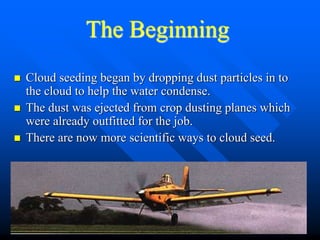
 Cloud seeding began by dropping dust particles in to
the cloud to help the water condense.
 The dust was ejected from crop dusting planes which
were already outfitted for the job.
 There are now more scientific ways to cloud seed.
 In 1946, Vincent Schaefer (GE) - a small piece of solid carbon
dioxide (dry ice) can generate a large number of ice crystals in a
laboratory-generated super-cooled fog.
 He then dropped about 1.5 kg of crushed dry ice into super-
cooled stratocumulus clouds over western Massachusetts and
found that snow crystals did indeed fall out from the cloud.
 In the following year Bernard Vonnegut (GE) found that particles
of silver iodide can also generate large numbers of ice crystals if
the cloud is cold enough.
 Seeding causes a large number of small supercooled droplets to
condense onto a smaller number of seed crystals. When the
seeding works correctly, the grown crystals will fall out as snow
and rain, leaving a clear space behind. For the technique to work,
the seed material must cause large numbers of ice crystals to
form.
The Beginning
Cloud Seeding
 Cloud seeding is actually a very complex process. In the simplest
terms, it introduces other particles (CCN’s) into a cloud to serve as
cloud condensation nuclei and aid in the formation of precipitation.
There are three types of cloud seeding: static mode, dynamic mode, and
hygroscopic seeding.
 Static mode cloud seeding seeks to increase rainfall by adding ice
crystals (usually in the form of silver iodide or dry ice) to cold clouds.
 Dynamic mode cloud seeding increases rainfall by enhancing "vertical
air currents in clouds and thereby vertically process more water through
the clouds." Basically, in this method of seeding, a much larger number
of ice crystals are added to the cloud than in the static mode.
 In hygroscopic seeding, salt crystals are released into a cloud. These
particles grow until they are large enough to cause precipitation to form.
Clouds can be seeded from above with the help of airplanes that drop
pyrotechnics, or from the ground by using artillery or ground-to-air
rockets
The Seeding Concepts
Static Seeding
Alter the microphysical
Properties of clouds
Dynamic Seeding
Attempt to modify the
Air motion within the clouds
Hygroscopic Seeding
Use of hygroscopic material to
Obtain the intended result (eg: salt)
Static or Dynamic
Cloud Seeding
Warm Cloud Seeding Cold Cloud Seeding
Glaciogenic Seeding
Cumulus Clouds
having cloud top temp
< 0oC
To increase population
of ice crystals
Seeding with Silver Iodide
To increase
population of water
drops
Stratiform Clouds
Sodium Chloride or
Urea
Warm Cloud Seeding
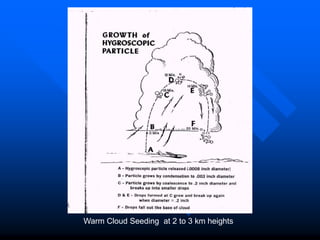
Formation of Rain through Hygroscopic Seeding
Hygroscopic Particles:
 Extremely moisture absorbent
 Grow in low humidity air below cloud base
Examples of Hygroscopic Material
 Common Table Salt
 Ammonium Nitrate – Urea Fertilizer
Objective of Hygroscopic Seeding
Introduce large drops into cloud
Large drops collide with small cloud droplets and grow into rain
drops (Coalescence)
Rain drops heavy and large enough to fall out of cloud and
reach ground.
Ice crystal Process
 Bergeron process of rain formation:
A process that produces
precipitation; involves tiny ice
crystals in a supercooled cloud
growing larger at the expense of the
surrounding liquid droplets
 Ice crystals and liquid cloud droplets
must coexist in clouds at below
freezing
 Accretion or riming of ice crystals:
Ice crystals grow larger by colliding
with the supercooled liquid droplets;
the droplets freeze into ice and stick
to the ice crystal
Mixed Clouds
Seeding Materials
 The materials used in cloud seeding include two primary
categories, tied to the type of precipitation process involved
» Glaciogenic (ice-forming) Silver iodide, dry ice and
compressed liquid propane
 The second major category is focused on cloud systems where
the warm (coalescence) process predominates.
» Hygroscopic (water attracting) materials such as salt, urea
and ammonium nitrate can be utilized. Of the hygroscopic
materials, the most commonly used are salts.
Silver Iodide
 Why Silver Iodide ?
– It has a crystalline structure similar to ice crystal, and it acts as an
effective ice nucleus at temp. of -4°C and lower
– Silver iodide, when burned, creates extra ice crystals in winter
clouds to increase snow fall. (The first AgI generator could
discharge 1016 particles per gram)
(www.wmi.cban.com/)
It can be distributed from the ground...
Silver Iodide
…or from the air.
Ground based Generator Automated High-Output Ground Seeding System
Aircraft-mounted flares
Cloud Seeding Aircraft
How Cloud Seeding Works
How Cloud Seeding works?
 In cold cloud seeding.,
 the introduction of an ice-forming nucleating
agent, (e.g., silver iodide) causes supercooled
liquid water droplets to freeze. Once these
droplets freeze, the initial ice embryos grow at
the expense of the water droplets around them.
– The first freezing process is often referred to as a static
seeding effect, increasing the efficiency of the
precipitation process within the seeded cloud volume.
– The second freezing process, resulting from release of
additional heat into the cloud, is often called the
dynamic effect, whereby the treated clouds are
invigorated, thus processing more moisture.
Warm Cloud Seeding at 2 to 3 km heights
Cold Cloud Seeding
A hole in a stratus cloud deck due to cloud seeding with aircraft, using dry ice
This is where super cooled cloud droplets are converted into ice crystals
, which then precipitate out of the cloud deck.
Indian Experiment
 IITM, Pune was involved in cloud seeding
experiment for a period of 11 years in the
seventies
 Reported Increase in rainfall due to seeding
~ 24%
 Different states have their own operational
programs whose success is still being debated
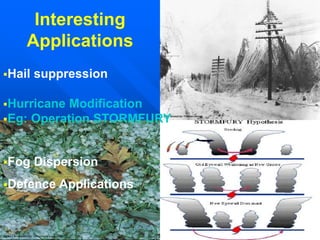
Interesting
Applications
Hail suppression
Hurricane Modification
Eg: Operation STORMFURY
Fog Dispersion
Defence Applications
Suppression of Hail
 Cloud seeding can
be used to cause
rain instead of hail.
 However
suppressing hail in
one area often
causes more in
another. (twri.tamu.edu)
Thank You

Cloud seed

  • 1.
    The Science ofCloud Seeding Students Seminar Series 13th October 2003 .by, Vinoj V PhD Student CAOS, IISc
  • 2.
    Background  By theyear 2025 two thirds of the world population will live under severe water stress conditions as determined by studies of the World Meteorological Organization (WMO)  The rapid growth of Agricultural and Industrial sector along with the population explosion makes India particularly vulnerable.  Though India get high amount of rainfall compared to many other countries, the large infrastructure and water intensive agricultural practice makes India vulnerable to even to the minor swings (< 5%) in rainfall  Water related problems within the states  India is at its absolute water limits (Bryson., 1989)
  • 3.
    Mitigation  Intelligent Utilizationof the available Water Resources  Rainwater Harvesting  New source of water? » Artificial Rain Making! - Cloud Seeding? » Remember Atmospheric Vapor is only 0.001% of the total water in the hydrosphere
  • 4.
    American Indians  Therain dance was a big part of American Indian culture and helped them carry on with their day to day activities.  They believe by pleasing the rain god he would provide rain for their crops.
  • 5.
    American Indians  Eachtribe had a different god or ceremony for their rain needs.  The tribes were similar in the fact that each one of them relied on rhythmic dancing in their events. (http://users.rowan.edu/)
  • 6.
     According toRig Veda - The earliest accepted Gods were » DYAUSH PITA (the sky father) » PRITHVI MATHA (the earth mother) » VAYU (the wind God) » PARJANYA (the rain God) » SURYA (the sun God) » VARUNA (the God of oceans) » AGNI (the fire God) » INDRA (the war God)… Indians
  • 8.
    The Cloud Formation Homogeneousnucleation of Water droplets require high Degree of super saturation (~350-400%) Heterogeneous nucleation in the presence of Cloud Condensation Nuclei (CCN) Two important processes on how rain is produced –Collision-Coalescence Process –Ice-crystal (or Bergeron) process
  • 9.
    Droplet Growth Warm Clouds -Collision and Coalescence Cold Clouds - Ice Crystal Process Typical Cold Clouds Typical warm Clouds
  • 10.
    Seeding – Definition The deliberate treatment of certain clouds or cloud systems with the intent of affecting the precipitation process(es) within those clouds.  Borrowed from Physical Chemists, “A method used to precipitate solute from the solvent - Pieces of solid material placed in a supersaturated solution to promote precipitation of the dissolved solute”
  • 11.
    The Beginning  Cloudseeding began by dropping dust particles in to the cloud to help the water condense.  The dust was ejected from crop dusting planes which were already outfitted for the job.  There are now more scientific ways to cloud seed.
  • 12.
     In 1946,Vincent Schaefer (GE) - a small piece of solid carbon dioxide (dry ice) can generate a large number of ice crystals in a laboratory-generated super-cooled fog.  He then dropped about 1.5 kg of crushed dry ice into super- cooled stratocumulus clouds over western Massachusetts and found that snow crystals did indeed fall out from the cloud.  In the following year Bernard Vonnegut (GE) found that particles of silver iodide can also generate large numbers of ice crystals if the cloud is cold enough.  Seeding causes a large number of small supercooled droplets to condense onto a smaller number of seed crystals. When the seeding works correctly, the grown crystals will fall out as snow and rain, leaving a clear space behind. For the technique to work, the seed material must cause large numbers of ice crystals to form. The Beginning
  • 13.
    Cloud Seeding  Cloudseeding is actually a very complex process. In the simplest terms, it introduces other particles (CCN’s) into a cloud to serve as cloud condensation nuclei and aid in the formation of precipitation. There are three types of cloud seeding: static mode, dynamic mode, and hygroscopic seeding.  Static mode cloud seeding seeks to increase rainfall by adding ice crystals (usually in the form of silver iodide or dry ice) to cold clouds.  Dynamic mode cloud seeding increases rainfall by enhancing "vertical air currents in clouds and thereby vertically process more water through the clouds." Basically, in this method of seeding, a much larger number of ice crystals are added to the cloud than in the static mode.  In hygroscopic seeding, salt crystals are released into a cloud. These particles grow until they are large enough to cause precipitation to form. Clouds can be seeded from above with the help of airplanes that drop pyrotechnics, or from the ground by using artillery or ground-to-air rockets
  • 14.
    The Seeding Concepts StaticSeeding Alter the microphysical Properties of clouds Dynamic Seeding Attempt to modify the Air motion within the clouds Hygroscopic Seeding Use of hygroscopic material to Obtain the intended result (eg: salt) Static or Dynamic
  • 15.
    Cloud Seeding Warm CloudSeeding Cold Cloud Seeding Glaciogenic Seeding Cumulus Clouds having cloud top temp < 0oC To increase population of ice crystals Seeding with Silver Iodide To increase population of water drops Stratiform Clouds Sodium Chloride or Urea
  • 16.
    Warm Cloud Seeding Formationof Rain through Hygroscopic Seeding Hygroscopic Particles:  Extremely moisture absorbent  Grow in low humidity air below cloud base Examples of Hygroscopic Material  Common Table Salt  Ammonium Nitrate – Urea Fertilizer Objective of Hygroscopic Seeding Introduce large drops into cloud Large drops collide with small cloud droplets and grow into rain drops (Coalescence) Rain drops heavy and large enough to fall out of cloud and reach ground.
  • 17.
    Ice crystal Process Bergeron process of rain formation: A process that produces precipitation; involves tiny ice crystals in a supercooled cloud growing larger at the expense of the surrounding liquid droplets  Ice crystals and liquid cloud droplets must coexist in clouds at below freezing  Accretion or riming of ice crystals: Ice crystals grow larger by colliding with the supercooled liquid droplets; the droplets freeze into ice and stick to the ice crystal
  • 18.
  • 19.
    Seeding Materials  Thematerials used in cloud seeding include two primary categories, tied to the type of precipitation process involved » Glaciogenic (ice-forming) Silver iodide, dry ice and compressed liquid propane  The second major category is focused on cloud systems where the warm (coalescence) process predominates. » Hygroscopic (water attracting) materials such as salt, urea and ammonium nitrate can be utilized. Of the hygroscopic materials, the most commonly used are salts.
  • 20.
    Silver Iodide  WhySilver Iodide ? – It has a crystalline structure similar to ice crystal, and it acts as an effective ice nucleus at temp. of -4°C and lower – Silver iodide, when burned, creates extra ice crystals in winter clouds to increase snow fall. (The first AgI generator could discharge 1016 particles per gram) (www.wmi.cban.com/) It can be distributed from the ground...
  • 21.
  • 22.
    Ground based GeneratorAutomated High-Output Ground Seeding System Aircraft-mounted flares Cloud Seeding Aircraft
  • 23.
  • 24.
    How Cloud Seedingworks?  In cold cloud seeding.,  the introduction of an ice-forming nucleating agent, (e.g., silver iodide) causes supercooled liquid water droplets to freeze. Once these droplets freeze, the initial ice embryos grow at the expense of the water droplets around them. – The first freezing process is often referred to as a static seeding effect, increasing the efficiency of the precipitation process within the seeded cloud volume. – The second freezing process, resulting from release of additional heat into the cloud, is often called the dynamic effect, whereby the treated clouds are invigorated, thus processing more moisture.
  • 25.
    Warm Cloud Seedingat 2 to 3 km heights
  • 27.
  • 31.
    A hole ina stratus cloud deck due to cloud seeding with aircraft, using dry ice This is where super cooled cloud droplets are converted into ice crystals , which then precipitate out of the cloud deck.
  • 32.
    Indian Experiment  IITM,Pune was involved in cloud seeding experiment for a period of 11 years in the seventies  Reported Increase in rainfall due to seeding ~ 24%  Different states have their own operational programs whose success is still being debated
  • 33.
    Interesting Applications Hail suppression Hurricane Modification Eg:Operation STORMFURY Fog Dispersion Defence Applications
  • 34.
    Suppression of Hail Cloud seeding can be used to cause rain instead of hail.  However suppressing hail in one area often causes more in another. (twri.tamu.edu)
  • 35.