Thunderstorms
http://youtu.be/YlOJr1csOR4
Thunderstorms
• What is a thunderstorm?
http://www.youtube.com/watch?v=pZ0h7QY-
HpQ&feature=youtu.be
– A thunderstorm is simply a storm that generates
lightning and thunder.
– They frequently produce gusty winds, heavy rain and
hail.
– They may be produced by a single cumulonimbus cloud
and influence a very small geographic area.
– Or they may be formed from clusters of cumulonimbus
clouds and affect large geographic areas.
http://youtu.be/w3QaAVpzedA
Different Types of
Thunderstorms
• Air-Mass Thunderstorms
– Frequently occur in maritime tropical (mT) air that
moves northward from the Gulf of Mexico.
– These warm, humid air masses contain abundant
moisture in their lower levels and can be rendered
unstable when heated from below or lifted along a front.
– mT air most often becomes unstable in spring and
summer, and form mostly in the midafternoon when
surface temperatures are highest.
– Generally occurred as scattered, isolated cells.
Stages of Thunderstorm
Development
• Important field studies conducted in the 1940s
probed the dynamics of air-mass
thunderstorms.
– Cumulus Stage
• Buoyant thermals produce fair weather clouds.
• This is important because this moves water vapor
from the ground to greater heights.
• The development of the cumulonimbus tower
requires a constant supply of moist air.
• Release of latent heat allows each new surge of warm
humid air to rise higher than the last, adding to the
height of the cloud.
Stages of Thunderstorm
Development
Cumulus Stage (cont’d)
Dominated by updrafts.
Precipitation within the cloud begins.
Eventually the precipitation in the cloud becomes too
great for the updrafts to support.
Falling precipitation causes drag on the air and initiates
downdraft.
Heavy cool air surrounding the cloud causes some of
the precipitation to evaporate (cooling).
This cools the air within the downdraft.
Stages of Thunderstorm
Development
Mature Stage
As the downdraft leaves the cloud, precipitation is
released.
The sharp, cool gusts of wind that you feel before a
thunderstorms are indicative of the updrafts higher in
the thundercloud.
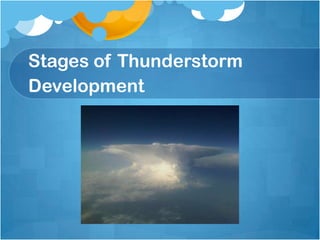
When the cloud grows the top of the unstable region
(often at the base of the stratosphere) the updrafts
spread laterally and produce the characteristic anvil
top.
Stages of Thunderstorm
Development
Stages of Thunderstorm
Development
– Mature Stage (cont’d)
• Generally, ice-laden cirrus clouds make up the top.
• Most active period of the thunderstorm.
– Dissipation Stage
• Once the downdrafts begin, the vacating air and
precipitation encourage more cooler and drier air to
surround the cell.
• Eventually, downdrafts dominate.
• Without a supply of warm most air, the cloud begins to
evaporate.
– http://youtu.be/AL8XDZkLEi0
Severe Thunderstorms
• Capable of producing heavy downpours, flash
floods, strong, gusty straight-line winds, large
hail, frequent lightning, and if this all wasn’t bad
enough, possibly tornadoes.
• What is a “severe” thunderstorm?
– Winds in excess of 93 km/h (58 mp/h)
– Or produce hailstones with diameters larger than
1.9 centimeters (0.75 inches)
– Or generate a tornado.
Thunderstorm Safety
• Lightning impacts peoples lives
– http://youtu.be/hl2h1Ubh-g8
• As the summer approaches, here is a public
service announcement from NOAA.
– http://youtu.be/6OdL6Z7TAaY
• Safety Tips
– http://youtu.be/60WJ8Vs6T7c
Thunderstorms
http://vimeo.com/28040685
Thunderstorms
Did you know that a storm is classified as a
thunderstorm only after thunder is heard?
But, because thunder occurs as a result of
lightning, lightning must be present.
Where Does Lightning
Come From
How does lightning form?
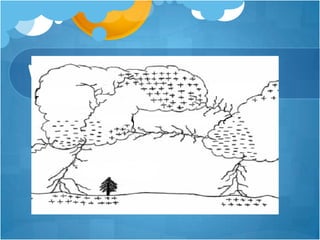
During the formation of a cumulonimbus cloud, a
separation of charge occurs, meaning that part of
the cloud itself develops a more negative charge
than the rest of the cloud.
The whole object of lightning is to equalize these
differences by producing a negative flow to the
region of positive charge, and vice versa.
The Making of Lightning
Because air is a poor conductor of electricity (it is a
great insulator), the electrical potential (charge
difference) must be very high for lightning to occur.
The most common type of lightning occurs between
oppositely charged zones within a cloud. (80 % of all
lightning is of this type).
http://youtu.be/Q3Awp-3CxSU
The Making of Lightning
Lightning within a cloud is often referred to as sheet
lightning because it produces a bright but diffuse
illumination of those parts of the cloud in which the
flash occurred.
The second type of lightning is cloud-to-ground, and
represents 20% of all lightning.
It is the most damaging and most dangerous form.
http://youtu.be/Q3Awp-3CxSU
What Causes Lightning?
The origin charge separation in the clouds is not fully
understood.
What is strongly suspected is that it hinges on rapid
vertical movements in the clouds.
This is because lightning occurs mainly in the violent
mature stage of a cumulonimbus cloud. (In mid-latitudes
[that’s us], this is a function of summertime heat).
Lightning rarely occurs before the growing cloud
penetrates the 5km level. (≈ 3 miles)
What Causes Lightning ?
Some physicists speculate that charge separation
occurs during the formation of ice pellets.
This is because, through experimentation, as
droplets begin to freeze, positively charged ions are
concentrated in the warmer regions.
Thus, as droplets freeze from the outside in, they
develop a positively charged ice shell and a
negatively charged interior.
What Causes Lightning?
As the interior begins to freeze, it shatters the
outside shell.
The smaller, positively charged fragments are
carried upward by the turbulence, and the
negatively charged, heavier particles travel
towards the base of the cloud.
What Causes Lightning?
What Causes Thunder?
http://youtu.be/Nn77o_7qsZ0
The electrical discharge of lightning superheats the
air surrounding the lightning channel.
In less than a second, the temperature rises by as
much as 33,0000C (59,4320F).
When air is heated this quickly, it expands explosively
and produces the sound waves that we hear as
thunder.
What Causes Thunder?
Lightning is seen almost instantaneously
But sound waves, which are relatively slower,
travel at approximately 330 meters (1000 feet)
per second.
If thunder is heard 5 seconds after the lightning
is seen, the lightning occurred about 1650
meters (approximately 1 mile) away.
What Causes Thunder?
The lightning that we hear as a rumble is produced
along a long lightning path located at some distance
from the observer.
When lightning occurs 12 miles away, thunder is
rarely heard.
We often heard this referred to as heat lightning.
This is no different than lightning that we normally
associate with thunder.
Supercell Thunderstorms
Consists of a single, very powerful cell.
It can extend to heights of 20 km (65,000 ft)
They can persist for many hours.
Their diameters may range between 20 and 50
km (12 to 30 miles).
Supercell Thunderstorm
Here is a supercell that was spotted in Charlton,
Massachusetts.
http://youtu.be/3iizREXMI64
Microbursts
What is a microburst?
Beneath some thunderstorms, strong localized
downdrafts known as microbursts can occur.
When they are small, they are less than 4 km (2.5
miles) across.
These straight-line concentrated bursts of wind are
produced when downdrafts are accelerated by a
great deal of evaporative cooling.
Microbursts
(Remember, the colder the air, the denser it is).
Typically last just two to five minutes.
Despite size and duration, they represent a
significant atmospheric hazard.
1993: Millions of trees were uprooted by a
microburst near Pak Wash, Ontario.
Microbursts
July, 1984: 11 people drowned when a
microburst caused a 28 meter (90 foot)
sternwheeler boat to capsize on the Tennessee
River.
Sometimes damage from these storms is
mistaken for tornado damage.
Microbursts
Wind shear associated with microbursts have been associated with
plane crashes.
http://youtu.be/0uD_eeKsrc4
http://youtu.be/MdZFuqr5ZYA
http://youtu.be/TkavH9aZue8
New Hampshire microburst is suspected in damage to camper
dealership
http://youtu.be/vjwjzKtHaE0
Lightning
No place is absolutely safe from the threat of
lightning, but some places are safer than others.
Large enclosed structures (substantially constructed
buildings) tend to be much safer than smaller or open
structures. (Does the structure incorporate lightning
protection?)
Fully enclosed metal vehicles such as cars, trucks,
busses, vans, fully enclosed farm vehicles with the
windows rolled up provide good shelter. Avoid contact
with metal or insides and outside conducting surfaces.
Lightning (cont’d)
Avoid being in or near high places, open fields,
isolated trees, unprotected gazebos, rain or
picnic shelters, baseball dugouts,
communication towers light poles, flagpoles,
bleachers (wood or metal) , metal fences,
convertibles, golf carts and water (yes, even
swimming pools).
Lightning (cont’d)
When inside a building, avoid:
Using the telephone
Taking a shower
Washing your hands
Doing dishes
Any contact with conductive surfaces with
exposure to the outside. (Metal doorframes,
electrical/telephone/cable tv wiring, plumbing, etc.
Lightning (cont’d)
In general, if you can see lightning or hear
thunder, you’re already in trouble. The more
frequent that it is seen or heard, the storm is
approaching.
If the time difference between the lighting and
the thunder is less than 30 seconds, you had
better be seeking a safe location.
Lightning (cont’d)
Ranging is not perfect due to difficulty with associating
the thunder with the proper lightning flash.
High winds, rainfall and cloud cover can serve as
warnings.
Many lightning casualties occur in the beginning of the
storm as it approaches OR as the perceived threat has
passed.
Pay attention to weather warnings (TV, NOAA,
Weatherbug)
Lightning (cont’d)
About how many people who are struck by
lightning are actually killed?
According to the National Weather Service, about
10% of lightning strike victims are killed; 90%
survive.
However, many survivors suffer from long lasting
disabilities.
http://youtu.be/6vqN8Kg_4JI

Thunderstorms

  • 2.
  • 3.
    Thunderstorms • What isa thunderstorm? http://www.youtube.com/watch?v=pZ0h7QY- HpQ&feature=youtu.be – A thunderstorm is simply a storm that generates lightning and thunder. – They frequently produce gusty winds, heavy rain and hail. – They may be produced by a single cumulonimbus cloud and influence a very small geographic area. – Or they may be formed from clusters of cumulonimbus clouds and affect large geographic areas. http://youtu.be/w3QaAVpzedA
  • 4.
    Different Types of Thunderstorms •Air-Mass Thunderstorms – Frequently occur in maritime tropical (mT) air that moves northward from the Gulf of Mexico. – These warm, humid air masses contain abundant moisture in their lower levels and can be rendered unstable when heated from below or lifted along a front. – mT air most often becomes unstable in spring and summer, and form mostly in the midafternoon when surface temperatures are highest. – Generally occurred as scattered, isolated cells.
  • 5.
    Stages of Thunderstorm Development •Important field studies conducted in the 1940s probed the dynamics of air-mass thunderstorms. – Cumulus Stage • Buoyant thermals produce fair weather clouds. • This is important because this moves water vapor from the ground to greater heights. • The development of the cumulonimbus tower requires a constant supply of moist air. • Release of latent heat allows each new surge of warm humid air to rise higher than the last, adding to the height of the cloud.
  • 6.
    Stages of Thunderstorm Development CumulusStage (cont’d) Dominated by updrafts. Precipitation within the cloud begins. Eventually the precipitation in the cloud becomes too great for the updrafts to support. Falling precipitation causes drag on the air and initiates downdraft. Heavy cool air surrounding the cloud causes some of the precipitation to evaporate (cooling). This cools the air within the downdraft.
  • 7.
    Stages of Thunderstorm Development MatureStage As the downdraft leaves the cloud, precipitation is released. The sharp, cool gusts of wind that you feel before a thunderstorms are indicative of the updrafts higher in the thundercloud. When the cloud grows the top of the unstable region (often at the base of the stratosphere) the updrafts spread laterally and produce the characteristic anvil top.
  • 8.
  • 9.
    Stages of Thunderstorm Development –Mature Stage (cont’d) • Generally, ice-laden cirrus clouds make up the top. • Most active period of the thunderstorm. – Dissipation Stage • Once the downdrafts begin, the vacating air and precipitation encourage more cooler and drier air to surround the cell. • Eventually, downdrafts dominate. • Without a supply of warm most air, the cloud begins to evaporate. – http://youtu.be/AL8XDZkLEi0
  • 10.
    Severe Thunderstorms • Capableof producing heavy downpours, flash floods, strong, gusty straight-line winds, large hail, frequent lightning, and if this all wasn’t bad enough, possibly tornadoes. • What is a “severe” thunderstorm? – Winds in excess of 93 km/h (58 mp/h) – Or produce hailstones with diameters larger than 1.9 centimeters (0.75 inches) – Or generate a tornado.
  • 11.
    Thunderstorm Safety • Lightningimpacts peoples lives – http://youtu.be/hl2h1Ubh-g8 • As the summer approaches, here is a public service announcement from NOAA. – http://youtu.be/6OdL6Z7TAaY • Safety Tips – http://youtu.be/60WJ8Vs6T7c
  • 12.
  • 13.
    Thunderstorms Did you knowthat a storm is classified as a thunderstorm only after thunder is heard? But, because thunder occurs as a result of lightning, lightning must be present.
  • 14.
    Where Does Lightning ComeFrom How does lightning form? During the formation of a cumulonimbus cloud, a separation of charge occurs, meaning that part of the cloud itself develops a more negative charge than the rest of the cloud. The whole object of lightning is to equalize these differences by producing a negative flow to the region of positive charge, and vice versa.
  • 15.
    The Making ofLightning Because air is a poor conductor of electricity (it is a great insulator), the electrical potential (charge difference) must be very high for lightning to occur. The most common type of lightning occurs between oppositely charged zones within a cloud. (80 % of all lightning is of this type). http://youtu.be/Q3Awp-3CxSU
  • 16.
    The Making ofLightning Lightning within a cloud is often referred to as sheet lightning because it produces a bright but diffuse illumination of those parts of the cloud in which the flash occurred. The second type of lightning is cloud-to-ground, and represents 20% of all lightning. It is the most damaging and most dangerous form. http://youtu.be/Q3Awp-3CxSU
  • 17.
    What Causes Lightning? Theorigin charge separation in the clouds is not fully understood. What is strongly suspected is that it hinges on rapid vertical movements in the clouds. This is because lightning occurs mainly in the violent mature stage of a cumulonimbus cloud. (In mid-latitudes [that’s us], this is a function of summertime heat). Lightning rarely occurs before the growing cloud penetrates the 5km level. (≈ 3 miles)
  • 18.
    What Causes Lightning? Some physicists speculate that charge separation occurs during the formation of ice pellets. This is because, through experimentation, as droplets begin to freeze, positively charged ions are concentrated in the warmer regions. Thus, as droplets freeze from the outside in, they develop a positively charged ice shell and a negatively charged interior.
  • 19.
    What Causes Lightning? Asthe interior begins to freeze, it shatters the outside shell. The smaller, positively charged fragments are carried upward by the turbulence, and the negatively charged, heavier particles travel towards the base of the cloud.
  • 20.
  • 21.
    What Causes Thunder? http://youtu.be/Nn77o_7qsZ0 Theelectrical discharge of lightning superheats the air surrounding the lightning channel. In less than a second, the temperature rises by as much as 33,0000C (59,4320F). When air is heated this quickly, it expands explosively and produces the sound waves that we hear as thunder.
  • 22.
    What Causes Thunder? Lightningis seen almost instantaneously But sound waves, which are relatively slower, travel at approximately 330 meters (1000 feet) per second. If thunder is heard 5 seconds after the lightning is seen, the lightning occurred about 1650 meters (approximately 1 mile) away.
  • 23.
    What Causes Thunder? Thelightning that we hear as a rumble is produced along a long lightning path located at some distance from the observer. When lightning occurs 12 miles away, thunder is rarely heard. We often heard this referred to as heat lightning. This is no different than lightning that we normally associate with thunder.
  • 24.
    Supercell Thunderstorms Consists ofa single, very powerful cell. It can extend to heights of 20 km (65,000 ft) They can persist for many hours. Their diameters may range between 20 and 50 km (12 to 30 miles).
  • 25.
    Supercell Thunderstorm Here isa supercell that was spotted in Charlton, Massachusetts. http://youtu.be/3iizREXMI64
  • 26.
    Microbursts What is amicroburst? Beneath some thunderstorms, strong localized downdrafts known as microbursts can occur. When they are small, they are less than 4 km (2.5 miles) across. These straight-line concentrated bursts of wind are produced when downdrafts are accelerated by a great deal of evaporative cooling.
  • 27.
    Microbursts (Remember, the colderthe air, the denser it is). Typically last just two to five minutes. Despite size and duration, they represent a significant atmospheric hazard. 1993: Millions of trees were uprooted by a microburst near Pak Wash, Ontario.
  • 28.
    Microbursts July, 1984: 11people drowned when a microburst caused a 28 meter (90 foot) sternwheeler boat to capsize on the Tennessee River. Sometimes damage from these storms is mistaken for tornado damage.
  • 29.
    Microbursts Wind shear associatedwith microbursts have been associated with plane crashes. http://youtu.be/0uD_eeKsrc4 http://youtu.be/MdZFuqr5ZYA http://youtu.be/TkavH9aZue8 New Hampshire microburst is suspected in damage to camper dealership http://youtu.be/vjwjzKtHaE0
  • 30.
    Lightning No place isabsolutely safe from the threat of lightning, but some places are safer than others. Large enclosed structures (substantially constructed buildings) tend to be much safer than smaller or open structures. (Does the structure incorporate lightning protection?) Fully enclosed metal vehicles such as cars, trucks, busses, vans, fully enclosed farm vehicles with the windows rolled up provide good shelter. Avoid contact with metal or insides and outside conducting surfaces.
  • 31.
    Lightning (cont’d) Avoid beingin or near high places, open fields, isolated trees, unprotected gazebos, rain or picnic shelters, baseball dugouts, communication towers light poles, flagpoles, bleachers (wood or metal) , metal fences, convertibles, golf carts and water (yes, even swimming pools).
  • 32.
    Lightning (cont’d) When insidea building, avoid: Using the telephone Taking a shower Washing your hands Doing dishes Any contact with conductive surfaces with exposure to the outside. (Metal doorframes, electrical/telephone/cable tv wiring, plumbing, etc.
  • 33.
    Lightning (cont’d) In general,if you can see lightning or hear thunder, you’re already in trouble. The more frequent that it is seen or heard, the storm is approaching. If the time difference between the lighting and the thunder is less than 30 seconds, you had better be seeking a safe location.
  • 34.
    Lightning (cont’d) Ranging isnot perfect due to difficulty with associating the thunder with the proper lightning flash. High winds, rainfall and cloud cover can serve as warnings. Many lightning casualties occur in the beginning of the storm as it approaches OR as the perceived threat has passed. Pay attention to weather warnings (TV, NOAA, Weatherbug)
  • 35.
    Lightning (cont’d) About howmany people who are struck by lightning are actually killed? According to the National Weather Service, about 10% of lightning strike victims are killed; 90% survive. However, many survivors suffer from long lasting disabilities. http://youtu.be/6vqN8Kg_4JI