Chapter 6: Moisture, Condensation, and Precipitation Physical Geography Ninth Edition Robert E. Gabler James. F. Petersen L. Michael Trapasso Dorothy Sack
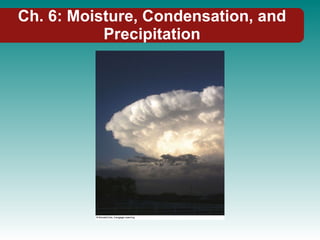
Ch. 6: Moisture, Condensation, and Precipitation
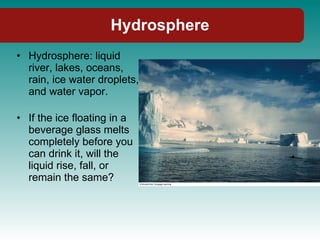
Hydrosphere Hydrosphere: liquid river, lakes, oceans, rain, ice water droplets, and water vapor. If the ice floating in a beverage glass melts completely before you can drink it, will the liquid rise, fall, or remain the same?
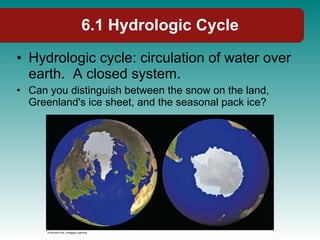
6.1 Hydrologic Cycle Hydrologic cycle: circulation of water over earth.  A closed system. Can you distinguish between the snow on the land, Greenland's ice sheet, and the seasonal pack ice?
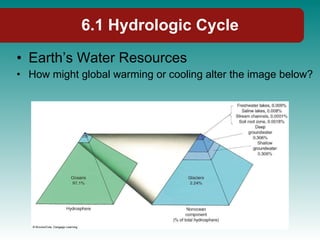
6.1 Hydrologic Cycle Earth’s Water Resources How might global warming or cooling alter the image below?
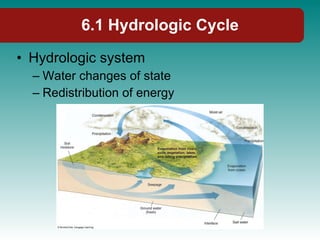
6.1 Hydrologic Cycle Hydrologic system Water changes of state Redistribution of energy
6.2 Water in the Atmosphere Water Budget and Heat Budget Water vapor absorbs and reflects energy Water Budget: Total quantity of water remains the same.  Any deficit must balance gains.  Latent Heat Heat transfer involved with evaporation and condensation is huge!  The energy stored and transferred in phase changes provides the power for Earth’s storms!
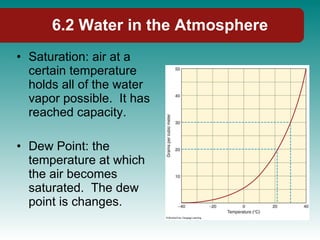
Saturation: air at a certain temperature holds all of the water vapor possible.  It has reached capacity. Dew Point: the temperature at which the air becomes saturated.  The dew point is changes. 6.2 Water in the Atmosphere
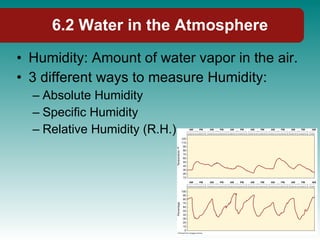
Humidity: Amount of water vapor in the air. 3 different ways to measure Humidity: Absolute Humidity Specific Humidity Relative Humidity (R.H.)  6.2 Water in the Atmosphere
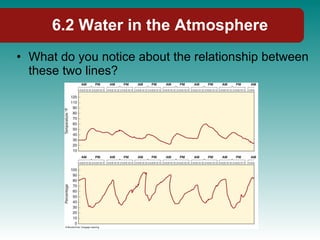
What do you notice about the relationship between these two lines? 6.2 Water in the Atmosphere
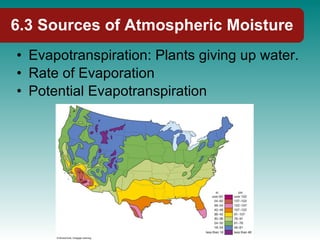
Evapotranspiration: Plants giving up water. Rate of Evaporation Potential Evapotranspiration 6.3 Sources of Atmospheric Moisture
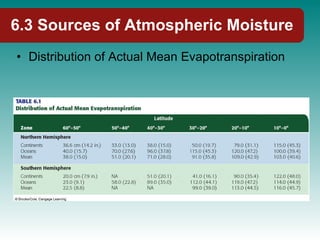
Distribution of Actual Mean Evapotranspiration 6.3 Sources of Atmospheric Moisture
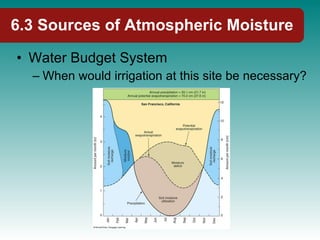
Water Budget System When would irrigation at this site be necessary? 6.3 Sources of Atmospheric Moisture
Condensation: occurs air is saturated to the dew point.  The R.H. becomes 100%. Condensation requires the presence of Condensation Nuclei.  These provide a surface for the water vapor to condense on. Fog and Clouds form when water vapor condenses and a large number of these droplets form a mass.  6.4 Condensation
Dew: condensation of water vapor at or near Earth’s surface White frost Rime 6.4 Condensation
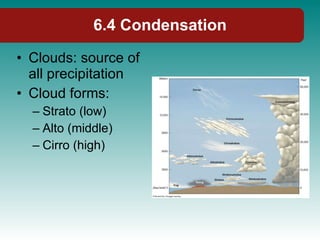
Clouds: source of all precipitation Cloud forms: Strato (low) Alto (middle) Cirro (high) 6.4 Condensation
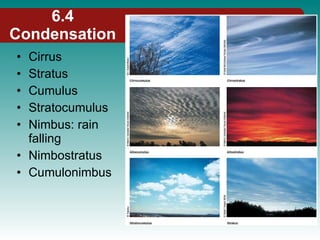
Cirrus Stratus Cumulus Stratocumulus Nimbus: rain falling Nimbostratus Cumulonimbus 6.4 Condensation
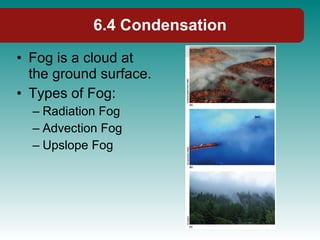
Fog is a cloud at the ground surface. Types of Fog: Radiation Fog Advection Fog Upslope Fog 6.4 Condensation
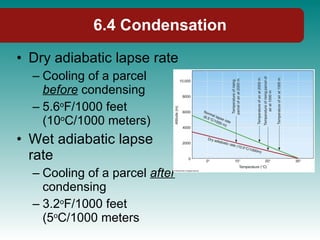
Adiabatic heating: descending air is compressed by increasing pressure and thus warms at 5.6 o F/1000 feet (10 o C/1000 meters) Adiabatic cooling: rising parcel of air cools as with decreasing pressure.  It cools at the same rate as above. 6.4 Condensation
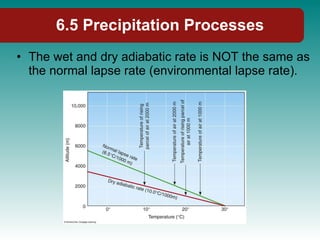
Dry adiabatic lapse rate Cooling of a parcel  before   condensing 5.6 o F/1000 feet (10 o C/1000 meters) Wet adiabatic lapse rate  Cooling of a parcel  after  condensing 3.2 o F/1000 feet (5 o C/1000 meters 6.4 Condensation
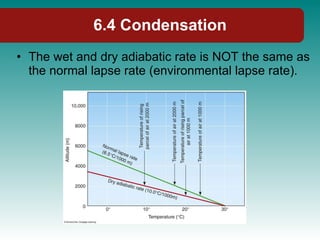
The wet and dry adiabatic rate is NOT the same as the normal lapse rate (environmental lapse rate). 6.4 Condensation
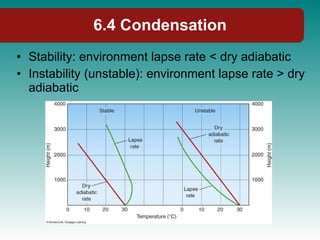
Stability: environment lapse rate < dry adiabatic  Instability (unstable): environment lapse rate > dry adiabatic  6.4 Condensation
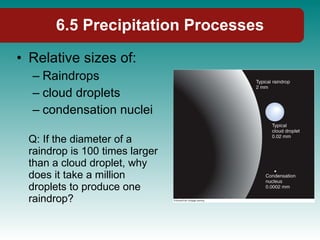
Relative sizes of: Raindrops cloud droplets condensation nuclei Q: If the diameter of a raindrop is 100 times larger than a cloud droplet, why does it take a million droplets to produce one raindrop? 6.5 Precipitation Processes
The wet and dry adiabatic rate is NOT the same as the normal lapse rate (environmental lapse rate). 6.5 Precipitation Processes
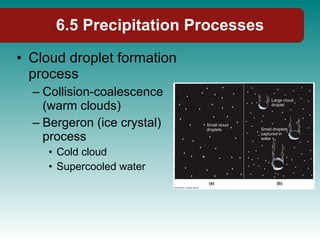
Cloud droplet formation process Collision-coalescence (warm clouds) Bergeron (ice crystal) process Cold cloud Supercooled water 6.5 Precipitation Processes
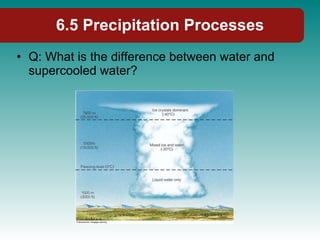
Q: What is the difference between water and supercooled water? 6.5 Precipitation Processes
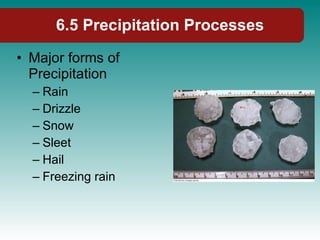
Major forms of Precipitation Rain Drizzle Snow Sleet Hail Freezing rain 6.5 Precipitation Processes
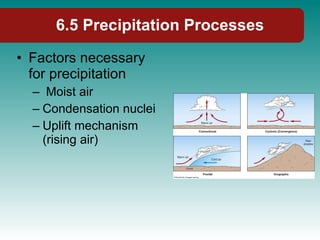
Factors necessary for precipitation Moist air Condensation nuclei Uplift mechanism (rising air) 6.5 Precipitation Processes
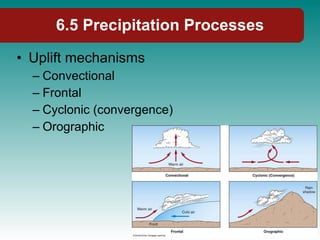
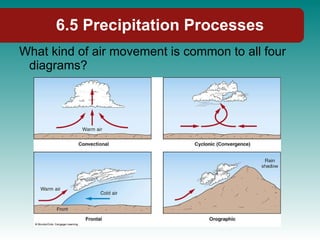
Uplift mechanisms Convectional Frontal Cyclonic (convergence) Orographic 6.5 Precipitation Processes
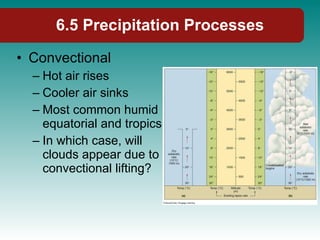
Convectional Hot air rises Cooler air sinks Most common humid equatorial and tropics In which case, will clouds appear due to convectional lifting? 6.5 Precipitation Processes
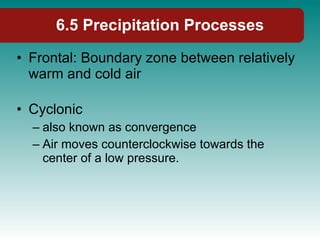
Frontal: Boundary zone between relatively warm and cold air Cyclonic also known as convergence Air moves counterclockwise towards the center of a low pressure. 6.5 Precipitation Processes
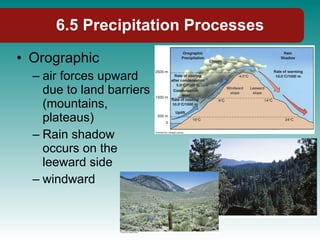
Orographic air forces upward due to land barriers (mountains, plateaus) Rain shadow occurs on the leeward side windward 6.5 Precipitation Processes
What kind of air movement is common to all four diagrams? 6.5 Precipitation Processes
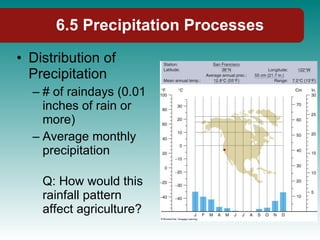
Distribution of Precipitation # of raindays (0.01 inches of rain or more) Average monthly precipitation Q: How would this rainfall pattern affect agriculture? 6.5 Precipitation Processes
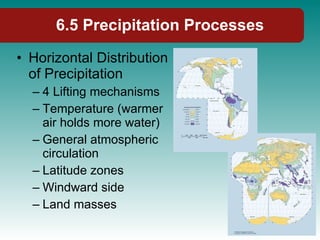
Horizontal Distribution of Precipitation 4 Lifting mechanisms Temperature (warmer air holds more water) General atmospheric circulation Latitude zones Windward side Land masses 6.5 Precipitation Processes
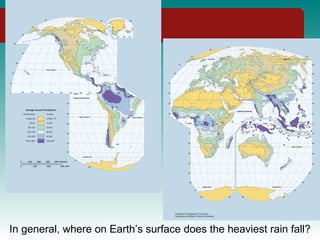
In general, where on Earth’s surface does the heaviest rain fall?
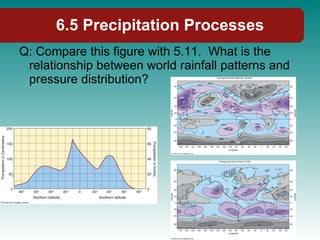
Q: Compare this figure with 5.11.  What is the relationship between world rainfall patterns and pressure distribution? 6.5 Precipitation Processes
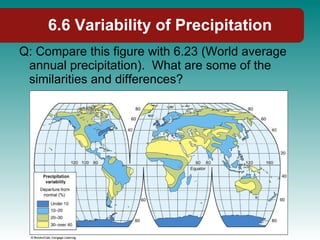
Q: Compare this figure with 6.23 (World average annual precipitation).  What are some of the similarities and differences?  6.6 Variability of Precipitation
Physical Geography End of Chapter 6: Moisture, Condensation, and Precipitation

6

  • 1.
    Chapter 6: Moisture,Condensation, and Precipitation Physical Geography Ninth Edition Robert E. Gabler James. F. Petersen L. Michael Trapasso Dorothy Sack
  • 2.
    Ch. 6: Moisture,Condensation, and Precipitation
  • 3.
    Hydrosphere Hydrosphere: liquidriver, lakes, oceans, rain, ice water droplets, and water vapor. If the ice floating in a beverage glass melts completely before you can drink it, will the liquid rise, fall, or remain the same?
  • 4.
    6.1 Hydrologic CycleHydrologic cycle: circulation of water over earth. A closed system. Can you distinguish between the snow on the land, Greenland's ice sheet, and the seasonal pack ice?
  • 5.
    6.1 Hydrologic CycleEarth’s Water Resources How might global warming or cooling alter the image below?
  • 6.
    6.1 Hydrologic CycleHydrologic system Water changes of state Redistribution of energy
  • 7.
    6.2 Water inthe Atmosphere Water Budget and Heat Budget Water vapor absorbs and reflects energy Water Budget: Total quantity of water remains the same. Any deficit must balance gains. Latent Heat Heat transfer involved with evaporation and condensation is huge! The energy stored and transferred in phase changes provides the power for Earth’s storms!
  • 8.
    Saturation: air ata certain temperature holds all of the water vapor possible. It has reached capacity. Dew Point: the temperature at which the air becomes saturated. The dew point is changes. 6.2 Water in the Atmosphere
  • 9.
    Humidity: Amount ofwater vapor in the air. 3 different ways to measure Humidity: Absolute Humidity Specific Humidity Relative Humidity (R.H.) 6.2 Water in the Atmosphere
  • 10.
    What do younotice about the relationship between these two lines? 6.2 Water in the Atmosphere
  • 11.
    Evapotranspiration: Plants givingup water. Rate of Evaporation Potential Evapotranspiration 6.3 Sources of Atmospheric Moisture
  • 12.
    Distribution of ActualMean Evapotranspiration 6.3 Sources of Atmospheric Moisture
  • 13.
    Water Budget SystemWhen would irrigation at this site be necessary? 6.3 Sources of Atmospheric Moisture
  • 14.
    Condensation: occurs airis saturated to the dew point. The R.H. becomes 100%. Condensation requires the presence of Condensation Nuclei. These provide a surface for the water vapor to condense on. Fog and Clouds form when water vapor condenses and a large number of these droplets form a mass. 6.4 Condensation
  • 15.
    Dew: condensation ofwater vapor at or near Earth’s surface White frost Rime 6.4 Condensation
  • 16.
    Clouds: source ofall precipitation Cloud forms: Strato (low) Alto (middle) Cirro (high) 6.4 Condensation
  • 17.
    Cirrus Stratus CumulusStratocumulus Nimbus: rain falling Nimbostratus Cumulonimbus 6.4 Condensation
  • 18.
    Fog is acloud at the ground surface. Types of Fog: Radiation Fog Advection Fog Upslope Fog 6.4 Condensation
  • 19.
    Adiabatic heating: descendingair is compressed by increasing pressure and thus warms at 5.6 o F/1000 feet (10 o C/1000 meters) Adiabatic cooling: rising parcel of air cools as with decreasing pressure. It cools at the same rate as above. 6.4 Condensation
  • 20.
    Dry adiabatic lapserate Cooling of a parcel before condensing 5.6 o F/1000 feet (10 o C/1000 meters) Wet adiabatic lapse rate Cooling of a parcel after condensing 3.2 o F/1000 feet (5 o C/1000 meters 6.4 Condensation
  • 21.
    The wet anddry adiabatic rate is NOT the same as the normal lapse rate (environmental lapse rate). 6.4 Condensation
  • 22.
    Stability: environment lapserate < dry adiabatic Instability (unstable): environment lapse rate > dry adiabatic 6.4 Condensation
  • 23.
    Relative sizes of:Raindrops cloud droplets condensation nuclei Q: If the diameter of a raindrop is 100 times larger than a cloud droplet, why does it take a million droplets to produce one raindrop? 6.5 Precipitation Processes
  • 24.
    The wet anddry adiabatic rate is NOT the same as the normal lapse rate (environmental lapse rate). 6.5 Precipitation Processes
  • 25.
    Cloud droplet formationprocess Collision-coalescence (warm clouds) Bergeron (ice crystal) process Cold cloud Supercooled water 6.5 Precipitation Processes
  • 26.
    Q: What isthe difference between water and supercooled water? 6.5 Precipitation Processes
  • 27.
    Major forms ofPrecipitation Rain Drizzle Snow Sleet Hail Freezing rain 6.5 Precipitation Processes
  • 28.
    Factors necessary forprecipitation Moist air Condensation nuclei Uplift mechanism (rising air) 6.5 Precipitation Processes
  • 29.
    Uplift mechanisms ConvectionalFrontal Cyclonic (convergence) Orographic 6.5 Precipitation Processes
  • 30.
    Convectional Hot airrises Cooler air sinks Most common humid equatorial and tropics In which case, will clouds appear due to convectional lifting? 6.5 Precipitation Processes
  • 31.
    Frontal: Boundary zonebetween relatively warm and cold air Cyclonic also known as convergence Air moves counterclockwise towards the center of a low pressure. 6.5 Precipitation Processes
  • 32.
    Orographic air forcesupward due to land barriers (mountains, plateaus) Rain shadow occurs on the leeward side windward 6.5 Precipitation Processes
  • 33.
    What kind ofair movement is common to all four diagrams? 6.5 Precipitation Processes
  • 34.
    Distribution of Precipitation# of raindays (0.01 inches of rain or more) Average monthly precipitation Q: How would this rainfall pattern affect agriculture? 6.5 Precipitation Processes
  • 35.
    Horizontal Distribution ofPrecipitation 4 Lifting mechanisms Temperature (warmer air holds more water) General atmospheric circulation Latitude zones Windward side Land masses 6.5 Precipitation Processes
  • 36.
    In general, whereon Earth’s surface does the heaviest rain fall?
  • 37.
    Q: Compare thisfigure with 5.11. What is the relationship between world rainfall patterns and pressure distribution? 6.5 Precipitation Processes
  • 38.
    Q: Compare thisfigure with 6.23 (World average annual precipitation). What are some of the similarities and differences? 6.6 Variability of Precipitation
  • 39.
    Physical Geography Endof Chapter 6: Moisture, Condensation, and Precipitation

Editor's Notes

  • #3 Insert cover image for Chapter 6 (p. 140).
  • #4 Insert figure 6.1
  • #5 Insert figure 6.2
  • #6 Insert figure 6.3
  • #7 Insert figure 6.4
  • #8 Insert figure 6.4
  • #9 Insert figure 6.5
  • #10 Insert figure 6.6
  • #11 Insert figure 6.6
  • #12 Insert figure 6.7
  • #13 Insert Table 6.1
  • #14 Insert Figure 6.8
  • #17 Insert Figure 6.10
  • #18 Insert Figure 6.11
  • #19 Insert Figure 6.9
  • #21 Insert Figure 6.12
  • #22 Insert Figure 6.12
  • #23 Insert Figure 6.13
  • #24 Insert Figure 6.14
  • #25 Insert Figure 6.12
  • #26 Insert Figure 6.15
  • #27 Insert Figure 6.16
  • #28 Insert Figure 6.17
  • #29 Insert Figure 6.19
  • #30 Insert Figure 6.19
  • #31 Insert Figure 6.20
  • #33 Insert Figure 6.21
  • #34 Insert Figure 6.19
  • #35 Insert Figure 6.22
  • #36 Insert Figure 6.23
  • #38 Insert Figure 6.24 and 5.11
  • #39 Insert Figure 6.25