

1
The Audio-Lingual Method
聽說教學法
理論組:邱宜政、劉佳宜、吳旻姍
教學組:張哲銘、饒崇祐、林芝筠、么佩伶
修改: 鄧桂薰老師
2
Introduction-1
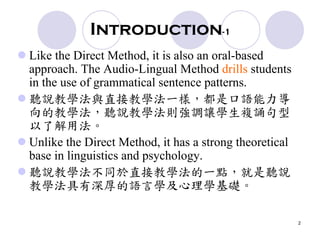
Like the Direct Method, it is also an oral-based
approach. The Audio-Lingual Method drills students
in the use of grammatical sentence patterns.
聽說教學法與直接教學法一樣,都是口語能力導
向的教學法,聽說教學法則強調讓學生複誦句型
以了解用法。
Unlike the Direct Method, it has a strong theoretical
base in linguistics and psychology.
聽說教學法不同於直接教學法的一點,就是聽說
教學法具有深厚的語言學及心理學基礎。
3
Introduction-2
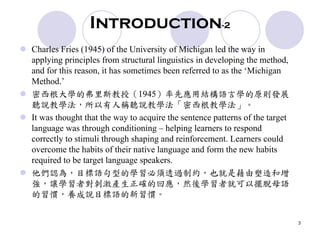
Charles Fries (1945) of the University of Michigan led the way in
applying principles from structural linguistics in developing the method,
and for this reason, it has sometimes been referred to as the ‘Michigan
Method.’
密西根大學的弗里斯教授(1945)率先應用結構語言學的原則發展
聽說教學法,所以有人稱聽說教學法「密西根教學法」。
It was thought that the way to acquire the sentence patterns of the target
language was through conditioning – helping learners to respond
correctly to stimuli through shaping and reinforcement. Learners could
overcome the habits of their native language and form the new habits
required to be target language speakers.
他們認為,目標語句型的學習必須透過制約,也就是藉由塑造和增
強,讓學習者對刺激產生正確的回應,然後學習者就可以擺脫母語
的習慣,養成說目標語的新習慣。
4
Think about the Experience-1
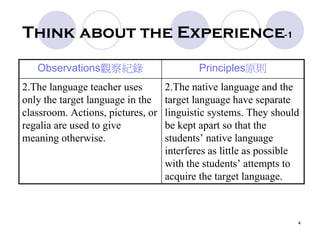
Observations觀察紀錄 Principles原則
2.The language teacher uses
only the target language in the
classroom. Actions, pictures, or
regalia are used to give
meaning otherwise.
2.The native language and the
target language have separate
linguistic systems. They should
be kept apart so that the
students’ native language
interferes as little as possible
with the students’ attempts to
acquire the target language.
5
Think about the Experience-2
Observations觀察紀錄 Principles原則
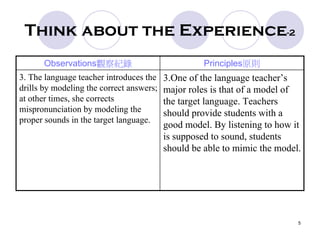
3. The language teacher introduces the
drills by modeling the correct answers;
at other times, she corrects
mispronunciation by modeling the
proper sounds in the target language.
3.One of the language teacher’s
major roles is that of a model of
the target language. Teachers
should provide students with a
good model. By listening to how it
is supposed to sound, students
should be able to mimic the model.
6
Think about the Experience-3
Observations觀察紀錄 Principles原則
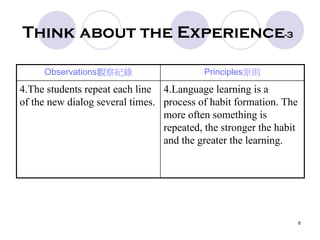
4.The students repeat each line
of the new dialog several times.
4.Language learning is a
process of habit formation. The
more often something is
repeated, the stronger the habit
and the greater the learning.
7
Think about the Experience-4
Observations觀察紀錄 Principles原則
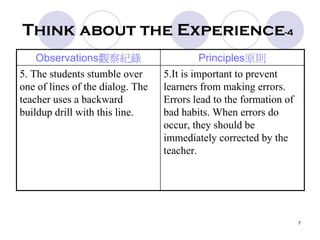
5. The students stumble over
one of lines of the dialog. The
teacher uses a backward
buildup drill with this line.
5.It is important to prevent
learners from making errors.
Errors lead to the formation of
bad habits. When errors do
occur, they should be
immediately corrected by the
teacher.
8
Think about the Experience-5
Observations觀察紀錄 Principles原則
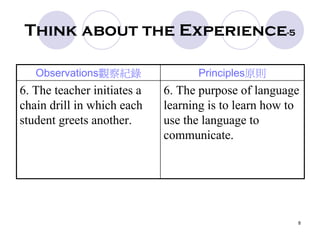
6. The teacher initiates a
chain drill in which each
student greets another.
6. The purpose of language
learning is to learn how to
use the language to
communicate.
9
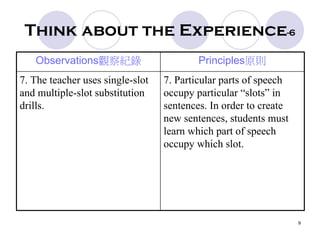
Think about the Experience-6
Observations觀察紀錄 Principles原則
7. The teacher uses single-slot
and multiple-slot substitution
drills.
7. Particular parts of speech
occupy particular “slots” in
sentences. In order to create
new sentences, students must
learn which part of speech
occupy which slot.
10
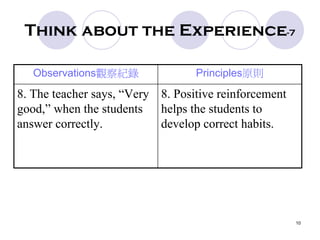
Think about the Experience-7
Observations觀察紀錄 Principles原則
8. The teacher says, “Very
good,” when the students
answer correctly.
8. Positive reinforcement
helps the students to
develop correct habits.
11
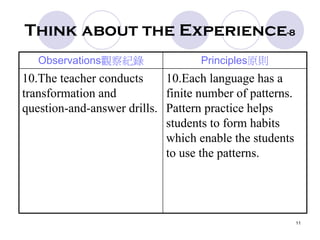
Think about the Experience-8
Observations觀察紀錄 Principles原則
10.The teacher conducts
transformation and
question-and-answer drills.
10.Each language has a
finite number of patterns.
Pattern practice helps
students to form habits
which enable the students
to use the patterns.
12
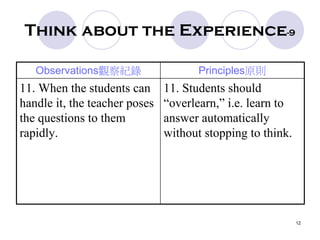
Think about the Experience-9
Observations觀察紀錄 Principles原則
11. When the students can
handle it, the teacher poses
the questions to them
rapidly.
11. Students should
“overlearn,” i.e. learn to
answer automatically
without stopping to think.
13
Think about the Experience-10
Observations觀察紀錄 Principles原則
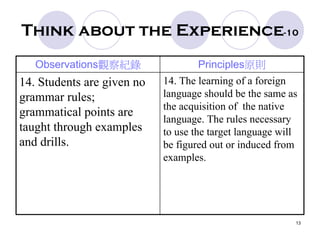
14. Students are given no
grammar rules;
grammatical points are
taught through examples
and drills.
14. The learning of a foreign
language should be the same as
the acquisition of the native
language. The rules necessary
to use the target language will
be figured out or induced from
examples.
14
Think about the Experience-11
Observations觀察紀錄 Principles原則
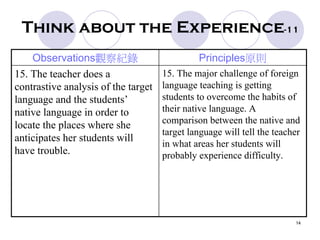
15. The teacher does a
contrastive analysis of the target
language and the students’
native language in order to
locate the places where she
anticipates her students will
have trouble.
15. The major challenge of foreign
language teaching is getting
students to overcome the habits of
their native language. A
comparison between the native and
target language will tell the teacher
in what areas her students will
probably experience difficulty.
15
Think about the Experience-12
Observations觀察紀錄 Principles原則
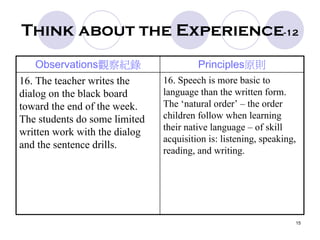
16. The teacher writes the
dialog on the black board
toward the end of the week.
The students do some limited
written work with the dialog
and the sentence drills.
16. Speech is more basic to
language than the written form.
The ‘natural order’ – the order
children follow when learning
their native language – of skill
acquisition is: listening, speaking,
reading, and writing.
16
Think about the Experience-13
Observations觀察紀錄 Principles原則
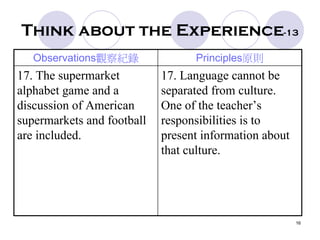
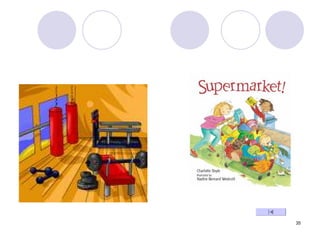
17. The supermarket
alphabet game and a
discussion of American
supermarkets and football
are included.
17. Language cannot be
separated from culture.
One of the teacher’s
responsibilities is to
present information about
that culture.
17
Reviewing the principles-1
1. What are the goals of teachers who use the
Audio-Lingual Method?
Teacher Want their students to be able to use the target
language communicatively. Their students achieve this by
forming new habits in the target language and overcoming the
old habits of their native language.
2. What is the role of the teacher? What is the
role of the students?
Teacher is responsible for providing her students with s
good model for imitation.
18
Reviewing the principles-2
3. What are some characteristics of the
teaching/learning process?
New vocabulary and structural patterns are presented
through dialogs. Grammar is induced from the examples given;
explicit grammar rules are not provided. Cultural information
is contextualized in the dialogs or presented by the teacher.
4. What is the nature of student-teacher
interaction? What is the nature of student-
student interaction?
There is student-to-student interaction in chain drills or
when students take different roles in dialogs, but this
interaction is teacher-directed. Most of the interaction is
between teacher and students and is initiated by the teacher.
19
Reviewing the principles-3
6. How is the language viewed? How is the
culture viewed?
Every language is seen as having its own unique system.
The system is comprised of several different levels:
phonological, morphological, and syntactic. Each level has its
own distinctive patterns.
Everyday speech is emphasized in the Audio-Lingual
Method. Culture consists of the everyday behavior and
lifestyle of the target language speakers.
20
Reviewing the principles-4
7. What areas of language are emphasized?
What language skills are emphasized?
Vocabulary is kept to a minimum while the students are
mastering the sound system and grammatical patters.
The natural order of skills presentation is adhered to:
listening, speaking, reading, and writing. The oral/aural skills
receive most of the attention. Pronunciation is taught from the
beginning, often by students working in language laboratories
on discriminating between members of minimal pairs.
21
Reviewing the principles-5
8.What is the role of the students’ native
language?
The habits of the students’ native language are thought to
interfere with the students’ attempts to master the target
language.
10.How does the teacher respond to student errors?
Student errors are to be avoided if at all possible through
the teacher’s awareness of where the students will have
difficulty restriction of what they are taught to say.
22
Reviewing the techiques-1
Dialog memorization
Students memorize the dialog through mimicry;
a) Students usually take the role of one person in the
dialog, and the teacher the other.
b) Another way of practicing the two roles is for half of
the class to take one role and the other half to take the
other.
c) After the dialog has been memorized, pairs of
individual students might perform the dialog for rest of
the class.
These patterns and points are later practiced in drills
based on the lines of the dialog.
23
Reviewing the techiques-2
Backward build-up (expansion) drill
This drill I used when a long line of a dialog is giving
students trouble.
Repetition drill
Students are asked to repeat the teacher’s modal as
accurately and as quickly as possible. This drill is often used to
teach the lines of the dialog.
Chain drill
A chain drill gets its name from the chain of conversation
that forms around the room as students, one-by-one, ask and
answer questions of each other
24
Reviewing the techiques-3
Single-slot substitution
The major purpose of this drill is to give the students
practice in finding and filling in the slots of a sentence.
Multiple-slot substitution drill
This drill is similar to the single-slot substitution drill. The
difference is that the teacher gives cue phrases, one at a time,
that fit into different slots in the dialog line.
25
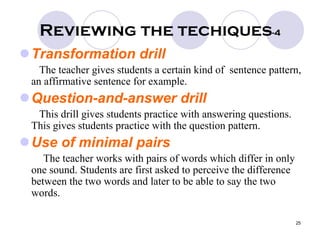
Reviewing the techiques-4
Transformation drill
The teacher gives students a certain kind of sentence pattern,
an affirmative sentence for example.
Question-and-answer drill
This drill gives students practice with answering questions.
This gives students practice with the question pattern.
Use of minimal pairs
The teacher works with pairs of words which differ in only
one sound. Students are first asked to perceive the difference
between the two words and later to be able to say the two
words.
26
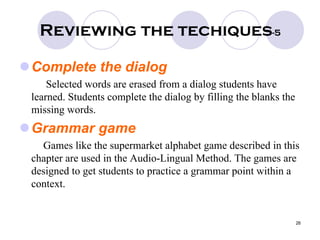
Reviewing the techiques-5
Complete the dialog
Selected words are erased from a dialog students have
learned. Students complete the dialog by filling the blanks the
missing words.
Grammar game
Games like the supermarket alphabet game described in this
chapter are used in the Audio-Lingual Method. The games are
designed to get students to practice a grammar point within a
context.
27
Teaching Demonstration
The Audio-Lingual Method
28
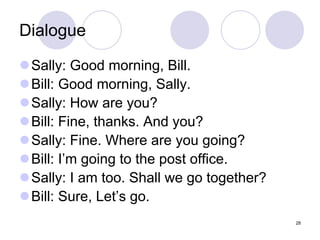
Dialogue
Sally: Good morning, Bill.
Bill: Good morning, Sally.
Sally: How are you?
Bill: Fine, thanks. And you?
Sally: Fine. Where are you going?
Bill: I’m going to the post office.
Sally: I am too. Shall we go together?
Bill: Sure, Let’s go.
29
Repeat the dialogues.
Chain Drill
How are you?
Fine, thanks. And you?
Substitution Drill
I am going to the post office.
30
Multiple-Slot Substitution Drill
I am going to the post office.
She, bank
She is going to the bank.
They, library
They are going to the library.
31
Transformation Drill ( An affirmative
sentence into a negative sentence.)
She is going to the post office.
Yes/no-question
Question and Answer
Repeat the dialogue
32
P. 40
Review the dialogue.
Expand the dialogue.
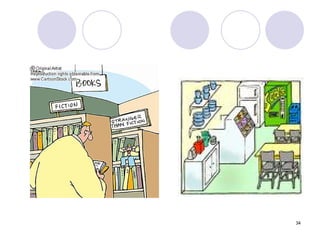
I am going to the supermarket. I need a little
butter, some eggs…
Mass and count nouns
Minimal pair words
Sheep/ship, leave, live
Supermarket alphabet game
A presentation by the teacher on supermarkets
in the United States.
33
34
35

The Audio Lingual Method

  • 1.
  • 2.
    2 Introduction-1 Like the DirectMethod, it is also an oral-based approach. The Audio-Lingual Method drills students in the use of grammatical sentence patterns. 聽說教學法與直接教學法一樣,都是口語能力導 向的教學法,聽說教學法則強調讓學生複誦句型 以了解用法。 Unlike the Direct Method, it has a strong theoretical base in linguistics and psychology. 聽說教學法不同於直接教學法的一點,就是聽說 教學法具有深厚的語言學及心理學基礎。
  • 3.
    3 Introduction-2 Charles Fries (1945)of the University of Michigan led the way in applying principles from structural linguistics in developing the method, and for this reason, it has sometimes been referred to as the ‘Michigan Method.’ 密西根大學的弗里斯教授(1945)率先應用結構語言學的原則發展 聽說教學法,所以有人稱聽說教學法「密西根教學法」。 It was thought that the way to acquire the sentence patterns of the target language was through conditioning – helping learners to respond correctly to stimuli through shaping and reinforcement. Learners could overcome the habits of their native language and form the new habits required to be target language speakers. 他們認為,目標語句型的學習必須透過制約,也就是藉由塑造和增 強,讓學習者對刺激產生正確的回應,然後學習者就可以擺脫母語 的習慣,養成說目標語的新習慣。
  • 4.
    4 Think about theExperience-1 Observations觀察紀錄 Principles原則 2.The language teacher uses only the target language in the classroom. Actions, pictures, or regalia are used to give meaning otherwise. 2.The native language and the target language have separate linguistic systems. They should be kept apart so that the students’ native language interferes as little as possible with the students’ attempts to acquire the target language.
  • 5.
    5 Think about theExperience-2 Observations觀察紀錄 Principles原則 3. The language teacher introduces the drills by modeling the correct answers; at other times, she corrects mispronunciation by modeling the proper sounds in the target language. 3.One of the language teacher’s major roles is that of a model of the target language. Teachers should provide students with a good model. By listening to how it is supposed to sound, students should be able to mimic the model.
  • 6.
    6 Think about theExperience-3 Observations觀察紀錄 Principles原則 4.The students repeat each line of the new dialog several times. 4.Language learning is a process of habit formation. The more often something is repeated, the stronger the habit and the greater the learning.
  • 7.
    7 Think about theExperience-4 Observations觀察紀錄 Principles原則 5. The students stumble over one of lines of the dialog. The teacher uses a backward buildup drill with this line. 5.It is important to prevent learners from making errors. Errors lead to the formation of bad habits. When errors do occur, they should be immediately corrected by the teacher.
  • 8.
    8 Think about theExperience-5 Observations觀察紀錄 Principles原則 6. The teacher initiates a chain drill in which each student greets another. 6. The purpose of language learning is to learn how to use the language to communicate.
  • 9.
    9 Think about theExperience-6 Observations觀察紀錄 Principles原則 7. The teacher uses single-slot and multiple-slot substitution drills. 7. Particular parts of speech occupy particular “slots” in sentences. In order to create new sentences, students must learn which part of speech occupy which slot.
  • 10.
    10 Think about theExperience-7 Observations觀察紀錄 Principles原則 8. The teacher says, “Very good,” when the students answer correctly. 8. Positive reinforcement helps the students to develop correct habits.
  • 11.
    11 Think about theExperience-8 Observations觀察紀錄 Principles原則 10.The teacher conducts transformation and question-and-answer drills. 10.Each language has a finite number of patterns. Pattern practice helps students to form habits which enable the students to use the patterns.
  • 12.
    12 Think about theExperience-9 Observations觀察紀錄 Principles原則 11. When the students can handle it, the teacher poses the questions to them rapidly. 11. Students should “overlearn,” i.e. learn to answer automatically without stopping to think.
  • 13.
    13 Think about theExperience-10 Observations觀察紀錄 Principles原則 14. Students are given no grammar rules; grammatical points are taught through examples and drills. 14. The learning of a foreign language should be the same as the acquisition of the native language. The rules necessary to use the target language will be figured out or induced from examples.
  • 14.
    14 Think about theExperience-11 Observations觀察紀錄 Principles原則 15. The teacher does a contrastive analysis of the target language and the students’ native language in order to locate the places where she anticipates her students will have trouble. 15. The major challenge of foreign language teaching is getting students to overcome the habits of their native language. A comparison between the native and target language will tell the teacher in what areas her students will probably experience difficulty.
  • 15.
    15 Think about theExperience-12 Observations觀察紀錄 Principles原則 16. The teacher writes the dialog on the black board toward the end of the week. The students do some limited written work with the dialog and the sentence drills. 16. Speech is more basic to language than the written form. The ‘natural order’ – the order children follow when learning their native language – of skill acquisition is: listening, speaking, reading, and writing.
  • 16.
    16 Think about theExperience-13 Observations觀察紀錄 Principles原則 17. The supermarket alphabet game and a discussion of American supermarkets and football are included. 17. Language cannot be separated from culture. One of the teacher’s responsibilities is to present information about that culture.
  • 17.
    17 Reviewing the principles-1 1.What are the goals of teachers who use the Audio-Lingual Method? Teacher Want their students to be able to use the target language communicatively. Their students achieve this by forming new habits in the target language and overcoming the old habits of their native language. 2. What is the role of the teacher? What is the role of the students? Teacher is responsible for providing her students with s good model for imitation.
  • 18.
    18 Reviewing the principles-2 3.What are some characteristics of the teaching/learning process? New vocabulary and structural patterns are presented through dialogs. Grammar is induced from the examples given; explicit grammar rules are not provided. Cultural information is contextualized in the dialogs or presented by the teacher. 4. What is the nature of student-teacher interaction? What is the nature of student- student interaction? There is student-to-student interaction in chain drills or when students take different roles in dialogs, but this interaction is teacher-directed. Most of the interaction is between teacher and students and is initiated by the teacher.
  • 19.
    19 Reviewing the principles-3 6.How is the language viewed? How is the culture viewed? Every language is seen as having its own unique system. The system is comprised of several different levels: phonological, morphological, and syntactic. Each level has its own distinctive patterns. Everyday speech is emphasized in the Audio-Lingual Method. Culture consists of the everyday behavior and lifestyle of the target language speakers.
  • 20.
    20 Reviewing the principles-4 7.What areas of language are emphasized? What language skills are emphasized? Vocabulary is kept to a minimum while the students are mastering the sound system and grammatical patters. The natural order of skills presentation is adhered to: listening, speaking, reading, and writing. The oral/aural skills receive most of the attention. Pronunciation is taught from the beginning, often by students working in language laboratories on discriminating between members of minimal pairs.
  • 21.
    21 Reviewing the principles-5 8.Whatis the role of the students’ native language? The habits of the students’ native language are thought to interfere with the students’ attempts to master the target language. 10.How does the teacher respond to student errors? Student errors are to be avoided if at all possible through the teacher’s awareness of where the students will have difficulty restriction of what they are taught to say.
  • 22.
    22 Reviewing the techiques-1 Dialogmemorization Students memorize the dialog through mimicry; a) Students usually take the role of one person in the dialog, and the teacher the other. b) Another way of practicing the two roles is for half of the class to take one role and the other half to take the other. c) After the dialog has been memorized, pairs of individual students might perform the dialog for rest of the class. These patterns and points are later practiced in drills based on the lines of the dialog.
  • 23.
    23 Reviewing the techiques-2 Backwardbuild-up (expansion) drill This drill I used when a long line of a dialog is giving students trouble. Repetition drill Students are asked to repeat the teacher’s modal as accurately and as quickly as possible. This drill is often used to teach the lines of the dialog. Chain drill A chain drill gets its name from the chain of conversation that forms around the room as students, one-by-one, ask and answer questions of each other
  • 24.
    24 Reviewing the techiques-3 Single-slotsubstitution The major purpose of this drill is to give the students practice in finding and filling in the slots of a sentence. Multiple-slot substitution drill This drill is similar to the single-slot substitution drill. The difference is that the teacher gives cue phrases, one at a time, that fit into different slots in the dialog line.
  • 25.
    25 Reviewing the techiques-4 Transformationdrill The teacher gives students a certain kind of sentence pattern, an affirmative sentence for example. Question-and-answer drill This drill gives students practice with answering questions. This gives students practice with the question pattern. Use of minimal pairs The teacher works with pairs of words which differ in only one sound. Students are first asked to perceive the difference between the two words and later to be able to say the two words.
  • 26.
    26 Reviewing the techiques-5 Completethe dialog Selected words are erased from a dialog students have learned. Students complete the dialog by filling the blanks the missing words. Grammar game Games like the supermarket alphabet game described in this chapter are used in the Audio-Lingual Method. The games are designed to get students to practice a grammar point within a context.
  • 27.
  • 28.
    28 Dialogue Sally: Good morning,Bill. Bill: Good morning, Sally. Sally: How are you? Bill: Fine, thanks. And you? Sally: Fine. Where are you going? Bill: I’m going to the post office. Sally: I am too. Shall we go together? Bill: Sure, Let’s go.
  • 29.
    29 Repeat the dialogues. ChainDrill How are you? Fine, thanks. And you? Substitution Drill I am going to the post office.
  • 30.
    30 Multiple-Slot Substitution Drill Iam going to the post office. She, bank She is going to the bank. They, library They are going to the library.
  • 31.
    31 Transformation Drill (An affirmative sentence into a negative sentence.) She is going to the post office. Yes/no-question Question and Answer Repeat the dialogue
  • 32.
    32 P. 40 Review thedialogue. Expand the dialogue. I am going to the supermarket. I need a little butter, some eggs… Mass and count nouns Minimal pair words Sheep/ship, leave, live Supermarket alphabet game A presentation by the teacher on supermarkets in the United States.
  • 33.
  • 34.
  • 35.