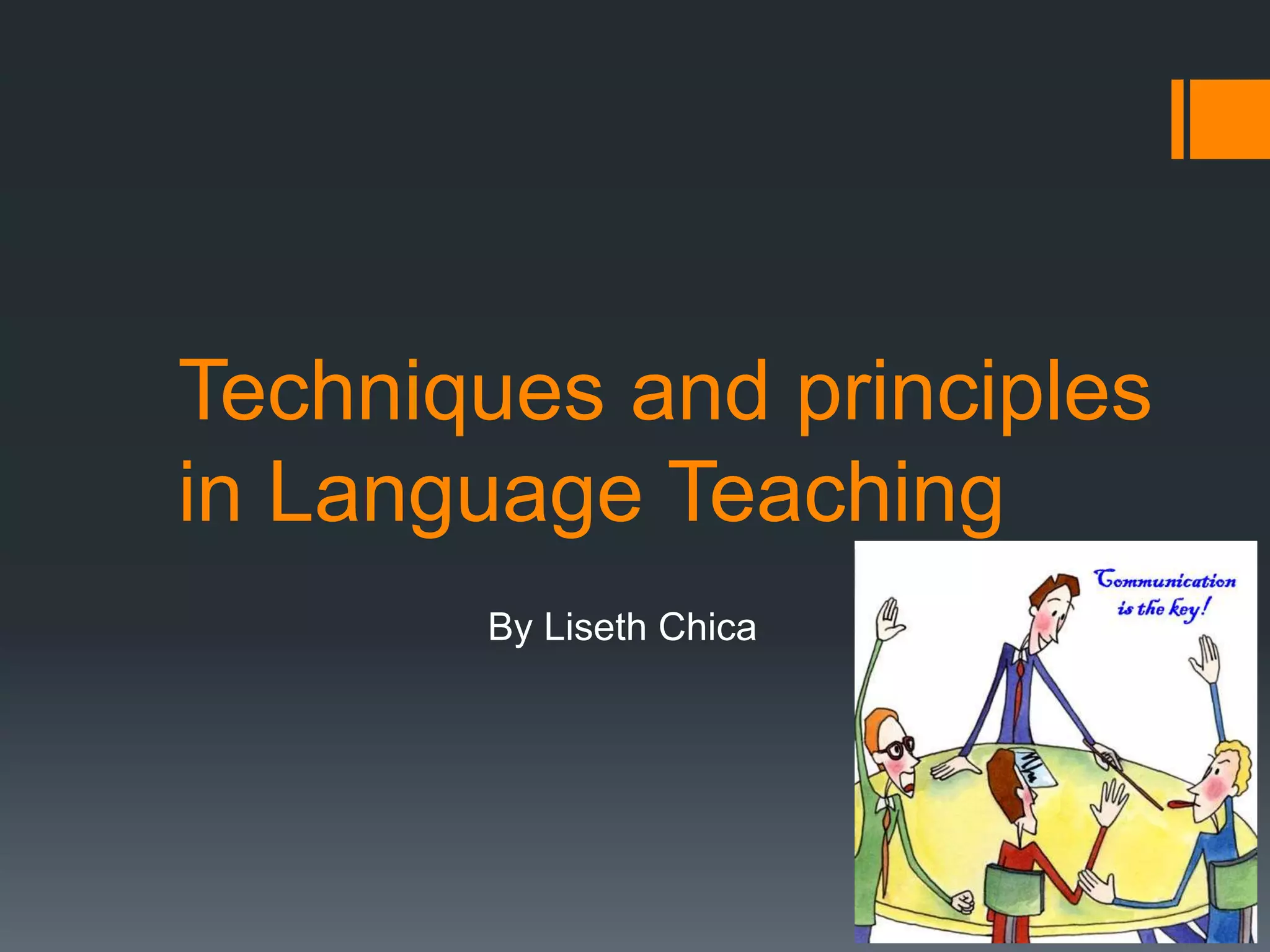
Techniques and principles
in Language Teaching
By Liseth Chica
Audiolingual Method - Principles
 The context helps to introduce language forms
 Languages have different linguistic systems
 Teacher have to provide good examples so the students can follow it
 People make habits and when a word is repeated they will made an habit
 An incorrect word can make a bad habit
 The communication is again the main point of learning
 A good treat makes good habits
 Teachers have to teach different skills (picture and spoken)
 Students need to have patter practice so then students can form habits
 When students have already understand is perfect to ask questions
 Teachers have to be special leaders so students are comfortable
 The teachers have to present new vocabulary through dialog
 The objective is not memorize rules, the rules have to be through examples
 Students need to know where they can have problems before doing it
 The first thing students have to understand is the listening
 Students need to know about the culture so teachers have to give information about it
Audiolingual Method -
Techniques
 Dialog memorization.- conversation include sentence patterns and grammar
points, students memorize two parts of the dialogs and then they share to the
class
 Backward buildup.- is used when students have problems with a long line, the
teacher divides the sentence and students repeat part by part
 Repetition drill.- students have to repeat the teachers’ model as fast as possible.
 Chain drill.- students give their responses one by one
 Single-slot substitution drill.- the teacher says a line and a different phrase and
students have to substitute.
 Multiple slot substitution drill.- teacher gives more phrases and students have to
find which one fit.
 Transformation drill.- teachers give a sentence and students have to transform
into a negative, reported speech etc.
 Question and answer drill.- teachers have to ask questions fast and then student
can do it too
 Use of minimal pairs.- students have to find differences between two similar
sound words
 Complete the dialog.- students have to fill with missing words in the blank spots
 Grammar game.- grammar has to be through games
Role of the Student Role of the Teacher
Audiolingual Method
Students have to answer questions fast
They need to imitate when teacher repeat
They make conversations with their
classmates
They need to see the teacher as a leader
They need to follow teacher instructions
Students have to change the form of
sentences
Students replace and rephrase sentences
Teachers have to get the control
Teachers have to be a good imitation
Teachers must provide the model of
pronunciation
Teachers gives words and phrases
Teachers correct student’s errors
Teachers have to be active and
concentrate of students performance
Audiolingual Method
 Assessment
Students are not going to memorize grammar rules
directly, they will learn through examples, teachers will
evaluate if the examples they provide are correct.
Teachers will evaluate students pronunciations at the
moment students repeat the words.
Silent Way-Principles
 Is good to begin with something students already now, so they can get confidence
 Students already know the “know-how” of a language
 Students think by themselves and not following a model
 The teacher can realize if students learned or not, just looking actions.
 Students get self confidence
 The teacher is in charge for teaching students and they for learn the language
 The teacher works in what students have already know
 Students will learn what they already know but in an more advanced phase
 Silent is an excellent tool for students because they feel confidence to work with other
students.
 Perception is the top of the pyramid which let students understand the meanings.
 Students learn working in groups when teacher is in silent
 Teachers have to be careful of criticizing students
 Student´s mistakes are excellent for teachers to reinforce classes
Silent Way-Principles part2
 Students learn more when they correct themselves
 During class time students learn their every class mistakes
 Is important to see progress and teacher have to be patient because everything is in
time
 If students don’t pay attention they can´t work well in the exercise
 Repetition is not necessary, students practice a lot with this method
 Students will increase their knowledge
 Students work by their own making choices
 They can apply their techniques freely
 Teachers and students learn from each other
 Every class time is a lesson
 The linguistic structures are in every day classes
 To change the routines students can make different combinations with sentences
 The skills work together
Silent Way- Techniques
Sound color chart.- it is a chart that have different block colors
according to different sounds
Teachers silence.- teacher helps only when is necessary
Peer correction.- students help each other in a cooperative way.
Rods.- they help students to be creative and words clearer, they can be
used from the beginning level until the harder ones, and also they can
be used to make family trees.
Self-correction gestures.- teachers can make signals or can use
specific objects to find the source of problems students have
Word chart.- helps to have a good pronunciation because words are
colored according to its pronunciation
Fidel charts.- it is a chart that separate words by its pronunciation
Structured feedback.- it is about how do the students feel during the
class, if they have doubts, the teacher have just to listen and give
direction when necessary.
Role of the Student Role of the Teacher
Silent Way
Students have all the responsibility
to learn and make choices
Students have already knowledge
and they will learn how to improve it
Students are obligated to pay
attention to do a better work
Students learn to work in groups
and to share opinions
Students learn to interact with other
integrants and to suggest
alternatives
Teachers must be in silent for
a better development in
students
Teachers can help only when
is necessary
Teachers facilitate learning
Teachers have to observe
students development
Teachers should see
progress in class
Teachers should be creative
Silent Way
 Assessment
 Teachers will evaluate students when they see progress in
the class
 The evaluation to students is going to be when they learn
more vocabulary since the beginning of the class
 Teachers will evaluate how students work in groups

Audiolingual and Silent Way Methods

  • 1.
    Techniques and principles inLanguage Teaching By Liseth Chica
  • 2.
    Audiolingual Method -Principles  The context helps to introduce language forms  Languages have different linguistic systems  Teacher have to provide good examples so the students can follow it  People make habits and when a word is repeated they will made an habit  An incorrect word can make a bad habit  The communication is again the main point of learning  A good treat makes good habits  Teachers have to teach different skills (picture and spoken)  Students need to have patter practice so then students can form habits  When students have already understand is perfect to ask questions  Teachers have to be special leaders so students are comfortable  The teachers have to present new vocabulary through dialog  The objective is not memorize rules, the rules have to be through examples  Students need to know where they can have problems before doing it  The first thing students have to understand is the listening  Students need to know about the culture so teachers have to give information about it
  • 3.
    Audiolingual Method - Techniques Dialog memorization.- conversation include sentence patterns and grammar points, students memorize two parts of the dialogs and then they share to the class  Backward buildup.- is used when students have problems with a long line, the teacher divides the sentence and students repeat part by part  Repetition drill.- students have to repeat the teachers’ model as fast as possible.  Chain drill.- students give their responses one by one  Single-slot substitution drill.- the teacher says a line and a different phrase and students have to substitute.  Multiple slot substitution drill.- teacher gives more phrases and students have to find which one fit.  Transformation drill.- teachers give a sentence and students have to transform into a negative, reported speech etc.  Question and answer drill.- teachers have to ask questions fast and then student can do it too  Use of minimal pairs.- students have to find differences between two similar sound words  Complete the dialog.- students have to fill with missing words in the blank spots  Grammar game.- grammar has to be through games
  • 4.
    Role of theStudent Role of the Teacher Audiolingual Method Students have to answer questions fast They need to imitate when teacher repeat They make conversations with their classmates They need to see the teacher as a leader They need to follow teacher instructions Students have to change the form of sentences Students replace and rephrase sentences Teachers have to get the control Teachers have to be a good imitation Teachers must provide the model of pronunciation Teachers gives words and phrases Teachers correct student’s errors Teachers have to be active and concentrate of students performance
  • 5.
    Audiolingual Method  Assessment Studentsare not going to memorize grammar rules directly, they will learn through examples, teachers will evaluate if the examples they provide are correct. Teachers will evaluate students pronunciations at the moment students repeat the words.
  • 6.
    Silent Way-Principles  Isgood to begin with something students already now, so they can get confidence  Students already know the “know-how” of a language  Students think by themselves and not following a model  The teacher can realize if students learned or not, just looking actions.  Students get self confidence  The teacher is in charge for teaching students and they for learn the language  The teacher works in what students have already know  Students will learn what they already know but in an more advanced phase  Silent is an excellent tool for students because they feel confidence to work with other students.  Perception is the top of the pyramid which let students understand the meanings.  Students learn working in groups when teacher is in silent  Teachers have to be careful of criticizing students  Student´s mistakes are excellent for teachers to reinforce classes
  • 7.
    Silent Way-Principles part2 Students learn more when they correct themselves  During class time students learn their every class mistakes  Is important to see progress and teacher have to be patient because everything is in time  If students don’t pay attention they can´t work well in the exercise  Repetition is not necessary, students practice a lot with this method  Students will increase their knowledge  Students work by their own making choices  They can apply their techniques freely  Teachers and students learn from each other  Every class time is a lesson  The linguistic structures are in every day classes  To change the routines students can make different combinations with sentences  The skills work together
  • 8.
    Silent Way- Techniques Soundcolor chart.- it is a chart that have different block colors according to different sounds Teachers silence.- teacher helps only when is necessary Peer correction.- students help each other in a cooperative way. Rods.- they help students to be creative and words clearer, they can be used from the beginning level until the harder ones, and also they can be used to make family trees. Self-correction gestures.- teachers can make signals or can use specific objects to find the source of problems students have Word chart.- helps to have a good pronunciation because words are colored according to its pronunciation Fidel charts.- it is a chart that separate words by its pronunciation Structured feedback.- it is about how do the students feel during the class, if they have doubts, the teacher have just to listen and give direction when necessary.
  • 9.
    Role of theStudent Role of the Teacher Silent Way Students have all the responsibility to learn and make choices Students have already knowledge and they will learn how to improve it Students are obligated to pay attention to do a better work Students learn to work in groups and to share opinions Students learn to interact with other integrants and to suggest alternatives Teachers must be in silent for a better development in students Teachers can help only when is necessary Teachers facilitate learning Teachers have to observe students development Teachers should see progress in class Teachers should be creative
  • 10.
    Silent Way  Assessment Teachers will evaluate students when they see progress in the class  The evaluation to students is going to be when they learn more vocabulary since the beginning of the class  Teachers will evaluate how students work in groups