Language Approaches:
Direct Method
Presented by: Donahbelle B. Suarez
MAED-English
Direct Method Approach
(Alternative Names: Natural or Conversational Approach)
 An approach that is focus on the target language.
 Uses the target language as a means of instruction and communication in
the classroom.
 The Direct Method emphasizes the use of pictures and objects, question,
and answer, spoken narratives, dictation, and imitation.
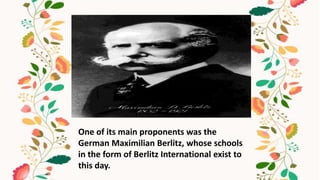
One of its main proponents was the
German Maximilian Berlitz, whose schools
in the form of Berlitz International exist to
this day.
Basic Principles
The tenets of the direct-method approach are summarized
by Richards and Rogers (2001) as follows:
1. Classroom instruction was conducted exclusively in the
target language.
2. Only everyday vocabulary and sentences were taught.
3. Oral communication skills were built up in a carefully
graded progression organized around question-and-answer
exchanges between teachers and students in small,
intensive classes.
4. Grammar was taught inductively.
5. New teaching points were introduced orally.
6. Concrete vocabulary was taught through
demonstration, objects, and pictures; abstract
vocabulary was taught through association of ideas.
7. Both speech and listening comprehension were
taught.
8. Correct pronunciation and grammar were
emphasized
TECHNIQUES
1. Question/answer exercise – the teacher asks questions of any type and the student
answers.
2. Dictation – the teacher chooses a grade-appropriate passage and reads it aloud.
3. Reading aloud – the students take turn reading sections of a passage, play or a
dialogue aloud.
4. Student self-correction – when a student makes a mistake the teacher offers
him/her a second chance by giving a choice.
5. Conversation practice – the students are given an opportunity to ask their own
questions to the other students or to the teacher. This enables both a teacher-
learner interaction as well as a learner-learner interaction.
6. Paragraph writing – the students are asked to write a passage in their own words.
ROLE OF TEACHERS
The role of the teacher is to direct class activities, but
students and teacher are partners in the learning process,
and there is a large amount of Learner-Learner interaction.
ROLE OF STUDENTS
the student role is less passive than in The Grammar-
Translation Method. The teacher and the students are more
like partners in the teaching/learning process.
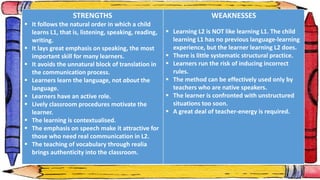
STRENGTHS
 It follows the natural order in which a child
learns L1, that is, listening, speaking, reading,
writing.
 It lays great emphasis on speaking, the most
important skill for many learners.
 It avoids the unnatural block of translation in
the communication process.
 Learners learn the language, not about the
language.
 Learners have an active role.
 Lively classroom procedures motivate the
learner.
 The learning is contextualised.
 The emphasis on speech make it attractive for
those who need real communication in L2.
 The teaching of vocabulary through realia
brings authenticity into the classroom.
WEAKNESSES
 Learning L2 is NOT like learning L1. The child
learning L1 has no previous language-learning
experience, but the learner learning L2 does.
 There is little systematic structural practice.
 Learners run the risk of inducing incorrect
rules.
 The method can be effectively used only by
teachers who are native speakers.
 The learner is confronted with unstructured
situations too soon.
 A great deal of teacher-energy is required.
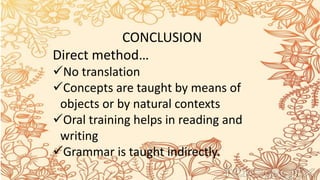
CONCLUSION
Direct method…
No translation
Concepts are taught by means of
objects or by natural contexts
Oral training helps in reading and
writing
Grammar is taught indirectly.
SOURCES
 https://www.google.com.ph/url?sa=t&rct=j&q=&esrc=s&source=web&cd=2&cad=rja&uact=8&ved=0ahUKEwil4SO
28bTAhUGUrwKHSWtAdEQFggmMAE&url=http%3A%2F%2Fhrmars.com%2Fhrmars_papers%2FThe_Direct-
Method_A_Good_Start_to_Teach_Oral_Language.pdf&usg=AFQjCNFp9-TLZG49qLDo0D4ap0Yrb-
HgKQ&sig2=mieR3caTF9O_nGsniEZikw
 https://www.google.com.ph/url?sa=t&rct=j&q=&esrc=s&source=web&cd=4&cad=rja&uact=8&ved=0ahUKEwil-
4SO28bTAhUGUrwKHSWtAdEQFgg2MAM&url=https%3A%2F%2Fwww.scribd.com%2Fdoc%2F134863355%2FDirect
-method-education-pdf&usg=AFQjCNEebaeJzYmTTF-ZZg_qG6gBpq-cDQ&sig2=SEGtUndnsVT5qpAES7E2Mw
 https://www.google.com.ph/url?sa=t&rct=j&q=&esrc=s&source=web&cd=5&cad=rja&uact=8&ved=0ahUKEwil-
4SO28bTAhUGUrwKHSWtAdEQFgg-
MAQ&url=http%3A%2F%2Fshodhganga.inflibnet.ac.in%2Fbitstream%2F10603%2F13029%2F11%2F11_chapter%25
203.pdf&usg=AFQjCNHpZ4wqOktlGsc0HXPZd9emasakXg&sig2=JhCRWN_3gNo_nT7_--rXjA
 https://www.google.com.ph/url?sa=t&rct=j&q=&esrc=s&source=web&cd=10&cad=rja&uact=8&ved=0ahUKEwil-
4SO28bTAhUGUrwKHSWtAdEQFghjMAk&url=http%3A%2F%2Ffiles.eric.ed.gov%2Ffulltext%2FED497389.pdf&usg=A
FQjCNEeo6bjyJnxh_YXP7wZS2JJpUhuUg&sig2=dj0-nBVWGThC35HIsCMMhA
 https://en.wikipedia.org/wiki/Direct_method_(education)
 https://www.slideshare.net/maviscinal/direct-method-5550563?qid=e3333a9d-6451-4e0d-b0a9-
cb0b6035cf16&v=&b=&from_search=3
 https://www.slideshare.net/Ayeshabashir1990/direct-method-of-language-teaching?qid=e3333a9d-6451-4e0d-
b0a9-cb0b6035cf16&v=&b=&from_search=1
 https://www.slideshare.net/AjabAliLashari/direct-method-of-english-language-teaching?qid=e3333a9d-6451-4e0d-
b0a9-cb0b6035cf16&v=&b=&from_search=4
THANK YOU FOR
LISTENING!   

Language Approach: Direct Method

  • 1.
    Language Approaches: Direct Method Presentedby: Donahbelle B. Suarez MAED-English
  • 2.
    Direct Method Approach (AlternativeNames: Natural or Conversational Approach)  An approach that is focus on the target language.  Uses the target language as a means of instruction and communication in the classroom.  The Direct Method emphasizes the use of pictures and objects, question, and answer, spoken narratives, dictation, and imitation.
  • 3.
    One of itsmain proponents was the German Maximilian Berlitz, whose schools in the form of Berlitz International exist to this day.
  • 4.
    Basic Principles The tenetsof the direct-method approach are summarized by Richards and Rogers (2001) as follows: 1. Classroom instruction was conducted exclusively in the target language. 2. Only everyday vocabulary and sentences were taught. 3. Oral communication skills were built up in a carefully graded progression organized around question-and-answer exchanges between teachers and students in small, intensive classes. 4. Grammar was taught inductively.
  • 5.
    5. New teachingpoints were introduced orally. 6. Concrete vocabulary was taught through demonstration, objects, and pictures; abstract vocabulary was taught through association of ideas. 7. Both speech and listening comprehension were taught. 8. Correct pronunciation and grammar were emphasized
  • 6.
    TECHNIQUES 1. Question/answer exercise– the teacher asks questions of any type and the student answers. 2. Dictation – the teacher chooses a grade-appropriate passage and reads it aloud. 3. Reading aloud – the students take turn reading sections of a passage, play or a dialogue aloud. 4. Student self-correction – when a student makes a mistake the teacher offers him/her a second chance by giving a choice. 5. Conversation practice – the students are given an opportunity to ask their own questions to the other students or to the teacher. This enables both a teacher- learner interaction as well as a learner-learner interaction. 6. Paragraph writing – the students are asked to write a passage in their own words.
  • 7.
    ROLE OF TEACHERS Therole of the teacher is to direct class activities, but students and teacher are partners in the learning process, and there is a large amount of Learner-Learner interaction. ROLE OF STUDENTS the student role is less passive than in The Grammar- Translation Method. The teacher and the students are more like partners in the teaching/learning process.
  • 8.
    STRENGTHS  It followsthe natural order in which a child learns L1, that is, listening, speaking, reading, writing.  It lays great emphasis on speaking, the most important skill for many learners.  It avoids the unnatural block of translation in the communication process.  Learners learn the language, not about the language.  Learners have an active role.  Lively classroom procedures motivate the learner.  The learning is contextualised.  The emphasis on speech make it attractive for those who need real communication in L2.  The teaching of vocabulary through realia brings authenticity into the classroom. WEAKNESSES  Learning L2 is NOT like learning L1. The child learning L1 has no previous language-learning experience, but the learner learning L2 does.  There is little systematic structural practice.  Learners run the risk of inducing incorrect rules.  The method can be effectively used only by teachers who are native speakers.  The learner is confronted with unstructured situations too soon.  A great deal of teacher-energy is required.
  • 9.
    CONCLUSION Direct method… No translation Conceptsare taught by means of objects or by natural contexts Oral training helps in reading and writing Grammar is taught indirectly.
  • 10.
    SOURCES  https://www.google.com.ph/url?sa=t&rct=j&q=&esrc=s&source=web&cd=2&cad=rja&uact=8&ved=0ahUKEwil4SO 28bTAhUGUrwKHSWtAdEQFggmMAE&url=http%3A%2F%2Fhrmars.com%2Fhrmars_papers%2FThe_Direct- Method_A_Good_Start_to_Teach_Oral_Language.pdf&usg=AFQjCNFp9-TLZG49qLDo0D4ap0Yrb- HgKQ&sig2=mieR3caTF9O_nGsniEZikw  https://www.google.com.ph/url?sa=t&rct=j&q=&esrc=s&source=web&cd=4&cad=rja&uact=8&ved=0ahUKEwil- 4SO28bTAhUGUrwKHSWtAdEQFgg2MAM&url=https%3A%2F%2Fwww.scribd.com%2Fdoc%2F134863355%2FDirect -method-education-pdf&usg=AFQjCNEebaeJzYmTTF-ZZg_qG6gBpq-cDQ&sig2=SEGtUndnsVT5qpAES7E2Mw https://www.google.com.ph/url?sa=t&rct=j&q=&esrc=s&source=web&cd=5&cad=rja&uact=8&ved=0ahUKEwil- 4SO28bTAhUGUrwKHSWtAdEQFgg- MAQ&url=http%3A%2F%2Fshodhganga.inflibnet.ac.in%2Fbitstream%2F10603%2F13029%2F11%2F11_chapter%25 203.pdf&usg=AFQjCNHpZ4wqOktlGsc0HXPZd9emasakXg&sig2=JhCRWN_3gNo_nT7_--rXjA  https://www.google.com.ph/url?sa=t&rct=j&q=&esrc=s&source=web&cd=10&cad=rja&uact=8&ved=0ahUKEwil- 4SO28bTAhUGUrwKHSWtAdEQFghjMAk&url=http%3A%2F%2Ffiles.eric.ed.gov%2Ffulltext%2FED497389.pdf&usg=A FQjCNEeo6bjyJnxh_YXP7wZS2JJpUhuUg&sig2=dj0-nBVWGThC35HIsCMMhA  https://en.wikipedia.org/wiki/Direct_method_(education)  https://www.slideshare.net/maviscinal/direct-method-5550563?qid=e3333a9d-6451-4e0d-b0a9- cb0b6035cf16&v=&b=&from_search=3  https://www.slideshare.net/Ayeshabashir1990/direct-method-of-language-teaching?qid=e3333a9d-6451-4e0d- b0a9-cb0b6035cf16&v=&b=&from_search=1  https://www.slideshare.net/AjabAliLashari/direct-method-of-english-language-teaching?qid=e3333a9d-6451-4e0d- b0a9-cb0b6035cf16&v=&b=&from_search=4
  • 11.