Downloaded 26 times


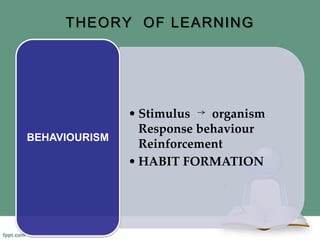



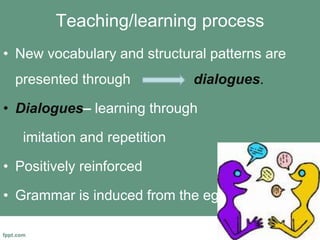


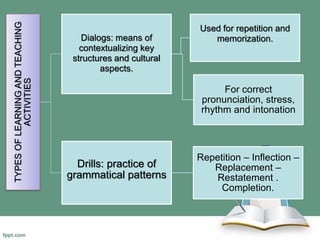
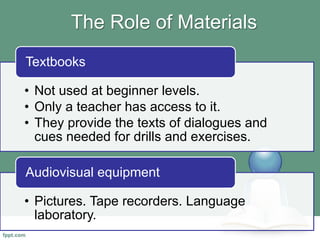






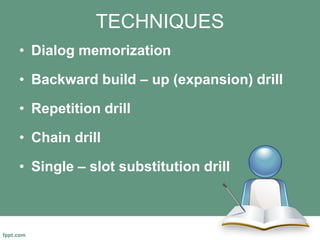
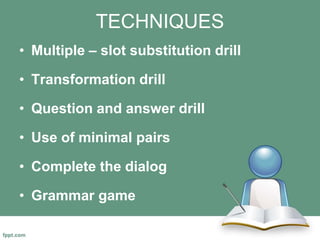


The Audio-Lingual Method (ALM) was developed in the 1950s-1960s based on principles of structural linguistics and behaviorism. It aimed to teach communicative competence through an intensive focus on oral skills using repetition and drills. Language was taught via memorization and imitation of dialogs. Grammar was induced from examples, not explicitly taught. The teacher led strict pattern practice drills while students played a passive role as imitators. Evaluation focused on discrete points and errors were avoided. Oral skills were emphasized over other skills.


